Loading services…

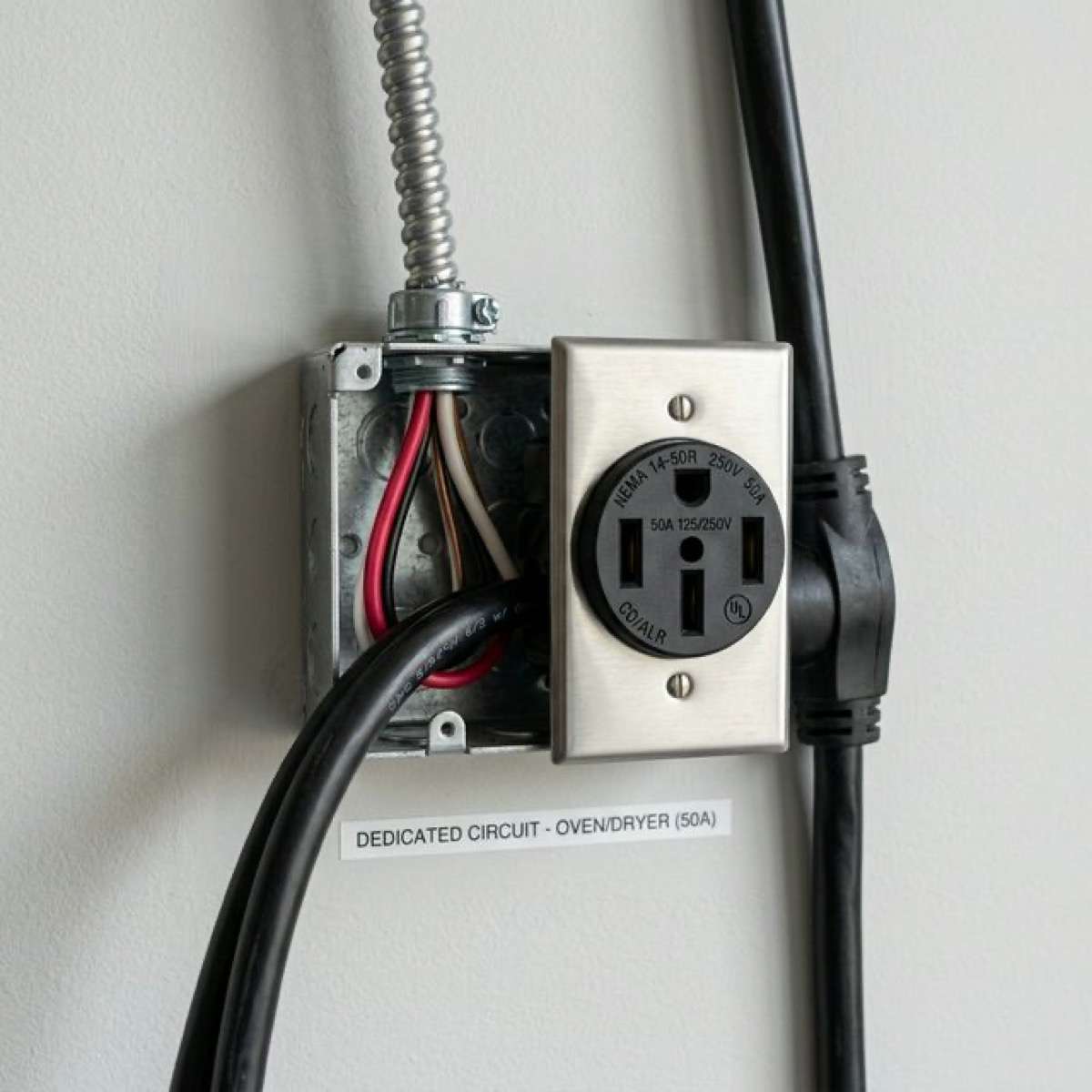
Dedicated Circuit Installation
Kitchen Dedicated Circuits
NEC 210.52(B)-compliant kitchen wiring — two small-appliance circuits plus dedicated runs for refrigerator, dishwasher, microwave, range, and disposal. Proper circuit separation reduces overloads and nuisance trips.
Quick answer
A code-compliant kitchen needs at least two 20-amp, 120-volt small-appliance branch circuits serving the countertop receptacles (NEC 210.52(B)), plus a separate dedicated circuit for each major appliance: typically 50A/240V for an electric range, 20A for the dishwasher, 20A for the microwave, and 15–20A circuits for the refrigerator and garbage disposal. All countertop receptacles must be GFCI-protected under NEC 210.8(A). In Northern Virginia, AJ Long Electric installs these circuits for $400–$900 each, or $2,500–$4,500 for a full code-compliant kitchen, permit and inspection included.
NEC Requirement
NEC 210.52(B) requires at least two 20-amp small-appliance branch circuits serving kitchen countertop outlets. Major appliances (range, dishwasher, microwave, refrigerator, garbage disposal) each need their own dedicated circuit per NEC 422.
Typical Amperage
20A small-appliance circuits, 50A for electric range, 20A for dishwasher, 20A for microwave (or 15A if shared with general lighting in older homes), 15A for refrigerator, 15A for garbage disposal.
Receptacle
NEMA 5-20R for countertop and small-appliance circuits (T-shaped neutral slot). NEMA 14-50R for electric range. Standard 5-15R for refrigerator and garbage disposal.
What it costs in Northern Virginia
Typical 2026 pricing
$400 – $900 per dedicated circuit
A full kitchen remodel that adds all the dedicated circuits required by NEC 210.52(B) typically runs $2,500–$4,500. Single-circuit additions (e.g., adding a microwave dedicated circuit during a kitchen update) run $400–$900 depending on run length and whether existing wall finishes can be preserved. Fairfax County, Arlington, Alexandria, or Loudoun permit included.
Why a kitchen needs more circuits than any other room
The kitchen is, electrically, the busiest room in a house. No other space concentrates so many high-draw appliances in so little square footage — a microwave, toaster oven, electric kettle, coffee maker, stand mixer, air fryer, and instant pot can all live within a few feet of each other on the countertop, and any two of them running together can pull more than a single circuit was ever designed to deliver. That is the reason the National Electrical Code treats the kitchen as a special case and requires, at minimum, two separate 20-amp small-appliance branch circuits for the countertop receptacles under NEC 210.52(B), rather than letting the kitchen ride on the same general-lighting circuits as the rest of the house.
Those two countertop circuits are only the starting point. The major appliances each carry their own dedicated load: an electric range or cooktop draws enough current to need its own 40- or 50-amp 240-volt circuit, while the dishwasher, microwave, refrigerator, and garbage disposal each get a dedicated 15- or 20-amp circuit so that one appliance cycling on never starves or trips another. In a typical Northern Virginia kitchen we are wiring six to eight separate home runs back to the panel — which is exactly why kitchen rewires are one of the most common reasons homeowners discover their existing panel is out of breaker space.
When AJ Long Electric assesses a kitchen, we map every appliance against the current code requirements, run an NEC 220 load calculation against your panel's available capacity, and itemize each circuit in the written quote. Whether you are correcting a single overloaded circuit that keeps tripping or wiring a gut-renovated kitchen from scratch, the goal is the same: correctly sized and protected circuits documented for the local jurisdiction's independent inspection.
GFCI, AFCI, and the protection your kitchen circuits need
Getting the circuit count right is only half of a code-compliant kitchen — the other half is protection. Under NEC 210.8(A), every 125-volt receptacle serving the kitchen countertop must be GFCI-protected, because of how close those outlets sit to the sink and other water sources. We provide that protection either with GFCI receptacles at the counter or with GFCI/AFCI combination breakers in the panel, depending on the layout and what makes the most sense for the rest of the run.
Recent NEC adoptions also call for AFCI (arc-fault) protection on most kitchen branch circuits, which guards against arcing faults in concealed wiring. In Northern Virginia jurisdictions that have adopted the newer code cycles, we install combination AFCI/GFCI breakers where required and coordinate the required inspection. We also install tamper-resistant receptacles where required by the adopted code.
Kitchen appliance circuit requirements at a glance
| Appliance / use | Circuit | Receptacle |
|---|---|---|
| Countertop small-appliance (×2 minimum) | 20A, 120V | NEMA 5-20R (GFCI) |
| Electric range / cooktop | 40–50A, 240V | NEMA 14-50R |
| Dishwasher | 20A, 120V | Hardwired or NEMA 5-20R |
| Microwave (built-in) | 20A, 120V | NEMA 5-20R |
| Refrigerator | 15–20A, 120V | NEMA 5-15R / 5-20R |
| Garbage disposal | 15A, 120V | Hardwired or NEMA 5-15R |
Key terms, defined
- Small-appliance branch circuit
- A 20-amp, 120-volt circuit that serves the kitchen, pantry, and dining-area countertop receptacles. NEC 210.52(B) requires at least two of them so high-draw countertop devices do not share capacity, and they may not feed lighting or other rooms.
- Dedicated circuit
- A branch circuit that serves a single appliance and nothing else — for example, the dishwasher or garbage disposal. It prevents one appliance from tripping the breaker when another is running on the same wire.
- NEMA 14-50R
- The 50-amp, 240-volt, 4-prong receptacle used for a freestanding electric range. It carries two hots, a neutral, and a separate ground on a dedicated double-pole breaker.
- GFCI protection (NEC 210.8(A))
- Ground-fault circuit-interrupter protection required on all kitchen countertop receptacles. It shuts off power within milliseconds of detecting current leaking to ground, the hazard that exists wherever outlets sit near a sink.
Signs you need a dedicated circuit
- The kitchen breaker trips when the microwave runs while another appliance is on
- You're remodeling the kitchen and need to bring it up to current code
- The refrigerator is sharing a circuit with countertop outlets — modern code requires its own dedicated 15A circuit
- You're adding an electric range, induction cooktop, or wall oven to a kitchen previously set up for gas
- Garbage disposal cycles trip the breaker because it's sharing with the dishwasher
- Your countertop outlets are wired in series with only one 20A circuit — code requires at least two separate circuits
Our installation process
- 1
In-home assessment
We map your existing kitchen wiring, identify which appliances are sharing circuits, calculate the load against NEC 210.52(B) requirements, and provide a written quote with each circuit itemized.
- 2
Permit pull
Fairfax County, Arlington, Alexandria, Loudoun, Prince William, or the authority serving your address. AJ Long Electric files required electrical permits under the company license and coordinates the inspection.
- 3
Wire runs from panel to kitchen
New circuits home-run from the main panel to each appliance location. Wherever possible we fish through existing walls; in finished spaces we coordinate with the homeowner on access points.
- 4
Receptacles and terminations
GFCI-protected NEMA 5-20R receptacles on countertop circuits per NEC 210.8(A). Tamper-resistant outlets per current code. Properly grounded and bonded to the panel.
- 5
Panel work
Install AFCI/GFCI breakers per current code requirements. AFCI is required on most new kitchen circuits in homes under recent NEC adoption.
- 6
Inspection
We coordinate the required electrical inspection and respond to documented correction items within the approved scope. The local authority controls scheduling and makes the final approval decision.
Frequently asked questions
Why do I need TWO 20-amp small-appliance circuits in the kitchen?
NEC 210.52(B) requires it. The reasoning: kitchen countertops host high-current devices (toasters, coffee makers, mixers, instant pots) that frequently run simultaneously. One 20A circuit can't handle two ~12-amp devices running at the same time without nuisance tripping. Two circuits gives you 40 amps of countertop capacity split across multiple receptacles.
Does the refrigerator need its own dedicated circuit?
Best practice yes — current code recommends a dedicated 15A or 20A circuit for the refrigerator. The refrigerator's compressor cycling can cause voltage drops on a shared circuit that affect other appliances. Older kitchens (pre-1990s) often share the refrigerator with countertop outlets; this is grandfathered but not ideal.
What about the dishwasher and garbage disposal?
Modern code requires each to have its own dedicated 15A or 20A circuit. They often share a circuit in older kitchens, which leads to nuisance tripping when both run simultaneously. We split them as part of any kitchen circuit refresh.
Do I need to upgrade my panel to add kitchen dedicated circuits?
Depends on your existing panel capacity. If you have a 200-amp panel with spare breaker slots, we add the new circuits without upgrading. If you have a 100-amp panel that's already near capacity (common in 1960s–1970s Northern Virginia homes), a panel upgrade is the right move first. We run the NEC 220 load calculation as part of the assessment.
How long does the work take?
The schedule is project-specific. Circuit count, panel capacity, route length, open versus finished walls, permit timing, inspection availability, and any correction work all affect duration. The written scope identifies the expected on-site window after those conditions are documented.
Code & manufacturer references
We cite the published standards this dedicated-circuit work is held to. Verify any of them yourself.
- NEC 210.52(B) — Small-Appliance Receptacle Outlets (NFPA 70) — The article requiring at least two 20-amp small-appliance branch circuits for kitchen countertops.
- ESFI — Kitchen electrical safety guidance — Independent guidance on GFCI protection and appliance circuits in the kitchen.
- Virginia DPOR — verify an electrical contractor's license — Verify AJ Long Electric's contractor license and John Long's Master Electrician credential with the state.
Add a kitchen dedicated circuits circuit
Written scopes. Required permit coordination included as documented. Led by John Long, Master Electrician.