
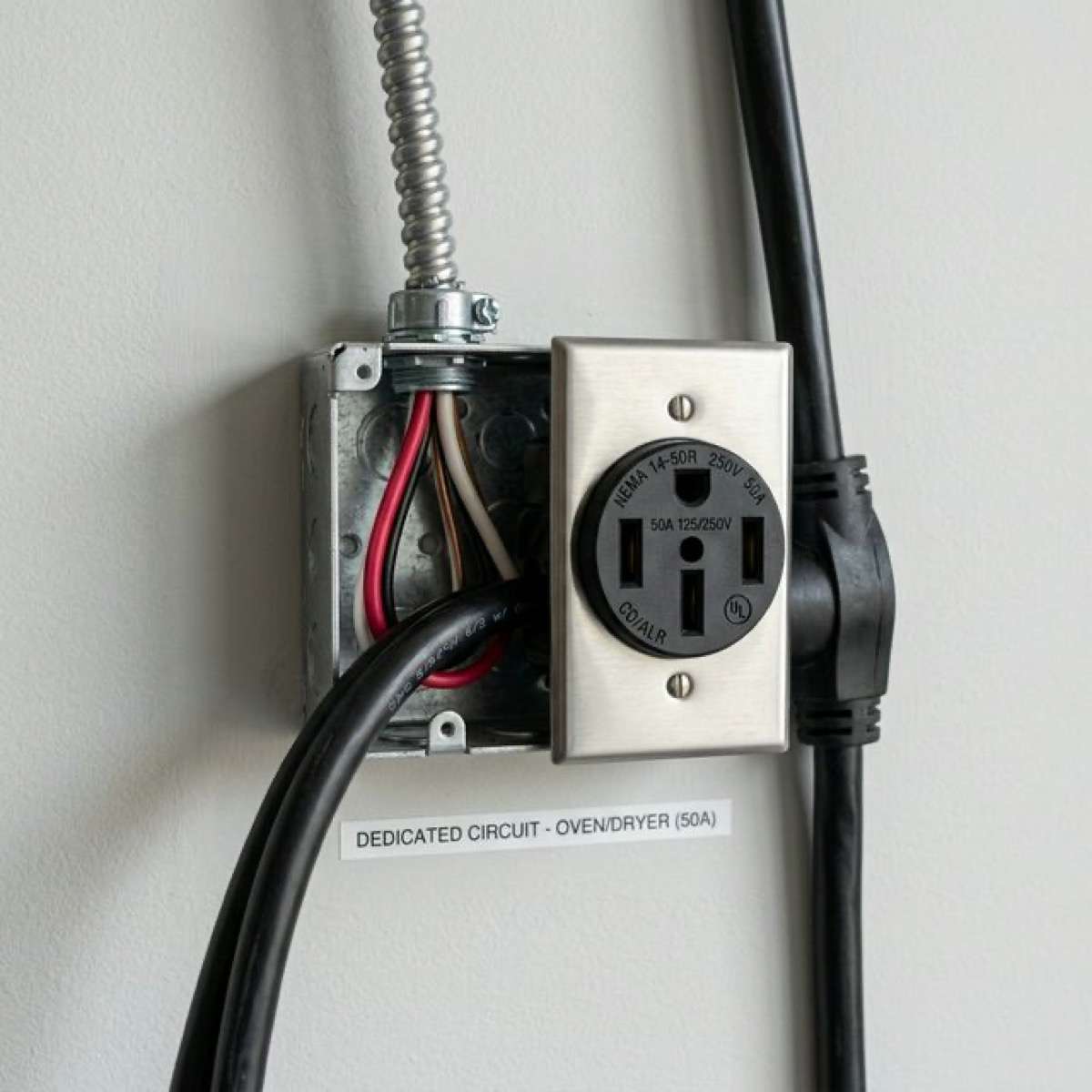
Dedicated Circuit Installation
Washer & Dryer Dedicated Circuits
Code-compliant laundry-room circuits — 20-amp dedicated for the washer, 30-amp 4-wire 240V for an electric dryer. Old 3-prong dryer outlets brought to current NEC 250.140 standard.
Quick answer
A modern laundry room needs two dedicated circuits: a 20-amp, 120-volt circuit for the washer (NEMA 5-20R) and a 30-amp, 240-volt 4-wire circuit for an electric dryer (NEMA 14-30R). The 4-prong dryer receptacle has been the NEC requirement for new installations since 1996; older 3-prong NEMA 10-30R outlets are grandfathered but should be upgraded during any laundry work. In Northern Virginia, AJ Long Electric installs or upgrades these circuits for $400–$900 each, permit and inspection included.
NEC Requirement
NEC 210.11(C)(2) requires a dedicated 20-amp branch circuit for the laundry receptacle (washer). NEC 250.140 requires 4-wire (hot-hot-neutral-ground) terminations for electric dryers — the old 3-wire setup is grandfathered in existing installations but cannot be installed new.
Typical Amperage
20A 120V for washer. 30A 240V for electric dryer. Gas dryers use a standard 120V outlet but the gas line itself requires a licensed plumber.
Receptacle
Standard NEMA 5-20R for washer. NEMA 14-30R for electric dryer (4-prong, code-required since 1996). If you have an old NEMA 10-30R 3-prong dryer outlet, that's grandfathered but upgrading to 14-30R is recommended during any laundry work.
What it costs in Northern Virginia
Typical 2026 pricing
$400 – $900 per circuit
Adding both washer (20A) and dryer (30A) dedicated circuits as a paired job typically runs $700–$1,200 since the runs and terminations can be done together. Replacing an existing 3-prong NEMA 10-30R with a code-compliant 4-prong NEMA 14-30R requires running a new 4-wire cable from the panel — typically $500–$800. Permit and inspection included.
Why washers and dryers each need their own circuit
Laundry appliances are two of the highest-draw loads in a typical home, and they were never meant to share a circuit. A washer's motor and an electric dryer's heating element can each pull most of a circuit's capacity on their own — run them at the same time on a shared circuit and you get nuisance breaker trips at best, and overheated conductors at worst. That is exactly why the National Electrical Code carves out dedicated circuits for the laundry area: NEC 210.11(C)(2) requires at least one dedicated 20-amp branch circuit serving the laundry receptacle, and that circuit is not allowed to feed lighting or outlets in other rooms.
The electric dryer is in a different category altogether. It runs on 240 volts, drawing power across both legs of your panel through a dedicated 30-amp double-pole breaker. There is no sharing a 240-volt dryer circuit — it exists solely to feed the dryer. When AJ Long Electric quotes a laundry room, we look at both loads together: the 120-volt washer circuit and the 240-volt dryer circuit are usually run in the same trip, which is why pairing them is more cost-effective than adding one now and the other later.
In older Northern Virginia homes — and there are a lot of them in Fairfax, Arlington, Alexandria, and the inner Loudoun and Prince William suburbs — it is common to find a single circuit feeding both the washer and a 120-volt utility outlet, or a 3-prong dryer receptacle that predates the modern 4-wire requirement. Bringing those installations up to current code is one of the most frequent laundry calls we get, especially when a homeowner buys a new appliance that ships with a 4-prong cord.
The 3-prong to 4-prong dryer outlet upgrade, explained
If your dryer receptacle has three slots, it is an old NEMA 10-30R — the pre-1996 standard. That configuration carried two hot legs and a single conductor that served as both neutral and ground. The problem is that bonding neutral and ground together at the appliance means the dryer's metal cabinet can become energized if the neutral ever opens. The 1996 NEC closed that gap by requiring 4-wire terminations for electric dryers under what is now NEC 250.140: two hots, a separate neutral, and a separate equipment ground, landing on a NEMA 14-30R receptacle.
Existing 3-prong installations are grandfathered, so you are not legally required to rip one out just because it is old. But you cannot install a new 3-prong outlet, and the safe, code-compliant fix when you are upgrading anyway is to run a fresh 4-wire 10/3 cable from the panel and swap in a 14-30R receptacle. We never recommend the 3-to-4-prong plug adapters sold online: any adapter that re-bonds neutral and ground reintroduces the exact hazard the 4-wire rule was written to eliminate.
A correct upgrade typically runs $500–$800 because it involves a new home run from your panel, not just a receptacle swap. If your laundry is finished and the panel is far away, fishing the cable adds time; if the panel backs onto the laundry wall or the run is accessible through a basement or attic, it goes quickly. Either way, the work is permitted, inspected, and warrantied.
What the NEC load calculation says about dryer sizing
Homeowners often ask why a 30-amp circuit is standard when their dryer's manual lists a smaller running load. The answer is in the code's load-calculation rules. Under NEC 220.54, a household electric clothes dryer is calculated at 5,000 watts — or the appliance nameplate rating if it is higher — regardless of the lower average draw during a typical cycle. At 240 volts, that demand lands squarely in 30-amp territory, which is why the 10-gauge copper conductor and 30-amp double-pole breaker are the long-standing standard pairing for residential dryers.
The washer side is more modest: a 20-amp, 120-volt dedicated circuit on 12-gauge copper covers the washer motor and any laundry-area outlet on that circuit. Because laundry rooms put receptacles near plumbing, NEC 210.8(A) requires GFCI protection there, so we install the washer circuit on a GFCI device as part of any modern installation. On the panel itself, current code also calls for AFCI protection on these branch circuits, which we handle with combination AFCI/GFCI breakers where appropriate.
Getting the sizing and protection right is not just a box to check for the inspector — it is what keeps a laundry room from becoming a recurring source of tripped breakers, warm receptacles, and shortened appliance life. When we hand off a job, both circuits are correctly sized, correctly protected, labeled in the panel, and signed off by the local jurisdiction.
Washer vs. electric dryer circuit at a glance
| Spec | Washer circuit | Electric dryer circuit |
|---|---|---|
| Voltage | 120V | 240V |
| Breaker | 20A single-pole | 30A double-pole |
| Wire (copper) | 12/2 with ground | 10/3 with ground |
| Receptacle | NEMA 5-20R | NEMA 14-30R (4-prong) |
| Required protection | GFCI (NEC 210.8(A)) | 4-wire termination (NEC 250.140) |
| Governing NEC article | 210.11(C)(2) | 220.54 / 250.140 |
| Typical installed cost | $400–$700 | $500–$900 |
Key terms, defined
- NEMA 14-30R
- The 4-prong, 30-amp, 240-volt receptacle required for new electric dryer installations since 1996. It provides separate neutral and ground conductors so the dryer cabinet stays isolated from the neutral path.
- NEMA 10-30R
- The legacy 3-prong, 30-amp dryer outlet used before 1996. It combines neutral and ground into one conductor. Existing ones are grandfathered, but new installations are not permitted and an upgrade to 14-30R is recommended during any laundry work.
- Dedicated branch circuit
- A circuit that serves a single appliance or area and nothing else. NEC 210.11(C)(2) requires a dedicated 20-amp branch circuit for the laundry receptacle so the washer does not share capacity with other rooms.
- 4-wire termination
- A connection carrying two hots, a separate neutral, and a separate equipment ground — the NEC 250.140 standard for electric dryers. It replaces the older 3-wire method that bonded neutral and ground together.
Signs you need a dedicated circuit
- Your dryer outlet has 3 prongs and you're moving in a newer dryer with a 4-prong plug
- The washer and dryer share a circuit (common in older homes) and the breaker trips when both run
- You're moving the laundry to a new location — basement to first floor, or vice versa
- You're going from gas dryer to electric — gas dryers use standard 120V; electric needs new 240V circuit
- The dryer outlet shows scorching, looks discolored, or feels warm during use — overheating connection
- You're remodeling and want to bring the laundry circuits up to current NEC code
Our installation process
- 1
Assessment + load calc
We confirm the existing panel capacity, identify whether the existing dryer outlet is 3-wire or 4-wire, and quote the work — separating washer and dryer if they're on the same circuit.
- 2
Permit pull
Local jurisdiction permit (Fairfax County, Arlington, Alexandria, Loudoun, Prince William, etc.), filed under AJ Long Electric's contractor license.
- 3
Run new cables
Home-run a 10/3 (4-wire) cable from the panel to the dryer location for the new 30A circuit. Home-run a 12/2 cable for the dedicated 20A washer circuit. Fished through walls/ceilings where possible.
- 4
Install receptacles and breakers
NEMA 14-30R for electric dryer (4-prong). Standard NEMA 5-20R for washer. AFCI breakers in the panel per current code; GFCI on the washer circuit (it's near plumbing).
- 5
Inspection
Local jurisdiction inspector verifies the 4-wire dryer termination, GFCI on the washer, and panel work. We schedule and meet on-site.
Frequently asked questions
What's the difference between 3-prong and 4-prong dryer outlets?
3-prong (NEMA 10-30R) is the old standard from before 1996. It carries two hot legs and a combined neutral/ground — which is unsafe because the dryer's metal chassis is bonded to neutral. 4-prong (NEMA 14-30R) is the current code: separate neutral and ground, isolating the dryer chassis from the neutral path. New dryers come with 4-prong cords; old 3-prong outlets are grandfathered in existing installations.
Can I just buy an adapter from 3-prong to 4-prong?
No. Plug adapters that re-bond neutral and ground are technically code violations and unsafe. The proper fix is to run a 4-wire cable from the panel and install a new NEMA 14-30R receptacle. Cost is usually $500–$800.
Do I need a GFCI on the washer circuit?
Yes per current code (NEC 210.8(A) — laundry areas). Older homes with the original washer circuit may not have GFCI; we add it as part of the upgrade. GFCI is critical near plumbing because of the water-electricity proximity.
What about stackable washer/dryer combos?
Same wiring requirements — you need both a 20A washer circuit and a 30A 4-wire electric dryer circuit (or 120V for the dryer half of a heat-pump or vented stackable). The stackable mounting saves floor space but not electrical capacity.
Can I run gas dryer + 240V circuit for future-proofing?
Yes, and we recommend it during any laundry remodel. Adding the 30A 4-wire circuit when the wall is open costs little incremental; doing it later (after the gas dryer is in place) costs significantly more. Future-proofing for electrification (gas-to-electric transition) is common practice in Northern Virginia builds.
What wire gauge does a 30-amp electric dryer circuit use?
A 30-amp 240V dryer circuit is wired with 10-gauge copper — specifically a 10/3 cable carrying two hots, a neutral, and a ground — landed on a 30-amp double-pole breaker. The dedicated 20-amp washer circuit uses 12-gauge copper (12/2 with ground) on a 20-amp single-pole breaker. Per NEC 220.54, a household electric dryer is calculated at 5,000 watts or its nameplate rating, whichever is larger, which is why 30 amps is the standard size even though many dryers draw less in normal operation.
How long does a washer and dryer circuit installation take?
Most laundry-circuit jobs are completed in a single visit of two to four hours, depending on how far the laundry room is from the panel and whether walls are open. Replacing a 3-prong dryer outlet with a 4-prong on an existing run is faster; pulling brand-new circuits from the panel to a relocated laundry area, or fishing cable through finished walls, takes longer. Permit filing and the jurisdiction inspection are scheduled separately and do not extend the on-site work.
Code & manufacturer references
We cite the published standards this dedicated-circuit work is held to. Verify any of them yourself.
- NEC 220.54 — Electric Clothes Dryers (NFPA 70) — Household dryers are load-calculated at 5,000 W or nameplate, whichever is larger.
- CPSC guidance on 3-prong vs. 4-prong dryer cords — Why the 4-wire configuration replaced the old 3-wire dryer connection.
- Virginia DPOR — verify an electrical contractor's license — Verify AJ Long Electric's contractor license and John Long's Master Electrician credential with the state.
Add a washer & dryer dedicated circuits circuit
Written scopes. Required permit coordination included as documented. Led by John Long, Master Electrician.