What whole-house surge protection costs
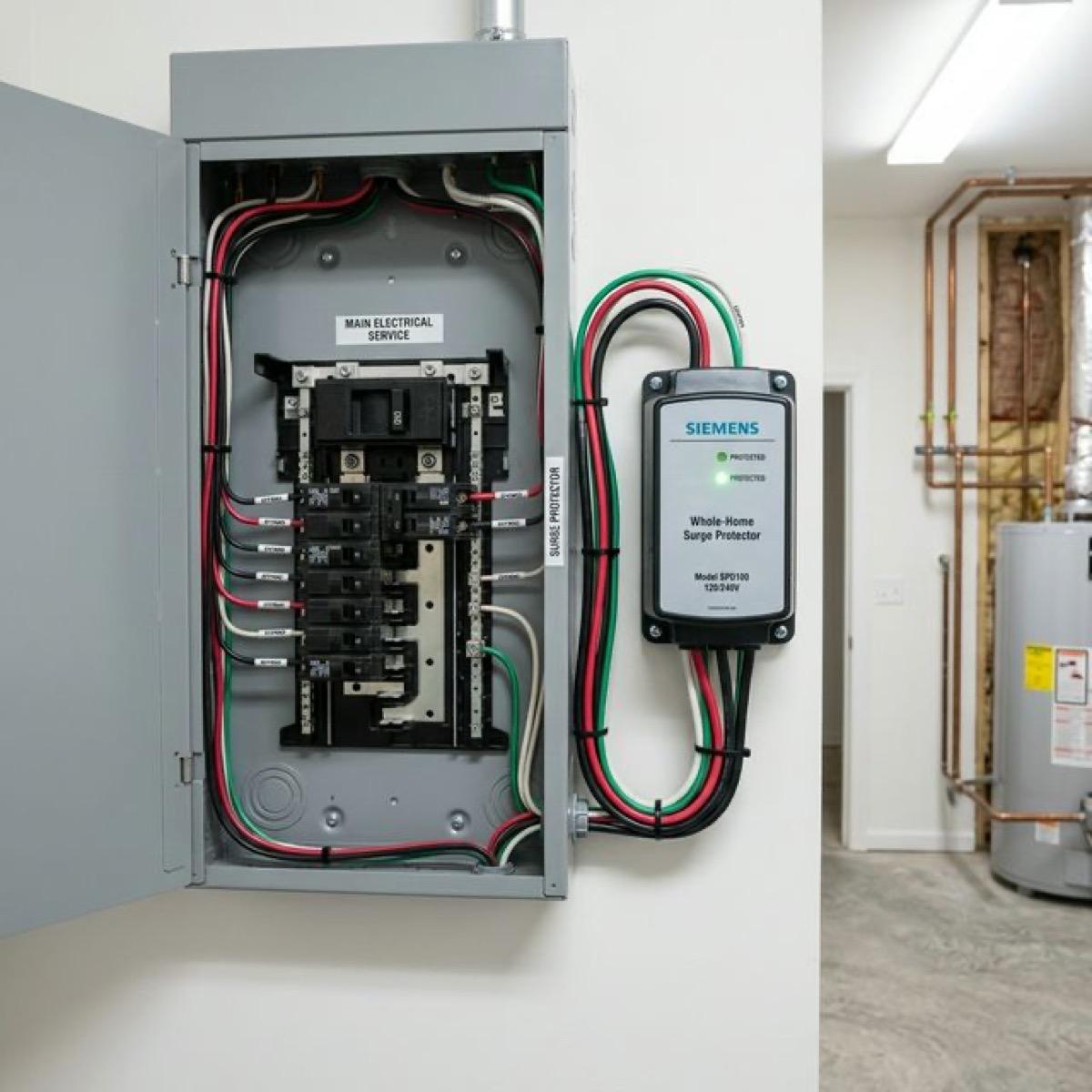
Whole-house surge protection in Northern Virginia runs $500 to $900 installed in 2026. The work covers: a Type 1 or Type 2 surge protective device (SPD) installed at the main panel, the local jurisdiction permit (where required), the wire run to the busbar, and the final inspection.
The device hardware itself is $250–$450 retail (Eaton SPD, Square D HEPD, Siemens FS140); the rest is labor + permit. Field time depends on panel compatibility and condition, equipment, working access, conductor routing, permit requirements, and inspection availability.
The 2020 NEC adoption made surge protection mandatory for all new dwelling-unit installations — which is why every panel upgrade we do in Northern Virginia now includes Type 2 surge protection. For existing panels (no upgrade planned), retrofit Type 2 SPDs are the standard recommendation.
| SPD Type | Location | Joule Rating | Install Cost |
|---|---|---|---|
| Type 2 (most common) | After main breaker | 40,000–60,000 J | $500 – $750 |
| Type 1 + Type 2 layered | Before + after main | 80,000+ J combined | $750 – $1,100 |
| Plug-strip "surge protector" | Outlet | 500–2,000 J | $15 – $80 (not equivalent) |
Type 1 vs Type 2: which do you need?
Type 1 SPDs are installed BEFORE the main breaker — on the line side of the service entrance. They protect against external surge events: nearby lightning strikes, utility transformer faults, and grid switching events.
Type 2 SPDs are installed AFTER the main breaker — on the load side. They protect against both external surges (filtered through the main breaker) AND internal surge events (motor startup, large appliances cycling).
For most Northern Virginia homes, a Type 2 SPD alone provides adequate protection. The 2020 NEC requires "Type 1 or Type 2" surge protection on new dwelling-unit installations; Type 2 is the practical default.
For homes in lightning-prone areas (more common in rural Loudoun, Prince William, Fauquier) or homes with high-value electronics (home theaters, server rooms, EV chargers, medical equipment), a layered Type 1 + Type 2 install adds Type 1 on the service-entrance side. Cost premium: ~$250–$350 over Type 2 alone.
Plug-strip surge protectors are NOT a substitute for whole-house protection. They protect only the devices plugged into them, they have far lower joule ratings (500–2,000 J vs 40,000+ for panel SPDs), and they don't protect hardwired devices like HVAC boards, smoke detectors, or appliance control boards.
The device-replacement math
A single utility-side surge can damage every electronic device in a Northern Virginia home in milliseconds. Replacement costs add up fast:
• HVAC control board: $400–$900 + service call • Refrigerator electronics: $300–$1,200 (full replacement if compressor damage) • Modern TV: $400–$2,500 • Home theater receiver: $400–$1,500 • Computer or gaming console: $500–$3,000 • Smart-home hub + integration: $400–$2,000 • EV charger electronics: $300–$700 • Microwave control board: $150–$400 • Smoke detector wiring upgrade (if surge damaged): $300–$800
A single moderate surge event can cause $3,000–$10,000 of replacement cost. Whole-house SPD at $700 installed protects all of them.
Homeowner's insurance generally covers surge damage with a deductible (often $500–$1,000), but: (1) deductible alone costs more than the SPD; (2) claim affects future premiums; (3) HVAC and similar appliance damage can disrupt the home for days.
Install details that matter
A panel-mounted SPD only works if it's connected correctly. Common ways a cheap install fails:
• Wire length too long. SPD lead length should be 12 inches or less — every additional inch reduces effectiveness by ~10%. Long leads add inductance that gates the surge response.
• Connection torque. Loose busbar connections on the SPD wires reduce performance and can fail entirely under repeated surge events.
• No status indicator monitoring. Modern SPDs have a status LED indicating the protection is active. After a major surge, the LED can change to red indicating the device needs replacement. We position the SPD where you can see the LED without opening the panel.
• Wrong type for the panel busbar. Square D SPDs are designed for Square D busbars; Eaton for Eaton; Siemens for Siemens. Cross-brand installs work but cleaner termination is brand-matched.
We use a 12" or shorter lead length, torque connections to spec, position the LED visibly, and brand-match where panels allow.
Northern Virginia Considerations
Code Requirements
NEC 230.67 requires surge protection on all new dwelling-unit installations.
Permit Information
Permit required in some Northern Virginia jurisdictions for new SPD install; not required for replacement.
Typical Costs
$500–$900 installed for Type 2; $750–$1,100 for Type 1 + Type 2 layered
Local Tips
Lightning frequency higher in rural Loudoun, Prince William, Fauquier. EV charger installations should always include SPD upgrade.
Frequently Asked Questions (5)
Does my homeowner's insurance cover surge damage?
Usually yes for individual appliance damage from documented surge events, with a deductible ($500–$1,500 typical). Some policies have specific "surge protection" sub-limits. A $700 SPD install is cheaper than a single deductible.
How long does a surge protector last?
Modern Type 2 SPDs typically protect for 8–15 years depending on local surge frequency. The status LED indicates when the device needs replacement (red = compromised, green = active). After a major lightning event, replacement may be needed immediately.
Do I need surge protection if I already have plug-strip protectors?
Yes. Plug-strip protectors only cover the devices plugged into them and have far lower joule ratings. They don't protect hardwired devices (HVAC, refrigerator, smoke detectors, EV chargers, microwave). Whole-house panel-mount SPD is the foundation; plug-strips are supplemental.
Will adding an SPD void my panel warranty?
No. Manufacturer-spec SPDs (Square D HEPD on Square D panels, Eaton SPD on Eaton panels, etc.) are designed for retrofit and don't affect the panel warranty. Cross-brand installs are also fine when wired correctly.
Is it worth it for a small home or condo?
Yes. The device-replacement math works for any home with modern electronics — and that's almost everyone now. Small homes and condos still have HVAC boards, refrigerators, TVs, and computers worth protecting.
Authoritative Sources
- NFPA 70: National Electrical Code (NEC)The NEC is the foundational safety standard for electrical wiring and installation in the U.S.
- Electrical Safety Foundation International (ESFI)Nonprofit dedicated to promoting electrical safety in the home and workplace.
- ENERGY STAREPA program identifying energy-efficient products and practices.