EV Charger Basics: Amperage, Circuit Sizing, and the 80% Rule
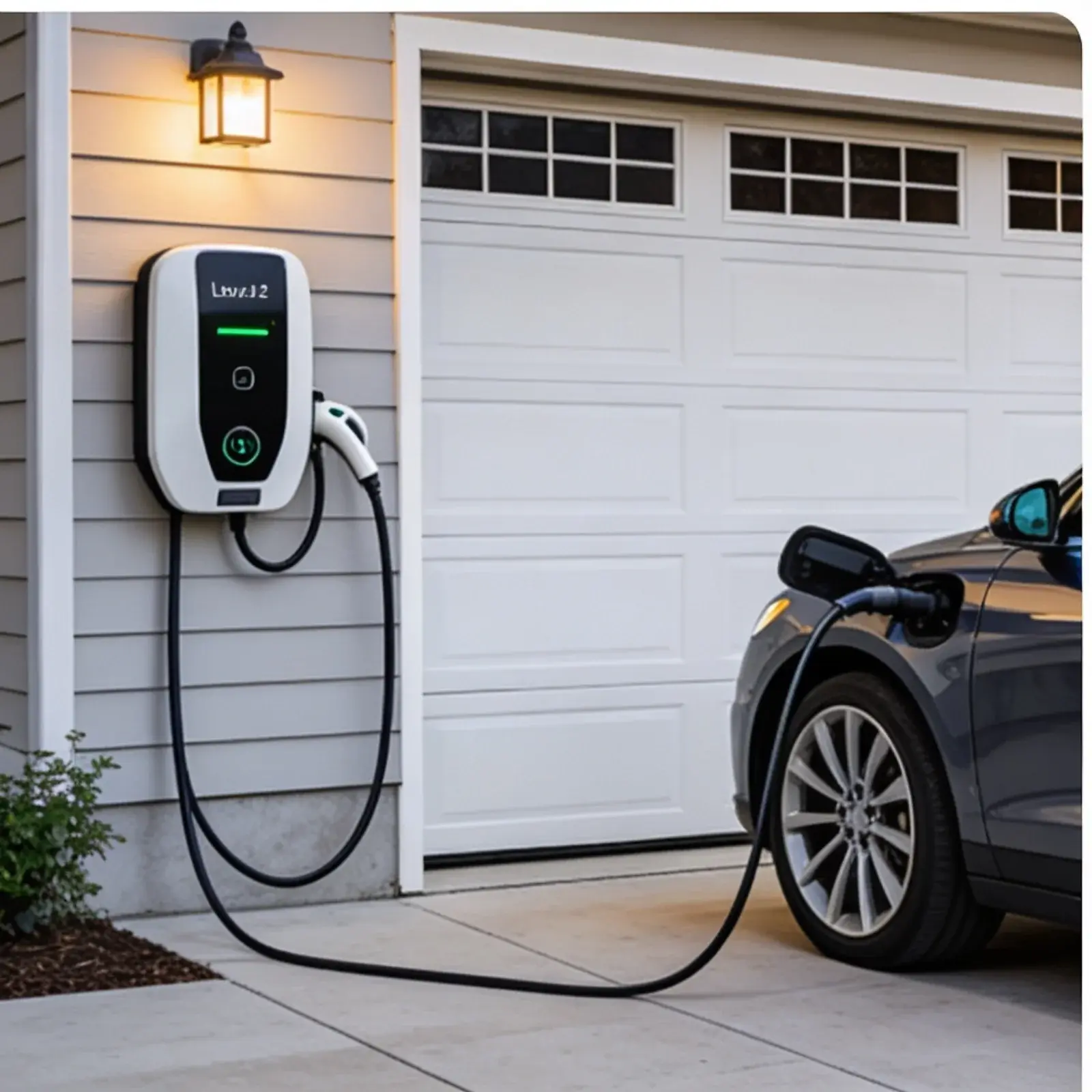
Level 2 home chargers operate on 240-volt AC power and replenish an electric vehicle five to eight times faster than a standard 120-volt household outlet. Because the National Electrical Code (NEC Article 625) classifies an EV charger as a continuous load, the branch circuit breaker and conductors must be sized at 125% of the charger's maximum continuous draw—meaning the charger output cannot exceed 80% of the circuit breaker rating.
Before selecting the highest-output charger on the shelf, match the amperage to three factors: your vehicle's onboard AC charger limit, your typical overnight parking window, and your electrical panel's calculated spare capacity. Most Northern Virginia commuters driving 30 to 60 miles per day recover their daily energy in two to four hours on a 32-amp or 40-amp continuous charger, making an oversized circuit unnecessary when a 100-amp or 150-amp panel is already heavily loaded.
| Charger Amperage | Circuit Size (80% Rule) | Typical Range Added / Hr | Best Use Case & Wiring Method |
|---|---|---|---|
| 16 amps (3.8 kW) | 20A 240V circuit | 12 – 14 mi/hr | Plug-in hybrids (PHEVs), tight 100A panels, or long overnight dwell times |
| 24 amps (5.8 kW) | 30A 240V circuit | 18 – 22 mi/hr | Townhouses or older panels where avoiding a heavy-up is a priority |
| 32 amps (7.7 kW) | 40A 240V circuit | 24 – 28 mi/hr | Common portable cord-and-plug EVSE limit on a 40A or 50A circuit |
| 40 amps (9.6 kW) | 50A 240V circuit | 30 – 35 mi/hr | Maximum continuous output permitted on a listed NEMA 14-50 receptacle |
| 48 amps (11.5 kW) | 60A 240V circuit | 40 – 48 mi/hr | Requires a hardwired connection; standard maximum for many modern EVs |
Key Features to Verify Before You Buy
When comparing Level 2 EVSE hardware, look past smartphone screenshots and verify the physical and electrical specifications that govern safety and daily usability:
1. Safety Listing (UL 2594 / ETL): Every permanently connected or plug-in EV charger installed in Virginia, Maryland, or DC must carry a recognized third-party safety listing (such as UL 2594) to pass local electrical inspection. Non-listed imported chargers cannot be legally permitted.
2. Connector Type (SAE J1772 vs. NACS / SAE J3400): Through 2024–2026, most automakers have transitioned or announced transitions toward the North American Charging Standard (NACS / J3400) popularized by Tesla, while millions of existing non-Tesla EVs on the road use the SAE J1772 port. You can choose a native NACS charger, a native J1772 charger, or a universal unit with an integrated adapter latch.
3. Adjustable Rotary or Installer-Locked Output: Quality wall chargers allow the electrician to lock the maximum amperage during commissioning (for example, setting a 48A-capable unit to 32A or 24A on a smaller branch circuit) in compliance with NEC 625.42.
4. Cold-Weather Cable Flexibility and Length: A 20- to 25-foot cable that remains pliable in 20°F Northern Virginia winter mornings prevents strain on your vehicle's charge port when backing into a driveway or navigating around a two-car garage.
5. Enclosure Rating (NEMA 3R or NEMA 4): Outdoor driveway, carport, and townhome pedestal mounts require a weatherproof NEMA 3R or watertight NEMA 4 enclosure rated for rain, sleet, and ice.
Comparing Major Home EV Charger Platforms
Rather than relying on discontinued models, evaluate active, UL-listed residential platforms with strong parts support and clear installation manuals:
• Tesla Universal Wall Connector & Standard Wall Connector: Supports up to 48A hardwired output on a 60A circuit, offers installer-configurable lower amperage settings, and supports coordinated power sharing across multiple units. The Universal model includes a built-in J1772/NACS Magic Dock adapter for mixed-brand households.
• ChargePoint Home Flex: Available in hardwired or plug-in configurations (adjustable from 16A to 50A depending on circuit sizing and hardwiring), ENERGY STAR certified, with replaceable J1772 or NACS cable assemblies.
• Emporia Level 2 EV Charger: UL-listed, available for hardwired (up to 48A) or NEMA 14-50 (up to 40A) installations, and pairs with optional listed home energy management hardware when panel capacity is constrained.
• Grizzl-E Classic / Smart / Ultimate: Built with a cast-aluminum NEMA 4 enclosure and heavy-duty cold-weather cable for homeowners who want simple, rugged outdoor durability with internal DIP-switch amperage settings.
Hardwired vs. NEMA 14-50 Receptacle & Load Management
Your choice between a hardwired wall charger and a 240-volt NEMA 14-50 receptacle affects both installation cost and long-term reliability. Under adopted NEC rules, a 240-volt garage or outdoor receptacle for EV charging requires a two-pole GFCI circuit breaker in the panel, and continuous 32A–40A charging demands a heavy-duty industrial EV-grade receptacle rather than a standard residential range outlet.
Hardwiring the EVSE directly to a dedicated branch circuit eliminates the plug-and-socket wear point, supports 48-amp charging on a 60-amp circuit, avoids nuisance trips between a panel GFCI breaker and the charger's internal ground-fault circuitry, and provides a sealed outdoor connection. Typical Level 2 circuit and hookup installation in Northern Virginia is $1,200–$3,500 (with EVSE hardware separate), while long runs, finished-ceiling routing, trenching to a detached garage, or listed load-management controllers extend up to the $1,200–$4,500 total band.
Step-by-Step Guide
Choose the right amperage
Set the output from your vehicle's onboard AC charging limit, your daily driving and overnight parking window, and the home load calculation. A higher setting only helps if the car can accept it and the panel can carry it; many commuters are well served at 32A or 40A, while 48A needs a hardwired 60A circuit.
Match the connector to your vehicle
Most non-Tesla EVs already on the road use the J1772 connector, and many automakers are moving to NACS (SAE J3400). Pick a native NACS charger, a native J1772 charger, or a universal unit such as the Tesla Universal Wall Connector, which has a built-in J1772 adapter for mixed-brand households.
Decide which features you need
Weigh smart features (app control, scheduling, energy monitoring), cord length (18-25 feet recommended), weather rating (NEMA 4 for outdoor or unheated-garage installs), warranty (3-5 years is standard), and cable management. Smart scheduling is most valuable if you want to charge during off-peak electricity rates.
Compare top models against your needs
Compare current, listed models such as the Tesla Universal or Standard Wall Connector, ChargePoint Home Flex, Emporia and Grizzl-E on amperage, connector, enclosure rating, cable and manufacturer support. Skip discontinued models whose app or parts support may end.
Choose hardwired vs. plug-in installation
Hardwiring removes the plug-and-receptacle wear point, supports 48A charging on a 60A circuit and avoids nuisance trips between a GFCI breaker and the charger's own ground-fault protection. A NEMA 14-50 plug-in unit is limited to 40A, needs a GFCI breaker and an EV-grade receptacle, and can be unplugged if you move. Factor in panel capacity and the distance from the panel.
Northern Virginia Considerations
Code Requirements
Virginia requires dedicated circuits for EV chargers. Outdoor installations must use weather-rated equipment.
Permit Information
All EV charger installations in Northern Virginia require electrical permits regardless of charger brand or model selected.
Typical Costs
Level 2 circuit and hookup: $1,200–$3,500 typical; $1,200–$4,500 only for long, detached, outdoor, trenched, or otherwise complex routes; EVSE hardware separate.
Local Tips
Utility EV rate plans and programs change. Check Dominion Energy or NOVEC directly for current terms before buying equipment.
Frequently Asked Questions (15)
What is the best EV charger for home use?
The best fit depends on your vehicle's connector and charging limit, the circuit your panel can support, indoor or outdoor mounting, and whether you want app features. Tesla owners often choose a Tesla Wall Connector; mixed-brand households can use the Universal Wall Connector or a J1772 unit such as ChargePoint Home Flex, Emporia or Grizzl-E. Choose a current, listed model rather than a discontinued one.
How much does a good home EV charger cost?
EVSE hardware is separate from installation. Compare the exact unit's current retail price, listing, connector, output, enclosure, cable, warranty, network requirements, and manufacturer support. When AJ Long Electric supplies listed equipment, it is billed at pass-through retail plus the published equipment markup.
Do I need a smart EV charger?
Smart features like scheduling and energy monitoring are valuable for optimizing charging during off-peak electricity rates. If you don't care about these features, a basic charger works fine.
What amp charger should I get?
Choose the charging output from the vehicle's onboard-charger limit, daily mileage, available charging window, manufacturer instructions, and the home load calculation. Actual range added and time to a target state of charge vary with the vehicle, battery, starting charge, temperature, charging losses, circuit, and equipment. A larger charger does not charge faster than the car's onboard charger allows.
Can I use any charger with any EV?
Only when the connector matches or you use an adapter the vehicle maker approves. Most non-Tesla EVs already on the road have J1772 ports, while Teslas and a growing number of new models from other brands use NACS (SAE J3400). A universal unit such as the Tesla Universal Wall Connector, with its built-in J1772 adapter, serves both.
Hardwired vs. plug-in - which is better?
For a permanent garage or driveway charger, hardwiring is usually the better choice: there is no plug-and-receptacle wear point, it supports 48A on a 60A circuit, and it avoids nuisance trips between a GFCI breaker and the charger's own ground-fault protection. A NEMA 14-50 plug-in unit is limited to 40A and needs a GFCI breaker and an EV-grade receptacle, but you can unplug it and take it with you.
How long should the charging cable be?
Most chargers come with 18-25 foot cables. Consider where you'll park and where the charger will be mounted. Longer cables provide more flexibility but cost more.
Do I need outdoor-rated charger?
If installing outdoors or in an unheated garage, choose a charger with NEMA 4 or higher rating for weather protection. Most quality chargers have this rating.
What warranty should I expect?
Quality EV chargers come with 3-5 year warranties. Some manufacturers offer extended warranty options. Always register your charger to activate the warranty.
Can I install two EV chargers?
Yes, but ensure your electrical panel has sufficient capacity. Some homes may need a panel upgrade to support two high-amperage chargers.
What is ENERGY STAR certification?
ENERGY STAR certified chargers meet EPA criteria for energy use, mainly in standby. Many residential Level 2 models carry the label; check the ENERGY STAR product finder for the exact model and version you plan to buy.
Do EV chargers require maintenance?
EV chargers require minimal maintenance. Keep the connector clean and dry, inspect the cable periodically for damage, and test the charger function monthly.
Can I use my EV charger for different vehicles?
Yes, as long as each vehicle's port matches the charger connector or uses an approved adapter. If the household has, or expects, both J1772 and NACS vehicles, a universal charger avoids keeping an adapter on hand. The charger's amperage setting stays fixed to the circuit, so a second car does not change the wiring.
What is load management and do I need it?
Load management allows multiple chargers to share available electrical capacity. It's useful for homes with two EVs but limited panel capacity, or for future-proofing.
Are there any rebates for EV chargers?
Section 30C is unavailable for property placed in service after June 30, 2026. Check current utility terms directly before purchasing equipment and consult the IRS or a qualified tax professional about historical eligibility; AJ Long Electric does not provide tax advice.
Authoritative Sources
- NFPA 70: National Electrical Code (NEC)The NEC is the foundational safety standard for electrical wiring and installation in the U.S.
- Electrical Safety Foundation International (ESFI)Nonprofit dedicated to promoting electrical safety in the home and workplace.
- ENERGY STAREPA program identifying energy-efficient products and practices.
- U.S. DOE: Electric Vehicle ChargingFederal reference on EV charging levels and equipment for homes, workplaces, and public sites.