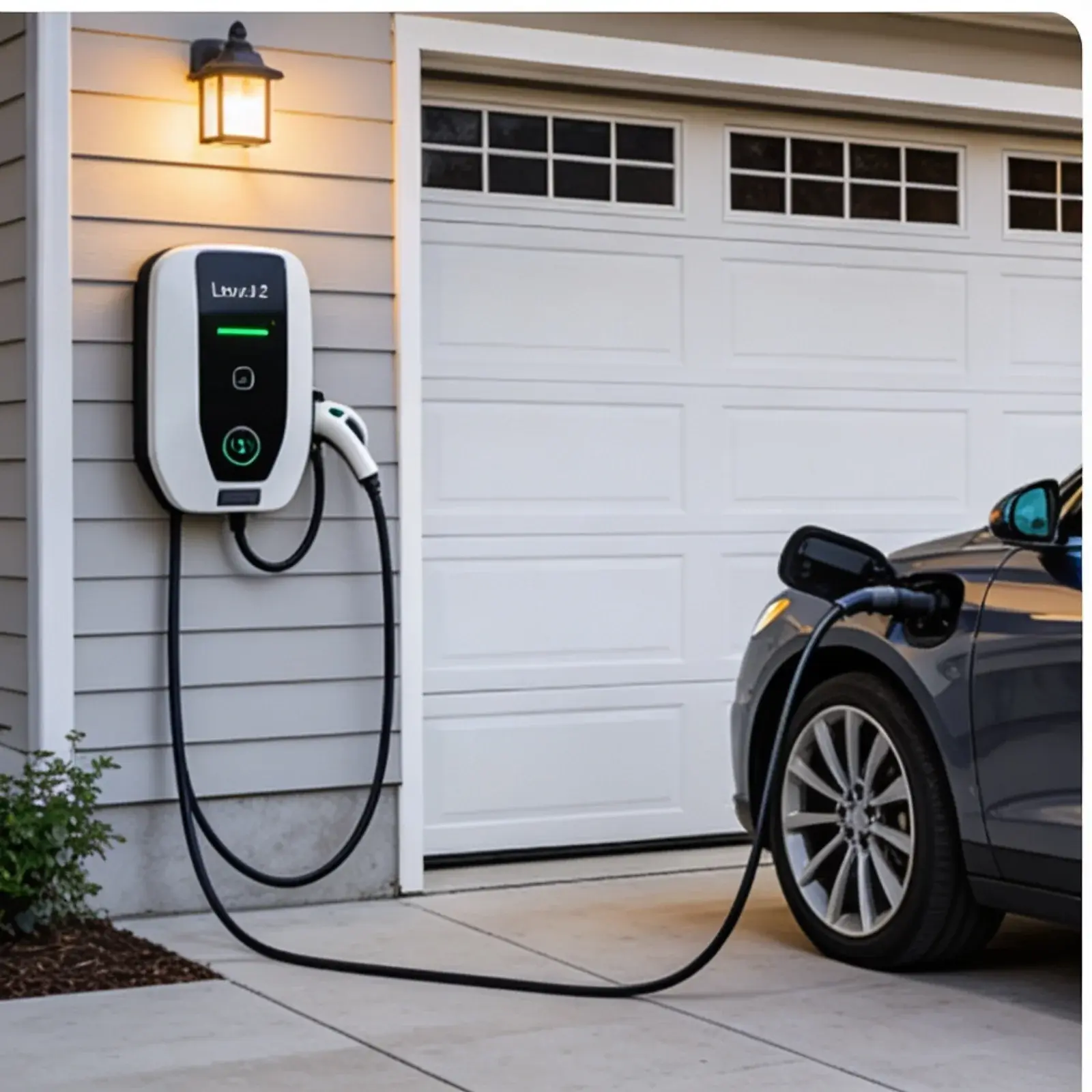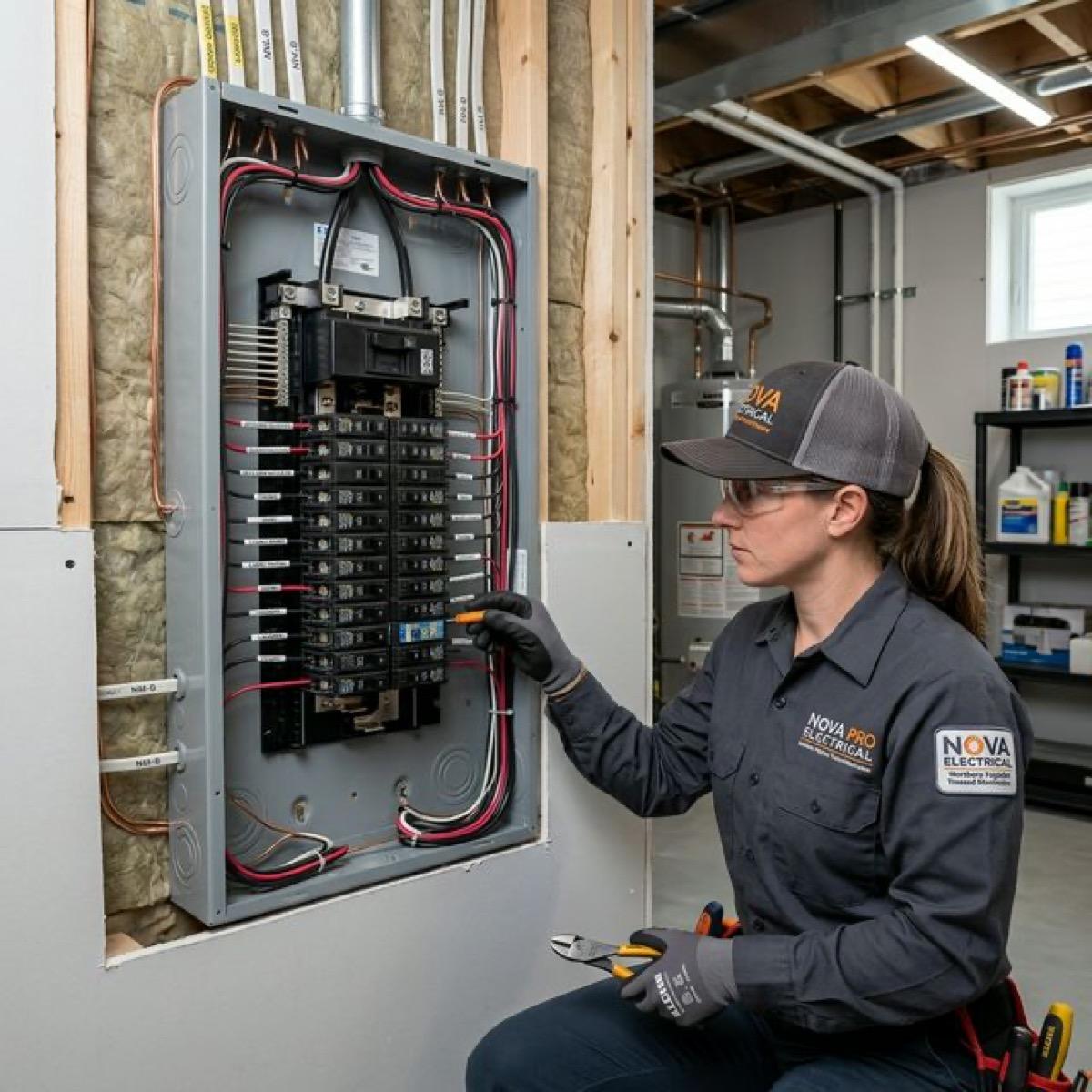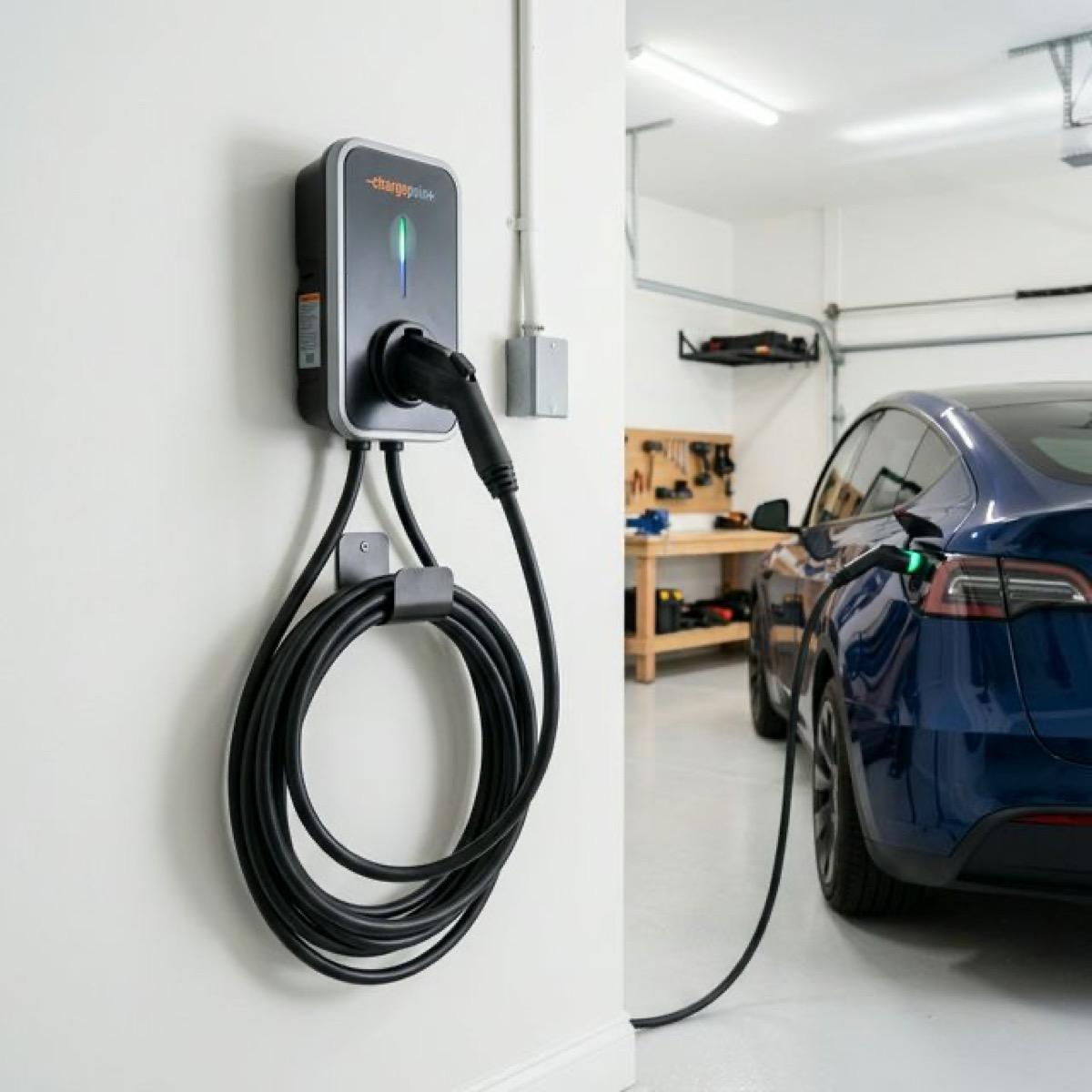
Baseline 2026 Level 2 install cost
A Level 2 circuit and hookup in Northern Virginia is typically $1,200–$3,500 in 2026. Only long, detached, outdoor, trenched, or otherwise complex routes extend to the full $1,200–$4,500 total band. The typical install paired with an existing panel that has verified spare capacity covers:
• Dedicated branch circuit sized for the listed EVSE • Raceway and conductors from panel to install location • Receptacle or hardwired termination at the charger • Required protection at the panel • Local jurisdiction permit and final inspection
EVSE hardware is separate and itemized if AJ Long Electric supplies it.
| Setup | Short Run (<25 ft) | Medium Run (25–50 ft) | Long Run (50+ ft) |
|---|---|---|---|
| NEMA 14-50 receptacle (up to 40A continuous) | $1,200–$3,500 | $1,200–$3,500 | $1,200–$4,500 |
| Compatible hardwired EVSE | $1,200–$3,500 | $1,200–$3,500 | $1,200–$4,500 |
Hardwired vs. NEMA 14-50: pick one
The biggest decision is hardwired vs. NEMA 14-50. Both deliver Level 2 charging, and either uses the same $1,200–$3,500 typical circuit-and-hookup band; charger hardware is separate.
A compatible hardwired EVSE can support up to 48 amps on a 60-amp branch circuit when the equipment listing, service capacity, and approved design allow. It avoids a receptacle connection and is well suited to a permanent installation.
A listed NEMA 14-50 setup can support up to 40 amps continuous on a 50-amp circuit and lets listed cord-and-plug equipment move with you. Use a compatible commercial-grade receptacle and follow the EVSE instructions. The route, panel capacity, and weather exposure usually affect project price more than the final connection method.
Do you need a panel upgrade?
Depends on your existing service:
• 200A panel with calculated spare capacity: no upgrade may be needed. The dedicated EV circuit and hookup is $1,200–$3,500 typical, with the $1,200–$4,500 total band reserved only for long, detached, outdoor, trenched, or otherwise complex routes. EVSE hardware is separate.
• Panel running near capacity: the load calculation gives the answer. Approved load management may be evaluated but does not guarantee a service upgrade can be avoided.
• 100A or 150A panel: a panel upgrade may be required first ($3,500–$7,500 for 200A). Adding the EV charger to the panel project is quoted as documented scope.
For multi-EV households, a 400A service may be appropriate after a load calculation and is quoted per project.
Multi-Tesla households: load sharing
Compatible networked EVSE can coordinate a site charging limit across multiple units. Each branch circuit, conductor route, breaker, equipment setting, and communication configuration must follow the current manufacturer instructions and approved load-management design.
A multi-EV installation is quoted as one project because route lengths, calculated service capacity, load-management equipment, and EVSE hardware vary. Use $1,200–$3,500 per ordinary circuit and hookup as a planning reference; only long, detached, outdoor, trenched, or otherwise complex routes extend to the $1,200–$4,500 total band. EVSE hardware is separate. A 400A service is not assumed—start with the load calculation and compare approved load management with a quoted service upgrade.
Federal tax credits and Dominion rebates
Section 30C is unavailable for property placed in service after June 30, 2026. See the <a href="https://www.irs.gov/credits-deductions/alternative-fuel-vehicle-refueling-property-credit-for-individuals">IRS guidance</a> for the historical eligibility rules. AJ Long Electric does not provide tax advice.
Dominion Energy and Virginia electric cooperatives may publish charging programs. Verify current eligibility and terms directly before purchasing equipment.
We do not claim credits or rebates for customers. We provide an itemized invoice for the electrical work.
Northern Virginia Considerations
Code Requirements
NEC 625 EV-charger article; NEC 210.8 GFCI; NEC 220 load calc; manufacturer-required dedicated circuit.
Permit Information
EV charger permits are required in Northern Virginia jurisdictions. AJ Long files the applicable permit and coordinates inspection; the authority having jurisdiction makes the final determination.
Typical Costs
$1,200–$3,500 typical for a circuit and hookup; $1,200–$4,500 only for long, detached, outdoor, trenched, or otherwise complex routes; EVSE hardware separate; $3,500–$7,500 when a 200A panel upgrade is required
Local Tips
Multi-EV households increasingly need 400A service. Outdoor installs need NEMA 4 enclosure. Tesla Wall Connector load-sharing supported by all Northern Virginia jurisdictions.
Frequently Asked Questions (5)
Is hardwired worth considering?
Yes for many permanent installations. A compatible hardwired EVSE can support 48A on a 60A branch circuit, while a listed NEMA 14-50 setup supports up to 40A continuous on a 50A circuit. Either method uses the $1,200–$3,500 typical installation band; route, panel capacity, weather exposure, and hardware selection determine the project quote.
How fast is Level 2 charging?
Depends on amperage and EV battery size. 32A NEMA 14-50: 25–30 mi/hr added for most EVs. 48A hardwired Tesla Wall Connector: 40–50 mi/hr added. Full overnight charge for a typical commute-sized EV battery (60–80 kWh).
What if I have an older panel?
Most 1990s+ Northern Virginia homes have 200A service and can add an EV circuit without upgrading. 1970s–80s homes with 100A or 150A service usually need the panel upgrade first. We run the NEC 220 load calc during the in-home assessment.
Can you install a Tesla charger if I don't own a Tesla?
Yes, with the Tesla Magic Dock J1772 adapter. Mixed-vehicle households (Tesla + Rivian, Tesla + Ford F-150 Lightning) can use a Wall Connector + Magic Dock combination for all their EVs.
Do you handle federal tax credit paperwork?
No. Section 30C is unavailable for property placed in service after June 30, 2026. See IRS guidance and consult a qualified tax professional about any historical filing question.
Authoritative Sources
- NFPA 70: National Electrical Code (NEC)The NEC is the foundational safety standard for electrical wiring and installation in the U.S.
- Electrical Safety Foundation International (ESFI)Nonprofit dedicated to promoting electrical safety in the home and workplace.
- ENERGY STAREPA program identifying energy-efficient products and practices.
- U.S. DOE: Electric Vehicle ChargingFederal reference on EV charging levels and equipment for homes, workplaces, and public sites.