Loading services…

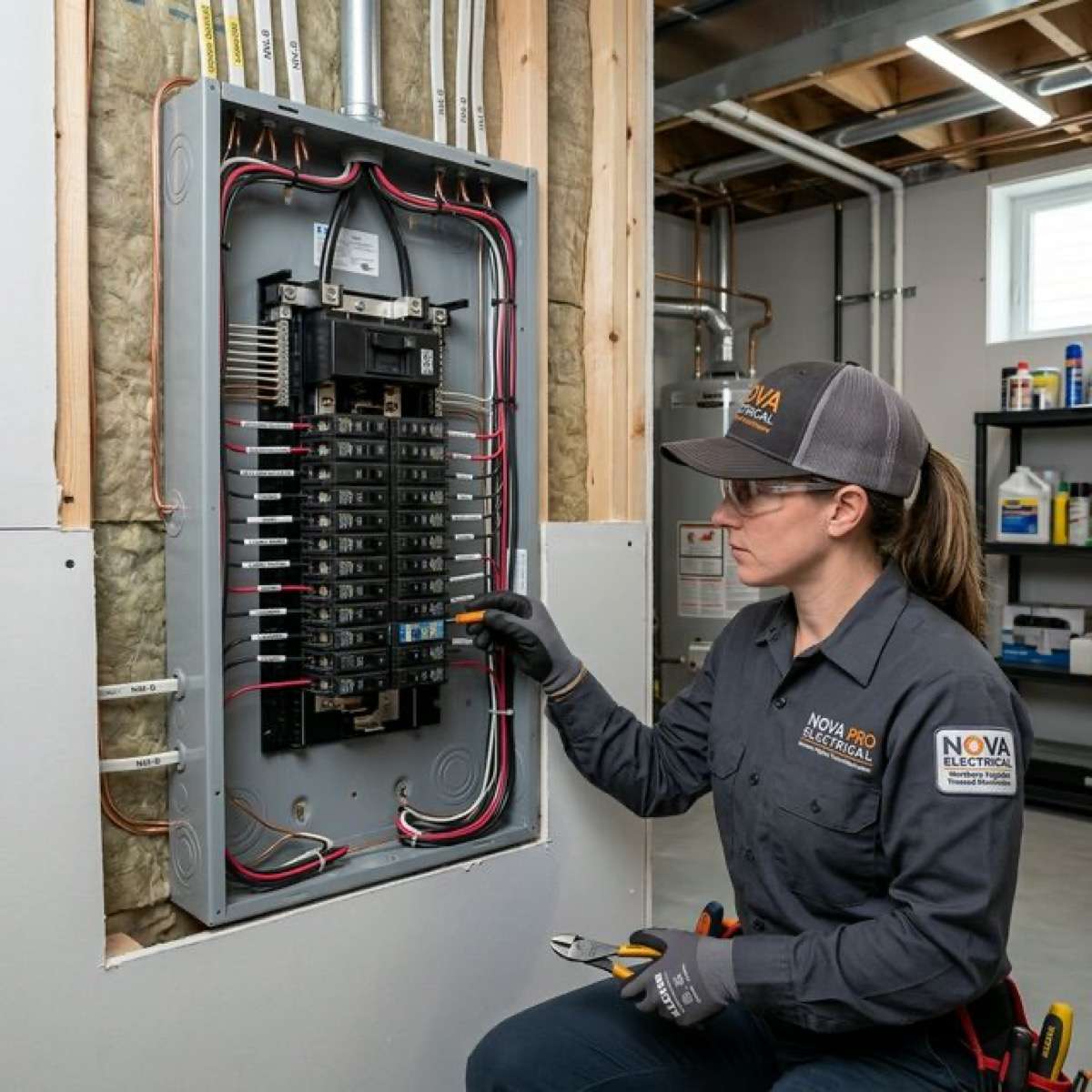
Documented Fire Hazard
Zinsco & Sylvania-Zinsco Panel Replacement in Northern Virginia
Zinsco breakers have documented failure modes. AJ Long Electric evaluates the service and replacement scope; a typical 200A replacement runs $3,500–$7,500 installed.
Insurers and buyers may ask about Zinsco panels
An insurer, lender or buyer's home inspector may name a Zinsco or Sylvania panel in a report. Ask for the exact requirement and its deadline in writing before you schedule.
Why Zinsco panels are a documented fire hazard
Zinsco panels were installed in the 1960s and 1970s, often co-branded with Sylvania or GTE-Sylvania or sold under the “Magnetrip” name. Some Northern Virginia homes built in that era still have one. These are the documented concerns:
- Breakers fuse to the bus bar. The most dangerous Zinsco failure mode: during repeated minor overloads, the breaker's metal contact heats up enough to melt and weld itself to the aluminum bus bar. Once fused, the breaker can never trip again — current keeps flowing past the wire's safe limit during the next major overload, melting insulation and starting fires.
- Aluminum bus bars corrode and pit. Zinsco panels used aluminum bus bars (cheaper than copper but more corrosion-prone). Over decades, the contact surfaces between breakers and bus bars pit, oxidize, and develop high-resistance contact points that generate heat under load.
- Breakers may not trip at their rating. Electricians and home inspectors report Zinsco breakers that did not trip at their rated current during testing. A 20A breaker that does not trip until far above 20A gives the wiring little protection.
- No AFCI compatibility. Like FPE, Zinsco never produced arc-fault circuit interrupter breakers. Bringing a home to current AFCI code requires replacing the panel.
- Discontinued, with no parts. If a Zinsco breaker fails today, replacement is difficult or impossible. Any new wiring work on a Zinsco panel typically means replacing the whole panel anyway.
Look at your panel. Colorful breakers (red, blue, green, yellow) — especially mixed colors in one panel — strongly suggest Zinsco. The cover may say “Zinsco”, “Sylvania”, “GTE-Sylvania”, or “Magnetrip”. If you have any of these, schedule an on-site estimate.
For independent background on circuit-breaker failure modes and residential electrical-fire risk, see the U.S. Consumer Product Safety Commission's guidance on home electrical safety (CPSC.gov) and the U.S. Fire Administration data on electrical home fires (USFA / FEMA).
Zinsco panel vs. a modern panel: side by side
The differences between a 1960s–70s Zinsco panel and a modern UL-listed panel are not cosmetic — they change whether your breakers actually protect the wiring behind your walls.
| Feature | Zinsco / Sylvania-Zinsco | Modern panel (Square D / Siemens / Eaton) |
|---|---|---|
| Bus bar material | Aluminum — corrodes, pits, and develops high-resistance hot spots over decades | Copper — stable contact resistance, far less prone to heat buildup |
| Breaker-to-bus connection | Can melt and fuse to the bus bar, after which the breaker never trips again | Full-clamp contact that holds firmly and trips reliably on overload |
| Overload trip reliability | Some breakers have been found that do not trip at their rated current | UL-listed breakers trip within rated tolerance |
| AFCI / GFCI support | None — no arc-fault breakers were ever made for these panels | Full AFCI / GFCI to current NEC requirements |
| Insurer and buyer questions | Some insurers and buyers ask about it by name; requirements vary | New listed panel with permit close-out records you can share |
| Replacement parts | Discontinued — breakers are hard or impossible to source | Readily available from major suppliers |
Our Zinsco replacement process
- 1
Free on-site estimate
We confirm the Zinsco panel, inspect the aluminum bus bars and feeder terminations for damage, perform a load calculation, identify aluminum branch wiring that needs CO/ALR devices at the new panel, and provide a written project scope.
- 2
Permit pull
Fairfax County, Loudoun, Arlington, Prince William, or Alexandria — whichever applies. Permit fees included in the quote.
- 3
Dominion Energy coordination
We request the meter disconnect and reconnect with Dominion Energy. The utility confirms the available work window, and the written schedule identifies the dependencies.
- 4
Panel and feeder termination
Remove the Zinsco panel and its aluminum bus bars. Inspect feeder wires for pitting; extend or replace as needed. Install a modern Square D, Siemens, or Eaton panel with copper bus bars and full-clamp breaker contacts.
- 5
Branch-circuit transfer with AFCI/GFCI
All branch circuits transferred and labeled. AFCI breakers installed on bedroom and living-area circuits per NEC 2020. GFCI on kitchens, bathrooms, garage, outdoor, and basement circuits.
- 6
Grounding and bonding upgrade
An older home may not have the ground rods or water-service bond current NEC Article 250 rules expect. Where the new installation needs them, we install or correct them and test continuity before the panel is energized.
- 7
Inspection coordination
We request the county inspection and address inspector questions through the documented permit process. The jurisdiction controls the available inspection window.
- 8
Insurance documentation
Itemized invoice, permit close-out, and a letter you can send to your insurance carrier confirming the Zinsco panel was replaced with a UL-listed modern panel.
Zinsco replacement cost in Northern Virginia
Typical 2026 pricing
$3,500–$7,500
Installed, including permit, surge protection, and Dominion coordination.
- 200A modern panel with copper bus bars
- AFCI / GFCI per NEC 2020 (Zinsco-era homes need this)
- Feeder-termination inspection and remediation
- Grounding system upgrade to current NEC 250 standards
- Permit + inspection + Dominion coordination
- Insurance documentation included
Aluminum-wiring remediation, if needed, adds $250–$800 depending on the number of devices. See our aluminum-wiring page for details, or the 2026 cost guide for the full breakdown.
Frequently asked questions
Why are Zinsco panels considered dangerous?
Zinsco breakers have a documented failure mode where the breaker melts and fuses to the aluminum bus bar instead of tripping during an overload. Once fused, the breaker can never trip again — current keeps flowing through the affected circuit even during severe overloads, melting wire insulation and starting fires. A second concern is breakers that do not trip at their rated current.
How can I identify a Zinsco panel?
Zinsco panels typically have a thin sheet-metal cover with the brand name “Zinsco”, “Sylvania”, “GTE-Sylvania”, or “Magnetrip” visible on the panel face or on the dead-front cover. The breakers themselves are often colorful (red, blue, green, yellow) — distinct from the uniform black or grey of modern panels. The bus bars inside the panel are aluminum (not copper) and frequently show pitting, discoloration, or melting around the breaker contacts.
Do I have to replace my Zinsco panel?
Code generally does not force you to remove working existing equipment, and the inspector decides what is acceptable when other work is permitted. We recommend replacement because of the breaker-to-bus failure mode described above. If an insurer or buyer is asking for replacement, the requirement and its deadline are theirs to set; once you have it in writing, we scope the work to match.
How much does Zinsco replacement cost?
A typical Zinsco-to-200A upgrade in Northern Virginia runs $3,500–$7,500 installed. This includes the new panel, basic surge protection, permit, Dominion Energy meter disconnect/reconnect coordination, and final inspection, plus an outdoor emergency disconnect when the job requires one. Larger homes or 400A services are quoted per project.
What sets the outage window for a Zinsco replacement?
Three things: the permit path for your address, the date Dominion Energy or NOVEC can disconnect and reconnect the service, and what our pre-installation review finds when we look at the existing panel. We set the installation date and the hours without power once all three are known, and the written proposal states them before work begins.
Are there extra steps for Zinsco vs. other panel replacements?
Yes. Zinsco panels frequently have aluminum bus bars with degraded contact surfaces, and the original feeder wires entering the panel are often pitted from years of arc-induced heating. We inspect and clean all feeder terminations during the replacement and may recommend extending feeders if the existing termination is damaged. Some Zinsco-era homes also have aluminum branch wiring that needs CO/ALR-rated devices at the new panel; we flag this in the quote.
Should I plan an EV charger circuit while the Zinsco panel is out?
It is a practical time to plan one, because the new panel's breaker layout and the load calculation are being settled anyway. If the home has a 100A or smaller service, that calculation decides whether the EV circuit fits or calls for a 200A upgrade. A typical Level 2 circuit and hookup is $1,200–$3,500, with documented long or complex routes reaching $1,200–$4,500; EVSE hardware is separate.
Related electrical services & guides
Federal Pacific (FPE) Replacement
The other documented fire-hazard panel brand from the same era.
All Panel Upgrades
Full panel-upgrade service for any age or brand.
Aluminum Wiring Remediation
Some Zinsco-era homes also have aluminum branch wiring that needs CO/ALR devices.
Whole-Home Surge Protection
Add surge protection at the new panel to shield modern electronics.
Complete Panel Upgrade Guide
How panel replacements work, what they cost, and how to plan one.
2026 Northern Virginia Electrical Cost Guide
Full breakdown of panel, wiring, and service-upgrade pricing for 2026.
Replace your Zinsco panel
Scope-based estimates, insurance-ready documentation, and work led by John Long, Master Electrician.
Authoritative Sources
- NFPA 70: National Electrical Code (NEC)The NEC is the foundational safety standard for electrical wiring and installation in the U.S.
- Electrical Safety Foundation International (ESFI)Nonprofit dedicated to promoting electrical safety in the home and workplace.
- Fairfax County: Residential Electrical PermitsCounty electrical permit guidance for single-family homes and townhouses; verify the authority from the project address.