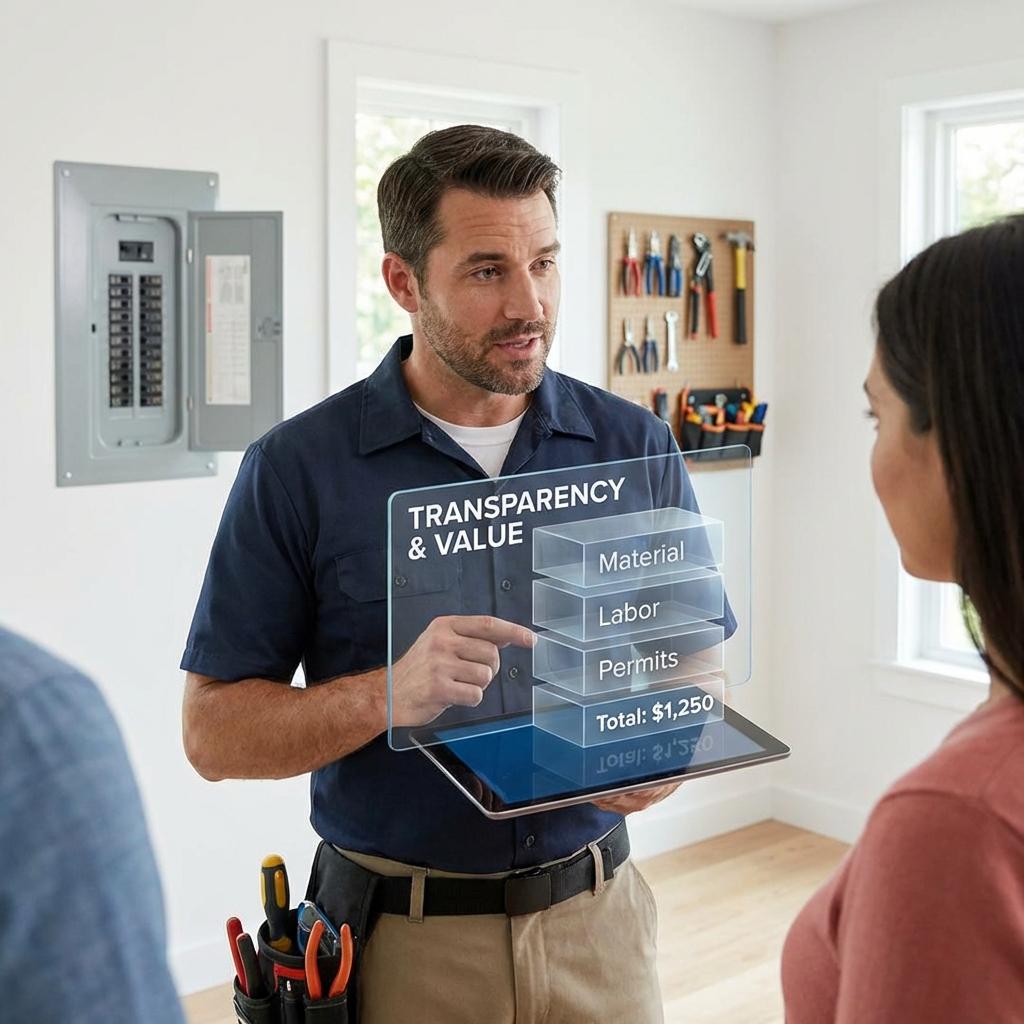

A 100A condominium distribution-panel replacement, a 200A service increase and a shared-building riser replacement are different projects. A useful Northern Virginia cost guide should tell you what local companies publish, what their figures cover and what you still need to ask. The lowest number on a page is only useful when it describes the work your home needs.
Read the scope before the price
- Panel work: separate subpanels, same-amp replacements, 200A and 400A service upgrades and condo unit panels.
- Repairs: ask what pays for arrival, diagnosis and the repair itself.
- Installations: compare equipment, wiring, permits and access in the same written scope.
This guide is published by AJ Long Electric. The regional examples below are attributed to the companies that published them; our own policies are identified separately. They are published guidance, not a survey of completed invoices or a guaranteed quote from any company. Competitor examples were captured October 11, 2026; confirm current terms before booking.
Electrical panel costs in Northern Virginia, by category
“Panel upgrade” can describe replacing an old cabinet, adding circuit space or increasing the power available to the entire home. Those labels cannot stand in for a scope of work. These examples preserve the differences in the publishers' descriptions.
| Project and publisher | Published range | Scope to keep with the number |
|---|---|---|
| Condo / same-amperage panel (publisher does not specify rating)Sparkwise's guide | $1,800–$3,000 | Regional guidance for condos and smaller panels. Not a price for every subpanel or a full service increase. |
| 100A to 200A upgradeRojas Electric's guide | $1,800–$3,500 | Regional guidance. Panel location, meter-base replacement and utility coordination affect the amount. The page says it handles permits and inspections. |
| Standard 200A upgradePRO Electric's guide | $1,500–$4,000 | Fairfax County guidance. The page states permit and utility handling; it does not provide an itemized equipment allowance for every site. |
| 200A upgradeSparkwise's guide | $4,000–$6,000 | Regional guidance, with overhead versus underground service among the price factors. This is a separate category from its smaller replacements. |
| 100A to 200A with new service entranceSparkwise's guide | $4,500–$8,500 | Broader heavy-up scope: panel, service-entrance work, permit and inspection. Compare this with another complete service proposal. |
Rojas and PRO Electric describe regional pricing in their articles; these figures are not verified offers to perform every job at the lower end. Sparkwise also labels its table as regional guidance. The spread between these sources is a reason to compare inclusions, not proof that one contractor is cheaper on an identical project.
Base price versus a complete service scope
Absolute Electric’s panel page, checked October 14, 2026, lists a $2,100 base plus factors: $930–$1,404 for 200A rather than 100A, $300–$900 for permits, $1,691–$2,116 for a disconnect and $273–$832 for surge protection. Adding just those factors gives $5,294–$7,352 if all apply. That is a conditional calculation from the published menu, not a quote or a claim that every replacement needs those additions. Meter, cable, grounding and conditional coordination charges require separate review; do not automatically add every factor.
EV Electric’s Fairfax panel page describes a load assessment, disconnect, surge protection, permits and utility coordination but provides no panel price in the reviewed page. It can inform an inclusion checklist, not a numerical cheapest-price comparison. Missing breaker counts or route lengths in any company’s guide remain questions for the written quote.
What type of electrical panel do you need?
“Panel size” can mean five different things: the utility service rating, the feeder breaker rating, the panel bus rating, the number of breaker spaces, or the physical enclosure dimensions. An estimate should state each relevant rating. Most detached homes use 120/240V single-phase service; some apartment and condo units receive 120/208V from a building distribution system. Equipment must match the actual supply, available fault current and approved breaker configuration.
A 125A-rated, two-space enclosure can be supplied by a 30A feeder. A 200A-rated cabinet can serve as a downstream subpanel. Neither label proves the home has that much additional capacity. Likewise, a “40-space/80-circuit” marking does not promise space for 80 full-size AFCI/GFCI breakers: the manufacturer’s listing controls tandem use, and two-pole breakers consume two poles. Eaton explains main-breaker and main-lug configurations.
| Rating | Typical application | Pricing implication |
|---|---|---|
| 30–60A feeder | Usually a feeder to an accessory load center, garage, pool equipment or selected loads. A 60A feeder may supply a cabinet with a 100A or 125A bus rating. | Price the feeder ampacity and length separately from the cabinet. This is not a 60A whole-house service recommendation. |
| 100A / 125A | Common existing dwelling-unit or main-panel ratings. Available space counts vary; specify 12, 20, 24 or 30 full-size spaces rather than just “small.” | A condo unit panel may be downstream of a meter-bank disconnect. Replacing that panel does not replace the building service. |
| 150A | An existing residential service rating, often using a cabinet platform also offered with a 200A main. | A new 200A-rated cabinet can retain 150A protection when the listed configuration permits. This alone does not create a 200A service. |
| 200A | A common main-service rating and also a possible feeder-panel rating. Specify the main device, bus rating and 30, 40, 42, 54 or other listed space count. | A 200A panel replacement and a 100A-to-200A service increase are different scopes. |
| 225A bus | The bus assembly rating can exceed the main breaker rating; a 225A bus with a 200A main is a common design choice. | It does not mean the property has a 225A utility service. Solar interconnection and equipment listings need separate design review. |
| 320A continuous / 400A maximum metering | A common residential metering class for a service often called “400A,” frequently feeding two 200A disconnects/panels. | Specify actual meter rating, load calculation, service arrangement and utility approval. Two 200A panels do not prove 400A capacity. |
| True 400A, 600A and larger engineered services | Some high-load homes and multifamily properties need other metering, service equipment or current-transformer arrangements. | A design and utility scope are necessary. Do not extrapolate a 200A panel price or promise a generic cost ceiling. |
Common electrical panel types in Northern Virginia homes
| Configuration | What the estimate must distinguish |
|---|---|
| Electrical panel with a main breaker | Also called a main-breaker load center. Contains a main breaker and branch breakers. It may be the service disconnect or a downstream distribution panel; the location and bonding arrangement determine its role. |
| Subpanel without a main breaker | Also called a main-lug-only (MLO) load center. Has incoming lugs without a main breaker in that cabinet. Upstream overcurrent protection is essential. A downstream panel can also have a main breaker used as a local disconnect. |
| Meter box and combined meter/shutoff | A meter socket holds the utility meter. A meter-main combines metering with a disconnect and may include distribution spaces. Replacing the utility-owned meter itself is not the same as replacing customer-owned meter equipment. |
| Indoor / outdoor; flush / surface mount | NEMA 1 is an indoor enclosure designation; NEMA 3R is commonly used outdoors. A flush replacement can require wall opening, a trim solution or circuit extensions; a surface installation has different routing and finish work. |
| Pool or spa equipment panel | Often an outdoor load center with GFCI-protected equipment circuits, sometimes integrated timers or automation. Pool bonding, feeder suitability and required protection are separate from buying a weatherproof box. |
| Condo or apartment electrical panel | Usually supplied by a building feeder. Confirm 120/240V single-phase versus 120/208V supply, panel and breaker ratings, feeder protection, building access and association responsibilities. |
| Backup power panel | Also called a critical-loads or transfer panel. Selected circuits served through listed transfer equipment for a generator or battery system. A standard subpanel cannot serve as a transfer switch by itself. |
| Smart / load-management panel | Monitoring, controllable breakers and backup integration are distinct features. Price the actual manufacturer, circuit count, controls and commissioning; a monitoring-only accessory is not a whole smart-panel replacement. |
| Old fuse boxes and split-bus panels | Identify the existing disconnect arrangement, circuit condition and replacement equipment. A fuse-to-breaker conversion is not automatically a service increase, and replacing the cabinet does not automatically rewire the house. |
Electrical panel replacement and upgrade costs
The table below lists the panel projects homeowners most often compare, with AJ Long Electric’s published price where one exists. Only the 200A package, smart panels and portable generator hookups have published AJLE prices. A 400A service is quoted per project, and the other scopes are quoted after we review the feeder, equipment, circuits and access. The named publisher examples above are separate evidence and are not AJLE prices.
| Project | AJLE price | Scope assumed | Separately evaluate |
|---|---|---|---|
| Small subpanel replacement2–4 breaker spaces; existing feeder | Quoted after review | Up to four breaker poles in a listed space/circuit configuration; accessible surface mount; compatible standard breakers; existing suitable feeder and upstream protection. | New feeder, trenching, pool-specific protection and circuit repairs. |
| Garage or workshop subpanel replacement6–12 breaker spaces; existing feeder | Quoted after review | Cabinet, standard branch breakers, reconnection, labeling and verification at an accessible existing location. | Feeder replacement, extensive conductor extensions and electronic breaker upgrades. |
| 100-amp or 125-amp panel replacementHouse or townhouse panel; existing rating kept | Quoted after review | New cabinet and compatible breakers at the same location and rating; circuit transfer, directory and verification. | A service-capacity increase, relocation, extensive AFCI/GFCI conversion and wall repairs. |
| Same-amp main panel replacement150A or 200A house or townhouse panel; existing rating kept | $3,500–$7,500 (published 200A package) | New cabinet and compatible breakers at the same location and rating; circuit transfer, directory and verification. | A service-capacity increase, relocation, extensive AFCI/GFCI conversion and wall repairs. |
| Condo or apartment unit panel replacementIn-unit panel on a building feeder | Quoted after review | Roughly 12–24 occupied breaker spaces; replacement at the same location; existing building feeder retained; standard breaker package. | Building riser, meter bank, feeder replacement, relocation and restoration. |
| 200-amp electrical service upgradeExisting meter socket and service cable rated for 200A | $3,500–$7,500 (published 200A package) | Load calculation, panel and breakers, applicable outdoor disconnect, basic surge protection, permit and inspection handling, and Dominion coordination. | A new meter socket or service-entrance cable, long underground runs, excavation, masonry or roof restoration and utility infrastructure charges. |
| 200-amp upgrade with meter and service cableNew meter socket and service-entrance cable | Quoted after review | Panel and breakers, a utility-approved meter socket or meter-main, a defined short service-entrance route, applicable outdoor disconnect, basic surge protection, grounding, permit and Dominion coordination. | Long underground runs, excavation, masonry or roof restoration and utility infrastructure charges. |
| Pool or hot tub panel replacementOutdoor subpanel with specified GFCI protection | Quoted after review | Weather-rated equipment, defined circuit count, specified GFCI breakers and verification of the affected equipment. | Automation center, heater/pump replacement, feeder reconstruction and correction of an entire pool bonding system. |
| 400-amp electrical service upgrade320A continuous-rated metering | Quoted per project; typically $9,500–$13,500 | Utility-approved metering, service disconnect arrangement, two standard distribution panels where specified, short accessible routes and permits. | Utility transformer/lateral upgrades, trenching, long feeders, generator transfer equipment and premium controls. |
| Leviton-class smart panelLoad center with selected smart breakers | $3,000–$5,000 | Compatible load-center or smart-breaker work with a specified number of smart breakers, monitoring, configuration and commissioning. | A fully populated premium breaker package, service increase, battery hardware and proprietary backup interfaces. |
| SPAN-class smart panelIntegrated circuit monitoring and control | $7,500–$9,500 | Whole-panel replacement with an integrated monitoring and control panel, circuit transfer and commissioning. | Verify the current model and installer requirements; batteries, transfer equipment, service entrance and utility work are separate. |
| Portable generator hookupInlet and listed interlock or manual transfer switch | $900–$2,500 | Inlet box, listed interlock or manual transfer switch and the connection for a customer-supplied portable generator. | Generator equipment, fuel work, a separate critical-loads subpanel, long feeders and automatic standby controls. |
| New garage or workshop subpanelNew panel and new feeder | Quoted after review | Standard panel, a defined accessible feeder route, feeder breaker, grounding review and a limited circuit package. | Excavation, concrete crossing, finished-wall fishing and wiring all garage receptacles/lights. |
| Condo electrical supply cable replacementAccessible individual-unit feeder | Quoted after review | One 100–200A unit feeder in usable accessible raceway; normal terminations and outage planning. | Shared riser replacement, inaccessible shaft work, asbestos, fire-rated assembly reconstruction and utility metering changes. |
The 200A package price includes permit and inspection handling. New electronic breakers, specialty enclosures and substantial corrections are identified in the written estimate. Do not add rows from the component table below to a package price: many rows describe components the package already includes, and some are alternatives.
What makes up the cost of a panel replacement?
The table separates retail equipment from installed work. Equipment figures are budget ranges cross-checked against public product listings, not a survey of completed invoices or any contractor’s internal cost sheet, and they are not installed prices. Installed work is either part of the 200A package or quoted after review. Model, breaker package, access and circuit condition matter. Buying a cabinet does not buy a panel replacement. Tax, delivery, procurement and warranty handling can make supplied-equipment charges different from retail.
| Component / task | Budget allowance | Unit / basis | What changes the cost |
|---|---|---|---|
| Small subpanel box2–4-space main-lug enclosure | $25–$140 each | Equipment only | Cover and ground-bar kit may be separate; bus rating is not feeder capacity. |
| Garage or workshop subpanel box6–12-space main-lug enclosure | $80–$250 each | Equipment only | Check indoor/outdoor designation, main-lug kit and listed breaker family. |
| 100-amp or 125-amp electrical panelLoad center and specified main device | $130–$400 each | Equipment only | Main breaker and cover inclusion vary; 12–30 spaces is a specification, not an installed price. |
| 150-amp or 200-amp electrical panelMain-breaker load center | $250–$650 each | Equipment only | Common standard residential equipment; premium copper-bus lines or higher fault ratings can cost more. |
| Standard circuit breaker | $7–$35 single-pole; $20–$80 two-pole | Per device, equipment only | New compatible listed breakers; specialty, high-amp and obsolete replacements can exceed this. |
| Arc-fault and ground-fault circuit breakersAFCI, GFCI or dual-function protection | $45–$130 single-pole; $90–$250 two-pole GFCI | Per device, equipment only | Specify function and exact circuit count. Dual-function means AFCI plus GFCI; “combination AFCI” does not mean both. |
| Panel connection parts and cover blanksGround bars, terminals and listed fillers | $20–$100 per panel | Equipment only | Listed accessories; bonding provisions depend on whether this is service equipment or a downstream panel. |
| Connectors, bushings, labels and fasteners | $30–$150 per panel | Small parts, equipment only | Cable fittings, approved splices, directory, blanks and mounting hardware; no separate unexplained fee for every screw. |
| Whole-house surge protectorType 1 or Type 2 device | Basic surge protection is included in AJLE’s published 200A panel package; an elective equipment upgrade is an itemized difference. Standalone work or an elective upgrade is quoted by actual equipment and installation scope. | Choose device-only OR installed amount | Installation overlaps the panel job. Do not add both prices or charge again if included. |
| Outdoor electrical shutoff200A emergency or service disconnect | $250–$650 equipment | Equipment only | Short accessible connections only; bonding/feeder conversion may add scope. A meter-main can replace, rather than add to, this line. |
| 200-amp meter box replacementCustomer-owned meter socket | $150–$450 equipment | Equipment only; customer-owned socket, same location | Utility-approved socket, short reconnections and accessible mounting; not the utility meter, a mast or a full new cable route. |
| Meter box with main shutoff200A meter-main combination | $400–$1,000 equipment | Equipment only; combined metering and main disconnect | Substitutes for separate socket/disconnect assemblies where approved; downstream feeder and grounding work must be defined. |
| Meter equipment for a 400-amp service320A meter socket or meter-main | $600–$2,000 equipment | Equipment only | Does not include two distribution panels, all service conductors or utility infrastructure. |
| Aluminum electrical supply cable100–200A feeder or service-conductor material | $5–$12 per route foot | Material only | Identify conductor assembly, number/size of conductors and actual route. A feeder and service cable are not interchangeable. |
| Copper electrical supply cable100–200A feeder or service-conductor material | $12–$28 per route foot | Material only | Exact ampacity, terminations, wiring method and procurement determine cost. This is not a conductor-sizing instruction. |
| Overhead electrical service mastRiser, weatherhead and specified connections | Quoted after review | Installed work | Mast/raceway, weatherhead, attachments and defined service conductors. Roof work, structural bracing and relocation change the scope. |
| Electrical grounding and bonding repairs | Quoted after review | Installed work | Identify electrodes, grounding electrode conductor, water-pipe bond and other applicable bonds; do not assume every house needs the same list. |
| Extending wires to the new panelAccessible splices and junction enclosure | Quoted after review | Installed work per defined group | Identify count, splice method, enclosure access and conductor condition. Not permission to conceal inaccessible junctions. |
| Permit, filing and inspection coordination | Jurisdiction fee plus any disclosed handling | Actual permit classification; not a flat regional fee | Fairfax County, City of Fairfax and other jurisdictions differ. Government charges and contractor administration are separate; ask whether both are in the installation total. |
| Power company disconnect and reconnect scheduling | Often part of the quoted installation scope | Verify inclusion rather than adding a default fee | Separate ordinary scheduling from utility engineering, lateral or transformer construction. Those utility charges require their own determination. |
| Moving an electrical panel | Quoted after review | Relocation with limited circuit extensions | Does not include a full house rewire; route length, working clearance and wall finish determine scope. |
| Drywall opening and patch preparation | Quoted after review | Defined opening; finish trade may be separate | Painting, matching texture, tile, stone, asbestos and fire-rated reconstruction require explicit pricing. |
| Trenching for underground electrical wiringSoft soil and conduit pathway | Quoted after review | Excavation/pathway only | Exclude conductors unless stated; rock, boring, utilities, concrete/asphalt and landscaping can be substantially more. |
| Condo building electrical survey and designShared riser planning; not construction | Quoted after review | Professional design stage | Not a building-wide construction quote. Building size, drawings, access and engineered deliverables govern the fee. |
Smart panels, monitoring and backup circuits
A standard load center with an energy monitor, a modular smart-breaker system and an integrated circuit-control panel are different purchases. Leviton describes a monitor plus selected compatible smart breakers; the count and functionality of those breakers belong in the quote. SPAN describes its integrated panel system; confirm the current model, compatibility and authorized installation requirements. Our published installation ranges are $3,000–$5,000 for Leviton-class work and $7,500–$9,500 for a SPAN-class panel; the written scope confirms the model, circuit count and compatibility. These are installation ranges, not manufacturer price lists.
A critical-loads subpanel redistributes selected circuits; a listed transfer device controls the alternate source. Batteries, generator inlets, transfer equipment and commissioning are not automatically included in the word “panel.” Load-management equipment may avoid a service increase in a suitable design, but that conclusion comes from the load assessment and listed system capabilities, not from the presence of an app.
How breaker quantities change the quote
Count devices and poles separately. A two-pole appliance breaker is one device but occupies two poles. A quote should list standard single-pole, standard two-pole, AFCI, GFCI and dual-function breakers individually. Replacing twenty standard breakers is not the same equipment purchase as twenty electronic breakers. In a hypothetical material comparison, twenty devices at $20 are $400; twenty at $75 are $1,500—a $1,100 equipment difference before any circuit corrections. This calculation explains the difference; it is not a claim that every replacement requires the more expensive package.
Meter box replacement: what is included?
The utility normally controls the revenue meter and its seals. The property owner commonly supplies the meter socket and associated service equipment, subject to the utility’s rules. A replacement socket at the same location can be a limited job; relocating it or combining it with an outdoor main changes the conductor route, grounding and inspection scope. Confirm the utility-approved catalog number, overhead/underground entry, bypass requirements where applicable, mounting condition and service rating. An equipment allowance should not imply the utility has approved a new service.
A meter-main can satisfy multiple equipment functions. If the quote uses a combination meter-main, do not also charge for a standalone meter socket and a separate emergency-disconnect assembly unless the actual design uses those additional components. Utility disconnect/reconnect scheduling is an operational step; utility construction charges require the utility’s own determination.
Replacing the electrical cable from the meter to the panel
The overhead mast/riser, weatherhead, attachment, service-entrance conductors, underground service lateral and downstream feeder are distinct items. Record the start and end points, route footage, wiring method, conductor material and ownership. A short surface-mounted run is not comparable to fishing a feeder through finished walls or rebuilding an underground path. Reusing a meter enclosure does not establish that the existing conductors support a service increase.
A quote for aluminum versus copper conductors must compare a design meeting the same ampacity and termination requirements, not identical wire gauges. Raceway size, temperature ratings, conductor count and conditions of use matter. Existing aluminum branch wiring is a separate issue from correctly specified modern aluminum service conductors. No homeowner should select service-conductor size from a price-per-foot table.
Condo, apartment and pool panels need their own scope
Condo or apartment panel replacement
Separate the in-unit distribution panel from the feeder serving that unit, the shared meter bank, and the building’s main distribution. A 100A or 125A panel replacement may retain a sound existing feeder. A larger cabinet with more circuit spaces can improve distribution without increasing the unit’s allocated capacity. Increasing the feeder rating requires review of upstream protection, building capacity, cable/raceway and association approval; the dwelling-unit panel price cannot cover all of that by implication.
Confirm a scheduled building shutdown, electrical-room access, elevator/loading arrangements, association documentation, inspection access and fire-rated wall penetrations. These are real scope items, not a generic “condo surcharge.” A unit may use a commercial electrical permit path even though the occupant is a homeowner; Fairfax County explains this distinction.
Condo building wiring and shared meter banks
A building riser may be a single unit feeder in a shaft, multiple feeders in common raceways, busway, or part of shared distribution. Identify which is actually being replaced. A single-unit feeder replacement is quoted after review, and that price does not cover a shared building riser. A building-wide job needs an electrical survey, utility coordination where service equipment changes, a shutdown/phasing plan and engineered quantities.
- Design: existing drawings, load study, fault-current review, feeder schedules and permit documents.
- Electrical equipment: meter-stack sections, tenant disconnects, distribution panels, busway or conductors, approved terminations and any required protection.
- Pathway: shaft access, raceway capacity, cable pulling, supports, floor penetrations and tested firestop systems.
- Occupied-building logistics: unit access, notice periods, outage stages, temporary power where required and after-hours work.
- Other trades: demolition, hazardous-material assessment, fire-rated reconstruction, finishes and inspection of concealed work.
No credible per-unit or per-floor total can be stated without those quantities. Price an initial survey/design stage, then an itemized construction proposal. The same principle applies to a damaged multi-position meter center: replacing one approved component is different from replacing the complete bank.
Pool and hot tub electrical panels
Specify enclosure rating, feeder condition, pump/heater/lighting circuits, GFCI devices, timers, automation and any transformer. A basic outdoor distribution enclosure is not equivalent to an integrated pool automation center. A spa disconnect with a GFCI breaker is also not necessarily a multi-circuit pool panel. List the exact equipment rather than grouping all three as a “small panel.”
Replacing pool equipment can uncover bonding defects, unsuitable conductors or moisture damage. Verification of the affected work belongs in the job; rebuilding an entire equipotential bonding system, digging to repair a feeder, or replacing pumps and controls is separate. Grounding electrodes do not substitute for pool bonding, and neither should be presented as an optional cosmetic improvement.
Virginia code: replacement versus service upgrade
Virginia DHCD identifies the 2021 Virginia codes and 2020 NEC as the adopted code framework checked October 14, 2026. Existing-building rules must be considered alongside new-work provisions. A later national NEC edition or a pending Virginia code proposal is not automatically the rule for this project.
Like-for-like replacement is not automatically a service upgrade
A panel replacement retaining the existing capacity, location and service arrangement may follow Virginia’s existing-building repair or alteration provisions. VEBC 504.1 allows like-material electrical repairs; Chapter 6 governs alterations. A like-for-like panel replacement in Virginia does not require an outdoor emergency disconnect. Relocating the panel or changing the meter, service conductors or disconnect arrangement is a different scope, and the permitting authority reviews that work. Virginia Existing Building Code: repairs.
When an outdoor emergency disconnect enters the scope
For a new or upgraded one- or two-family dwelling service subject to the current new-work requirements, NEC 230.85 addresses a readily accessible outdoor emergency disconnect. It can be part of approved service equipment rather than a second box. An indoor main breaker alone does not provide an outdoor disconnect. “Only if amperage increases” is too broad: reconstruction or relocation can change the applicable scope even when the final amperage stays the same. Schneider Electric: 2020 NEC emergency disconnect.
Emergency disconnect and service disconnect are not always the same device
An outdoor device marked as service equipment and an emergency disconnect marked not service equipment can produce different bonding arrangements. If the service disconnect moves outdoors, the interior panel commonly becomes feeder-supplied, with neutral and equipment-grounding paths separated. The quote should identify any required feeder conversion rather than calling every outside switch a “fireman’s disconnect.” Virginia Existing Building Code: alterations.
Surge protection is a separate question
NEC 230.67 addresses dwelling service surge protection; do not assume that the emergency-disconnect trigger also settles the surge-protection question. Evaluate existing-building applicability and the service equipment being changed. List the Type 1 or Type 2 device and location in the scope, and identify when it is an included improvement rather than claiming all existing panels must be retrofitted. Schneider Electric: service-equipment requirements.
AFCI, GFCI and existing branch circuits
Replacing a panel does not by itself establish that every existing circuit needs a new dual-function breaker. New circuits, circuit extensions, changed uses and the applicable existing-building provisions affect protection requirements. Pool equipment and other locations have specific GFCI considerations. Price the required circuit count and compatible breaker types; never remove existing required protection to achieve a lower price. Virginia alterations framework.
What this means for the price: a qualifying like-for-like panel repair should not automatically carry every cost of a new service. Conversely, keeping the same amperage does not excuse defective equipment or make a relocated/reconstructed service a simple repair. Ask the contractor to identify the applicable code provision and permit classification beside each required upgrade. We do not label an outdoor disconnect mandatory for every panel replacement.
Three scopes to use when requesting comparable quotes
These scenarios show what to put in the request. They are not three completed jobs. Each contractor should return one installation total and identify additions instead of treating an equipment-only figure as the finished price.
| Scope item | Specify in the quote |
|---|---|
| AJLE price | Quoted after review |
| Equipment | 100A or 125A cabinet with correct main device; indoor enclosure and cover; existing approved supply retained. |
| Example breaker schedule | 12 single-pole and four two-pole devices: 16 devices using 20 full-size spaces. Identify existing required electronic protection separately. |
| Installation | Isolation, removal, mounting, circuit transfer, terminations, labels and electrical verification. |
| Building and permit | Electrical-room access, planned shutdown, applicable residential/commercial permit and inspection handling. |
| Separate scope | Shared riser, meter bank, feeder replacement, relocation, wall finishes and protection changes beyond the defined schedule. |
| Scope item | Specify in the quote |
|---|---|
| AJLE price | $3,500–$7,500 (published 200A package) |
| Equipment | 200A main-breaker or correctly protected downstream panel, 40-space cabinet, cover, compatible breakers and specified surge device. |
| Example breaker schedule | 24 single-pole plus four two-pole devices occupy 32 spaces; eight remain spare. Required breaker functions follow the circuit schedule. |
| Installation | Transfer and identify circuits; handle short conductors only as expressly included; label, verify and arrange inspection. |
| Retained systems | Suitable meter socket, service conductors and approved disconnect arrangement. An outdoor disconnect is not an automatic duplicate charge. |
| Separate scope | New service entrance, meter relocation, extensive conductor extensions, concealed defects and wall restoration. |
| Scope item | Specify in the quote |
|---|---|
| AJLE price | Quoted after review |
| Equipment arrangement | Panel and breaker schedule, utility-approved meter socket plus applicable disconnect; or an approved meter-main alternative. |
| Conductor route | Measured exterior and interior route lengths, conductor assembly, mast/raceway, weatherhead, fittings, attachment and support. |
| Protection | Specified surge device, grounding electrodes and bonding work; downstream feeder conversion where the disconnect arrangement changes. |
| Installation and coordination | Load assessment, outage planning, coordinated interior/exterior installation, permit, inspection and ordinary utility scheduling. |
| Separate scope | Trenching, long underground routes, utility infrastructure, structural roof work, major wall finishes and building-wide distribution. |
Sparkwise’s published regional guide lists a service-entrance upgrade as a broader category than its panel-only work, so compare a complete service proposal with that category rather than with a panel-only figure. A combined meter-main replaces the separate socket/disconnect allowance where appropriate. Do not count the same conductors, labor or equipment in two packages.
Permit charges are local, not a universal panel surcharge
Fairfax County’s fee schedule effective July 1, 2026 lists a $141.75 base fee and $78.75 service-panel/subpanel entries, with applicable levies and surcharges. Those entries are not a complete assessed permit invoice: the application type, equipment and property classification determine the total. Some condo/apartment work follows a different permit path. The independent City of Fairfax uses its own process. Ask for the applicable fee basis and whether filing and inspection handling are already included.
What a complete panel estimate should specify
- Existing and proposed service rating, feeder rating, voltage, phase, bus rating and main-device rating.
- Manufacturer/model or an agreed equipment class, space count, enclosure rating and mounting method.
- Exact branch-breaker quantities, protection functions and compatibility; any circuits retained, added or repaired.
- Whether this is a panel-only replacement, feeder change, meter replacement or service-capacity increase.
- Meter socket/meter-main, outdoor disconnect and service conductor scope, including route footage.
- Grounding, bonding, surge protection and any circuit-protection changes with the reason they apply.
- Permit jurisdiction, inspection responsibility, utility coordination and building/association approvals.
- Wall openings, patching, painting, trenching, firestopping and other restoration responsibilities.
- Equipment, labor and third-party fees included once; written approval process for additional work.
- Outage plan, acceptance checks, circuit directory and workmanship/manufacturer warranty terms.
Photos of the closed panel, its readable directory/nameplate, the meter area and the surrounding access can help establish a preliminary scope. Leave dead-front covers in place; internal inspection belongs to the electrician. A free estimate should lead to a defined project, not an unexplained low number that grows only after work begins.
For what each AJLE panel scope includes, see AJLE’s Fairfax panel project options. The attributed publisher examples above are separate from AJLE’s prices.
Electrical repair pricing: what does the first fee buy?
A service-call or dispatch fee may pay only for getting an electrician to the property. A diagnostic charge pays for investigation; repair labor may be included or quoted separately. Time-and-materials work can cover both finding the problem and fixing it during the billed time, with parts additional. A flat fee can also cover a defined diagnostic service before the exact fault is known. The important question is what you authorize and what happens after the cause is found.
Published normal-hours examples
| Company and terms | 30 / 45 / 60 minutes | What the comparison means |
|---|---|---|
| Creager Electrical$150 first 30 minutes; $75 each additional 30 minutes or fraction, per electrician. | $150 / $225 / $225 | Normal-hours service labor for one electrician. Materials additional; its page also lists separate overtime and card-payment terms. |
| AJ Long Electric$195 first 30 minutes; $60 per additional 15 minutes. | $195 / $255 / $315 | Diagnosis and repair labor share the billed time. Parts and separately quoted work are additional. These are AJLE's rates, not a regional average. |
| Premier Electrical$175 travel plus $175 for up to one hour of work. | $350 minimumFor each of these durations. | The published minimum sends two electricians and excludes materials. It is a different crew configuration from a one-electrician comparison. |
For another pricing structure, Absolute Electric's pricing page lists a $445 troubleshooting figure with job factors. The reviewed page does not establish a directly comparable 30-, 45- or 60-minute total, so it is not inserted into the timed table. Ask what the diagnostic service covers, whether repair labor is included and which additions apply.
Creager's published one-electrician example is lower than AJLE's at the three durations shown. Premier's minimum covers two electricians. These are meaningful differences to weigh alongside availability, scope and qualifications; they are not interchangeable hourly rates or a ranking of workmanship.
Why a small repair may follow a longer diagnosis
Finding the failed connection can take longer than correcting it. Once the electrician has traced the fault and safely gained access, replacing a damaged connection or device may be a short part of the visit. Other faults need more investigation or a separately scoped circuit repair. Ask whether the time already spent opening and investigating the problem is included in the repair labor, and whether a separate repair price will follow.
For a worked comparison and the questions to ask about credits, see diagnostic fees versus completed repair costs. A low arrival fee alone cannot answer what the visit will total; a clearly disclosed travel fee is not automatically a hidden charge.
EV chargers, circuits, lighting and other installations
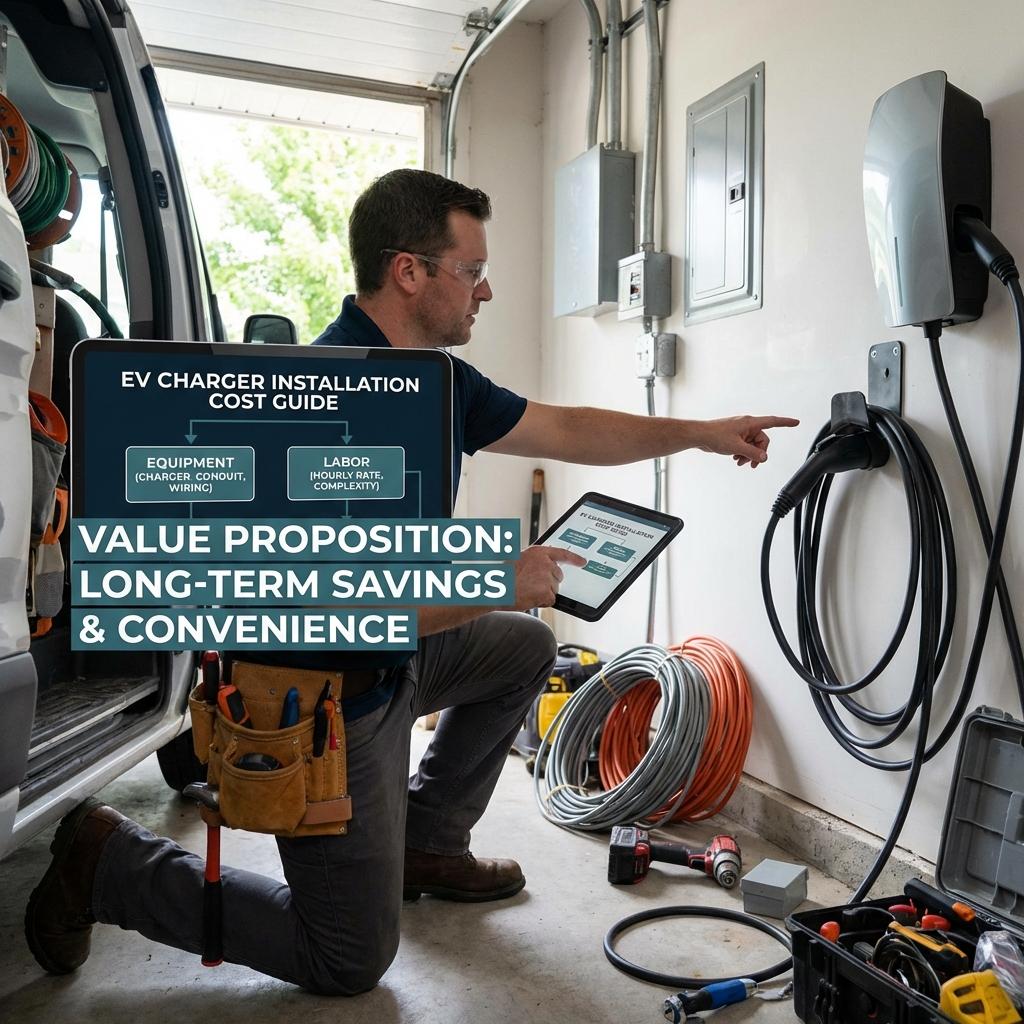
For EV charging, Rojas publishes $500–$1,800 for most Level 2 installations, with distance, charger model and panel work affecting the scope (page checked October 12, 2026). Its FAQ lists an additional $1,800–$3,500 if a panel upgrade is needed. Confirm hardware, circuit capacity, route, permits and any panel work before treating it as a complete quote. Mounting a charger on a suitable existing circuit is a different scope from a new circuit, trench or detached-garage run.
Sparkwise's guide lists $500–$1,500 for added dedicated circuits, depending on distance. This is its published example, not a price for replacing one outlet on an existing circuit. A new appliance circuit, a fixture replacement and troubleshooting a dead outlet should each be described separately.
For lights, fans and outlets, identify whether the existing wiring and box are suitable, who supplies the equipment, mounting height and access. For rewiring, specify the circuits or rooms, cable routes and responsibility for wall repairs. Backup-power quotes should separate a portable-generator connection from supplied automatic standby equipment, fuel work or battery integration. Without those details, a generic per-device or per-square-foot figure can leave out most of the work.
Free estimates, dispatch fees and diagnostic visits
Ask every company to distinguish a visit to quote known installation work from a working visit to investigate an unknown fault. If a dispatch or diagnostic fee is credited toward a repair, ask exactly which fee is credited and whether any minimum applies.
AJLE's policy: Estimates are free for every service. Scheduled estimate visits and written project prices are free. Diagnostic and repair work is a separately priced service. The $99 dispatch fee applies when you book a technician to come out for work. It is waived for members and is never charged for an estimate visit or written estimate. Troubleshooting is priced separately. The dispatch fee is separate from the diagnostic-and-repair time rate above. Send a project request and available photos to establish what can be priced in advance and what still needs an on-site assessment.
Permits and local conditions
A Fairfax mailing address can fall in the independent City of Fairfax or Fairfax County. Fairfax County's electrical permit guidance covers service and equipment replacement and explains that some condos and apartments follow a commercial permit path. Confirm the jurisdiction and property type rather than attaching a generic county surcharge.
Ask the electrician to identify which grounding, bonding, surge, disconnect and circuit-protection requirements apply to the equipment being changed. A downstream panel and service equipment are different. A competitor's code claim or generic list of components does not establish what your property requires.
Surge installation and breaker repair: compare the right scope
A surge device's retail price is not the installed project total. Compare the selected model, panel connection, labor, visit charges and any required corrections. Basic surge protection is already included in AJLE's published 200A panel package. Use the surge-protection cost guide to separate standalone installation, replacement and a panel-project upgrade.
A repeatedly tripping breaker is not automatically a failed part. Diagnosis, a confirmed compatible replacement and main-breaker or damaged-panel work have different scopes. Our breaker replacement cost guide explains device types, parts, shared diagnostic/repair labor and the questions to ask about the completed bill.
Seven questions before you book
- What does the first fee cover: travel, diagnosis, repair labor or a combination?
- What are the minimum, billing increments and crew size?
- Are parts extra, and will there be a separate repair charge after diagnosis?
- Which fees are credited or waived, and under what conditions?
- For installation work, what equipment, breakers, permits and coordination are included?
- What unknown conditions could change the scope, and how do I approve additional work?
- What warranty applies to this specific work and to manufacturer-supplied equipment?
AJLE installation warranty: Our quoted electrical installations include a five-year workmanship warranty from completion. Parts and equipment carry their manufacturer warranties. Other companies' warranty and credit terms should be checked directly. The electrical quote checklist explains how to make exclusions and additional work visible before deciding.
How to use the sources
These are a selected set of publicly available local examples, not a statistical market average. Some publishers describe regional guidance; others state their own service fees. We retain lower and higher figures, keep their scope beside them and do not assume missing details are excluded or improperly charged. Follow each linked source, then request a current written proposal for the same work at your property.