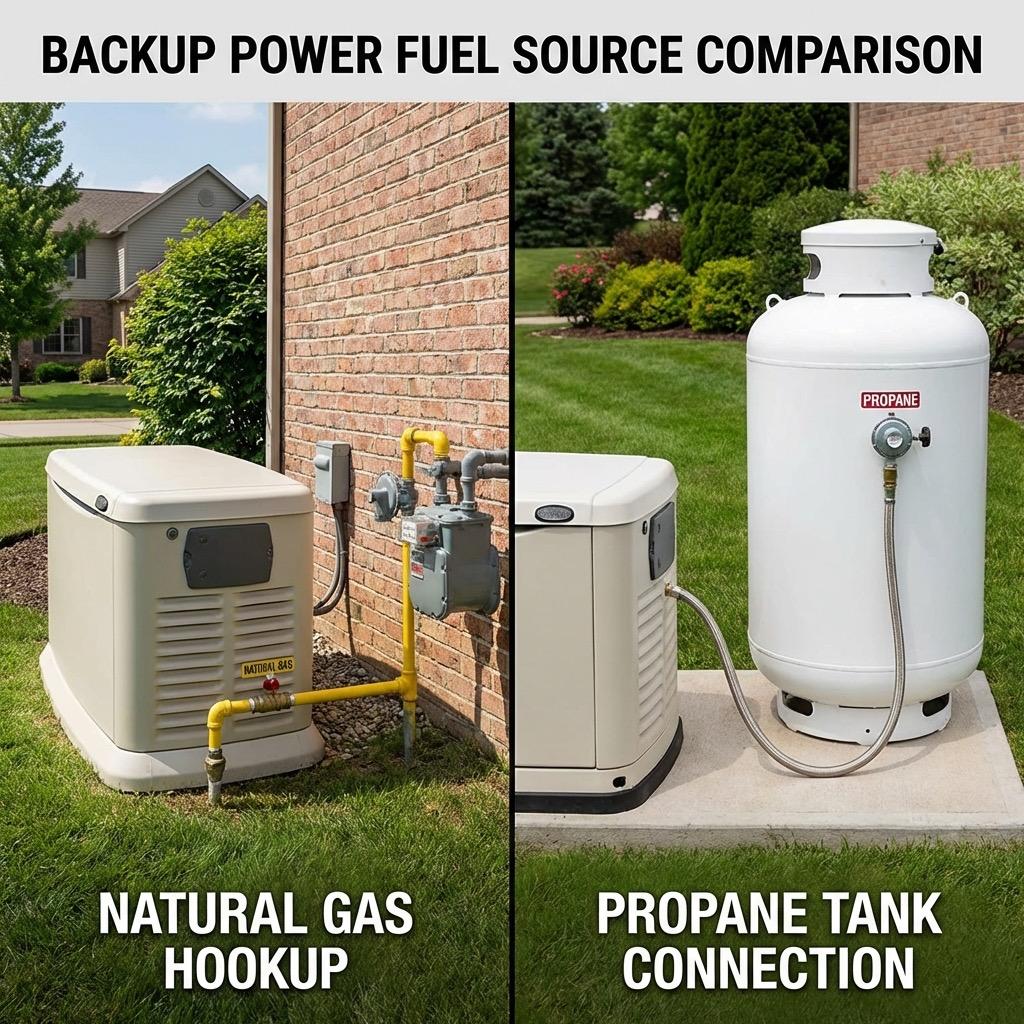

When the power goes out in Northern Virginia, you have two practical, code-compliant ways to keep the lights on without a permanent standby unit: a whole-home battery backup system, or a portable-generator hookup wired into your panel. Our team compares both approaches so you can choose the right fit for your home and budget.
Key Takeaways
- A battery power station stores energy without combustion exhaust. Placement, clearance, operating conditions, transfer behavior, load management, and supported circuits follow the exact listing, manufacturer instructions, and approved design.
- A portable-generator hookup is the lowest-cost way to power essentials during long outages, but you must run the generator outdoors and connect it through a transfer switch or interlock to prevent dangerous backfeed.
- Both approaches fall under NEC 702 (optional standby systems) and require an electrical permit for the hardwired transfer-switch or smart-panel work; neither requires a gas permit.
- Typical investment in Northern Virginia: a complete portable-generator hookup is $900–$2,500, including the inlet plus listed transfer or interlock equipment; a portable battery setup is $2,500–$6,000, and whole-home battery integration is $6,000–$15,000+. The portable generator itself is separate.
- Compare batteries for stored-energy convenience and compatible load management with portable-generator hookups for potentially longer runtime per dollar; generator runtime still depends on fuel supply, duty limits, maintenance, and operating conditions.
Two Ways to Back Up Your Home
Before comparing the options head to head, it helps to understand what each one actually is. A battery power station stores energy and discharges it during an outage. Compatible larger units can connect through listed transfer or load-management equipment to support selected circuits and recharge from the grid or compatible solar equipment. Battery systems have no combustion exhaust, but placement, clearance, operating sound, transfer time, load shedding, and supported circuits depend on the exact listing, manufacturer instructions, and design.
Planning Backup Power for Your Home?
Plan for the next outage with a listed portable-generator hookup or a compatible battery-backup installation. We evaluate the panel, selected loads, equipment, and transfer method before quoting the electrical scope. Call (571) 444-6886 to request an in-home assessment.
A portable-generator hookup is the electrical infrastructure that lets you safely power your home from a portable inverter generator. We install a manual transfer switch or a generator interlock kit at your panel, and usually an exterior generator inlet box (power inlet) on the wall. During an outage you run the portable generator outdoors, plug it into the inlet, and switch over your circuits. The transfer switch or interlock prevents the generator from backfeeding electricity onto the utility lines, which is both a code requirement and a safety must.
Battery Power Stations: Stored Energy Without Combustion Exhaust
Battery backup has matured quickly, and for many Northern Virginia homes it is now a convenient option. AJ Long Electric can include compatible listed battery equipment in an approved scope or connect customer-selected listed equipment; the written proposal identifies the exact equipment and responsibility boundaries. Capacity is measured in kilowatt-hours (kWh) of storage and watts of output, rather than the engine kW you would see on a fuel-burning unit.
Battery Backup Pros
- No combustion engine: The equipment avoids engine and exhaust noise, although inverters, contactors, and cooling fans may still make sound.
- No combustion exhaust: There is no gasoline or propane exhaust, but placement, clearances, ventilation, temperature, and unattended operation still follow the exact listing and manufacturer instructions.
- Defined transfer behavior: Compatible listed transfer or smart-panel equipment follows its documented operating sequence. Transfer time, load shedding, and supported circuits depend on the exact design.
- Recharges from grid or solar: Top the unit back up from a wall circuit, or pair it with solar for extended off-grid capability.
- Monitoring: Product-specific controls may show state of charge, output, and circuit status; features depend on the selected equipment and configuration.
- Low maintenance: No oil changes, no fuel stabilizer, no exercise cycles to keep up with.
Battery Backup Cons
- Finite stored energy: Capacity is limited by the kWh you buy. Once depleted, you must recharge from the grid or solar rather than simply adding more fuel.
- Higher upfront cost for whole-home coverage: Covering many circuits with a smart home panel and added battery modules pushes the project into the higher end of the range.
- Output limits: A single unit may not start large motor loads (like central air) without careful circuit selection and adequate output.
Portable-Generator Hookups: Long Runtime per Dollar
If you want the most backup runtime for the least upfront cost, a portable-generator hookup is hard to beat. The portable inverter generator itself is something you buy and store; AJ Long Electric installs the code-compliant connection so you can power your home safely.
Portable-Hookup Pros
- Lowest entry cost: A manual transfer switch or interlock kit is a modest investment compared with whole-home battery integration.
- Refuel for extended operation: Runtime depends on safe fuel availability, the generator's duty limits, maintenance, and operating conditions.
- Power where you need it: A transfer switch lets you select essential circuits (refrigerator, furnace blower, sump pump, a few outlets) to match your generator's output.
- Portable equipment: The generator can also serve a job site or a camping trip when it is not backing up your home.
Portable-Hookup Cons
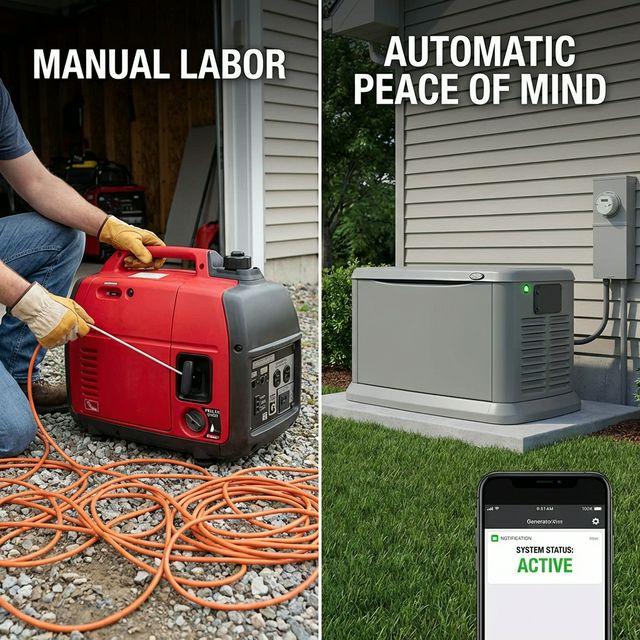
- Manual operation: You have to roll the generator out, fuel it, start it, and switch circuits over by hand at each outage.
- Serious carbon-monoxide risk: A portable generator must run outdoors, well away from windows, doors, and vents, and never in a garage or enclosed space, even with the door open.
- Noise and fumes: Even quiet inverter models produce engine noise and exhaust while running.
- Fuel storage and upkeep: You will need to store fuel safely and keep the generator maintained so it starts when you need it.
Carbon-Monoxide Safety: Never run a portable generator indoors, in a garage, or near windows, doors, or vents. Portable generators produce carbon monoxide, which is colorless, odorless, and deadly. Battery power stations have no combustion exhaust, but placement and operation must follow the exact listing and manufacturer instructions.
Head-to-Head Comparison
| Feature | Whole-Home Battery Backup | Portable-Generator Hookup |
|---|---|---|
| Typical installed cost (Northern Virginia) | $2,500–$6,000 portable; $6,000–$15,000+ whole-home | $900–$2,500, including inlet plus listed transfer/interlock; generator separate |
| Runtime | Limited by usable kWh, load, settings, temperature, and recharge conditions | Depends on fuel supply, duty limits, maintenance, and operating conditions |
| Transfer | Transfer time, load shedding, and supported circuits depend on compatible listed equipment and design | Manual switchover by hand |
| Noise | No combustion engine; inverter, contactor, and cooling-fan sound varies by equipment | Engine noise while running |
| Combustion exhaust | None; placement still follows listing and manufacturer instructions | Carbon-monoxide risk; run outdoors only |
| Sizing | kWh capacity + watt output | Portable generator wattage you provide |
| Recharge / refuel | Grid or solar recharge | Gasoline or propane refuel |
| Maintenance | Minimal | Oil, fuel, and start-up checks |
| Monitoring | Product-specific controls, when included | Product-specific; many portable units have none built in |
| Permit | Electrical permit (no gas permit) | Electrical permit (no gas permit) |
Northern Virginia Note: Ice storms and severe summer thunderstorms can cause extended outages across Fairfax, Loudoun, and Prince William counties. A battery may support documented loads through shorter outages, while a portable-generator hookup can extend operation when safe fuel, duty limits, maintenance, and operating conditions allow. Some homeowners plan for both under a defined load-management design.
Cost, Runtime, and Maintenance
Upfront Cost
A complete portable-generator hookup is $900–$2,500, including the inlet plus listed transfer or interlock equipment; the portable generator is purchased separately. A portable battery setup is $2,500–$6,000, while whole-home battery integration is $6,000–$15,000+. These are planning ranges, not guarantees; the final quote depends on panel work, circuit count, capacity, route, and listed equipment.
Runtime
Stored battery energy is finite and runtime depends on usable kWh, actual loads, equipment settings, temperature, and recharge conditions. A portable generator may extend operation, but its runtime depends on safe fuel supply, duty limits, maintenance, load, weather, and other operating conditions.
Noise and Maintenance
Battery stations have no combustion engine, though inverter, contactor, and cooling-fan sound varies by equipment. A portable generator produces engine noise and exhaust whenever it runs, and it needs routine maintenance, safe fuel storage, and periodic checks.
Pro Tip: Whichever path you choose, the code-compliant connection is what keeps your home and the utility line workers safe. A transfer switch or interlock kit prevents your power source from backfeeding electricity onto the grid. Battery integration and portable-generator hookups both fall under NEC 702 for optional standby systems, and both need an electrical permit and inspection in every Northern Virginia jurisdiction. Neither requires a gas permit.
Which Should You Choose?
Choose Whole-Home Battery Backup If:
- You want stored-energy backup without combustion exhaust
- Your site can meet the selected equipment's placement, clearance, ventilation, and operating requirements
- You want app monitoring and the option to recharge from solar
- Most of your outages are short to moderate in length
Choose a Portable-Generator Hookup If:
- You want the lowest upfront cost to power your essentials
- You need the longest possible runtime through multi-day outages
- You do not mind manual setup, refueling, and outdoor operation
- You already own or plan to buy a portable inverter generator
Professional Installation Matters Most
Whichever approach you choose, a safe and code-compliant connection is the most important factor. A correctly sized transfer switch or smart home panel, proper circuit selection, and a permitted, inspected installation will protect your home and your family for years. The U.S. Department of Energy outlines the safety fundamentals of emergency backup power for the home, and in Northern Virginia an electrical permit and inspection are required for the hardwired transfer-switch or smart-panel work in every county.
AJ Long Electric can supply compatible battery-backup equipment or connect customer-selected listed equipment, and we install portable-generator hookups without selling the generator itself. Contact us to request a site assessment and project-specific quote.