
For businesses across Northern Virginia and the greater DMV region, power outages mean more than inconvenience -- they mean lost revenue, spoiled inventory, missed deadlines, and damaged customer relationships. With severe summer thunderstorms, ice storms, and aging infrastructure contributing to outages in Fairfax, Loudoun, and Prince William counties, a comprehensive backup power strategy is not a luxury but a necessity for protecting your bottom line.
Key Takeaways
- The average cost of a one-hour power outage for a medium business is $10,000-$50,000 when all factors are considered.
- A customer-provided portable generator may support documented loads through compatible listed transfer equipment. Battery equipment has no combustion exhaust, but sound, placement, clearance, duration, and supported loads depend on the exact listing and approved design.
- UPS systems can provide short-duration bridging for supported loads when their topology, transfer specification, battery condition, and installation match the equipment requirements. Medical equipment also requires device-manufacturer compatibility and a facility emergency plan.
- Combined battery/UPS-and-generator systems provide the most comprehensive protection and are standard for data centers and healthcare facilities.
- Any backup power connected to building wiring requires permits, a transfer switch to prevent backfeed, and ongoing testing.
The True Cost of Power Outages
Before investing in backup power, understanding the real costs of outages helps justify the investment:
Need a Commercial Electrician?
From fleet EV charging to panel upgrades and full tenant build-outs, our licensed team handles commercial electrical projects across Northern Virginia with minimal disruption to your operations. Call (571) 444-6886 to discuss your project.
- Lost Revenue: Every hour without power is an hour without sales for retail and hospitality businesses
- Spoiled Inventory: Restaurants, grocers, and pharmacies can lose thousands in perishable goods
- Data Loss: Unexpected shutdowns can corrupt data and damage IT equipment
- Productivity Loss: Office workers cannot work without power; hourly costs multiply by employee count
- Security Compromise: Alarm systems, cameras, and access controls may fail
- Reputation Damage: Closed businesses and missed commitments erode customer trust
- Recovery Time: Systems require time to restart and verify after outages
Studies estimate the average cost of a one-hour outage for a medium business at $10,000-50,000 when all factors are considered.
Local Reality Check: In 2023, Northern Virginia experienced several widespread outages due to severe thunderstorms and utility infrastructure failures. Businesses along the Route 28 corridor, in Tysons, and across Loudoun County reported multi-hour outages that cost restaurants thousands in spoiled food and forced retail stores to close during peak shopping hours. These events are not rare -- they happen every year.
Types of Commercial Backup Power Systems
Businesses have several options for backup power, each suited to different needs and budgets:
Portable Generators with a Commercial Transfer Switch
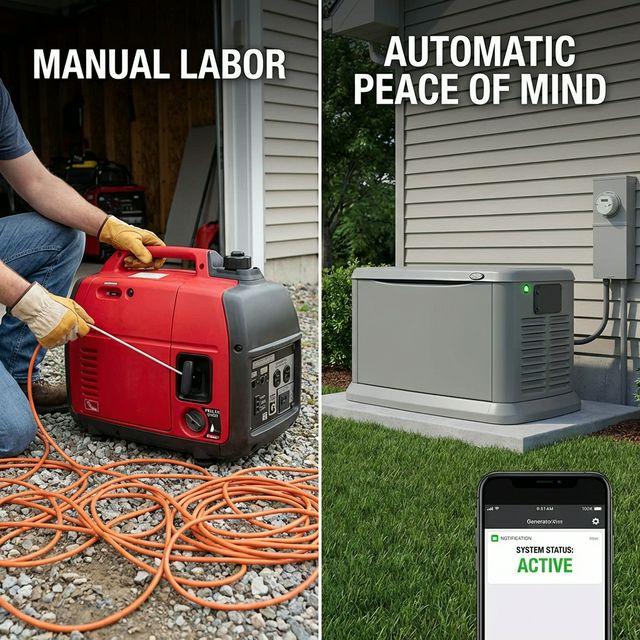
A portable inverter generator, connected to your building through a manual transfer switch or interlock, can power critical circuits during an outage. It is the most economical backup option for many small businesses:
- Operation: The generator runs outdoors and connects through a transfer switch and exterior inlet box; the transfer switch prevents dangerous backfeed onto utility lines.
- Safety: Portable generators emit carbon monoxide and must be run outside, well away from doors, windows, and air intakes—never indoors or in a loading dock.
- Sizing: Match the generator's watt output to your critical circuits (refrigeration, POS, key lighting). Larger commercial loads quickly outgrow a portable unit.
- Cost: A commercial-grade manual transfer switch or interlock and inlet box typically runs a few thousand dollars installed, plus the generator itself.
Commercial Battery Backup Systems
Battery power stations and larger battery energy storage systems have no combustion exhaust. Placement, clearance, operating conditions, transfer behavior, and supported loads follow the exact equipment listing, manufacturer instructions, and approved design:
- No combustion exhaust: Battery equipment has no fuel-burning engine, but fan, relay, and inverter sound plus placement, clearance, ventilation, temperature, and operating limits vary by exact equipment.
- Sizing: Rated in kilowatt-hours (kWh) of capacity and watts of output; scale capacity to the runtime your critical loads require.
- Integration: Compatible listed systems may hardwire through transfer or load-management equipment. Detection, transfer timing, restart behavior, selected loads, and supported recharge inputs depend on the exact equipment, settings, manufacturer instructions, and approved design.
- Best fit: Critical electronics, refrigeration, and essential lighting during the most common shorter outages, often paired with a UPS or a portable generator for extended events.
Uninterruptible Power Supplies (UPS)
UPS systems provide short-duration battery bridging according to the selected topology and transfer specification:
- Transfer Performance: Online, line-interactive, and standby UPS designs have different transfer characteristics; verify the exact specification against each supported load.
- Power Conditioning: They filter and regulate power, protecting equipment from surges, sags, and electrical noise.
- Runtime: Battery-only runtime is typically 5-30 minutes, intended to bridge until generators start or allow graceful shutdown.
- Applications: Servers, POS systems, and compatible electronics. Medical equipment requires device-manufacturer compatibility, appropriate facility engineering, and an emergency plan rather than reliance on a continuity promise.
Combined Battery/UPS and Generator Systems
The most comprehensive protection combines technologies:
- A compatible UPS or battery system bridges supported loads according to its documented transfer specification and available capacity
- A battery system may support documented loads within its usable capacity; fan and inverter sound vary by equipment, load, and operating state
- A portable or larger generator extends runtime for the longest events
- The battery/UPS conditions and bridges power, protecting sensitive equipment
This layered approach is used where a documented continuity target is required. The design, testing, maintenance, supported loads, and emergency procedures must match the facility and equipment requirements.
Determining Your Backup Power Needs
Sizing a backup power system requires careful analysis of your specific operations:
Critical Load Assessment
Identify which systems absolutely must remain powered:
- Refrigeration and freezers (food, medicine, samples)
- IT infrastructure (servers, networking, phone systems)
- Point-of-sale systems
- Security systems
- Essential lighting
- HVAC for temperature-sensitive environments
- Manufacturing or production equipment
Load Calculation
Each critical load is measured in watts or kilowatts. Starting loads (for motors) can be 3-6 times running loads and must be considered in generator sizing.
Runtime Requirements
How long must you operate on backup power? Consider typical outage durations in your area, fuel availability for generators, and business continuity requirements.
Pro Tip: When sizing backup power, do not just calculate your current loads -- account for growth over the next 5-10 years. Backup power is a long-term investment, and adding capacity later is far more expensive than sizing correctly upfront. Most Northern Virginia businesses we work with benefit from a system sized about 25% above current calculated critical loads.
Backup Power Installation Requirements
Connecting backup power to your building involves multiple considerations beyond the equipment itself:
Location and Placement
- A portable generator must run outdoors with adequate clearance from doors, windows, and air intakes because of carbon monoxide
- Battery equipment has no combustion exhaust, but permitted location, clearance, ventilation, temperature, and fire-separation requirements follow the exact listing, manufacturer instructions, and AHJ-approved design
- Service access for maintenance and inspection
- Compliance with noise ordinances and setback requirements for any outdoor equipment
Electrical Infrastructure
Installation includes:
- A transfer switch rated for your service size to prevent backfeed onto utility lines
- For a portable generator, an exterior inlet box and rated connection cord
- Connection panels and disconnects
- Conduit runs between the equipment, transfer switch, and main electrical
- Proper grounding and bonding per NEC Article 250
Permits and Inspections
Backup power installations require electrical permits and inspections. Battery and transfer-switch work needs an electrical permit but no gas permit. Depending on size and location, zoning approval, fire marshal review, and environmental permits may also be needed for outdoor equipment. In Fairfax and Loudoun counties, equipment placement and noise levels receive particular scrutiny.
Maintenance and ROI
Portable Generator and Battery Maintenance
Backup power systems require regular attention to ensure reliability when you need them most:
- Run a portable generator under load periodically and keep its fuel fresh and stabilized
- Keep a battery system charged, within its rated temperature range, and on current firmware
- Verify transfer switch and inlet box operation
- Test that selected critical circuits energize as expected
UPS Maintenance
- Battery testing and monitoring
- Replacement every 3-5 years (varies by type)
- Cooling system maintenance
- Firmware updates
Financing and ROI
Any financing or operating-cost comparison should use the written project scope, current financing terms, documented loads and duration, equipment life and capacity loss, maintenance, rates, and the facility's own outage history and consequences. No payback period, insurance outcome, or avoided-loss result is guaranteed.
AJ Long Electric Commercial Backup Power Services
AJ Long Electric plans commercial backup-power electrical scopes throughout Northern Virginia, including connection equipment for customer-provided portable generators, compatible listed battery integration, and UPS-supported loads. The scope starts with a critical-load assessment and documents equipment responsibility, transfer behavior, supported duration, permitted placement, maintenance requirements, and the applicable permit path.
Contact AJ Long Electric to discuss backup power solutions that protect your business from costly outages. We serve businesses across Fairfax, Loudoun, Prince William, and Arlington counties.