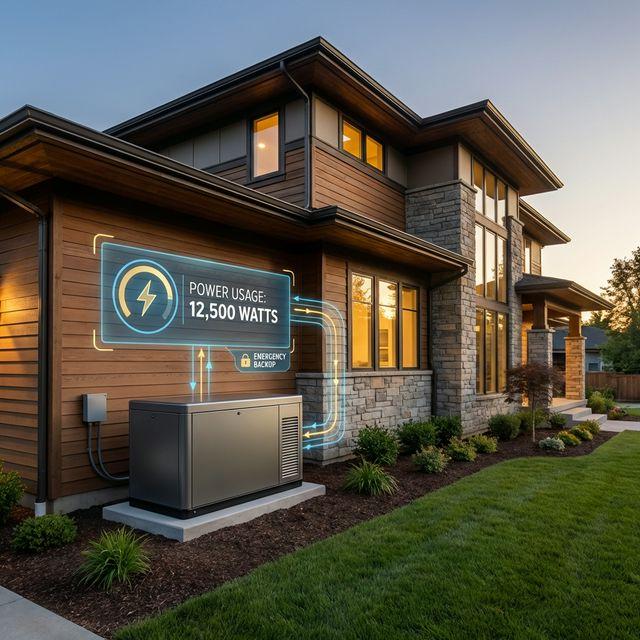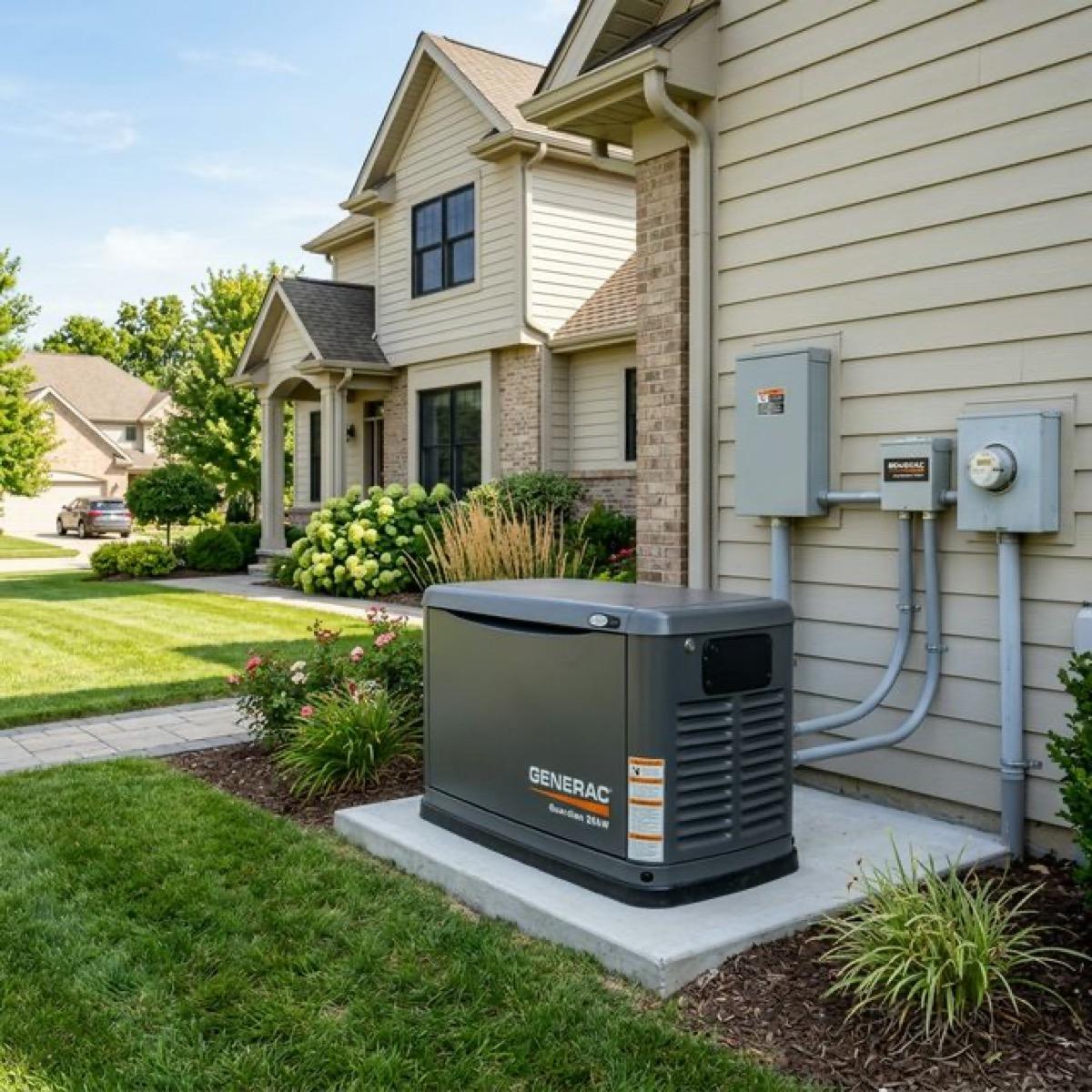

Power outages in Northern Virginia are more common than many homeowners realize. From summer thunderstorms and hurricanes to winter ice storms and the occasional grid failure, losing electricity can disrupt your life for hours or even days. For most DMV area homeowners, two practical backup-power options cover that gap: a portable generator connected through a transfer switch, or a battery power station. AJ Long Electric installs the safe, code-compliant infrastructure for both.
Key Takeaways
- A portable generator must connect through listed transfer or interlock equipment and an inlet, never a backfeed cord
- The published $900–$2,500 hookup range covers the inlet plus listed transfer or interlock equipment; the portable generator is purchased separately
- A battery power station plus install typically runs $2,500–$6,000, while whole-home battery integration runs $6,000–$15,000+
- Hardwired transfer and smart-panel work may require an electrical permit under the adopted code and local rules
AJ Long Electric installs transfer switches, interlock kits, generator inlet boxes, and compatible listed battery integration throughout Fairfax, Loudoun, Arlington, and Prince William counties. For battery projects, the approved scope can include compatible listed equipment or connect customer-selected listed equipment; the written proposal identifies the exact equipment and responsibility boundaries.
Why Set Up Home Backup Power?
Before diving into the details, let's consider why a backup-power setup is worth the investment for Northern Virginia homeowners:
Planning Backup Power for Your Home?
Plan for the next outage with a listed portable-generator hookup or a compatible battery-backup installation. We evaluate the panel, selected loads, equipment, and transfer method before quoting the electrical scope. Call (571) 444-6886 to request an in-home assessment.
Planned Support for Essential Loads
- Climate Control: Maintain heating in winter and air conditioning during brutal DMV summers
- Food Preservation: Keep refrigerators and freezers running, protecting hundreds of dollars in food
- Medical Equipment Planning: Confirm backup-power compatibility with the device manufacturer and maintain the emergency plan recommended by the care team; no optional backup system guarantees uninterrupted power
- Security Systems: Maintain home security, cameras, and lighting
- Sump Pumps: Critical in areas prone to basement flooding
- Remote Work: Stay connected and productive during outages
Protecting Your Home and Routine
A well-planned backup setup keeps essentials running so an outage stays a minor inconvenience rather than an emergency. In the competitive Northern Virginia real estate market, a clean, code-compliant transfer switch or a permanently integrated battery system can also be a selling point that sets your home apart.
Peace of Mind
A documented list of supported loads helps you plan for refrigeration, sump pumps, communications, and selected circuits without improvising an unsafe connection in the dark. For medical equipment, confirm device-manufacturer compatibility and keep the emergency plan recommended by the care team; optional backup power does not guarantee uninterrupted operation.
The Two Backup-Power Options We Install
AJ Long Electric does not sell or install permanent standby generators. We focus on portable-generator hookups and compatible listed battery integration. The right approach depends on the documented loads, equipment listing, placement, transfer design, outage plan, and budget.
Option 1: Portable Generator Hookups
A portable generator is a smaller, mobile unit, typically a portable inverter generator, that you run outdoors during an outage. AJ Long Electric installs the electrical infrastructure that lets you connect it to your home safely and legally: a manual transfer switch, a generator interlock kit, and an exterior generator inlet box (power inlet). You never plug a generator directly into a wall outlet, that creates dangerous backfeed onto the utility lines and can injure or kill line workers.
Pros:
- Lower upfront cost than whole-home battery integration
- One generator can also serve camping, job sites, and other uses
- A transfer switch or interlock lets you power selected circuits cleanly and safely
- Runtime can be extended by refueling, subject to safe fuel availability, the generator's duty limits, maintenance, and operating conditions
Cons:
- Requires manual setup each outage: roll out the generator, connect the inlet, and switch over
- Runs on gasoline and produces carbon monoxide, so it must always run outdoors
- Limited power capacity, typically 3,000-10,000 watts depending on the unit
- Generator must be stored, fueled, and maintained between outages
Critical Safety Warning: Never operate a portable generator inside your home, in your garage, or in any enclosed space, and never near open windows or doors. Carbon monoxide from generator exhaust is odorless and deadly. Always run a portable generator outdoors, at least 20 feet from the house, with the exhaust directed away from windows and doors. Install carbon monoxide detectors on every level of your home. Equally important: a portable generator must connect through a transfer switch or interlock kit, never plugged into the home directly, to prevent backfeed onto utility lines.
Option 2: Battery Power Stations
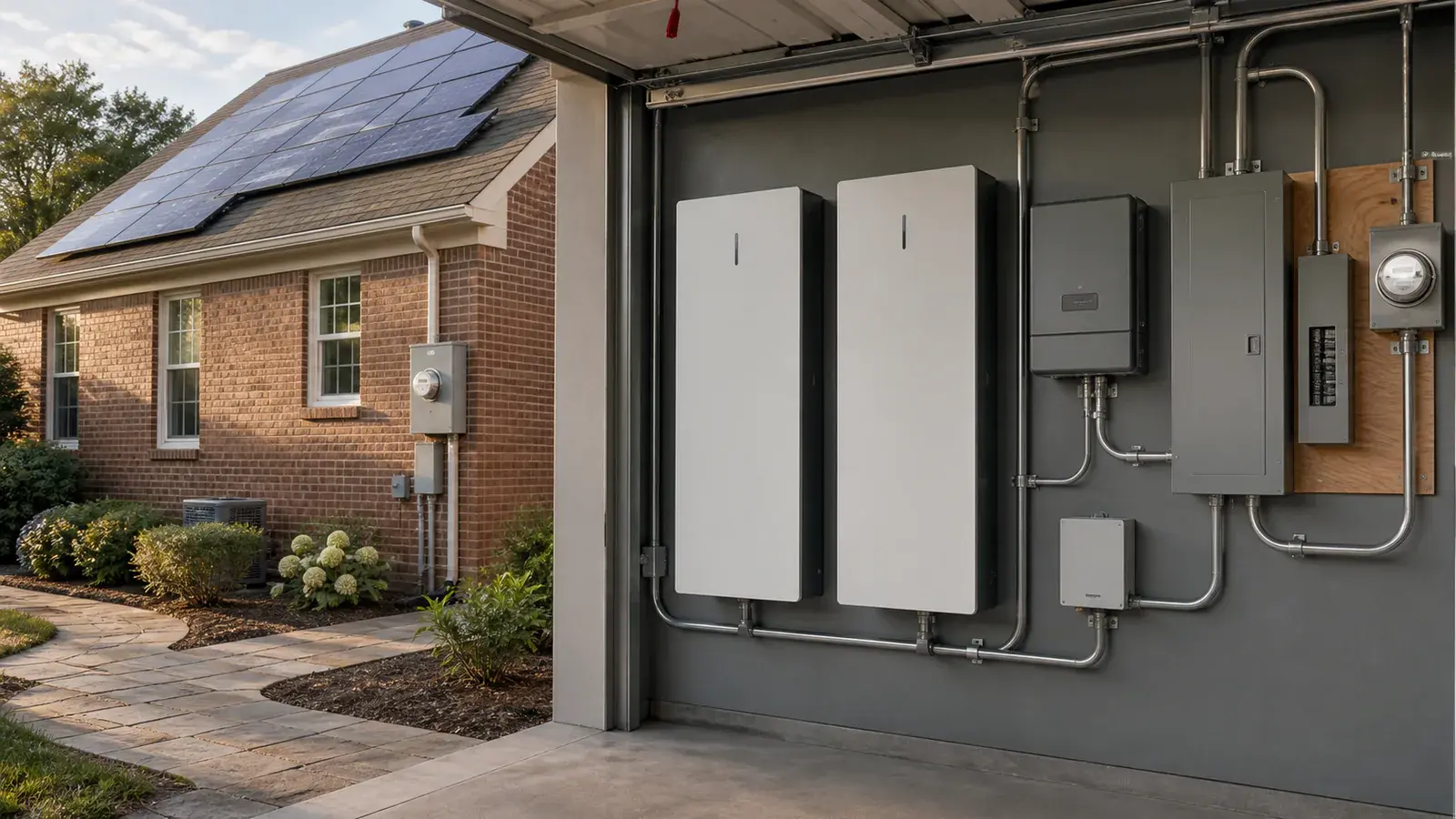
AJ Long Electric can include compatible listed battery equipment in the approved scope or connect customer-selected listed equipment. The written design identifies the selected loads, usable capacity, running and starting output, recharge path, compatible transfer or load-management equipment, placement requirements, and responsibility boundaries.
Pros:
- No combustion engine; inverter and cooling equipment may still produce operating sound
- No combustion exhaust; placement, clearances, ventilation, and operating conditions still follow the exact listing and manufacturer instructions
- Recharge from the grid or pair with solar
- App monitoring lets you track charge level and consumption from your phone
- Compatible larger systems can connect through listed transfer or load-management equipment to support documented circuits; transfer behavior depends on the exact design
Cons:
- Finite stored capacity, measured in kWh, so very long outages may need recharging from solar or the grid
- High-demand loads like central AC require a larger system or careful circuit selection
- Whole-home integration costs more than a basic portable-generator hookup
Many Northern Virginia homeowners compare a battery power station for selected essential circuits with a portable-generator hookup for longer outages. We help document capacity, budget, listed placement, compatible transfer equipment, and the loads the final design can support.
Sizing Your Backup Power
Proper sizing is crucial. An undersized setup won't carry your essential loads; an oversized one wastes money. Here's how to determine the right capacity for your home:
Understanding the Two Sizing Languages
Portable generators are rated in watts (running watts and higher starting watts). Battery power stations are rated two ways: storage capacity in kilowatt-hours (kWh), which helps determine runtime, and continuous output in watts, which limits what can operate at once. Compare the exact listed equipment against documented running and starting loads, placement requirements, transfer behavior, temperature limits, and recharge conditions.
Calculating Your Power Needs
To properly size a generator, you need to identify what you want to power during an outage:
Essential Loads (Critical)
- Refrigerator: 200-400 watts running, 1,200-2,000 watts starting
- Sump pump: 800-1,200 watts running, 2,000+ watts starting
- Furnace/boiler: 500-700 watts
- Lighting: varies by bulb type and quantity
- Well pump (if applicable): 1,000-2,000 watts
Comfort Loads
- Central air conditioning: 3,000-6,000 watts depending on size
- Electric water heater: 4,000-5,000 watts
- Electric dryer: 4,000-5,000 watts
- Electric range: 3,000-8,000 watts
Convenience Loads
- Television: 100-400 watts
- Computer: 100-400 watts
- Microwave: 1,000-1,500 watts
- Garage door opener: 500-700 watts
Common Backup Capacities for Northern Virginia Homes
- Single battery power station (around 2-4 kWh, ~3,000+ watts output): Selected essentials such as a refrigerator, a few outlets, lights, and internet, subject to the unit's listing, placement requirements, starting-current limits, and actual load
- Stacked battery system (several kWh, higher output): Most essential circuits plus some comfort loads, hardwired to the panel through a transfer switch
- Whole-home battery integration: Compatible listed transfer or load-management equipment supports documented circuits according to the approved design; transfer time and load shedding vary by equipment and configuration
- Portable generator (3,000-10,000 watts) through a transfer switch or interlock: Essential and some comfort circuits during longer outages, with the generator running outdoors
For most Northern Virginia single-family homes in the 2,000-3,500 square foot range, a stacked battery system or a portable-generator hookup comfortably covers essential circuits; central air conditioning is a high-demand load that needs careful circuit selection or a larger system.
Fuel, Recharging, and Carbon-Monoxide Safety
The two options differ most in how they're powered and in their safety profile.
Portable Generators (Gasoline)
Considerations:
- Run on gasoline you refuel during the outage, so keep a safe supply on hand
- Produce carbon monoxide and must always run outdoors, at least 20 feet from the house, never in a garage or near windows
- Must connect through a transfer switch or interlock kit to prevent backfeed onto utility lines
- Require storage and occasional maintenance between outages
Battery Power Stations (Stored Electricity)
Considerations:
- No combustion fuel or exhaust; placement, clearances, ventilation, and operating conditions still follow the exact listing and manufacturer instructions
- Recharge from the grid before a storm or from solar panels during a prolonged outage
- No combustion engine, although inverter and cooling equipment may still make operating noise
- Finite stored capacity in kWh, so very long outages may require a recharge source
Recommendations for Northern Virginia
If you want backup without combustion exhaust or refueling, compare listed battery equipment by usable capacity, supported loads, placement instructions, transfer design, and recharge path. For occasional multi-day outages, a portable-generator hookup may extend runtime, but actual operation depends on safe fuel supply, duty limits, maintenance, and conditions. Some homeowners use both approaches under a documented load plan.
Good to Know: A battery power station has no combustion exhaust, but that does not make every location suitable. Follow the exact listing and manufacturer instructions for placement, clearance, ventilation, temperature, charging, and unattended operation. A portable generator produces carbon monoxide and must run outdoors, away from windows, doors, and vents, with the exhaust pointed away from the house.
The Installation Process
Professional installation involves several steps and typically takes part of a day to a couple of days of on-site work, plus additional time for permits and inspections.
Step 1: Site Assessment and Planning
A qualified electrician evaluates your home to determine:
- Which circuits you most want to keep powered during an outage
- Electrical panel capacity and condition
- The best location for an inlet box, transfer switch, interlock kit, or battery power station
- For a portable generator, a safe outdoor staging spot away from windows and doors
- Local code requirements under NEC 702 for optional standby systems
At AJ Long Electric, we provide comprehensive site assessments and detailed proposals before any work begins.
Step 2: Permits
Hardwired backup-power work requires an electrical permit in Northern Virginia jurisdictions. Because we install no fuel lines or tanks, no gas permit is needed.
- Electrical permit: For transfer switch, interlock kit, inlet box, or battery smart-panel connections
- No gas permit: Battery and portable-generator hookups involve no gas piping, so a gas permit does not apply
Permit requirements by jurisdiction:
- Fairfax County: Electrical permit required for hardwired transfer-switch and smart-panel work
- Loudoun County: Similar requirements; HOA approval may be needed for any exterior equipment
- Arlington County: Compact lots may affect placement of an inlet box or wall-mounted battery
- Prince William County: Standard electrical permit requirements; many rural properties have more placement flexibility
We handle all permit applications and coordinate inspections as part of our installation service.
Step 3: Mounting the Equipment
No concrete pad or fuel tank is needed. Depending on your option, we mount:
- An exterior generator inlet box (power inlet) on a wall near where you'll stage the portable generator
- A wall-mounted battery power station or smart home panel in a suitable interior or protected location
- A transfer switch or interlock kit at or beside your existing electrical panel
Equipment placement follows the exact listing and manufacturer instructions for access, clearances, ventilation, temperature, environmental exposure, and cable routing.
Step 4: Transfer Switch or Interlock Installation
The transfer switch or interlock kit is the critical safety component that:
- Isolates your home from the utility grid before backup power is applied
- Prevents dangerous backfeed onto utility lines, which protects line workers and your home's wiring
- Lets you transfer selected circuits to generator or battery power
- Returns those circuits to utility power safely when the grid comes back
An interlock kit is a code-compliant, lower-cost alternative that physically prevents the main breaker and the backup breaker from being on at the same time. Compatible listed transfer or smart-panel equipment can manage a battery system according to its documented operating sequence; transfer time, load shedding, and supported circuits depend on the exact design. All of this is installed at your electrical panel and must be sized and configured by a licensed electrician.
Step 5: Inlet Box or Battery Connection
For a portable-generator hookup, we wire the exterior inlet box to the transfer switch or interlocked breaker so you can connect your generator with a single weather-rated cord. For a battery power station, we connect the unit to the transfer switch or smart home panel and configure the circuits it will power.
- Correctly sized conductors for the load
- Weather-rated inlet and connectors for outdoor use
- Proper grounding and bonding
- Compliance with all electrical codes
Step 6: Final Connection and Configuration
The system is connected and, for a battery, configured for the circuits you selected:
- Backup circuits assigned and labeled
- Battery charging set from grid and, if applicable, solar
- App monitoring set up on your phone for battery systems
Step 7: Testing and Commissioning
After installation, comprehensive testing ensures everything works correctly:
- Simulated outage and transfer test
- Verification that backfeed protection works as intended
- Battery discharge and recharge check
- Homeowner training on safe operation and, for portable generators, carbon-monoxide safety
Step 8: Inspection
County inspectors verify the installation meets all code requirements. The typical inspection is:
- Electrical inspection of the transfer switch, interlock, inlet, or smart-panel work
- Final inspection
Backup Power Costs in Northern Virginia
Costs vary with the option you choose and your home's panel. The figures below are typical estimates for the Northern Virginia market, not guarantees:
Portable Generator Hookups
- Portable-generator hookup: typically $900–$2,500 for the inlet plus listed transfer or interlock equipment; generator purchased separately
Battery Power Stations
- Battery power station plus install (portable-unit setups): typically $2,500 - $6,000
- Whole-home battery integration: typically $6,000 - $15,000+ depending on capacity, supported circuits, transfer equipment, placement, and route
Additional Costs
- 200-amp electrical panel upgrade (if needed): $3,500–$7,500
- Permit: $200 - $600
The portable generator itself is purchased separately by the homeowner. For battery projects, AJ Long Electric can include compatible listed equipment in the approved scope or connect customer-selected listed equipment; the written proposal identifies the exact equipment and responsibility boundaries.
Maintenance and Upkeep
Both options need far less upkeep than a permanent standby unit, but a little attention keeps them ready.
Battery Power Stations
- Keep the unit charged and check charge level periodically through the app
- Store and operate it only where its listing and manufacturer instructions permit, including required clearance, ventilation, temperature, and environmental conditions
- Run a periodic discharge-and-recharge cycle per the manufacturer's guidance
Portable Generator Hookups
- Start and run your portable generator periodically and keep fresh, stabilized fuel on hand
- Inspect the inlet box, cord, and connectors for wear or damage before storm season
- Confirm the transfer switch or interlock operates smoothly
Choosing Listed Battery Equipment
Compare equipment by usable capacity, continuous and starting output, listing, transfer method, supported loads, mounting location, recharge sources, warranty, and monitoring features. AJ Long Electric can include compatible listed equipment in the approved scope or connect customer-selected listed equipment; the written proposal identifies the exact product and responsibility boundaries without implying an unsupported manufacturer relationship.
Frequently Asked Questions
Can I just plug a portable generator into a wall outlet?
No. Plugging a generator into an outlet causes backfeed, which sends power onto the utility lines and can electrocute line workers and damage your home's wiring. A portable generator must connect through a manual transfer switch, interlock kit, or inlet box installed by a licensed electrician.
Where can a battery power station be used?
Battery power stations have no combustion exhaust, but placement is product-specific. Follow the exact equipment listing and manufacturer instructions for clearances, ventilation, temperature, charging, and unattended operation. Portable generators produce carbon monoxide and must always run outdoors away from windows, doors, and vents.
How long will a battery power station run my home?
Runtime depends on the unit's kWh capacity and how much you're powering. A single station can run essential loads like a refrigerator, lights, and devices for many hours; stacked or whole-home systems run longer and can recharge from solar or the grid during the outage.
Can I install a transfer switch or battery system myself?
No. Hardwired transfer-switch, interlock, inlet-box, and smart-panel work requires an electrical permit, must meet code, and should only be performed by licensed professionals. Improper work can cause fire, backfeed hazards, or electrocution.
Do I need a gas permit for any of this?
No. Neither a portable-generator hookup nor a battery power station involves gas piping, so no gas permit is required. Hardwired transfer-switch and smart-panel work does require an electrical permit, which we handle.
Does NEC 702 apply to a battery and transfer-switch install?
Yes. NEC Article 702 governs optional standby systems, which includes battery backup and portable-generator transfer-switch installs. We design and install to that standard.
Request a Backup Power Assessment
AJ Long Electric installs portable-generator hookups and compatible listed battery integration throughout Northern Virginia, including Fairfax, Loudoun, Arlington, Prince William, and Fauquier counties. The written battery proposal identifies the supported loads, transfer behavior, placement requirements, exact equipment, and responsibility boundaries.
Call AJ Long Electric at (571) 444-6886 to request an on-site backup-power assessment. Estimates are free. The $99 dispatch fee applies only when we arrive prepared to complete a project, provide the price on site, and you decline the work. It covers travel and preparation. It is waived when you accept the on-site quote and for active members. It is not charged for a scheduled estimate visit. The written proposal documents the loads, selected equipment, placement, transfer design, responsibility boundaries, and project-specific price.
From assessment through installation, AJ Long Electric is your trusted partner for home backup power in Virginia. Call (571) 444-6886 or contact us online to get started!