
Key Takeaways
- Never feed a generator into a household receptacle or use a male-to-male cord.
- Panel compatibility and source capacity are separate design checks.
- Neutral switching and bonding must match the generator and transfer equipment.
- Automatic operation and whole-house connections do not guarantee enough power for every load.
- Battery integration requires the listed system's instructions, not a generic generator diagram.
First distinguish direct appliance use from home-wiring integration
Using a portable source's own outlets for suitable equipment is different from connecting it to the building's wiring. An installed inlet and approved transfer arrangement establish the intended connection for a house. Turning off a main breaker without approved transfer equipment is not an equivalent safeguard against backfeeding utility lines.
Need a Panel Upgrade?
Outdated or overloaded electrical panels can present safety and capacity concerns. Our team evaluates 200-amp upgrades throughout Northern Virginia and confirms scheduling after reviewing the property. Call (571) 444-6886 to get started.
The CPSC portable-generator guidance warns against feeding a generator through a wall outlet. Such a connection can endanger occupants and utility workers. Have a qualified electrician design the installation and follow the generator instructions for operation.
Manual transfer switch, interlock, or automatic system?
| Approach | What it can do | What must be checked |
|---|---|---|
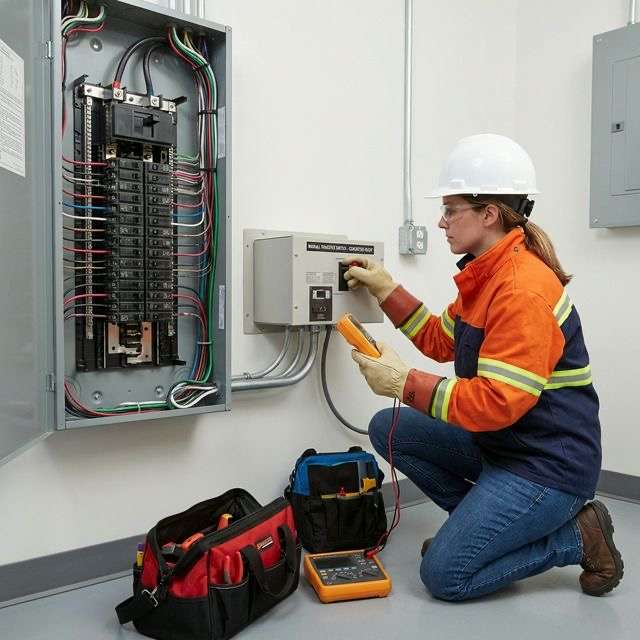
| Manual transfer equipment for selected circuits | Lets an operator supply designated loads from the alternate source. | Ratings, neutral arrangement, circuit selection and source capacity. |
| Listed or otherwise approved panel interlock arrangement | Mechanically prevents the utility and generator supply breakers from being on together in the approved configuration. | Exact panel compatibility, breaker position and retention, inlet, circuit protection and operating instructions. |
| Automatic transfer or integrated backup system | Transfers compatible loads according to the system's controls. | Source/start controls, transfer ratings, service-equipment role and load management. |
Not every transfer switch is automatic, and not every selected-circuit panel has the same circuit count. An interlock approved for one panel is not interchangeable with a similar-looking model. A system that can connect the entire panel may still require the operator or automatic controls to limit simultaneous loads.
What the panel assessment includes
The electrician identifies the service disconnect, panel condition, available listed equipment, suitable positions and wiring space, existing feeders, and any other sources such as solar. A panel replacement may be appropriate when equipment condition or compatibility warrants it, but it is not automatically necessary for backup power.
The transfer equipment's service or feeder rating and the generator's available output answer different questions. A transfer device in a full-service position must suit that installation even if the alternate source is smaller. Selected-circuit equipment has a different role. Do not choose every component solely from either the main-breaker number or the generator's advertising wattage.
Neutral switching and grounding need a coordinated design
A generator may have a bonded or floating neutral, and transfer equipment may or may not switch the neutral. Those details affect system bonding, protective-device operation and whether the alternate source is treated as a separately derived system. Adding a ground rod is not a universal solution.
The Reliance Panel/Link XR instructions show an equipment-specific neutral-switching arrangement and discuss separately derived and non-separately derived configurations. They also require a qualified electrician. This is an example of why the actual manuals must be reviewed together, not a recommendation that every installation use that model.
Do not remove a generator's factory bond or bypass its GFCI protection based on a general internet rule. Obtain manufacturer guidance for the exact equipment and intended use. Shared-neutral branch circuits also require attention when selecting and transferring circuits.
Size the load and the runtime separately
List essential loads and their actual nameplate or measured requirements. Motor starting demand, simultaneous operation, and 120/240-volt supply needs matter. A refrigerator, well pump, furnace blower and heat pump do not all have interchangeable starting requirements. A fixed list of generic appliance wattages is a poor substitute for equipment information.
For a battery, output power describes what it can support at once; usable energy capacity helps determine runtime. Conversion losses, operating limits, temperature and cycling loads affect real runtime. For either source, identify which loads must remain off or be managed. A transfer switch does not automatically shed loads unless the selected system provides that function.
Portable generator placement and battery limits
Run a fuel-burning portable generator outside, at least 20 feet from the home, with exhaust directed away from doors, windows and vents. Never run one inside a home, garage or other enclosed space, even with doors open. Follow the CPSC guidance and the equipment manual, including carbon-monoxide alarm and weather precautions.
A battery produces no combustion exhaust during normal operation, but it is not automatically suitable for every indoor location or connection. Follow its listing and instructions for ventilation, clearances, temperature, mounting and fire-related restrictions. Damaged, overheating or recalled battery equipment requires the manufacturer's safety guidance. A portable station's ordinary outlet should not be treated as approval to hardwire it into a panel.
Permits and what belongs in a quote
Permanent connection equipment requires permit and inspection coordination appropriate to the jurisdiction and scope. Fairfax County electrical permit guidance is one starting point for a county residential project. Fuel piping, structural work, battery installations and utility interactions may involve additional approvals.
Ask the proposal to identify the exact source and transfer equipment, inlet and wiring route, included circuits, load-management responsibilities, permit handling, testing, labeling and operating handoff. If buying the generator separately, confirm compatibility before purchase. Do not assume a manufacturer's dealer relationship or equipment warranty from a general installation description.
Request a free project estimate with the panel model, selected source manual and priority loads. Keep covers installed when taking photos. AJ Long Electric can review the proposed connection scope and availability before a written installation proposal; a request does not confirm an appointment or equipment compatibility.