
If your Northern Virginia commercial space still relies on fluorescent tube lighting, an LED conversion may reduce lighting wattage and maintenance, but the financial result depends on the existing lamps and ballasts, operating hours, tariff, light-level requirements, equipment choice, installation scope, and current utility-program eligibility.
Key Takeaways
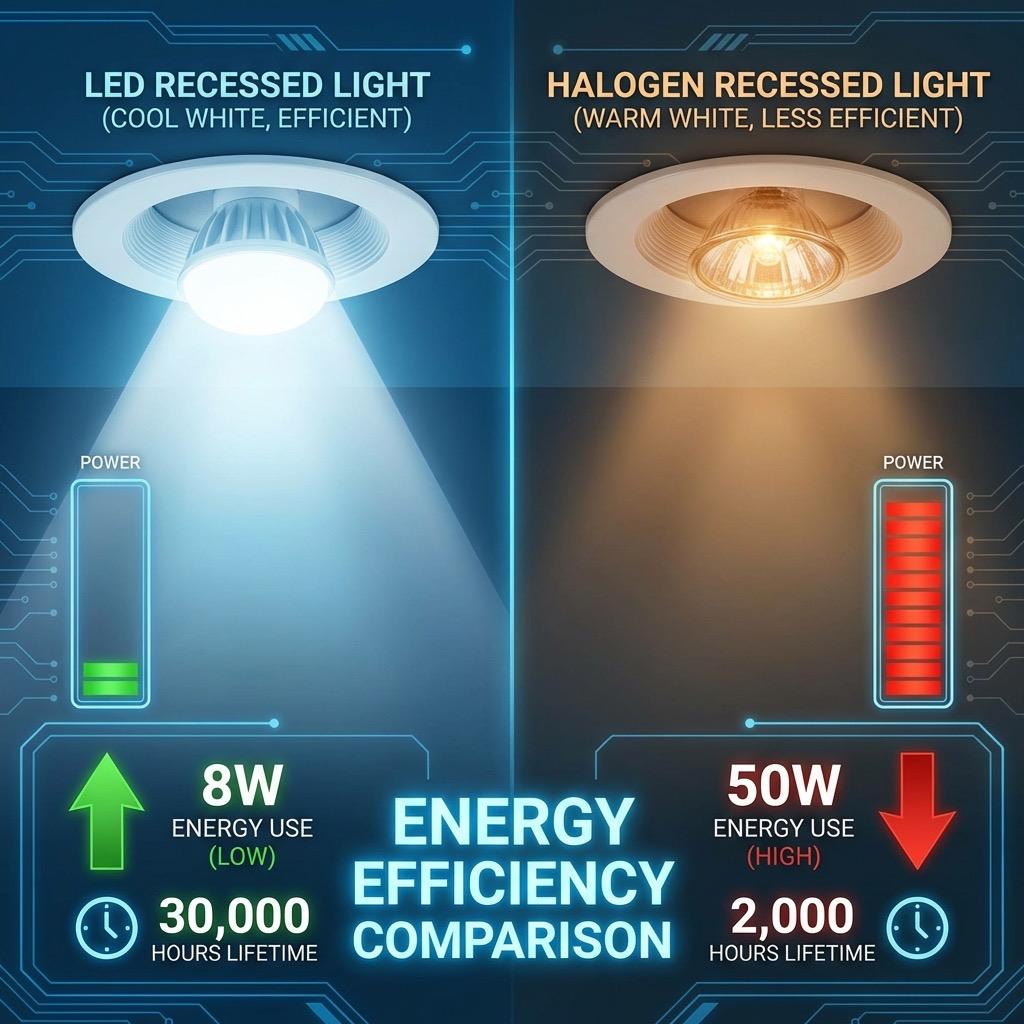
- Many LED products use less power than comparable fluorescent systems, but the exact reduction must be calculated from the existing system watts and proposed listed equipment.
- LED fixtures last 50,000–100,000 hours versus 7,000–15,000 hours for fluorescent tubes, dramatically reducing lamp replacement and maintenance labor costs.
- Fluorescent ballasts — the most common failure point in fluorescent systems — are eliminated entirely with LED; LEDs have no ballast to fail.
- Energy-code requirements and utility programs can change; verify the current official requirements and eligibility before relying on a rebate or incentive.
- No universal savings or payback period applies. Use fixture count, measured system watts, runtime, tariff, maintenance history, equipment cost, and installation scope for the property.
Why Commercial Lighting Choice Matters More Than Residential
Longer operating hours can increase the value of each watt reduced, while difficult fixture access can increase the value of longer product life. The result still varies by use schedule, existing ballast draw, light-level requirements, maintenance access, and the selected equipment.
Need a Commercial Electrician?
From fleet EV charging to panel upgrades and full tenant build-outs, our licensed team handles commercial electrical projects across Northern Virginia with minimal disruption to your operations. Call (571) 444-6886 to discuss your project.
The U.S. Energy Information Administration's Commercial Buildings Energy Consumption Survey (CBECS) provides national commercial-building context. Use the property's current tariff and bills, not a generalized regional rate, for a project calculation.
LED vs Fluorescent: Commercial Comparison
| Factor | T8 Fluorescent (32W) | LED Tube / Fixture (15–18W) |
|---|---|---|
| Wattage per 4-ft lamp | 32W (plus 10–15W ballast) | 15–18W (no ballast) |
| System watts (lamp + ballast) | 42–47W | 15–18W |
| Lifespan | 7,000–15,000 hours | 50,000–100,000 hours |
| Color Rendering Index (CRI) | 75–85 | 80–95+ |
| Lumen maintenance at 40,000 hrs | N/A (replaced) | >70% (L70 rated) |
| Mercury content | 3–5 mg per lamp | None |
| Ballast required | Yes (failure-prone) | No |
| Instant start (no flicker/warm-up) | Some flicker possible | Full brightness, instant |
| Operating temp range | 50–104°F optimal | -40°F to 113°F |
| Dimming capability | Requires special ballast | Most models dimmable |
| Disposal requirement | Hazmat (mercury) | Standard waste |
Utility Programs: Incentive amounts, eligible equipment, customer classes, application timing, and funding can change. Verify the current Dominion Energy program documents and receive written eligibility confirmation before treating an incentive as part of the project economics. AJ Long Electric can provide project documentation identified in the approved scope but does not guarantee program approval or payment.
The True Cost of Fluorescent Maintenance
Most facility managers focus on lamp purchase cost when comparing fluorescent to LED. This dramatically underestimates fluorescent's total cost. The full picture includes lamp replacements every 2–4 years, ballast replacements every 5–10 years (at $15–$50 per ballast plus labor), disposal costs for mercury-containing lamps ($0.25–$1.00 per lamp under Virginia hazardous waste rules), and crew time or lift rental for high-bay replacements.
For a typical 100-fixture Northern Virginia office over 10 years:
Fluorescent maintenance cost: 100 fixtures × 2 lamps × $3/lamp × 3 replacements = $1,800 in lamps; 100 ballasts × $25 average × 1 replacement = $2,500; labor at $50/hour for 40 hours = $2,000. Total: approximately $6,300 in maintenance alone, not counting energy.
LED maintenance: The proposed system may eliminate fluorescent ballasts and reduce relamping, but driver life, warranty coverage, operating temperature, controls, access, and actual runtime still affect maintenance. Use the selected manufacturer's written specifications and warranty terms.
Pro Tip: When specifying commercial LEDs, insist on fixtures with DLC (DesignLights Consortium) qualification. DLC listing is required for most Dominion Energy commercial rebates and ensures the fixture meets minimum efficacy (lumens per watt) and lumen maintenance standards. Avoid "contractor grade" LED tubes from big-box stores — they often fail within 2–3 years in commercial applications and void rebate eligibility.
Conversion Options for Commercial Spaces
There are three approaches to converting Northern Virginia commercial spaces from fluorescent to LED, each with different costs and benefits:
Type A LED tubes (plug-and-play): These LED tubes work with your existing fluorescent ballast. Installation is as simple as swapping bulbs. Cost: $8–$15 per tube. Downside: you are still dependent on the ballast, which can fail and is less efficient than driving LEDs directly. Best for: low-budget projects where ballasts are recently replaced and in good condition.
Type B LED tubes (ballast bypass): The ballast is bypassed and the LED tube connects directly to line voltage. Requires an electrician to rewire each fixture, but eliminates ballast dependency. Cost: $12–$20 per tube plus $5–$10 labor per fixture. Best for: most commercial retrofits seeking long-term reliability without replacing fixtures.
Full fixture replacement: Replace fluorescent fixtures with new LED fixtures. Highest upfront cost ($40–$150 per fixture installed) but delivers the best optical performance, longest lifespan, and maximum energy savings. Often the right choice when fixtures are 15+ years old or when reconfiguring lighting layouts. Best for: complete renovations, warehouse high-bay upgrades, and spaces requiring improved light levels.
Light Quality and Productivity Impact
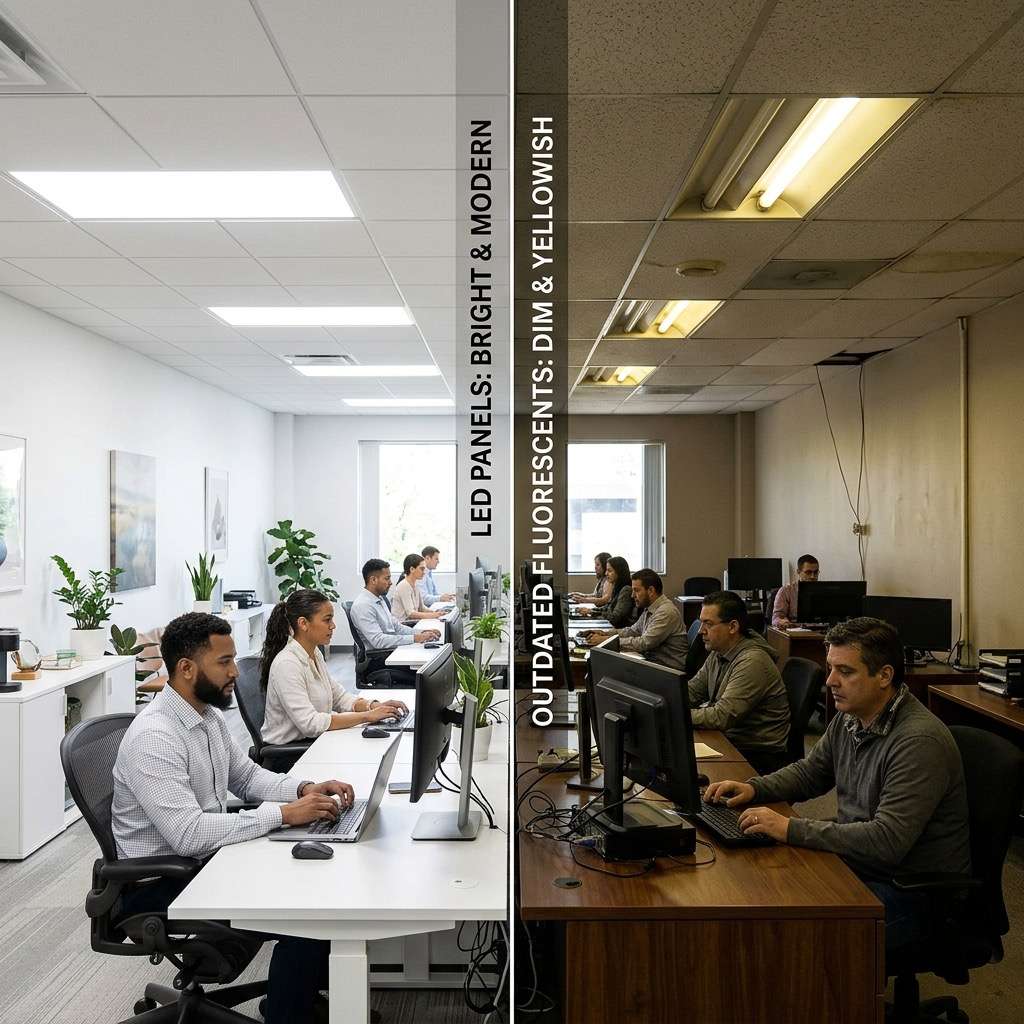
Commercial lighting affects more than the electric bill. Multiple studies published in the Journal of Environmental Psychology and Lighting Research & Technology link higher-CRI, flicker-free lighting to improved worker productivity, reduced eye fatigue, and better accuracy in detail work. Fluorescent tubes flicker at 60 Hz — imperceptible to most workers consciously, but measurably affecting performance in studies.
Modern commercial LED fixtures deliver CRI 85–95+ compared to typical T8 fluorescent at CRI 75–85. For Northern Virginia businesses in healthcare, retail, printing, and design, the improved color rendering is commercially significant. The 2020 NEC and ASHRAE 90.1-2019 (Virginia's energy code baseline) both increasingly incentivize lighting that achieves higher CRI minimums.
Important for T12 Users: If your commercial space still has T12 fluorescent fixtures (the larger 1.5-inch diameter tubes), ENERGY STAR has discontinued T12 lamp production in the U.S. Parts are increasingly difficult to source. T12 systems should be prioritized for LED conversion immediately — you risk being unable to replace failed lamps at all within the next few years.
ROI Analysis for Northern Virginia Commercial Spaces
For a representative 10,000 sq ft Northern Virginia office with 100 two-lamp T8 fluorescent fixtures operating 12 hours per day, 260 days per year:
Current fluorescent energy cost: 100 fixtures × 2 lamps × 47W system = 9,400W × 12 hrs × 260 days = 29,328 kWh/year × $0.11/kWh = $3,226/year in lighting energy
After LED conversion: 100 fixtures × 32W LED system = 3,200W × 12 hrs × 260 days = 9,984 kWh/year × $0.11/kWh = $1,098/year
Illustrative annual energy difference: $2,128 under the assumptions above. This example is not a proposal, current tariff quote, maintenance guarantee, rebate commitment, or payback promise. Replace every input with the property's measured system watts, operating hours, tariff, maintenance history, selected equipment, installation scope, and confirmed utility-program terms.
Our Recommendation for Northern Virginia Businesses
Start by auditing the highest-use or hardest-to-maintain areas and compare existing system watts, measured light levels, controls, maintenance records, and fixture access with the proposed design. That property-specific analysis determines whether a conversion is operationally and financially justified.
AJ Long Electric serves commercial clients throughout Northern Virginia including Tysons, Reston, the Dulles Corridor, Prince William County, and the I-66 corridor. Call (571) 444-6886 to request an on-site commercial lighting assessment and project-specific analysis. Estimates are free. The $99 dispatch fee applies only when we arrive prepared to complete a project, provide the price on site, and you decline the work. It covers travel and preparation. It is waived when you accept the on-site quote and for active members. It is not charged for a scheduled estimate visit.