
If your home was built before 2015, chances are you have halogen recessed lights throughout. While halogens served us well for decades, LED technology has advanced dramatically, offering compelling reasons to upgrade. Let us explore whether converting to LED makes sense for your Northern Virginia home.
Key Takeaways
- A lower-wattage LED can reduce energy use when it provides comparable light output; dollar savings depend on actual wattage, runtime, tariff, and fixture count.
- Manufacturer-rated LED life is often longer than halogen lamp life, but actual service life depends on the selected product and operating conditions.
- Halogen lamps produce more heat than comparable LEDs. Fixture listing, enclosure, clearances, and insulation-contact rating still control safe installation.
- No universal payback applies. Equipment cost, dimmer and housing compatibility, installation scope, runtime, and tariff determine the result.
- Modern LEDs achieve CRI 90-95 and offer tunable color temperatures, smart home integration, and smooth dimming.
Understanding the Technology
How Halogen Lights Work
Halogen bulbs are an improved version of traditional incandescent lights. A tungsten filament inside a halogen gas-filled envelope heats up to produce light. This technology is proven and produces warm, high-quality light, but at a cost of significant energy consumption and heat generation.
Request an Estimate from AJ Long Electric
Whether it is a simple repair or a major electrical project, our licensed team is ready to help. Serving all of Northern Virginia with transparent pricing and expert workmanship. Call (571) 444-6886 today.
How LED Lights Work
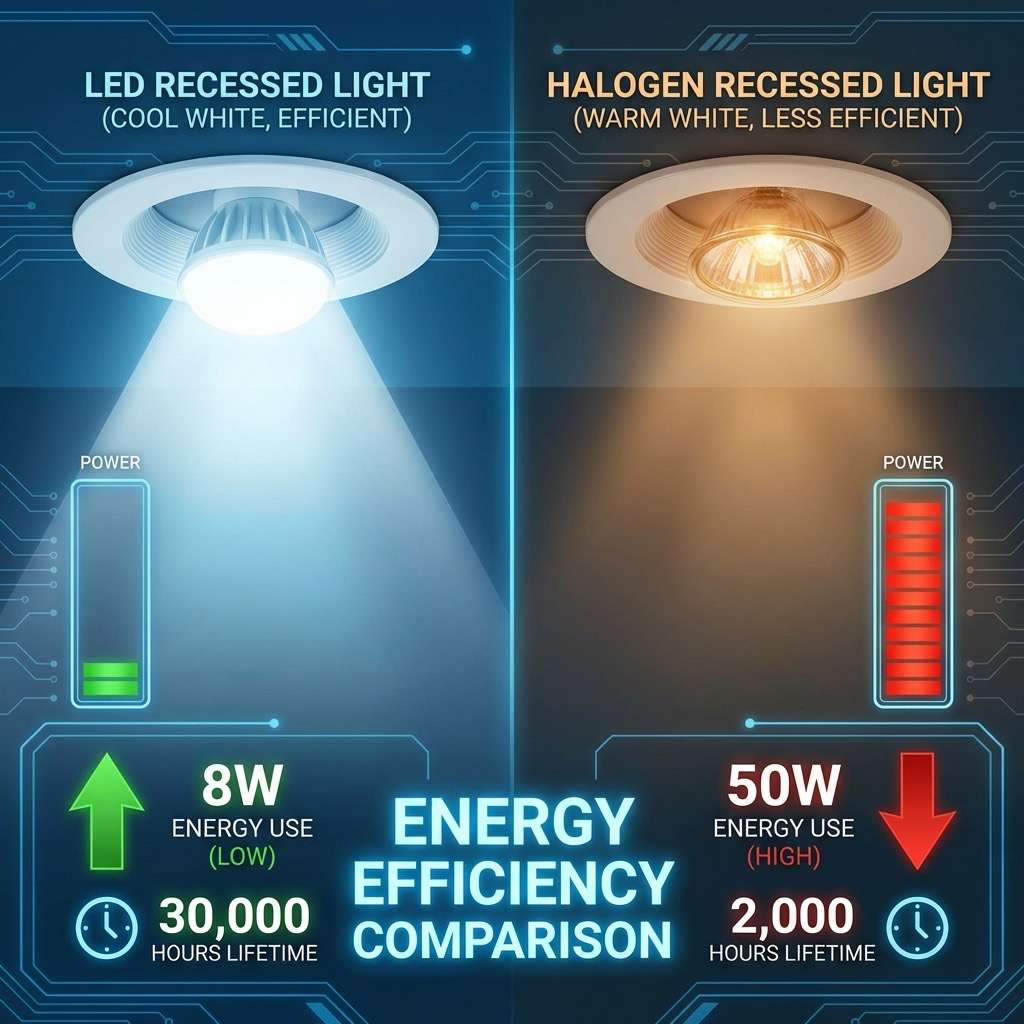
LEDs produce light when current passes through semiconductor material. They can provide comparable light output at a lower wattage than incandescent lamps. The U.S. Department of Energy consumer guide to energy-efficient lighting (PDF) describes potential energy reductions of up to 90% and lifetimes up to 25 times as long compared with incandescent lighting. Those figures do not establish the savings or lifespan for every halogen replacement. Compare the actual lamps, light output, fixture compatibility, and operating hours for your project.
LED vs Halogen: Complete Comparison
| Feature | Halogen Recessed | LED Recessed |
|---|---|---|
| Wattage (equivalent brightness) | 65W | 8-12W |
| Lifespan | 2,000-4,000 hours | 25,000-50,000 hours |
| Annual cost (20 fixtures, 5 hrs/day) | ~$331 | ~$51 |
| Color Rendering Index (CRI) | 100 | 90-95 (quality brands) |
| Heat output | High (~90% of energy) | Low (minimal) |
| Dimming | Smooth with any dimmer | Smooth with compatible dimmer |
| Color temperature options | Warm only (~3000K) | 2700K-5000K selectable |
| Smart home integration | None | Available on many models |
| Bulb cost per unit | $3-$8 | $15-$40 (retrofit kit) |
| Replacement frequency (5 hrs/day) | Every 1-2 years | Every 13-27 years |
Energy Savings Breakdown
A lower-wattage LED can reduce lighting energy use when it provides comparable light output. The following is an illustration for 20 fixtures used five hours daily at an assumed $0.14/kWh; it is not a current utility quote or a guaranteed result:
- Halogen annual cost: 20 lights x 65W x 5 hours x 365 days x $0.14/kWh = $331/year
- LED annual cost: 20 lights x 10W x 5 hours x 365 days x $0.14/kWh = $51/year
- Illustrative difference: $280 per year under those assumptions
Actual savings depend on the old and new fixture wattage, measured runtime, electric tariff, dimmer compatibility, equipment price, installation scope, cooling interaction, and replacement history.
Pro Tip: Verify the exact LED and dimmer compatibility documentation before replacing a legacy halogen load. An incompatible pairing can flicker, buzz, or have a poor dimming range; the existing dimmer does not need replacement when the manufacturer documents compatibility and testing confirms acceptable operation.
Heat Reduction and Safety
Halogen recessed lights produce substantially more heat than comparable LEDs. That can add cooling load, discolor finishes, and create a hazard when a fixture is not listed for insulation contact or installed with required clearances. LEDs reduce heat at the light source, but the exact fixture listing, driver temperature, enclosure rating, insulation-contact rating, and installation instructions still control safe use.
Where insulation is present, verify whether the existing housing is IC-rated and whether the proposed LED retrofit is listed for that housing. A retrofit can reduce heat exposure but does not erase unrelated wiring, enclosure, clearance, or installation defects.
Conversion Options and Costs
Option 1: LED Retrofit Kits
The simplest upgrade path uses LED retrofit kits that screw into your existing halogen cans. These kits include the LED module and a new trim ring. Installation takes about 5 minutes per fixture. Cost: $15-$40 per fixture. Best for DIY homeowners and budget-conscious upgrades.
Option 2: Integrated LED Fixtures
For new construction or major renovations, integrated LED fixtures replace the entire recessed housing. These offer the best efficiency and light distribution but require electrical work. Cost: $40-$100 per fixture plus installation.
Option 3: Canless LED Downlights
Modern canless LED lights mount directly to the ceiling without traditional recessed housing. They are thinner, more efficient, and easier to install in retrofit situations with low-clearance ceilings. Cost: $25-$60 per fixture plus installation.
Project-Specific Cost Comparison: Compare the written equipment and installation cost with the measured wattage difference, expected runtime, current electric tariff, dimmer work, cooling interaction, and replacement history. Those inputs determine whether and when a particular conversion produces a financial return; AJ Long Electric does not guarantee a payback period or savings amount.
What to Look for in LED Recessed Lights
Essential Specifications
- Lumens: Match halogen output (650-700 lumens replaces 65W halogen)
- Color temperature: 2700K-3000K for warm residential lighting
- CRI: 90+ for best color rendering
- Dimmable: Ensure compatibility with your dimmers
- IC-rated: Safe for insulation contact if needed
- Warranty: Minimum 5-year warranty
Recommended Brands
When comparing retrofit fixtures, evaluate the listed housing compatibility, light output, color rendering, color temperature, wet- or damp-location rating, dimmer compatibility, warranty terms, and current ENERGY STAR listing where applicable. Brand and model specifications change, so verify the exact product before purchase.
Our Verdict
LED recessed lighting can reduce wattage and heat while adding product-specific color-temperature and control options. Whether a conversion makes sense depends on existing housing compatibility, light quality, runtime, equipment condition, dimmer work, installation cost, and the homeowner's goals.
AJ Long Electric evaluates existing housings, wiring, fixture compatibility, dimmer requirements, and access before quoting an LED conversion. Contact us to request a lighting assessment.