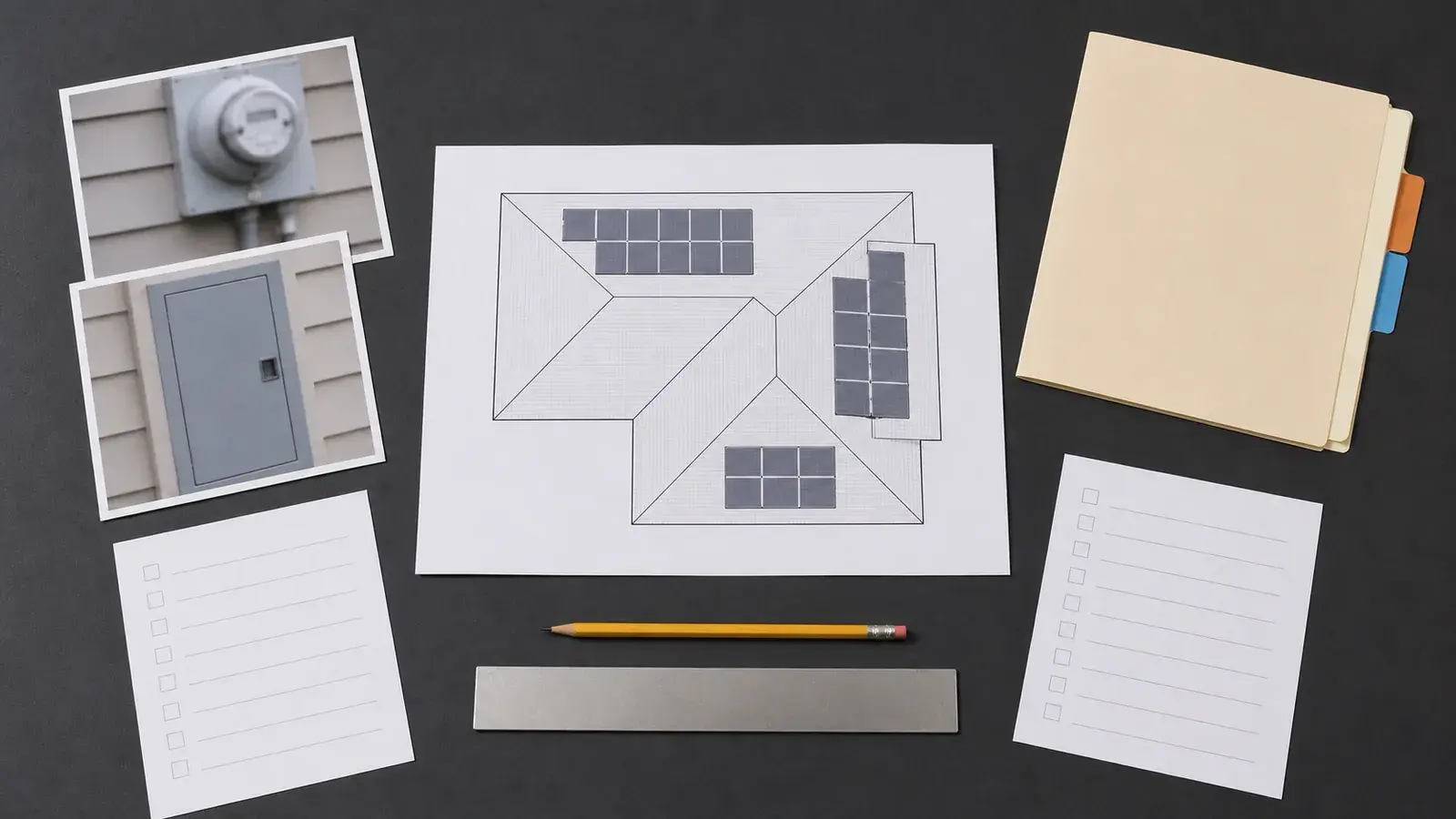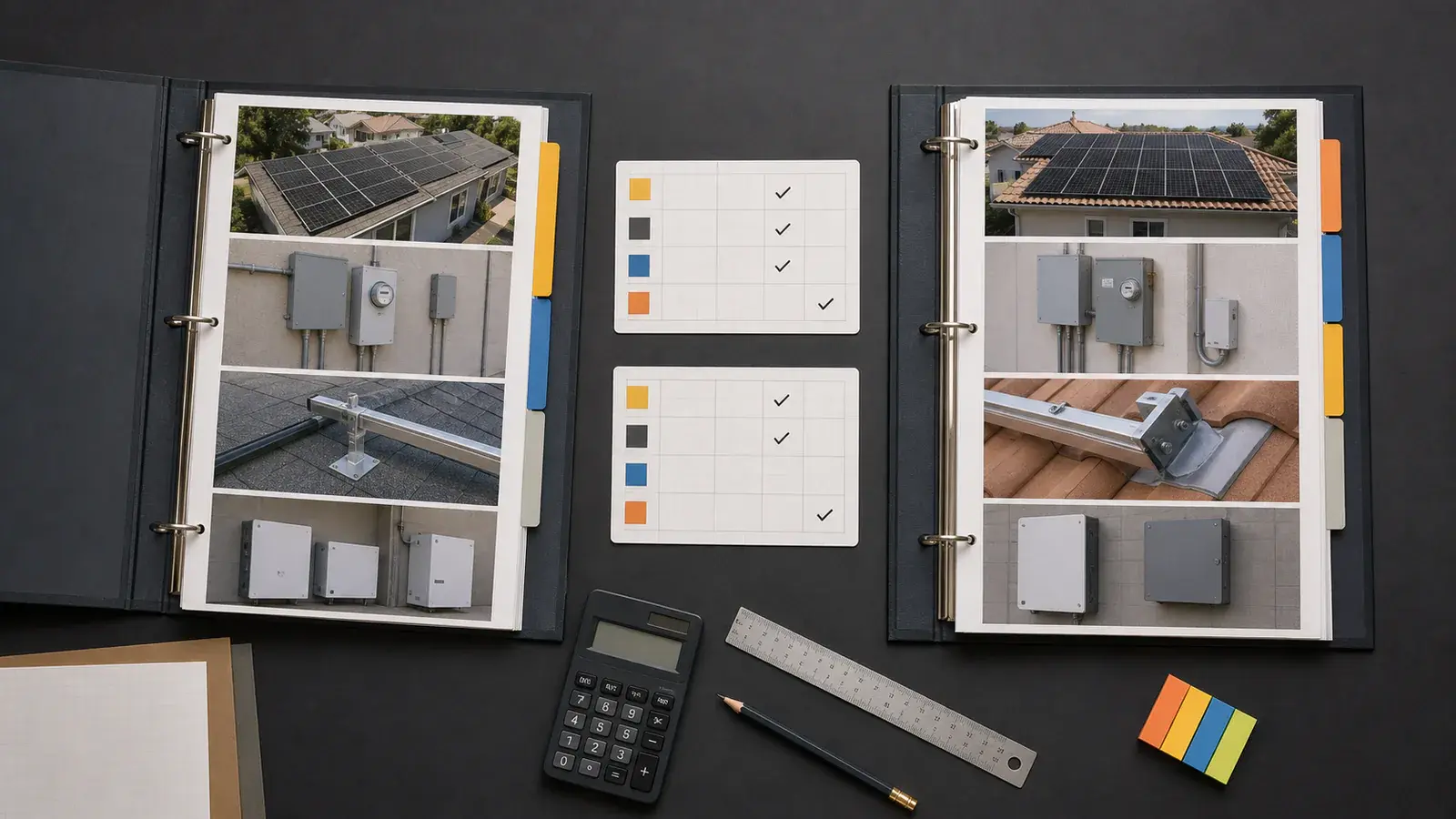
Use the same written checklist for every proposal
The Federal Trade Commission advises homeowners to understand the system, costs, contract, financing, and claims before signing. Put each proposal into the same worksheet and mark missing answers. This is proposal literacy, not a prediction of another contractor's performance.
Solar proposal comparison worksheet
Ask for model-specific equipment and scope, not brand families or verbal assurances. Every allowance and exclusion should have an owner and a change-order rule.
| Decision | What the proposal should state | Question to resolve |
|---|---|---|
| Array size and production assumptions | DC array size, modeled annual production, shade, orientation, degradation, and modeling inputs | Are guarantees, estimates, and assumptions clearly distinguished? |
| Equipment | Module, inverter or microinverter, racking, attachment, listing, and model numbers | Are substitutions allowed and on what terms? |
| Roof responsibility | Roof condition review, attachment method, flashing, structural responsibility, and leak or penetration terms | Who repairs existing conditions and who owns roof-interface work? |
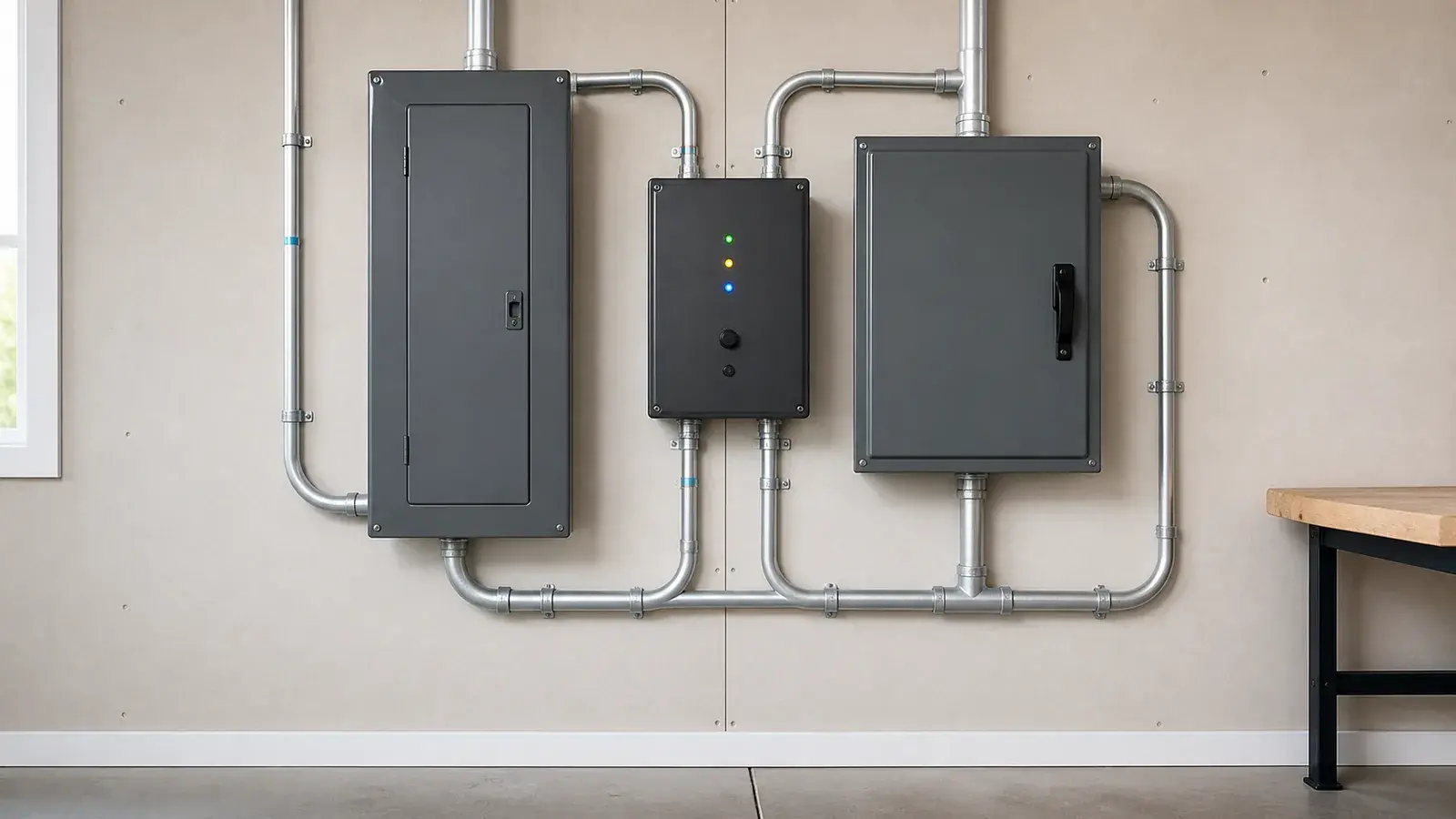
| Electrical service scope | Panel capacity, busbar, grounding, disconnects, labeling, conductor route, trenching, and any service upgrade | Is panel or service work included, excluded, or an allowance? |
| Battery, smart loads, and EV | Storage equipment, backup circuits, transfer boundary, load management, and EV coordination | Does the design reserve capacity and explain outage behavior? |
| Permits and interconnection | Who files permits, schedules inspection, submits the utility application, handles meter steps, and obtains permission to operate | Which authority and serving utility were verified for the address? |
| Warranties and service | Equipment, workmanship, roof-penetration, monitoring, labor, transferability, and service-response terms | Who provides each remedy and for how long? |
| Financing and ownership | Cash price, financed price, fees, interest or escalator, lien or security terms, ownership, and transfer on sale | Who owns the system and incentives, and what happens when the home is sold? |
| Exclusions and change orders | Roof repair, structural work, service upgrades, trenching, utility charges, restoration, and triggers for added cost | What discovery can change the price and who authorizes it? |
Separate production assumptions from guarantees
Compare the same weather basis, shading inputs, equipment losses, orientation, and degradation assumptions. A production estimate is only as comparable as its inputs. Ask whether any written guarantee exists, what remedy it provides, and which conditions or outages are excluded.
Assign the roof and electrical interfaces
The proposal should say who evaluates roof condition and structural responsibility, who owns attachments and penetrations, and how roof work affects warranties. It should also name panel, electrical service, grounding, disconnect, labeling, routing, and interconnection scope instead of leaving those items for an unspecified change order.
Read ownership, financing, cancellation, and tax wording
Compare the cash and financed totals, fees, ownership, lien or security terms, transfer terms, cancellation rights, warranties, monitoring, and service responsibility. A $0-down monthly payment is not the same number as a cash installed price. AJ Long Electric publishes $19,000–$34,000 at $2.40–$2.85/W as a cash planning band for a typical 8–12 kW Northern Virginia rooftop array; panel, battery, EV, and roofing extras are itemized separately. Section 25D does not apply to systems installed after December 31, 2025. Read current IRS guidance and consult a qualified tax professional; AJ Long Electric does not provide tax advice.
Who this guide fits, and what it cannot rank
This guide fits homeowners comparing complete written proposals. It is not a cheapest-installer ranking and cannot validate a contractor, production model, financing product, permit outcome, utility decision, or warranty from marketing copy. Verify license and insurance, read the full contract, confirm the property authority and serving utility, and get material promises in writing.
Continue to the Next Decision
Frequently Asked Questions (5)
What is the first thing to compare in solar proposals?
Confirm that the proposals describe the same array size, production assumptions, equipment, roof scope, and electrical scope. Headline totals are not comparable when the included work differs.
Should a solar proposal include panel and service work?
It should state whether panel capacity, grounding, disconnects, labeling, routing, and any service upgrade are included, excluded, or handled through a defined allowance and change-order process.
How should I compare solar financing?
Compare cash price, financed price, fees, interest or escalator terms, ownership, liens or security interests, transfer on home sale, cancellation rights, and who receives any incentive described in the contract.
What is a typical cash price for rooftop solar in Northern Virginia?
AJ Long Electric publishes $19,000–$34,000 at $2.40–$2.85/W as a cash planning band for a typical 8–12 kW rooftop array. Compare that cash number to any financed quote after dealer fees, and confirm whether panel, roof, battery, and EV work are included. The written proposal is project-specific.
Can an installer promise a tax credit?
Tax treatment depends on current law and the taxpayer's facts. Section 25D does not apply to systems installed after December 31, 2025. Read current IRS guidance and consult a qualified tax professional; AJ Long Electric does not give tax advice.
Authoritative Sources
- Federal Trade Commission: Solar Power for Your HomeFederal consumer guidance for comparing solar claims, contracts, financing, and written proposals.
- IRS: Residential Clean Energy CreditOfficial IRS guidance on the residential clean-energy credit and its current eligibility rules.
- U.S. Department of Energy: Solar and Resilience BasicsFederal overview of how solar, storage, and resilience planning relate.
- NFPA 70: National Electrical Code (NEC)The NEC is the foundational safety standard for electrical wiring and installation in the U.S.