
The most useful hiring question is not “Which electrician has the biggest advertisement?” It is “Which proposal explains my project clearly enough that I know what I am buying?” A panel replacement, an EV circuit and an intermittent power problem need different conversations. Use this checklist to turn a shortlist into a decision you can explain.
Start with the outcome you need
Write a short brief before contacting companies: the equipment or symptom, the property address, where the work is located, and any timing constraint. For an installation, include the model you have selected and whether you already own it. For a repair, describe what stopped working and when, without deciding in advance which component needs replacement.
This distinction matters. “Install my charger on the garage wall” describes a project to evaluate and quote. “The charger trips intermittently” describes an issue that may require diagnostic work before a repair can be defined. Ask which visit you are requesting and how that visit is priced.
Verify the business on the proposal
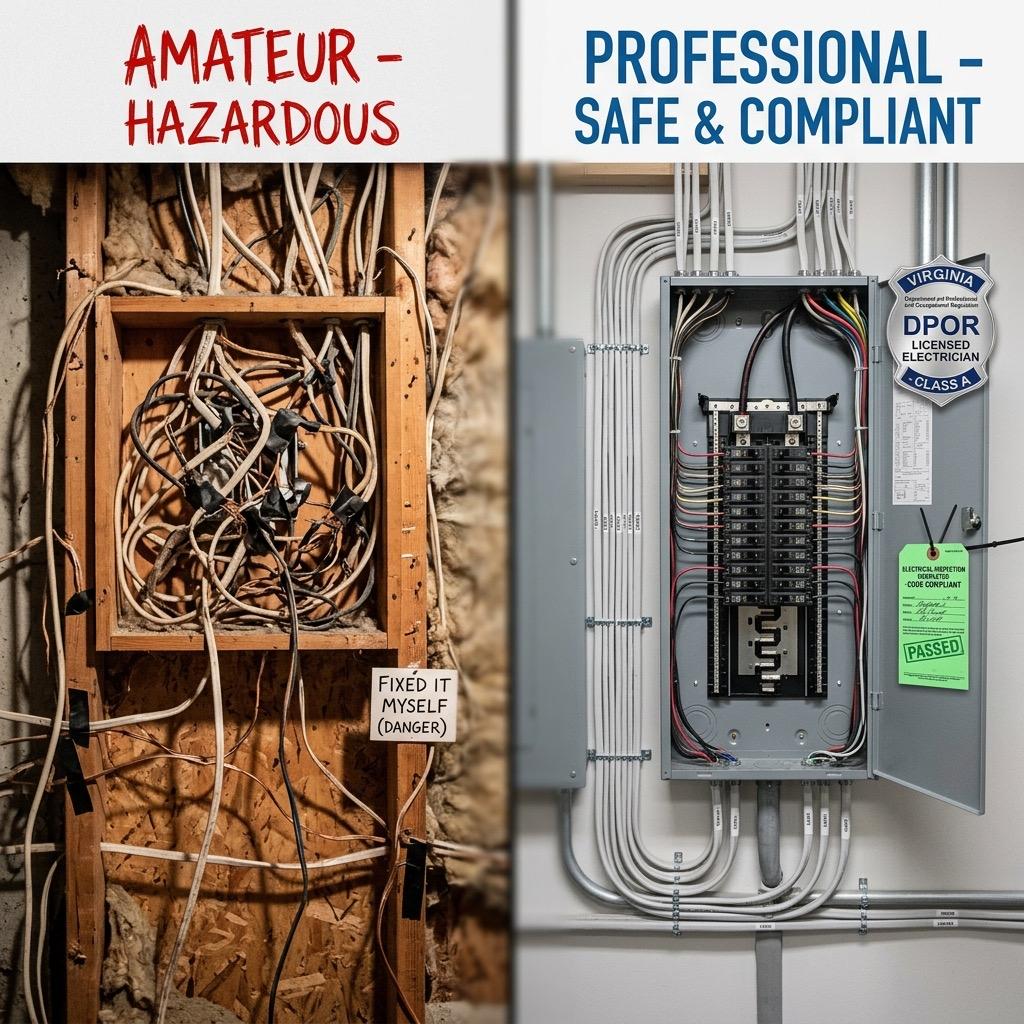
The Virginia Board for Contractors licenses contracting businesses; license class concerns project value and specialty concerns the type of work. Individual electrician credentials are a separate tradesmen program. A person's credential and a company credential answer different questions.
Concerned About Your Home's Electrical Safety?
A professional electrical inspection identifies hidden hazards before they become emergencies. Our licensed electricians provide thorough safety inspections throughout Northern Virginia. Call (571) 444-6886 to schedule yours.
- Ask for the legal business name and contractor license number.
- Use the official DPOR lookup to compare the name, status, class and specialty with the proposal.
- Resolve mismatched names or unclear scope with the company and DPOR before proceeding.
- Save the information with the dated proposal rather than relying on a logo that says “licensed.”
Ask for current insurance documentation and a contact who can explain the relevant coverage. A certificate is information to review, not a guarantee that every possible loss is covered. Questions about your own property's coverage belong with your insurer.
Look for experience that matches the work
Ask how the company would approach the constraints of your property. For an occupied home, that may mean an outage plan, protection for finished surfaces and an accessible equipment location. For an EV installation, it includes charging needs and the route between the panel and parking space. For troubleshooting, ask how findings and additional work will be communicated.
References and reviews are most useful when they describe a similar scope and what happened when a question arose. Read both recent and older feedback for specific details about communication and completion. A review total is context; it is not a substitute for verifying the proposal.
Compare the same project in every proposal
Copy these rows into your notes and fill one column for each company. “Not stated” means there is a question to resolve, not that the item is included. Ask for a revised written scope after material clarifications.
| Compare | What to record | Question if unclear |
|---|---|---|
| Equipment | Model, quantity and who supplies it | Is customer-owned equipment included in the installation price? |
| Electrical scope | Circuit, route, connection and required supporting work | What condition would change this scope? |
| Access and finishes | Wall openings, surface routing, patching and cleanup | Who restores paint or drywall? |
| Permits and closeout | Responsible party, included fees and inspection coordination | What completion records will I receive? |
| Price and changes | Fixed scope or time-based work; exclusions and approvals | How do I approve additional work before it starts? |
| Timing and payment | Dependencies, milestones and amounts due | What happens if equipment or utility work is delayed? |
| Follow-through | Written workmanship terms and service contact | Who handles a question after completion? |
Two EV proposals can look similar while one includes a longer finished-basement route and the other assumes exposed garage wiring. A panel proposal may cover replacement at the existing service size while another includes service-entrance changes. Resolve those differences before judging the totals. A cheaper proposal is not evidence of misconduct; an unexplained omission is a reason to ask another question.
Set the handoff before accepting
Keep the accepted scope, payment schedule and change approvals together. DPOR's consumer guide recommends written agreements and progress-based payments. Discuss the schedule for your actual project instead of assuming one deposit percentage suits every job.
Ask who confirms the work date, how you will hear about changes, and which documents mark completion. If the work requires inspection, distinguish installation day from inspection and any utility coordination. Pause when the business identity, scope or payment request remains unexplained.
Apply the same checklist to AJ Long Electric
AJ Long Electric is family-owned and has served Northern Virginia since 1996. Our credentials page and company information are starting points; ask us the same project-specific questions you would ask anyone else.
Estimates are free for every service. Scheduled estimate visits and written project prices are free. Diagnostic and repair work is a separately priced service. Our quoted electrical installations include a five-year workmanship warranty from completion. Parts and equipment carry their manufacturer warranties.
For the next conversation, use our ten questions for the estimate visit. When you have an equipment choice and location in mind, the EV project checklist or panel preparation checklist can help organize the details before you send a request for staff review.