
An outdoor EV installation needs suitable equipment, a protected wiring route, stable mounting and a cable layout that works where the car parks. Weather rating alone does not settle placement, drainage, permits or underground work.
Assess the parking space in normal use
Photograph the driveway or carport with the car in its usual position. Mark the charge-port location, walking routes, steps, gates and garage-door travel. A wall that is close to the panel may still be a poor charging location if the cable crosses the entrance or reaches only when the car blocks another space.
For shared parking, establish who controls the wall, ground and electrical supply before selecting equipment. A driveway installation and a cable across a public sidewalk are different projects. Approval from one property owner does not authorize work on a neighbor’s land or public right-of-way.
Read the complete equipment rating
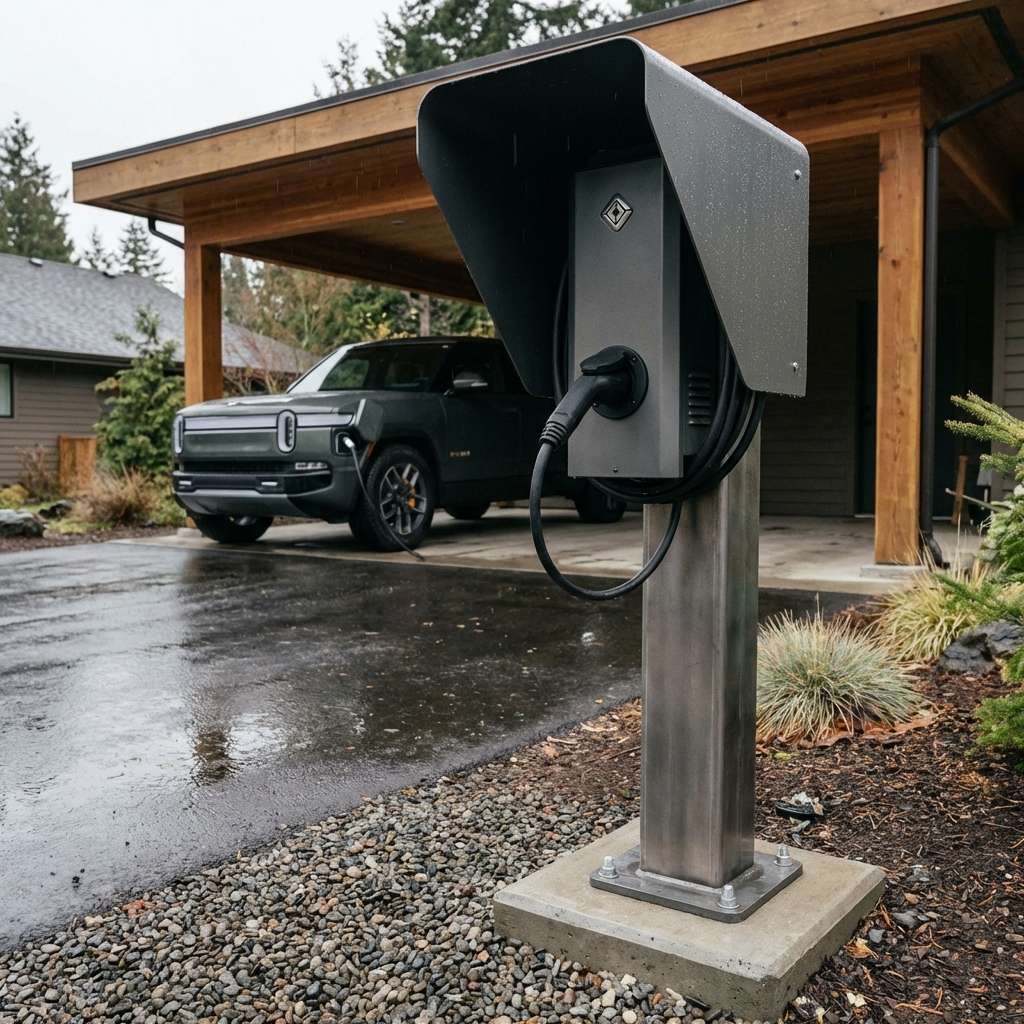
An enclosure type describes particular environmental protection, not immunity to every condition. UL’s enclosure-type table distinguishes rain protection from hose-directed water and submersion ratings. A Type 3R or Type 4 label alone is not permission to place equipment where it can flood.
Ready to Install a Home EV Charger?
Our licensed electricians evaluate panel capacity, circuit routing, equipment requirements, and permit needs for home EV charging. Call (571) 444-6886 or request an estimate online.
Confirm the selected charger’s outdoor listing, operating limits, mounting orientation and installation instructions. Then check the rest of the installation: cable entries, boxes, receptacle arrangement where used, supports and conductors. Site exposure, drainage, impact risk and nearby irrigation matter. Do not hose down a charger or improvise a cover that traps heat or conflicts with its instructions.
Compare wall and freestanding mounting
An exterior wall can avoid a separate footing when the structure and route are suitable. A pedestal may put the connector closer to the car, but it adds support, location and often excavation decisions. A generic wood post is not automatically an approved substitute for the charger or pedestal manufacturer’s mounting system.
Document the finished mounting location, cable storage and protection from vehicle movement. The quote should identify the support arrangement and any separate concrete, landscaping or finish work. Select a position that can be serviced without moving permanent obstacles or stretching the cable across a circulation route.
Define underground work before digging
There is no single burial-depth rule for every EV installation. Wiring method, location, vehicle traffic, protection and adopted requirements affect the design. Do not dig a trench from a generic internet depth and ask an electrician to make the equipment fit afterward.
Virginia 811 explains the utility-location process and the need to identify private lines separately. An 811 request does not prove every irrigation, lighting, outbuilding or other privately owned line has been marked. The excavator must follow the current notification and clearance process before work. The scope should also address property boundaries, existing pavement, spoil handling and restoration.
Resolve protection and connection together
A hardwired installation and a receptacle-fed unit have different design details. The charger’s internal protective device is not a blanket substitute for every upstream protection requirement. Match the connection, circuit protection and equipment instructions with the adopted rules for the property; repeated tripping needs investigation, not a bypass.
For example, ChargePoint’s Home Flex instructions allow outdoor hardwiring or a suitable outdoor receptacle arrangement and describe product-specific protection considerations. That example does not establish the requirements for another brand or model. Circuit capacity still requires a load assessment even when the installation is outside.
Get a quote that includes the actual route
A typical Level 2 circuit and hookup is $1,200–$3,500. Documented long, detached, outdoor, trenched or otherwise complex routes can extend to the $1,200–$4,500 total band. EVSE hardware is separate; unusual site work is identified in the project proposal. A photograph cannot reveal every buried or concealed condition.
Send the address, equipment model, parking photos, approximate panel-to-parking distance and any known access or restoration constraints. Request a free EV installation estimate; staff review the scope and confirm the next step. For an installation that already shows heat damage, exposed conductors or unexplained tripping, request troubleshooting instead of treating the issue as cosmetic cable storage.