
You can plan an EV circuit today while leaving solar or storage for later. The aim is a useful first installation and a clear record of future decisions, not a promise that every later system will fit without changes.
Key Takeaways
- Size the present charging arrangement for the home's evaluated capacity and actual driving routine.
- Separate consuming loads, generation, storage, and backup operation.
- Document routes and equipment assumptions before finishes or landscaping are closed up.
- A future-ready plan is not a commitment to buy a battery or array now.
Write a short brief for each stage
| Stage | Decide now | Keep open when equipment is unknown |
|---|---|---|
| EV charging now | Parking location, vehicle, charging window, usable output, circuit route | Second vehicle or future parking changes |
| Possible solar later | Share the goal; record panel and service details | Array design, inverter, connection method, utility application |
| Possible battery later | List desired outage loads and expected use | Battery model, output, usable energy, transfer equipment, controls |
Add a rough time horizon: committed work this year and a possibility several years away deserve different spending decisions. If the only definite project is a charger, ask for a complete charger quote and separately identified preparation options. The Department of Energy charging-installation overview provides context on equipment, site assessment, and installation planning.
Ready to Install a Home EV Charger?
Our licensed electricians evaluate panel capacity, circuit routing, equipment requirements, and permit needs for home EV charging. Call (571) 444-6886 or request an estimate online.
Design today's charging without assuming tomorrow's sunshine
Give the electrician your normal energy use between charges, time parked, vehicle AC charging capability, and large household loads. A lower installer-configured output or compatible load management may fit an existing service when the assessment and equipment support it. Neither approach is guaranteed to avoid an upgrade.
Do not simply subtract expected solar production from the charger demand. Charging can happen after sunset, and production varies. A household battery also has finite output and stored energy. The electrical design must address how the selected equipment actually operates.
If the specific concern is a smaller service, use the 100-amp EV and future-solar guide. That article compares capacity options; this checklist focuses on coordinating several projects over time.
Keep four different functions separate
Consumption: the EV charger draws power at its configured output, subject to vehicle and system behavior. Generation: a solar inverter supplies power when available. Storage: a battery can draw power while charging and supply power while discharging. Backup: an outage-capable system must isolate appropriately and support the selected loads.
Solar production alone does not establish outage capability. The Department of Energy inverter overview explains grid interaction and operation during disturbances. Request explicit operating-mode information for the eventual system.
Similarly, service-limit management for an EV charger and management of loads during an outage solve different problems. Ask which function a proposed controller actually performs. A monitoring screen or remote switch is not, by itself, proof of either automatic function.
Coordinate routes before choosing preparation work
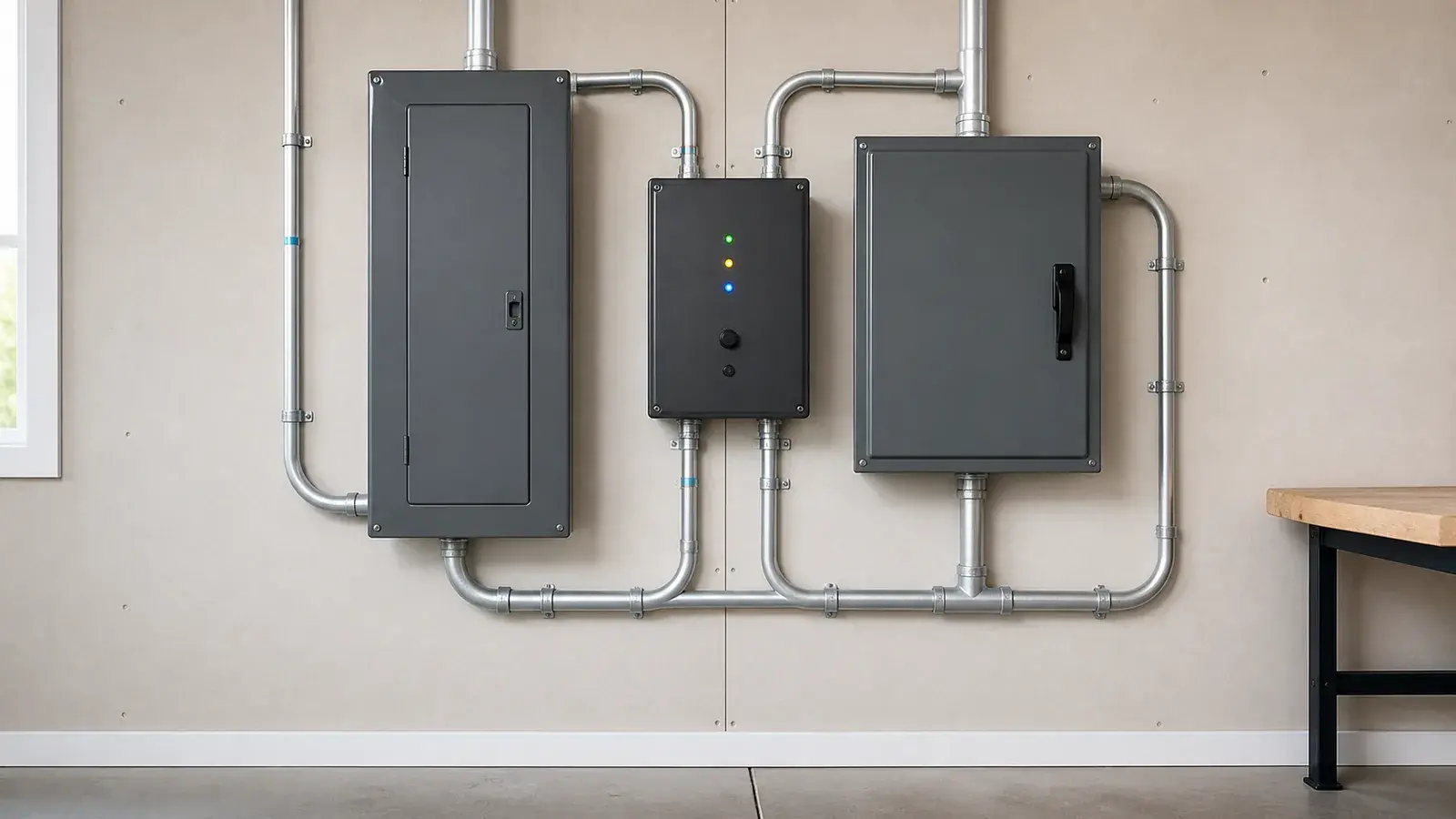
Walk through the charger location, accessible panel area, possible future equipment locations, and any likely cable paths. Note walls being opened, planned paving, landscaping, and access restrictions. These are opportunities to compare preparation costs while access is available.
Ask the designer whether a reserved pathway is useful and what it is designed to accommodate. Do not assume an EV raceway can later carry every solar, battery, or communication connection. Conductor requirements, separation, capacity, accessibility, and equipment locations still govern. An unidentified future cable is a planning assumption, not an approved circuit.
Keep photographs of completed routes before concealment, measurements, permit records, and the updated circuit directory. Mark any spare route or reserved area on the handoff record so the next contractor can confirm it rather than guess.
Decide what the car should do during an outage
Should charging stop during backup operation, remain available at a reduced output, or be a design priority? Put that preference alongside refrigerators, pumps, heating equipment, and other desired loads. A vehicle's large energy demand can materially affect a backup plan.
Ask for both power capability and a runtime estimate with stated assumptions when storage is eventually quoted. “Whole-home” does not mean every load can operate simultaneously for an unlimited time. Vehicle-to-home capability is a separate equipment and compatibility project, not an automatic feature of ordinary Level 2 charging.
Keep the quote and future assumptions separate
A typical Level 2 circuit and hookup is $1,200–$3,500, with EVSE hardware separate. A panel or service upgrade, when required, is separate work. Have the quote identify the configured charging output, management equipment if any, route, restoration, permit responsibility, and any optional preparation.
Our quoted electrical installations include a five-year workmanship warranty from completion. Parts and equipment carry their manufacturer warranties.
Request a free EV installation estimate with vehicle details, parking photos, closed-panel photos, and your future goals. Staff will review the request and discuss timing; submitting it does not book an appointment.