
Future-load planning can document raceway, conductor, panel, service, load-management, connector, and second-vehicle options during the initial EV charging design. Whether that reduces later work or cost depends on the eventual equipment, code, utility, permit, route, restoration, and access requirements. No future compatibility, savings, or payback result is guaranteed.
Key Takeaways
- The installed circuit, breaker, conductors, raceway, commissioned output, and EVSE must match the current listed equipment and approved design.
- A future-load alternate can evaluate larger or spare raceway, subject to fill, derating, route, and access requirements.
- A second-vehicle design still requires a load calculation, listed equipment, and authority review.
- Future software, network service, connector compatibility, and manufacturer support are not guaranteed.
- Compare listed load management with a $3,500–$7,500 panel scope when the load calculation identifies limited capacity; larger service is quoted per project.
Why Future-Proofing Matters
The EV market is in a period of rapid advancement. Vehicles are gaining larger batteries, faster onboard chargers, and new features like vehicle-to-home (V2H) capability. The average Northern Virginia household keeps a vehicle for 6-8 years, and many keep their homes much longer. An EV charger installation built for today's specifications may become a limitation for tomorrow's vehicle.
Ready to Install a Home EV Charger?
Our licensed electricians evaluate panel capacity, circuit routing, equipment requirements, and permit needs for home EV charging. Call (571) 444-6886 or request an estimate online.
The Cost of Retrofitting
Upgrading electrical infrastructure after the initial installation can require reopening finished areas, retrenching, or obtaining another permit. Planning a spare raceway or a larger raceway during the first project may reduce that disruption. The incremental cost is quoted with the project because route, wiring method, access, and required capacity vary.
Circuit Sizing: Build for Tomorrow's Charger
Circuit and raceway planning can preserve options, but the installed design must serve the current listed EVSE and pass the applicable load, code, and authority review. Any incremental price or future benefit is project-specific.
Plan a Raceway and Conductors for the Intended Future Load
If a future 48-amp charger is likely, ask the electrician to evaluate a raceway and conductor design that can support a 60-amp branch circuit. The installed breaker and equipment settings must still match the listed charger and the approved design. Material and labor differences are quoted with the project because conductor type, route length, terminal ratings, and wiring method vary.
Consider 4-Gauge Wire for Maximum Flexibility
For a long route, the electrician may recommend larger conductors to manage voltage drop or preserve future capacity. Ampacity is not determined by gauge alone; conductor type, temperature rating, terminals, raceway fill, and adjustment factors all matter. The final design should follow the charger listing, permit drawings, and load calculation.
Conduit Sizing: Think Bigger Now
Conduit is the protective tube that houses your electrical wire. Oversizing conduit during initial installation provides the ability to pull larger or additional wire in the future without the labor-intensive process of replacing the conduit itself.
Use 1-Inch Conduit Minimum
The raceway should be sized for the present conductors plus the future design you have discussed with the electrician. A larger raceway may allow a future conductor pull, subject to conduit-fill, derating, and routing rules. This matters most underground, where replacing an undersized raceway can mean re-trenching the yard or driveway.
Spare Conduit for Future Circuits
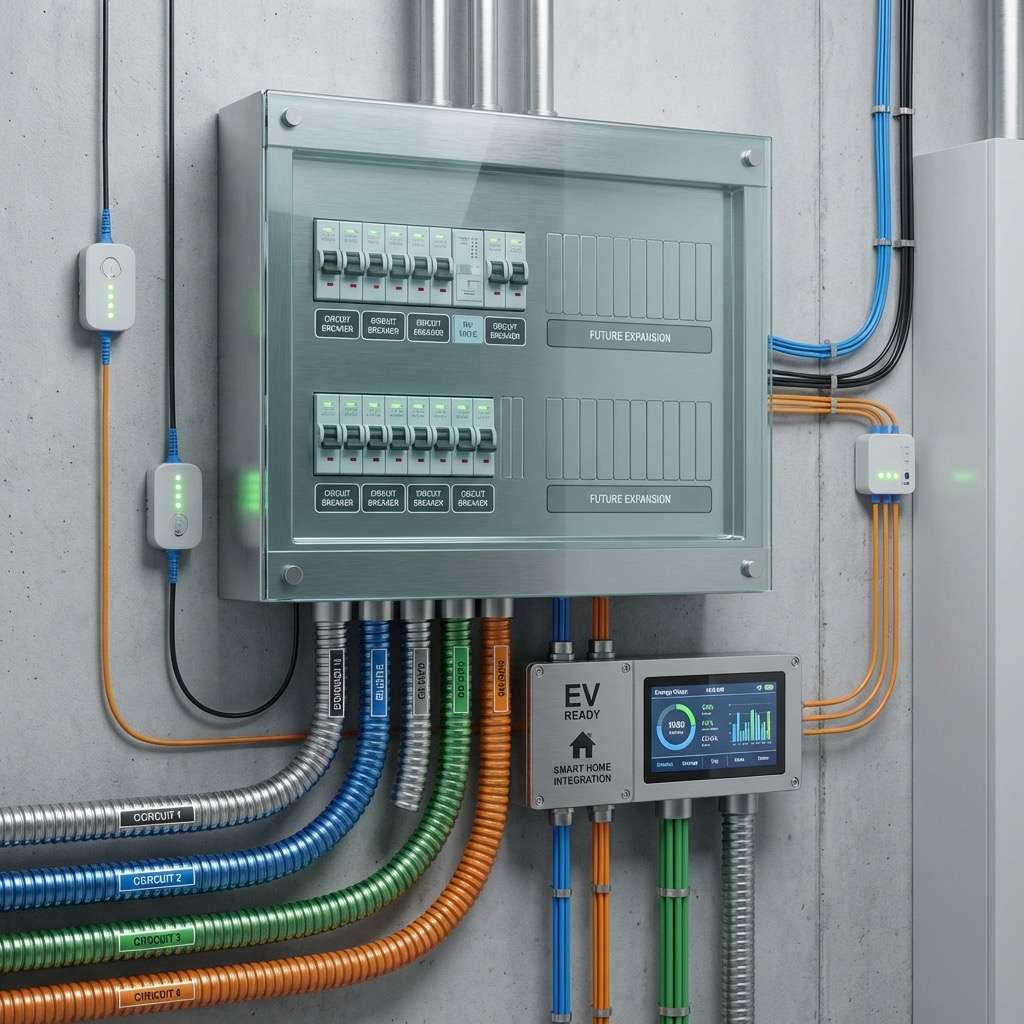
If a second EV is plausible, ask for a spare-raceway alternate during design. The incremental cost and later usefulness depend on length, route, trenching, restoration, fill, derating, pull points, code changes, and future equipment. An approved pull string may assist a future pull, but it does not guarantee that the raceway will support an unknown future circuit.
Good to know: In homes where the raceway runs underground to a detached garage or crosses a finished area, access and restoration can drive more of the project cost than the raceway material. Ask for the larger or spare-raceway option as an alternate in the project quote.
Panel Capacity: Invest in Headroom
Your electrical panel is the hub of your home's electrical system, and its capacity determines what you can power now and in the future.
Assess Future Electrical Needs
When evaluating panel capacity for your EV charger installation, think beyond just the charger. Consider potential future needs including a second EV charger for a second vehicle, a heat pump system if you electrify your heating, an electric water heater replacing a gas unit, a home battery system for solar or backup power, electric cooking equipment replacing a gas range, and a hot tub, pool heater, or workshop equipment. Each of these represents a significant electrical load. If your panel is at or near capacity after adding the EV charger, you may face an upgrade sooner than expected.
When to Upgrade Now
If the load calculation shows limited capacity after adding the EV charger and you anticipate more major loads, compare load management with a panel or service upgrade. A 200-amp panel upgrade remains within the published $3,500–$7,500 range even when coordinated with an EV project; documented project-specific extras are quoted separately.
Consider 320-Amp Service
For homes evaluating multiple EVs, electric HVAC, a battery, or other major loads, a load calculation and utility review determine the service options. A 320- or 400-amp service does not eliminate every capacity, transformer, feeder, equipment, or control constraint and is quoted per project after utility, site, equipment, and load review.
Smart Infrastructure: Software That Grows With You
Some smart EVSE supports network updates, but future software, cloud service, features, security support, and compatibility are controlled by the manufacturer and are not guaranteed.
Software Updates Add Features
Review the exact model's current update policy, offline behavior, network requirements, privacy terms, cybersecurity support, warranty, and feature documentation. Do not purchase based on an assumed future feature or utility program.
Integration with Emerging Technologies
Smart chargers are better positioned to integrate with emerging home energy technologies. Vehicle-to-home (V2H) systems that use your EV battery to power your home during outages will require smart communication between the charger and the vehicle. Home energy management systems that coordinate solar panels, home batteries, and EV charging require smart charger connectivity. Utility grid services that compensate you for allowing charging adjustments during peak demand require charger communication with utility systems. By choosing a smart charger now, you position your home to participate in these emerging technologies as they become available.
Connector Standards: Preparing for the Transition
The EV industry is transitioning from the J1772 connector to the Tesla-originated NACS connector as the North American standard. Most major manufacturers have announced NACS adoption for future vehicles.
What This Means for Your Installation
The electrical infrastructure (circuit, wiring, panel capacity) is connector-agnostic. Regardless of whether your charger has a J1772 or NACS connector, the circuit behind it is the same. If you install a J1772 charger now and later need NACS, you simply swap the charger unit while keeping the existing circuit. If you install a Tesla Wall Connector now, future non-Tesla NACS vehicles will connect directly. Adapters are available for cross-compatibility in the interim.
The branch circuit may be reusable for a future EVSE only if the new equipment, rating, conductors, connection, enclosure, load calculation, code, permit, and manufacturer instructions remain compatible. Replacement ease and cost are project-specific.
Pro tip from our team: When future-proofing your installation, focus your investment on the permanent infrastructure elements: wire gauge, conduit size, and panel capacity. These are the expensive and disruptive components to change later. The charger unit itself is the least permanent and most easily upgraded element of the installation. By building robust infrastructure, you give yourself the freedom to adopt the best charger technology of whatever era you are in.
Second Vehicle Preparation
If a second EV is plausible, document its parking position, expected vehicle needs, load calculation, panel and service capacity, listed sharing or load-management options, raceway, and access during the first design. Preparation may reduce later disruption, but no savings amount is guaranteed.
Run Conduit Now
Running a second raceway during the first installation may avoid reopening finished areas or retrenching later. Because length, access, wiring method, and restoration vary, the alternate is quoted with the project rather than published as a separate installation band.
Reserve Panel Space
Breaker spaces alone do not establish capacity. The electrician evaluates calculated load, service rating, bus and panel listing, feeder capacity, working space, and the approved design. Any subpanel is separately scoped and quoted; combining work does not guarantee a lower price.
Plan Charger Placement for Two Vehicles
Position the first charger considering where a second charger might eventually go. In a two-car garage, mounting the first charger on the wall between the two parking positions can allow a single charger to reach both vehicles as an interim solution before the second charger is installed.
Build Your Future-Proof EV Charging Infrastructure
AJ Long Electric can document present and planned loads, listed EVSE, raceway alternates, panel and service capacity, load management, permit, inspection, utility, and access inputs. Future equipment, code, utility requirements, compatibility, savings, and payback are not guaranteed. Contact (571) 444-6886 to request a project-specific assessment.