Loading services…

Residential project planning
Knob-and-Tube Wiring Replacement in Fairfax, VA
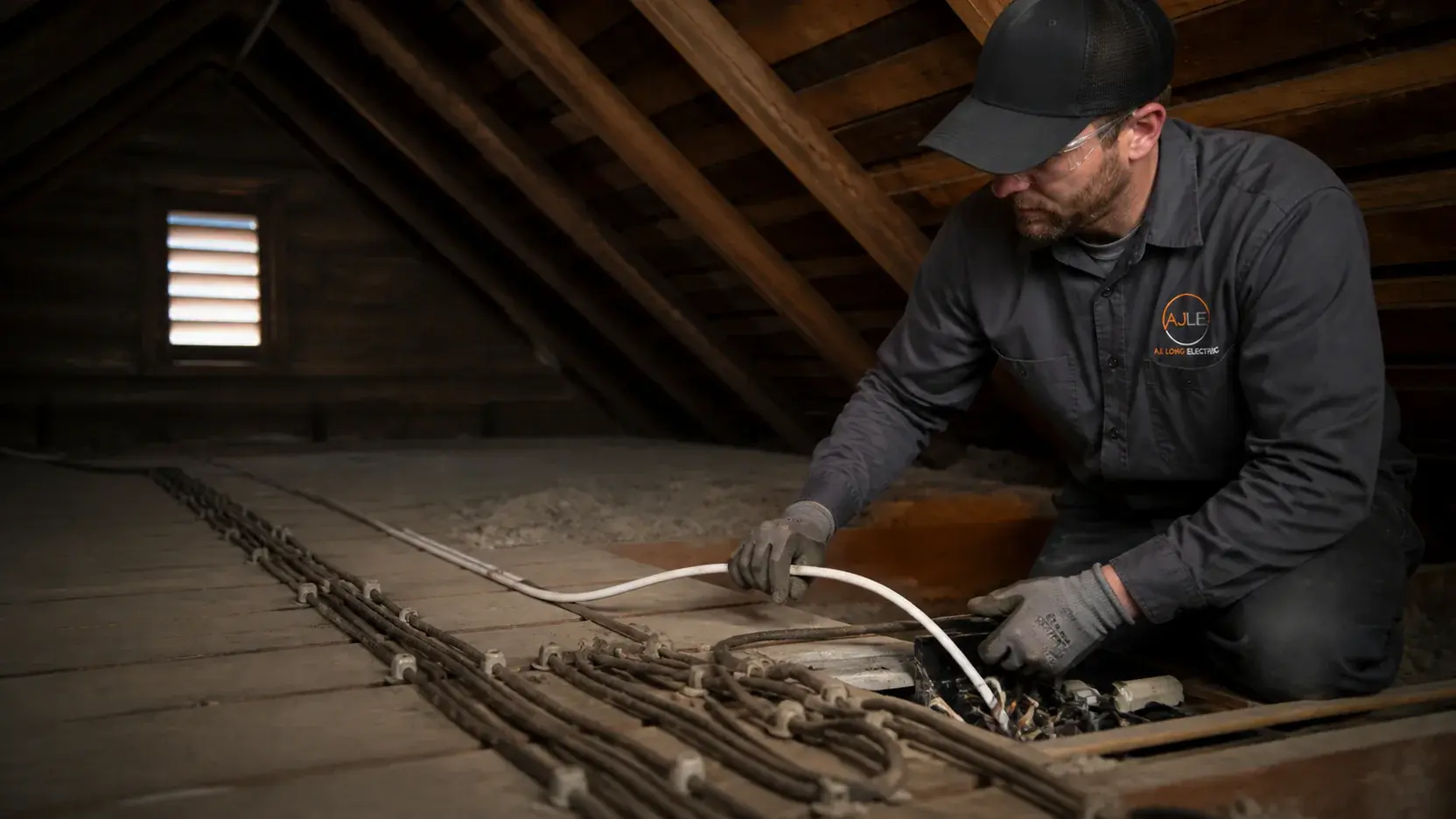
Knob-and-tube replacement starts by tracing older circuits and deciding how much of the system belongs in the current project. Work can be staged or comprehensive and may add grounding, while access openings and finish restoration remain separate planning questions.
- Licensed & insured
- Family-owned since 1996
4.9 ★ on our Fairfax, VA Google Profile (1,180+ Local Reviews)Backed by 1,463+ 4.9 ★ Reviews Across the DMV
2724 Dorr Ave, Suite 102, Fairfax, VA 22031Our Fairfax headquarters — where mail, dispatch, and our licensed electrical team have been based since 1996.
Field briefing / Fairfax, VA
Project briefing
Jurisdiction confirmed by property address
- Project
- Knob-and-Tube Wiring Replacement
- Use property records only to select inspection points; let the mapped active circuits and reachable routes establish the replacement boundary.
- Permit path
- City of Fairfax Code Administration for City addresses; Fairfax County Land Development Services outside the independent city
- Final jurisdiction is confirmed from the property address.
Scope first
What this project involves
Partial or full replacement
Choose a defined section, staged sequence, or broader replacement based on mapped circuits and homeowner priorities.
Access and deadlines
Plan attic and wall access, and account for any documented insurance deadline without assuming the restoration scope.
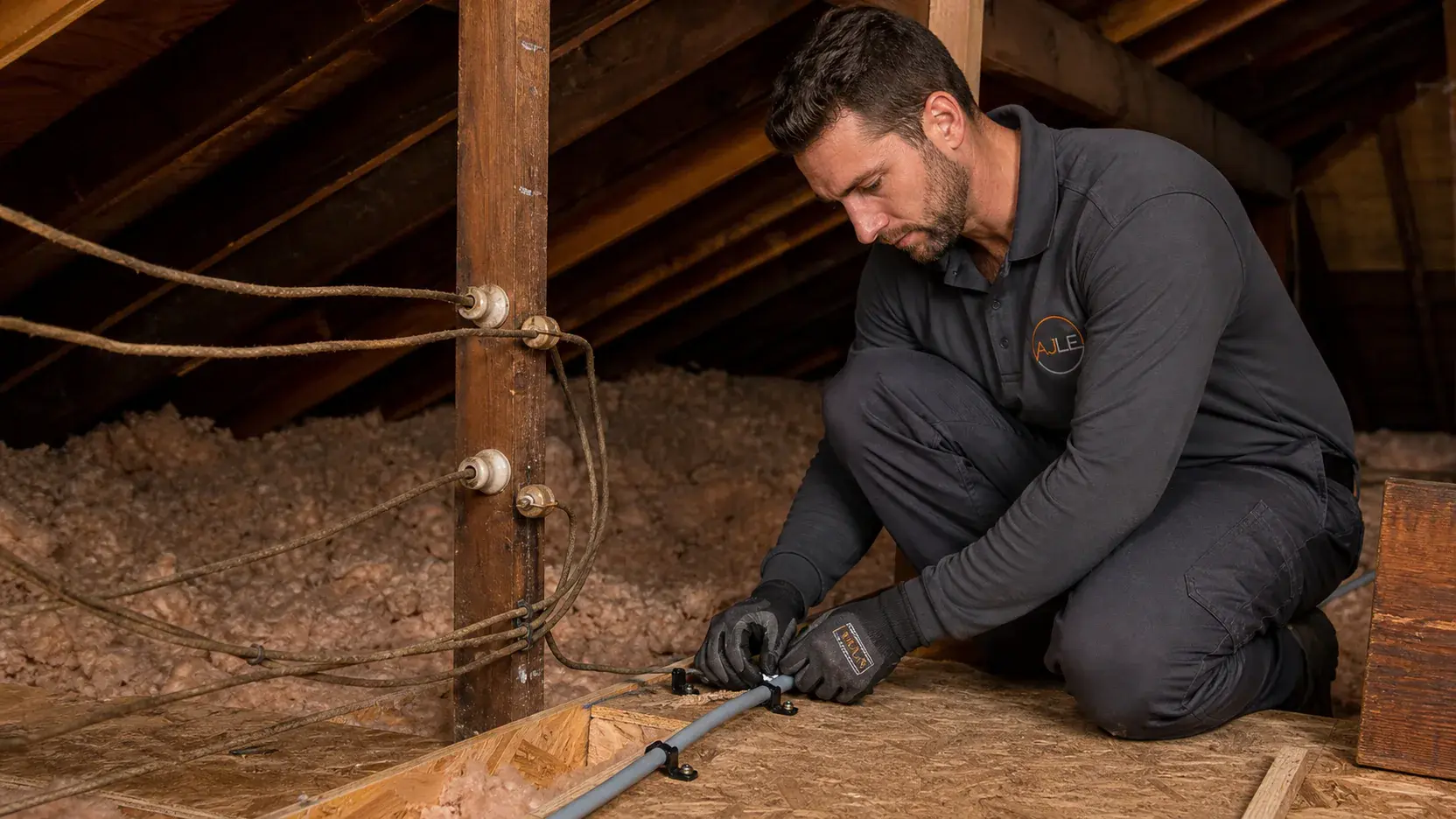
Field view / Knob-and-Tube Wiring Replacement
Representative field view for Knob-and-Tube Wiring Replacement; final scope is confirmed at the property.Address-specific planning
What matters in Fairfax
A Fairfax knob-and-tube inquiry is resolved through circuit evidence and the exact address, not a broad older-home assumption. City-versus-County review is assigned only after the active wiring and authorized work are defined.
Mantua, Fairfax City, and Fairfax Station demonstrate the postal-area boundary without identifying a wiring method. If older wiring is identified, we trace the served rooms, panel origin, and reachable junctions before comparing replacement scopes. City addresses use City of Fairfax Code Administration, while addresses outside the independent city use Fairfax County Land Development Services. Actual route access is assessed independently from that authority check.
Explore the Fairfax service areaProject fit / review at the property
- Mapping accessible older circuits under a property-specific City or County boundary
- Comparing a partial, staged, or full replacement scope from the verified active map
- Planning grounded replacement routes without converting an age cue into a wiring finding
Local housing & wiring
Planning electrical work in Fairfax
Knob-and-tube in Fairfax is a small-number problem, found in the oldest houses in Fairfax City and on a few early lots in Country Club Hills, while most Fairfax homes carry newer cable.
Most of Fairfax City and the surrounding county was developed from the 1950s onward, and neighborhoods like Mantua, Mosby Woods and Kings Park were built in the 1960s and 1970s with sheathed copper or, in some cases, aluminum cable. That means knob-and-tube is the exception here. The houses where it turns up tend to be early frame homes in the older blocks of Fairfax City, farmhouses that were absorbed into later subdivisions, or older cores buried inside big additions. In those houses the old circuits are often in the attic, in a basement ceiling, or tucked behind a 1950s kitchen, and a modern panel feeds a mix of old and new. Because a Fairfax address may sit in the City or in the county, the permit path is the first question. Properties inside the City go through City of Fairfax Code Administration, and those outside go through Fairfax County Land Development Services. We read the parcel, not the mailing address, before we describe a permit and inspection plan.
Quote inputs
Scope and cost drivers
Included in the defined scope
- Map accessible knob-and-tube circuits, devices, and served areas
- Define a partial, staged, or full replacement scope
- Plan grounded replacement circuits and updated connections
- Coordinate electrical access needs with separate finish-restoration planning
What can change scope and cost
- Number and reach of mapped older circuits
- Partial, staged, or full replacement scope
- Attic, wall, and ceiling access conditions
- Coordination required for finish restoration
Work sequence
From assessment to completion
- 01
Map the circuits
Trace accessible older wiring and identify the rooms, devices, and loads it serves.
- 02
Set the scope
Define whether the project covers selected areas, stages, or the mapped system more broadly.
- 03
Plan access
Choose replacement routes and identify openings or restoration coordination before work begins.
- 04
Replace and verify
Install the authorized grounded circuits, retire replaced wiring from service, and test the new work.
Property-specific answers
Local questions
Which Fairfax access paths are documented?
Attic access, wall access, and ceiling access are checked for the circuits included in the map. Any proposed opening is paired with the route it is intended to reach.
How can earlier Fairfax property records guide mapping?
They may identify a panel, room, or alteration to inspect, but the active circuit trace must verify the lead. The final record distinguishes City-versus-County context from electrical findings.
Is disconnected knob-and-tube in a Country Club Hills attic safe to leave in place?
Wiring that is truly disconnected at both ends is not a shock or heat hazard, but it has to be proven dead first, because old runs are sometimes fed from a junction nobody expected. We trace and test each run, then cut it back and mark it as abandoned so a later electrician or insulation crew knows it is out of service.
My Mantua house has two-prong outlets. Is that knob-and-tube?
Almost certainly not. Mantua homes date from the 1960s, well after knob-and-tube ended, so two-prong outlets there usually mean ungrounded sheathed cable or later wiring. That is a different fix, and we confirm by tracing what is behind the outlet before recommending anything.
What should I do if I find knob-and-tube while finishing a basement?
Stop before the ceiling or insulation goes in. Have the runs traced and tested, and decide whether they will be replaced or confirmed abandoned. It is far less disruptive to replace wiring while the joists are exposed than after the drywall is up.
Related Services
Related Services in Fairfax
Guides
Knob-and-Tube Wiring Replacement Planning Guides
Expert electrical guides to help you make informed decisions.
Beginner
Home Electrical Safety Inspection Checklist
A comprehensive room-by-room electrical safety checklist every homeowner should review regularly to identify potential hazards.
10 min read
Read GuideIntermediate
Understanding Electrical Permits in Northern Virginia
Navigate the electrical permit process in Northern Virginia with confidence. Learn requirements for Fairfax County, Arlington, Alexandria, and surrounding areas.
12 min read
Read GuideNearby Knob-and-Tube Wiring Replacement Service Areas
We also provide expert electrical services in these communities.
Next step / property-specific quote
Request a quote for Knob-and-Tube Wiring Replacement in Fairfax
Share the property address and project goal so the scope can be reviewed for your home.