
Chevrolet Bolt EV and Bolt EUV charging capability varies by model year and configuration. A home Level 2 circuit can provide more energy during a parking window than Level 1, but the result depends on the vehicle limit, starting and target charge, commissioned EVSE output, temperature, charging curve, and losses. This guide explains the inputs Northern Virginia homeowners should verify before selecting equipment and an electrical scope.
Key Takeaways
- The 2022+ Bolt EV/EUV features an 11.5 kW onboard charger supporting 48 amps; earlier models have a 7.2 kW charger supporting 32 amps.
- Knowing your model year determines the optimal charger and circuit sizing for your home.
- A ChargePoint Home Flex with adjustable amperage is the ideal choice for Bolt owners who may upgrade vehicles in the future.
- A 50-amp circuit accommodates all Bolt model years; a 40-amp circuit is sufficient for pre-2022 models.
- The myChevrolet app provides scheduling, preconditioning, and remote charge monitoring.
Chevrolet Bolt Charging Specifications by Model Year
The Bolt's charging capabilities changed significantly between model generations, making it important to know which version you own.
Ready to Install a Home EV Charger?
Our licensed electricians evaluate panel capacity, circuit routing, equipment requirements, and permit needs for home EV charging. Call (571) 444-6886 or request an estimate online.
2017-2021 Bolt EV
The first-generation Bolt EV comes with a 7.2 kW onboard charger that accepts up to 32 amps at 240 volts on Level 2. At maximum speed, it adds approximately 25 miles of range per hour. The 60 kWh battery charges from 20% to 100% in about 7-8 hours on a 32-amp charger, fitting into an overnight window. Installing a charger rated higher than 32 amps does not provide any speed benefit for these models, as the vehicle's onboard charger is the limiting factor.
2022+ Bolt EV and Bolt EUV
The refreshed 2022 model year brought an upgraded 11.5 kW onboard charger that accepts up to 48 amps on Level 2. This increases charging speed to approximately 32 miles of range per hour. The 65 kWh battery charges from 20% to 100% in about 6-7 hours. The Bolt EUV (the slightly larger crossover variant) shares the same charging hardware and battery capacity.
Charge Port Location
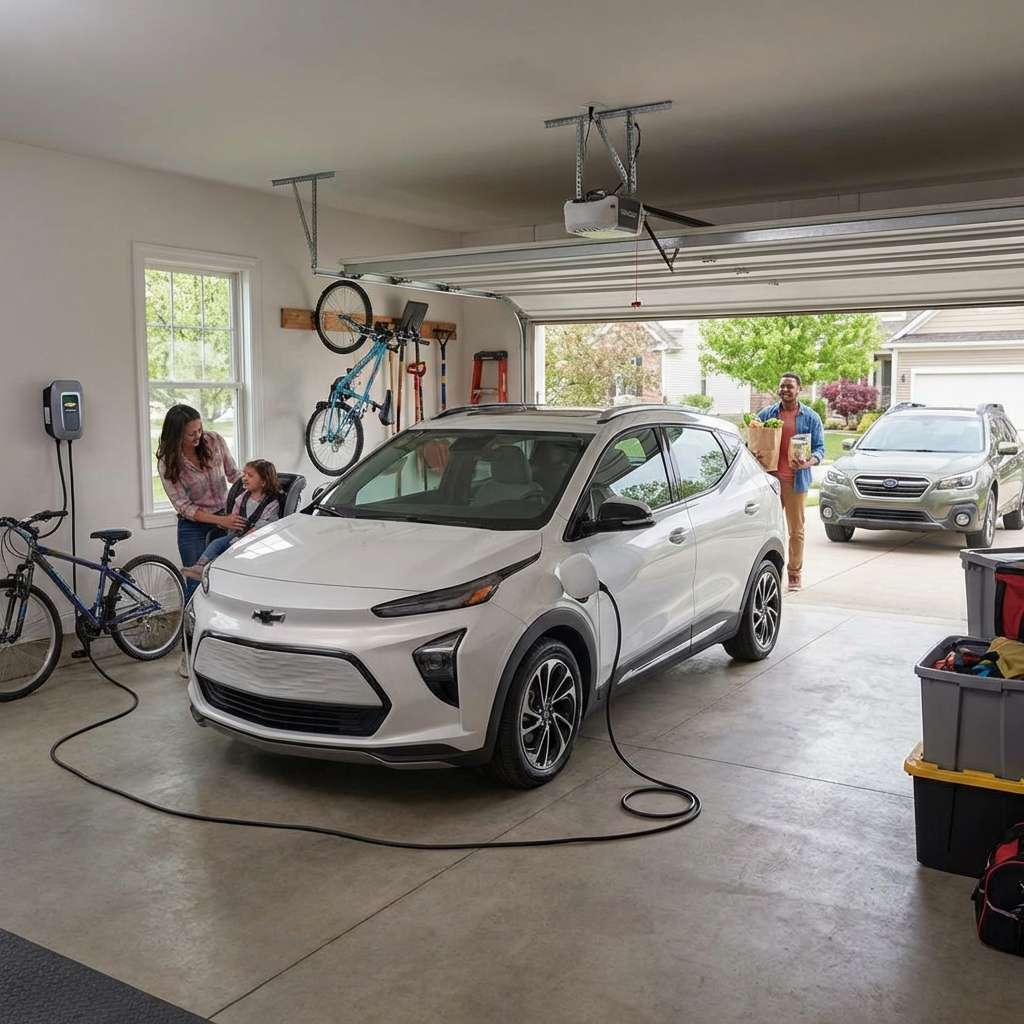
All Bolt models have the charge port on the driver's side front fender. Position your charger to reach this location comfortably. The included portable charger uses a J1772 connector, and all home Level 2 chargers with J1772 connectors are compatible.
Recommended Home Chargers for the Chevrolet Bolt
The right charger depends on your model year and whether you plan to keep the Bolt long-term or may upgrade to a different EV in the future.
For 2017-2021 Bolt EV Owners
Since the pre-2022 Bolt maxes out at 32 amps, you do not need a 40 or 48-amp charger for maximum speed. However, buying a higher-capacity charger future-proofs your installation for a future vehicle that may accept more power.
- Best value: A 32-amp charger like the Lectron V-Box 32 provides exactly the speed your Bolt can accept at the lowest price point.
- Best for future-proofing: The ChargePoint Home Flex set to 32 amps now, with the ability to increase to 50 amps for a future vehicle, provides maximum flexibility.
- Best budget option: The Grizzl-E Classic at 40 amps delivers more than the pre-2022 Bolt needs (the Bolt simply draws 32 amps from the available 40) while providing a rugged, reliable charger at an excellent price.
For 2022+ Bolt EV/EUV Owners
The upgraded onboard charger warrants a 48-amp home charger for maximum speed. Our recommended options include the ChargePoint Home Flex at 50 amps for full speed plus smart features, the JuiceBox 48 for equivalent speed with strong app integration, and the Grizzl-E Classic at 40 amps for a budget option that delivers 90% of maximum speed.
Good to know: If you own a pre-2022 Bolt and plan to keep it for several more years, installing a 40-amp charger on a 50-amp circuit is a smart middle ground. You get more charger than you need now, but you are ready for a future vehicle upgrade without any electrical changes. The Bolt simply draws what it needs (32 amps) from the charger's available capacity.
Circuit Requirements for Bolt Home Charging
Matching your circuit to your Bolt's needs ensures safe, efficient charging without overinvesting in infrastructure you do not need.
For Pre-2022 Bolt (32 Amps Max)
A 32-amp continuous load requires a 40-amp circuit breaker (32 times 1.25 equals 40). Conductor size depends on the wiring method, terminal ratings, route length, and voltage-drop design. A load calculation must confirm whether the existing panel can support the circuit. The typical Level 2 circuit-and-hookup range is $1,200–$3,500; the full long, detached, or outdoor range is $1,200–$4,500.
For 2022+ Bolt (48 Amps Max)
A 48-amp continuous load requires a 60-amp branch circuit. Conductor size depends on the wiring method, terminal ratings, route length, and voltage-drop design. This is the same branch-circuit rating used by many 48-amp wall connectors. The typical circuit-and-hookup range is $1,200–$3,500; the full long, detached, or outdoor range is $1,200–$4,500.
Future-Proof Option
If a future vehicle may require a different circuit, ask the electrician to evaluate a future-load alternate. Conductor ampacity is not determined by gauge alone, and a breaker change is not automatically sufficient; wiring method, insulation, terminals, route, derating, voltage drop, service and panel capacity, load calculation, EVSE listing, permit, and code must all be reviewed. Future reuse or savings is not guaranteed.
myChevrolet App and Charging Management
The myChevrolet mobile app provides comprehensive charging management for all Bolt models.
Charging Scheduling
Schedule charging to begin during off-peak Dominion Energy hours to minimize electricity costs. The app allows you to set departure times, and the Bolt calculates when to start charging to reach your target level by departure. This feature works with any home charger, not just the GM-branded option.
Hilltop Reserve and Target Charge Level
The Bolt offers a "Hilltop Reserve" or "Target Charge Level" setting that limits charging to less than 100%, typically around 90%. This preserves long-term battery health by avoiding the stress of sitting at maximum charge. For daily driving in Northern Virginia, setting an 80-90% target provides ample range while extending battery lifespan.
Preconditioning
During cold Northern Virginia winters, use the app to precondition the cabin 10-15 minutes before departure. When plugged in, preconditioning uses grid power rather than battery power, preserving your driving range. The Bolt's heat pump (on newer models) makes this process particularly efficient.
Remote Monitoring
Check charge status, current battery level, and estimated range from anywhere through the app. Verify your Bolt is plugged in and charging while you are at work in Tysons or Reston, ensuring you always come home to a charged vehicle.
Pro tip from our team: The Chevrolet Bolt includes a portable EVSE that can plug into either a 120V standard outlet (Level 1) or a 240V outlet. If you already have a NEMA 14-50 outlet in your garage (from an RV hookup or electric dryer), try the included charger on 240V before investing in a separate wall-mounted unit. At 32 amps, the included charger provides the same Level 2 speed as any aftermarket charger for pre-2022 models. Many Bolt owners find the included charger is sufficient for their needs.
Bolt-Specific Installation Considerations
A few unique factors affect Bolt charging installations.
Battery Conditioning Delays
In extreme cold or heat, the Bolt may delay charging while it conditions the battery to an acceptable temperature. This is normal behavior controlled by the battery management system. It does not indicate a problem with your charger or installation. During Northern Virginia summer heat waves, you may notice a brief delay before charging begins if the vehicle has been sitting in direct sun.
One-Pedal Driving and Regenerative Braking
While not directly related to home charging, the Bolt's efficient one-pedal driving mode helps maximize your range, reducing how much energy you need to replace each night. Northern Virginia's stop-and-go traffic on I-66 and I-495 is actually ideal for regenerative braking, helping the Bolt recapture energy that gas cars simply waste as heat.
Get Your Bolt Home Charger Installed
AJ Long Electric designs home charging for Bolt EV and EUV owners across Northern Virginia. We match the circuit and charger to your specific model year and the home's calculated capacity. Our team handles permits and inspections across Fairfax, Arlington, Loudoun, and Prince William counties. Contact AJ Long Electric at (571) 444-6886 to discuss home charging for your Chevrolet Bolt.
Authoritative Sources
- U.S. DOE: Electric Vehicle ChargingFederal reference on EV charging levels, equipment, and home installation.
- NFPA 70: National Electrical Code (NEC)The NEC is the foundational safety standard for electrical wiring and installation in the U.S.
- ENERGY STAREPA program identifying energy-efficient products and practices.
Key Facts
| 2017–2021 Bolt onboard charger | 7.2 kW, accepts up to 32 amps |
|---|---|
| 2022+ Bolt EV/EUV onboard charger | 11.5 kW, accepts up to 48 amps |
| Charge speed | ~25 mi/hr (pre-2022) to ~32 mi/hr (2022+) |
| Circuit for pre-2022 Bolt | 40-amp breaker, 8-gauge copper |
| Circuit for 2022+ Bolt | 60-amp breaker, 6-gauge copper |
| Connector | J1772 (universal Level 2 standard) |
Frequently Asked Questions
How fast can a Chevy Bolt charge at home on Level 2?
It depends on the model year. The 2017-2021 Bolt EV has a 7.2 kW onboard charger that accepts up to 32 amps at 240 volts, adding about 25 miles of range per hour and charging the 60 kWh battery from 20% to 100% in roughly 7-8 hours. The 2022+ Bolt EV and Bolt EUV have an upgraded 11.5 kW onboard charger that accepts up to 48 amps, adding about 32 miles per hour and charging the 65 kWh battery from 20% to 100% in roughly 6-7 hours.
What size circuit do I need for a Chevy Bolt?
For a pre-2022 Bolt (32 amps max), the continuous load requires a 40-amp branch circuit. A 2022+ Bolt accepting 48 amps requires a 60-amp branch circuit. Conductor sizing depends on wiring method, terminal ratings, route length, and voltage-drop design. Either circuit and hookup typically falls within $1,200–$3,500; the full long, detached, or outdoor range is $1,200–$4,500. Charger hardware is separate.
Is a 48-amp charger worth it for an older Bolt?
No, not for speed. The 2017-2021 Bolt’s onboard charger caps at 32 amps, so it will only ever draw 32 amps even from a higher-capacity charger. Installing a 40-amp charger on a 50-amp circuit can still be a smart middle ground for future-proofing, because the 6-gauge wire used for a 50-amp circuit is the same gauge needed for a 60-amp circuit, so only the breaker needs changing if you later buy a vehicle that accepts 48 amps.
Do I even need a wall-mounted charger for my Bolt?
Not necessarily. The Bolt includes a portable EVSE that plugs into either a 120V outlet (Level 1) or a 240V outlet. If you already have a NEMA 14-50 outlet in your garage from an RV hookup or electric dryer, the included charger delivers 32 amps on 240V, which is the same Level 2 speed as any aftermarket unit for pre-2022 models. Many Bolt owners find the included charger sufficient for their daily needs.
How should I set charging to protect my Bolt’s battery?
Use the myChevrolet app’s "Hilltop Reserve" or "Target Charge Level" setting to cap charging below 100% (around 90%), which preserves long-term battery health by avoiding the stress of sitting at full charge. For daily Northern Virginia driving, an 80-90% target provides ample range while extending battery lifespan. Schedule charging for off-peak Dominion Energy hours to lower costs, and in winter use plugged-in preconditioning so cabin heating draws grid power instead of battery range.
Tags:
ChevroletBolthome chargingsetup
VA License #2705031092
25+ Years Combined Experience

Written by
Matt Long
General Manager
Licensed & Insured in VA, MD & DCBackup Power & Battery InstallsEV Charging Specialists
Our team of licensed electricians brings 25+ years of combined experience serving Northern Virginia. We're committed to providing expert electrical solutions with a focus on safety, quality, and customer satisfaction.
Panel UpgradesEV ChargersGeneratorsLightingCommercialSmart Home
AJ Long Electric · Led by John Long, Master Electrician · VA License #2705031092 · View Credentials