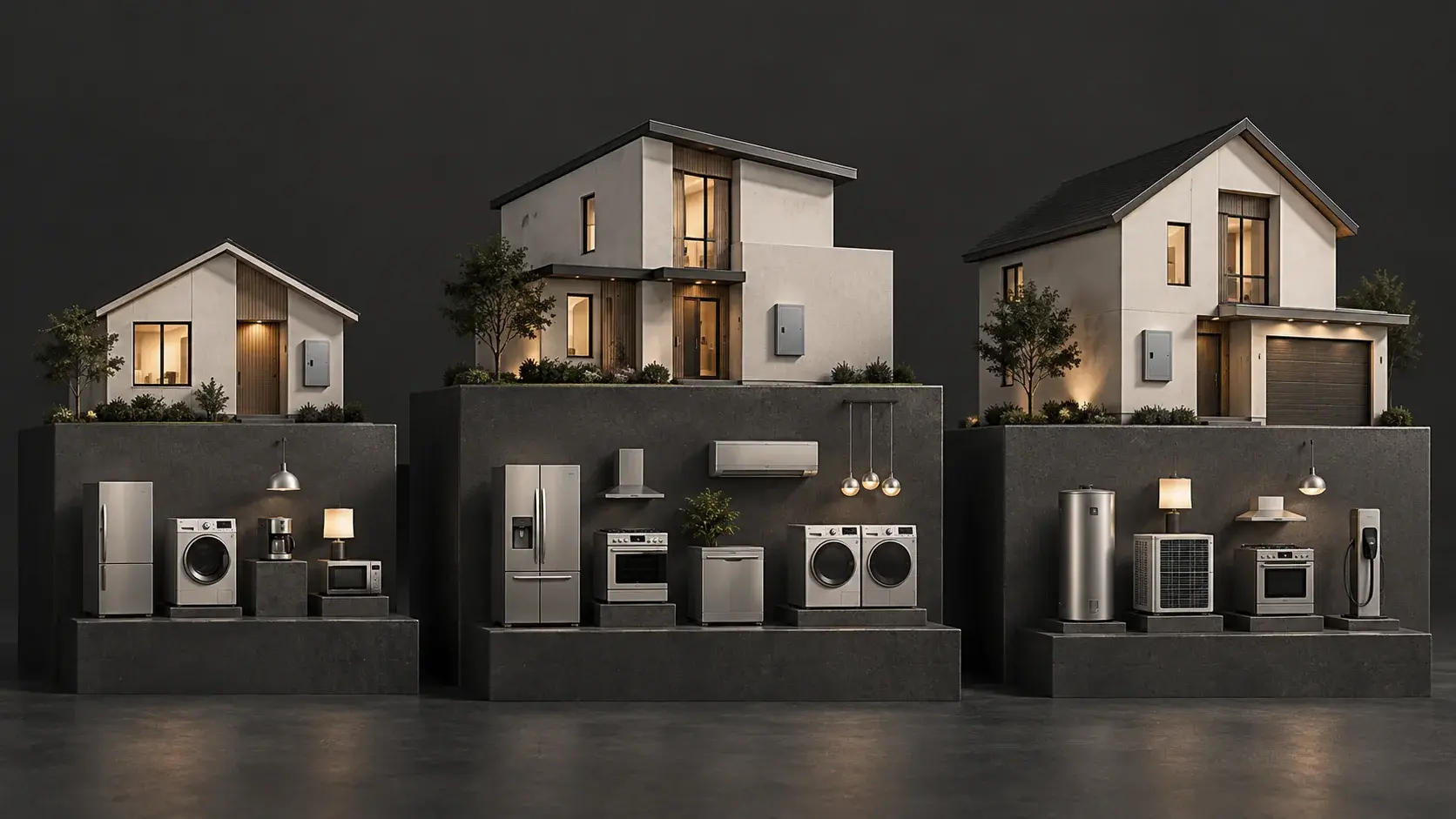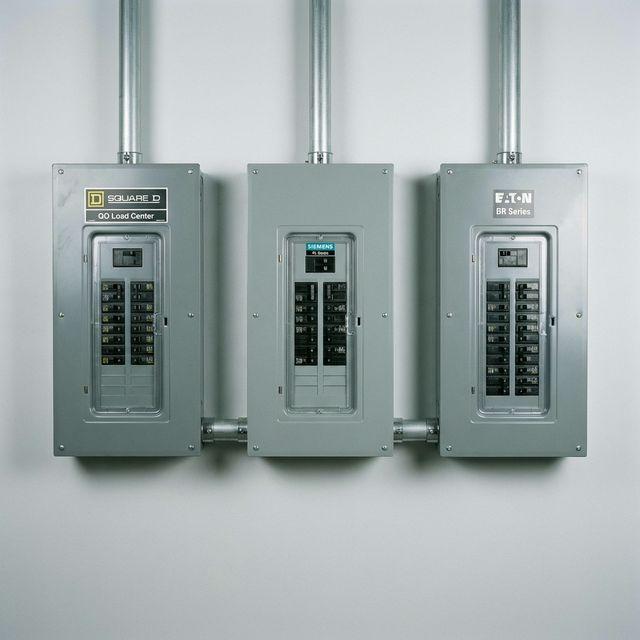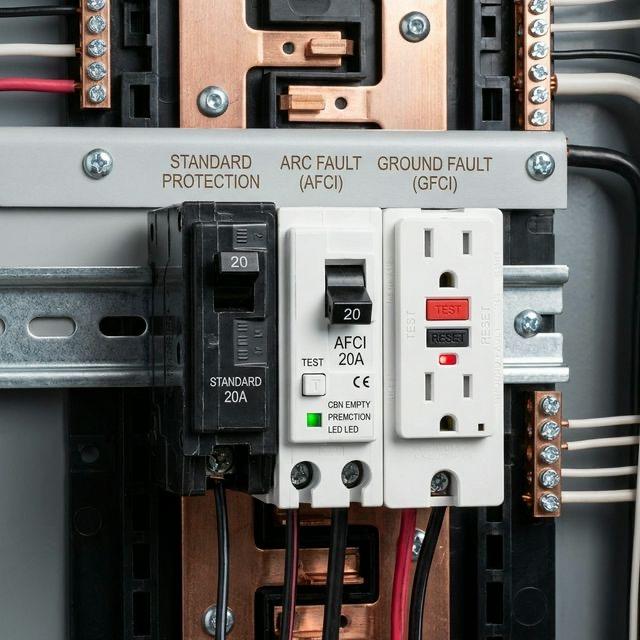

“Residential panel” and “commercial panel” are shorthand for how distribution equipment is commonly applied, not a strict rule that every home uses one design and every business uses another. In practice, load centers appear in homes and some light-commercial spaces, while panelboards can be configured for single-phase or three-phase systems with either plug-on or bolt-on breakers. The right equipment depends on the utility supply at the building, the actual equipment nameplates, fault-current ratings, and the jurisdiction’s permit path.
Key Takeaways
- Do not rely on a simple residential-versus-commercial label; match the enclosure, bus, and breakers to the building’s actual voltage, phase, calculated load, and available fault current.
- Per Eaton’s load-center fundamentals, load centers serve residential and light-commercial applications, and panelboards can use plug-on or bolt-on breakers in single- or three-phase configurations.
- Adding a subpanel does not change single-phase 120/240V service into three-phase power; verify equipment nameplates before purchasing commercial appliances or machinery for a home or tenant space.
- Permitting depends on building classification and scope, not just the word on the box—confirm whether your project follows a residential or commercial review path with the local authority.
Why “Load Center vs. Panelboard” Is Not a Strict Home-vs.-Business Binary
Many comparison guides draw a hard line: homes get single-phase 120/240V load centers with plug-on breakers up to 400 amps, and commercial buildings get three-phase 120/208V or 277/480V panelboards with bolt-on breakers above 400 amps. That summary misses where the two categories overlap and where mistakes happen.
Need a Commercial Electrician?
From fleet EV charging to panel upgrades and full tenant build-outs, our licensed team handles commercial electrical projects across Northern Virginia with minimal disruption to your operations. Call (571) 444-6886 to discuss your project.
Eaton’s load-center fundamentals explain that load centers are used in residential and light-commercial applications, while panelboards are available in single-phase and three-phase designs and can accommodate plug-on or bolt-on circuit breakers depending on the chassis and product family. Small offices, retail bays, and multifamily units frequently operate below 400 amps or use single-phase distribution, while some larger residences and outbuildings require multi-panel distribution or higher-duty equipment. Always verify the exact model’s listing, voltage rating, interrupting rating, and installation instructions rather than relying on general terminology.
Decision Table: Matching Distribution Equipment to the Actual Project
Before selecting a panel or approving a tenant buildout, evaluate the electrical inputs that actually govern equipment compatibility:
| Decision input | Typical detached-home scope | Light-commercial, multifamily, or specialty scope | What must be verified first |
|---|---|---|---|
| Utility supply, voltage, and phase | Usually single-phase 120/240V (some multifamily units receive two legs of a 120/208V system) | Single-phase 120/240V, three-phase 120/208V, or three-phase 277/480V depending on building service | Check the serving utility supply, transformer, and meter arrangement at the address |
| Equipment nameplates | Household HVAC, cooking, laundry, water heating, EV charging | Commercial kitchen appliances, three-phase HVAC/motors, lighting systems, process equipment | Confirm exact nameplate voltage, phase, minimum circuit ampacity, and overcurrent protection |
| Fault-current and duty ratings | Standard residential load center ratings matched to utility fault current | Higher available fault current or continuous-duty demands may require specific panelboard ratings | Verify available fault current and listed series or interrupting ratings for the panel and breakers |
| Breaker mounting and enclosure | Listed plug-on breakers in an indoor or outdoor residential load center | Load center or panelboard with plug-on or bolt-on breakers and enclosure sized for conduit/wire bending space | Match breaker family, mounting style, and NEMA enclosure type to the environment and raceways |
| Metering and tenant coordination | Single utility meter serving one dwelling | Multi-metering, house panels, tenant subpanels, or landlord shutdown rules | Confirm meter sockets, disconnect grouping, working space, and building access windows |
| Permit and plan-review path | Residential electrical permit tied to the scope of work | Commercial permit, tenant layout review, or design-professional submittal where required | Check the local building department’s classification and submittal rules for the exact property |
Voltage and Phase: Why a Subpanel Alone Cannot Run Incompatible Equipment
One of the most expensive mistakes we see is a homeowner or small-business tenant buying used commercial espresso machines, ovens, compressors, or shop tools before checking the building’s electrical service. Installing a new subpanel in a single-phase 120/240V home does not create three-phase power, and a piece of equipment rated strictly for 208V or three-phase input may not operate properly—or safely—on a 240V single-phase circuit.
Conversely, in some condominiums, apartments, and mixed-use buildings supplied from a three-phase 120/208V network, an individual unit’s panel receives 120/208V single-phase power across two hot legs. Standard 240V heating elements and certain appliances operate at reduced output on 208V unless specified for that voltage. Have a licensed electrician check the supply voltage at the panel and review the equipment cut sheets before ordering appliances or machinery.
Load Calculations and Future Capacity Without Arbitrary Rules of Thumb
Square footage alone—such as assuming every home over a certain size needs commercial switchgear or that every commercial panel needs a fixed 25% expansion multiplier—does not determine panel selection. Load calculations follow the National Electrical Code (NEC) rules applicable to the occupancy and the actual connected and continuous loads:
- Dwelling units: Calculations account for general lighting and receptacle area, small-appliance and laundry circuits, fixed appliances, HVAC equipment, EV charging, and applicable demand factors. Compare capacity options in our 100A vs. 200A vs. 400A service guide.
- Commercial and mixed-use spaces: Calculations evaluate continuous lighting, receptacle allowances, specific appliance and motor loads, HVAC nameplate data, and any documented future equipment the owner wants designed into the feeder and bus capacity.
- Emergency and standby systems: Not every commercial building requires an emergency generator or automatic transfer switch. Life-safety, legally required standby, and optional standby equipment depend on building occupancy, fire-code requirements, and what the owner chooses to back up.
Permits and Building Classification in Northern Virginia
Whether a project follows a residential or commercial permit path depends on how the local authority classifies the building and the scope—not simply whether a load center or panelboard is installed. For example, Fairfax County’s residential electrical permit guidance applies to detached one- and two-family dwellings and townhouses under the residential code, while certain apartment, condominium, and commercial occupancy scopes follow commercial permitting and plan-review requirements. Fairfax also sets scope-dependent design requirements for larger services.
Independent cities (such as the City of Fairfax, Falls Church, and Alexandria) and neighboring jurisdictions in Arlington, Loudoun, Prince William, Montgomery County, and Washington, D.C., maintain their own permit portals and submittal thresholds. Confirm the permit path, any required engineering drawings, and utility coordination for your exact address before work is scheduled.
Comparing Scope and Project Costs
For a typical residential 200-amp panel upgrade in Northern Virginia, AJ Long Electric’s current public range is $3,500–$7,500, with the written proposal defining the exact load center, breakers, grounding and bonding work, permit, and utility coordination. You can also compare residential product families in our electrical panel brand guide.
Light-commercial panelboards, tenant buildouts, multi-panel residential services, and three-phase equipment connections are quoted per project after we inspect the existing service, verify equipment nameplates, and confirm permitting and utility requirements. Review our panel upgrade services or request a free project estimate to have our team evaluate your home or business distribution equipment.