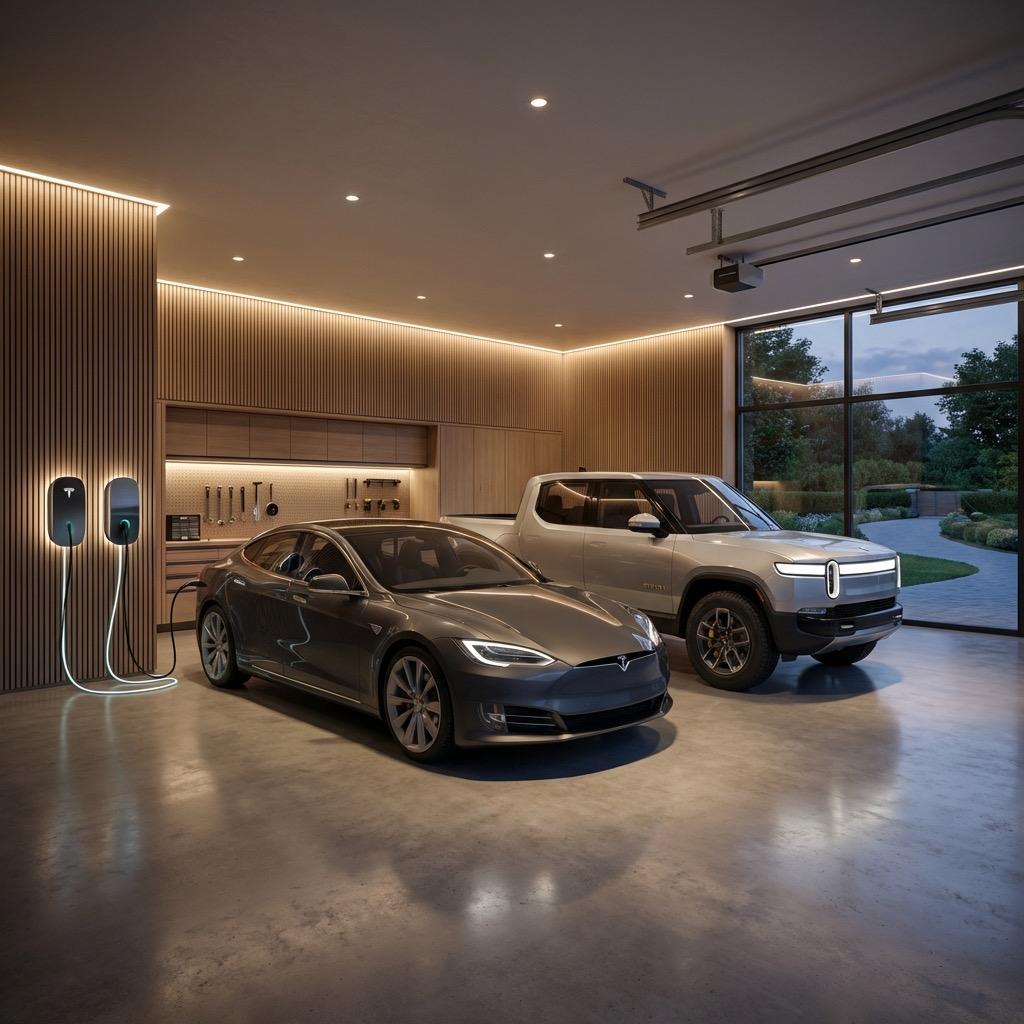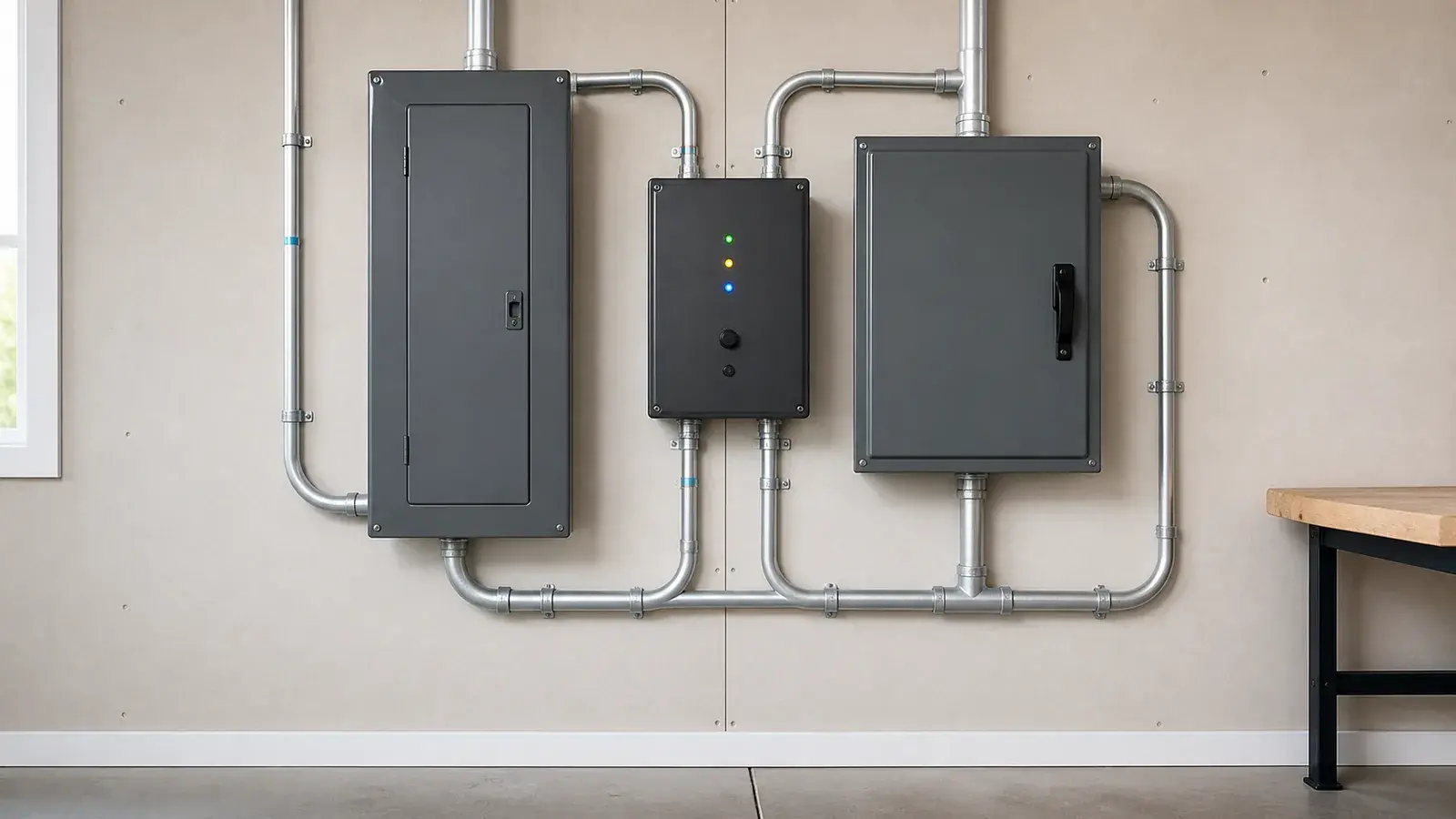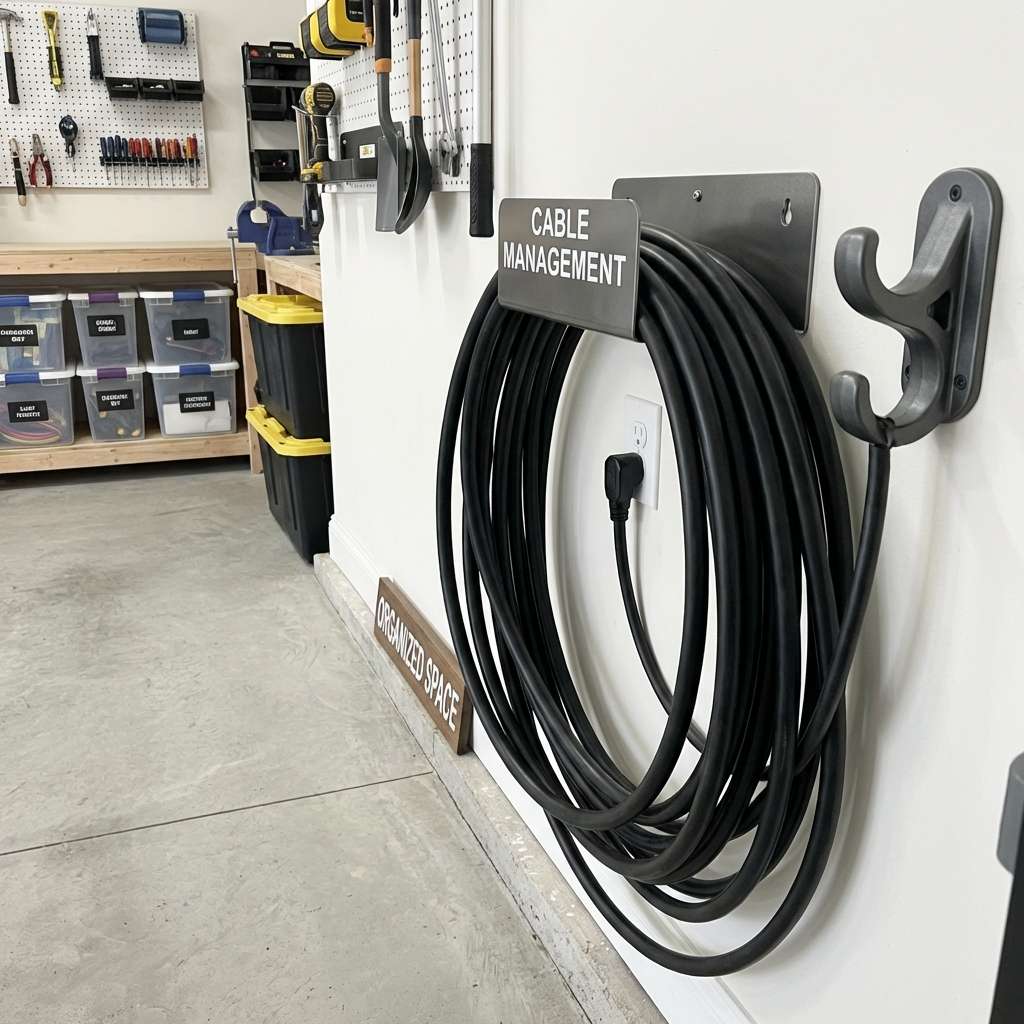

Plan the charger around the parked vehicle and a clear walking route, then use the equipment’s approved holster or cable support. Avoid driving over, pinching, tightly bending or extending the charging cable. Mounting height and bend limits come from the exact equipment and site, not a universal garage rule.
Start with the parking layout
Mark where the car normally stops and where its charge port actually sits. Do this for both vehicles if a unit may serve two parking spaces. Measure the practical cable route around the car, not a straight line through its body. Allow comfortable reach without pulling the connector sideways. Check that an open garage door, stored equipment and a second vehicle will not pinch the cable.
The shortest electrical wiring route is not always the best daily charging location. A charger near the panel can still put its cable across the door into the house. Compare mounting positions before committing to a circuit route. Keep stairs, exits and normal walking paths clear.
Choose support that suits the equipment
An integrated holster is often the simplest storage point. A separate holster must match the connector and retain it as intended. A broad, smooth cable support can hold a loose loop when allowed by the manufacturer. Avoid sharp hooks, small-radius corners or tight ties that pinch the jacket.
Ready to Install a Home EV Charger?
Our licensed electricians evaluate panel capacity, circuit routing, equipment requirements, and permit needs for home EV charging. Call (571) 444-6886 or request an estimate online.
Retractors add moving parts, a mounting load and repeated bending. They are not automatically compatible with every EVSE cable. Get approval for the cable-handling method and mounting orientation; do not turn a wall-mounted charger into a ceiling unit merely because an overhead arrangement looks tidy. Where an accessory is unsuitable, moving the wall unit or changing the parking orientation may be the better answer.
Use the manual for height, bend limits and storage
There is no single 42-to-48-inch mounting rule that fits every charging unit and user. Product instructions, site conditions and applicable accessibility requirements determine the placement. Likewise, do not apply a generic four-to-six-inch bend radius to every cable. Preserve the manufacturer’s specified clearances and cable shape.
ChargePoint provides its Home Flex installation guide for its own equipment. Use the matching manual for another model rather than borrowing its mounting dimensions. Arrange excess length as directed, and distinguish storage while disconnected from cable handling during an active session.
Keep the cable out of damage paths
Do not drive over a cable or close a garage door on it. Do not pull the connector out by the cable or use it to support other objects. Before moving the car, disconnect as the vehicle instructs and return the connector to its holder. If a cable or connector is damaged, gets unusually hot or shows scorching, stop using it and follow manufacturer service guidance. Tape is not a repair for damaged charging insulation.
Look at accessible surfaces without touching connector contacts, inserting tools or opening the charging unit. Cleaning methods vary by equipment; use its instructions instead of adding solvents, sprays or a universal contact-cleaning routine.
Outdoor parking and shared spaces
Use equipment and accessories rated for the actual exposure, and place the stored connector away from standing water and routine impact. An outdoor rating does not mean a connector can be left submerged. The route must also work when vehicles, bins or seasonal items are in their ordinary places.
A cable across a sidewalk or another person’s parking space raises access and permission issues beyond cable storage. Do not assume a cable cover authorizes that route. Confirm property boundaries, shared-space approval and any local right-of-way requirements. A home charging extension cable or improvised adapter is not a substitute for a suitable installation location.
What to include in the estimate request
Send wide photos of the parking area, the charger and vehicle models, approximate cable length, normal walking route and the proposed mounting surface. Photos from a safe standing position are sufficient; do not open equipment or climb to inspect framing. Identify any retractor or accessory you want so compatibility and support can be checked before quoting.
AJ Long Electric can include cable reach and accessory mounting in an EV installation scope. Hardware and unusual mounting work should be identified in the written estimate. For two cars, the two-EV planning guide helps compare placement and charging demand together. Cable management improves the route and storage arrangement; it is not a guarantee against all damage or trips.