
Installing an EV charger in a townhouse or condominium presents unique challenges that single-family homeowners never encounter. HOA approvals, shared parking structures, long conduit runs, metering questions, and neighbor considerations all add complexity to what is otherwise a straightforward electrical project. For the thousands of townhouse and condo owners across Northern Virginia, from the high-rise condos of Rosslyn and Ballston to the townhouse communities of Reston, Herndon, Centreville, and Woodbridge, this guide navigates the complete process from HOA approval through installation and inspection.
Key Takeaways
- Review current Virginia law, association documents, and legal advice for the specific property rather than assuming approval.
- Association review timing follows the governing documents, meeting calendar, completeness of the submission, and current queue.
- Townhouse and condominium scope depends on panel ownership, service capacity, parking rights, common areas, route, metering, fire-rated construction, and access.
- A typical Level 2 circuit and hookup is $1,200–$3,500; only long, detached, outdoor, trenched, shared-building, or otherwise complex routes extend to the $1,200–$4,500 total band.
- EVSE, sub-metering, and other control hardware are separate.
Understanding Your Rights: Virginia EV Charger Law
Before diving into the installation process, it is important to understand your legal rights as a Virginia homeowner in a community association.
Ready to Install a Home EV Charger?
Our licensed electricians evaluate panel capacity, circuit routing, equipment requirements, and permit needs for home EV charging. Call (571) 444-6886 or request an estimate online.
Virginia Code Section 55.1-1823.1
Virginia law explicitly addresses EV charger installation in common interest communities. The law prohibits HOAs from completely banning EV charger installation in parking spaces that an owner has exclusive use of, whether deeded, assigned, or designated. The HOA can impose reasonable restrictions regarding insurance requirements, installation standards and licensed contractor requirements, aesthetics and placement guidelines, compliance with building codes, and responsibility for electricity costs and damage. However, the HOA cannot use these restrictions to effectively prevent installation or make it prohibitively expensive through unreasonable requirements.
What This Means for You
If your HOA denies your EV charger request outright, review Virginia Code Section 55.1-1823.1 and the association documents, and consider obtaining legal advice about your specific rights. A complete professional plan can help the board evaluate equipment, routing, insurance, permits, and restoration without relying on unsupported approval promises.
The HOA Approval Process
Most HOAs require an architectural review or modification request before any exterior or electrical work. Here is how to navigate this process smoothly.
Step 1: Review Your Governing Documents
Before submitting a request, review your HOA's Declaration of Covenants, Conditions and Restrictions (CC&Rs) and Architectural Guidelines for any existing provisions regarding EV chargers. Some newer community documents in Loudoun and Prince William County developments already include EV charger provisions.
Step 2: Prepare a Professional Proposal
HOA boards respond better to thorough, professional submissions. Include a description of the proposed charger and its specifications, the exact installation location with photos or diagrams, the routing path for any conduit or wiring, confirmation that a licensed electrician will perform the work, proof of liability insurance from your contractor, and a timeline for the installation. AJ Long Electric provides detailed installation proposals specifically formatted for HOA submissions, including diagrams and specification sheets.
Step 3: Submit and Follow Up
Submit the request through the association's official architectural-review process and keep proof of delivery. Meeting calendars, review periods, and response rules vary; use the governing documents and current association guidance rather than assuming a turnaround.
Step 4: Address Conditions
If the association approves with conditions, such as conduit color, routing, restoration, metering, or insurance provisions, have the electrician document how those requirements change the design, price, permit path, and schedule before proceeding.
Good to know: If you are the first person in your community to install an EV charger, a complete professional submission can give the association a useful template for future requests. Include equipment specifications, routing, insurance, permits, restoration, and the responsible contractor.
Townhouse EV Charger Installation
Townhouse installations are generally simpler than condo installations because townhouses typically have individual electrical panels, attached or tuck-under garages, and direct access to the installation area without passing through common spaces.
Garage Installations
If your townhouse has an attached garage, the installation may resemble a single-family home installation when the panel and parking space are close. A typical circuit and hookup is $1,200–$3,500; charger hardware is separate. The route and load calculation still determine the final scope.
Driveway Installations
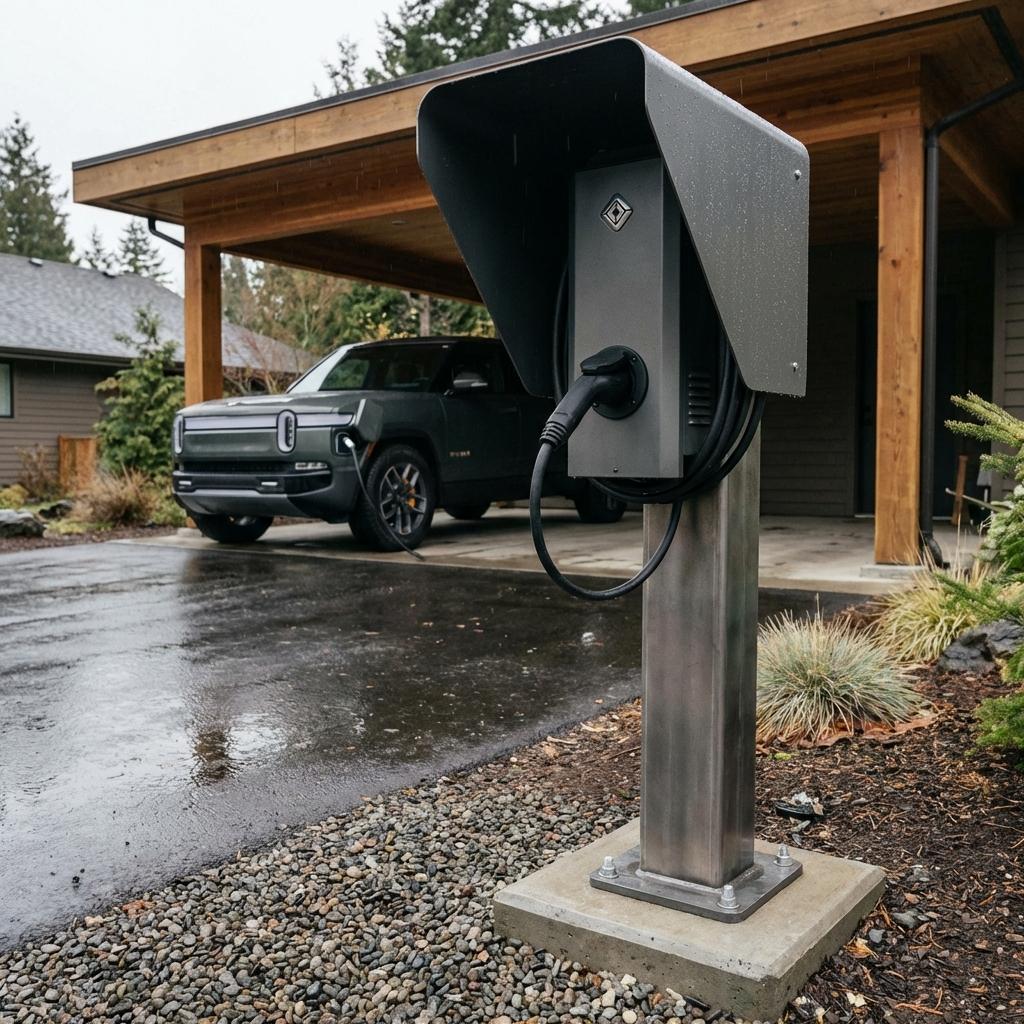
Some townhouses have driveways but no garages. In these cases, the charger may mount outside and the circuit may pass from an interior panel through the exterior wall. Weatherproof wiring methods and listed outdoor equipment are required. A typical circuit and hookup is $1,200–$3,500; only a documented long, detached, outdoor, trenched, or otherwise complex route extends to the $1,200–$4,500 total band, with EVSE hardware separate.
Parking Pad Installations
Townhouses with assigned parking pads away from the unit may require longer or underground raceway routes. Only a documented long, detached, outdoor, trenched, shared-property, or otherwise complex route extends to the $1,200–$4,500 total band; unusually complex multi-unit work is quoted per project. EVSE and pedestal hardware are separate.
Condominium EV Charger Installation
Condo installations are the most complex residential EV charger projects due to the shared building infrastructure and the distance between your unit's electrical panel and your parking space.
Parking Garage Considerations
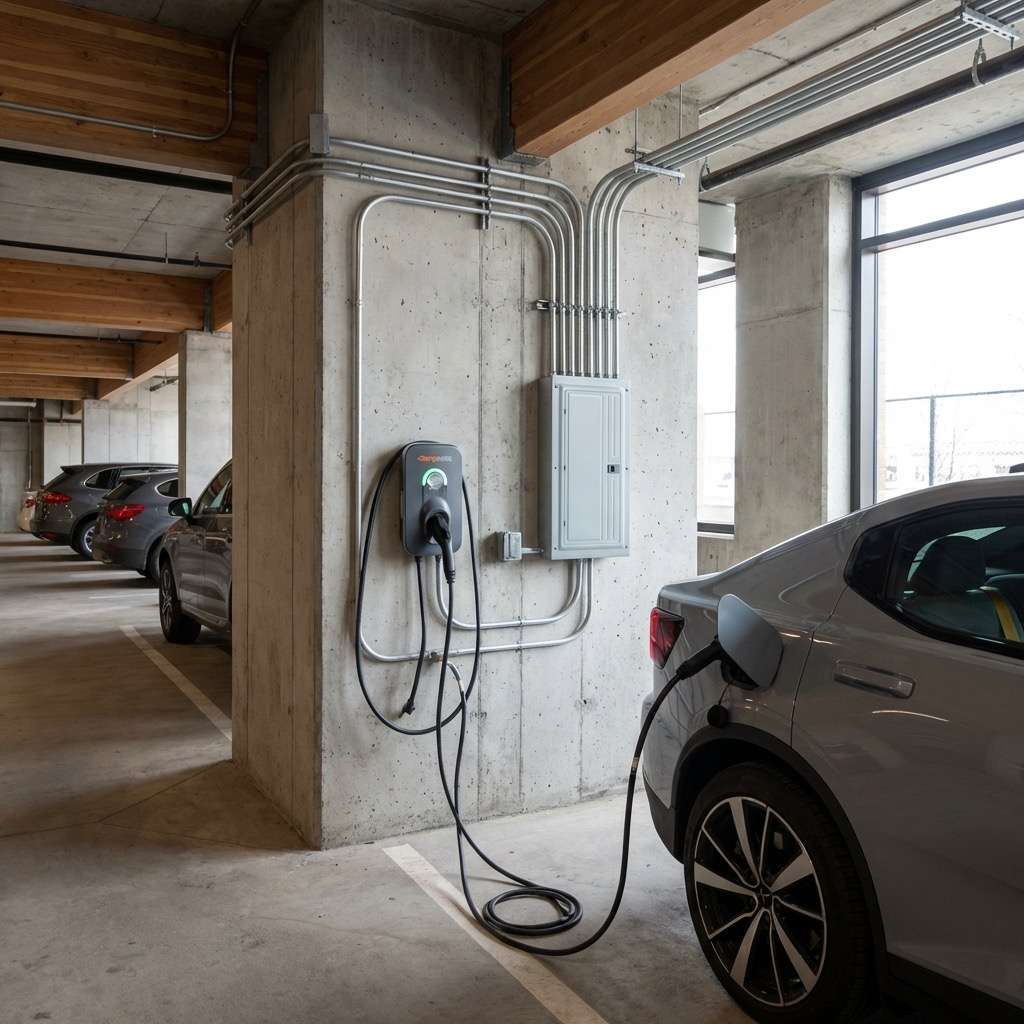
In condo buildings with parking garages, power may come from a unit panel, house service, or an approved charging system. The raceway may pass through common areas, utility chases, floors, or garage structure. A documented long, shared-building, fire-rated, or otherwise complex route may extend to the $1,200–$4,500 total band; unusually complex multi-unit work is quoted per project after capacity, metering, routing, and access review.
Metering and Electricity Costs
If EVSE connects to a unit panel, charging may be reflected on that account. A common-service design may require listed sub-metering, networked billing, or another association-approved allocation method. Metering and control hardware are separate and quoted after service, compatibility, association, utility, and authority review; billing accuracy and allocation outcomes depend on the selected system.
Building Management Coordination
Condo installations often require coordination with building management for access to utility chases, common area conduit routing, fire code compliance in parking structures, and scheduling work during building-approved hours. Our team has experience coordinating with condo management companies throughout the Arlington, Tysons, and Reston areas.
Fire Code Compliance
Parking garages have specific fire code requirements that affect EV charger installation. Conduit must be routed to avoid fire suppression systems, and some jurisdictions require fire-rated materials for electrical runs through certain areas. Your electrician must be familiar with these requirements to ensure a code-compliant installation.
Pro tip from our team: If you live in a condo building and multiple residents want EV chargers, coordinate your installations. A single project serving multiple spaces may share conduit routes and present one unified proposal to building management. The actual per-unit cost depends on service capacity, metering, fire-rated routing, and the approved design.
Cost Breakdown for Townhouse and Condo Installations
Here are typical cost ranges for the Northern Virginia area based on our installation experience.
- Typical attached-garage or nearby-space circuit and hookup: $1,200–$3,500
- Long, detached, outdoor, trenched, shared-building, or otherwise complex route: $1,200–$4,500 total band only when those conditions are documented
- Complex condo or multi-unit design: Quoted per project after route, capacity, metering, and access review
The circuit-and-hookup ranges include the electrical scope described in the proposal. EVSE, sub-metering, networking, pedestal, and other control hardware are separate.
Get Your Townhouse or Condo Charger Installed
AJ Long Electric documents the service and panel, listed equipment, route, metering, association, permit, inspection, utility, fire-rated construction, restoration, and access inputs for proposed townhouse and condominium EV charging work. The written scope identifies coordination responsibilities; the association and authority make their own approval decisions. Contact (571) 444-6886 to request an assessment.