
Whether home or public charging costs less depends on the customer's current utility tariff, rate-plan enrollment, vehicle efficiency, charging losses, annual mileage, public-station price and fees, equipment, installation scope, and charging behavior. Use live inputs for a personal comparison; AJ Long Electric does not guarantee an annual savings amount, time savings, or payback period.
Key Takeaways
- Use the current all-in home tariff and actual public-station price, membership, session, parking, and idle fees.
- Measure vehicle efficiency and include charging losses rather than relying on a universal miles-per-kWh assumption.
- Rate-plan eligibility and whole-home usage determine whether scheduled charging changes the total bill.
- A typical Level 2 circuit and hookup is $1,200–$3,500; only long, detached, outdoor, trenched, or otherwise complex routes extend to the $1,200–$4,500 total band, and EVSE hardware is separate.
- No annual savings, time-savings, or installation-payback result is guaranteed.
Is It Cheaper to Charge an EV at Home or at a Public Charging Station?
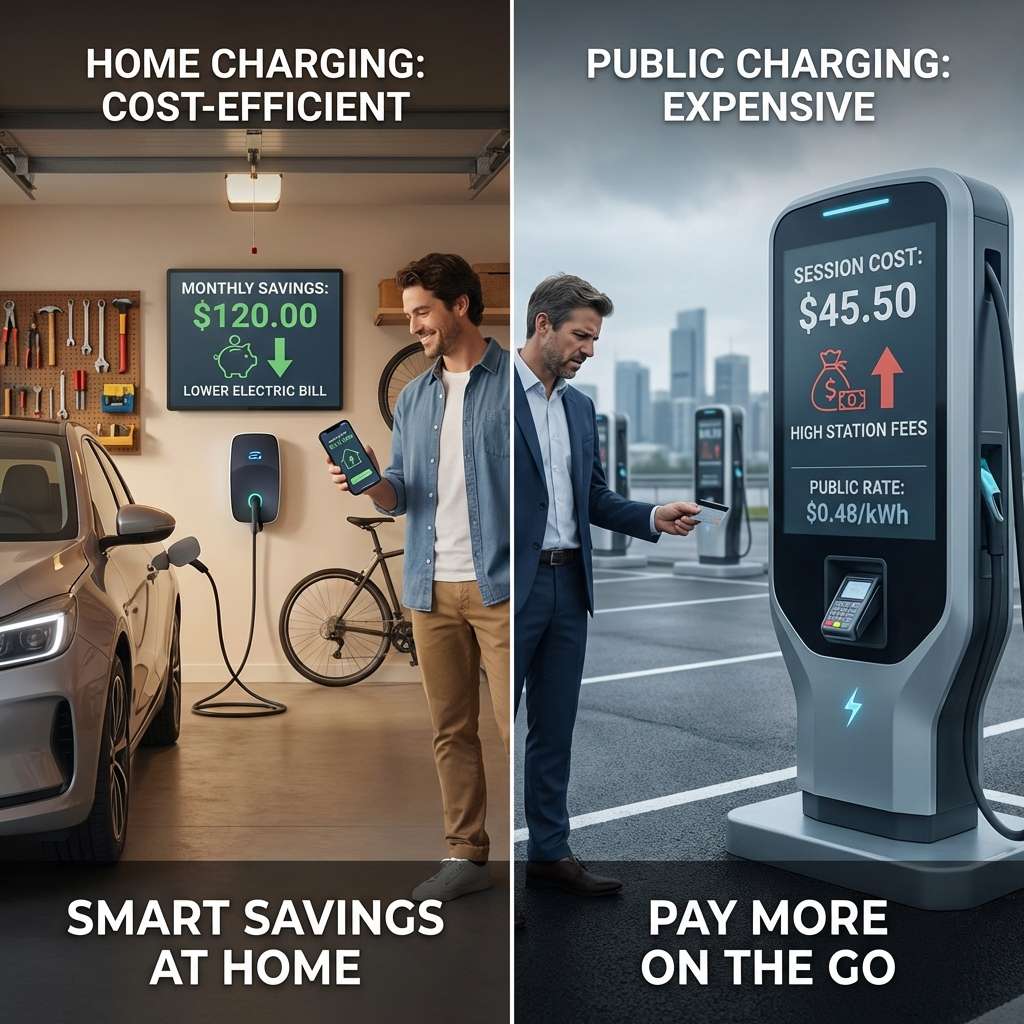
Calculate each option from live inputs. Home cost per mile equals the all-in utility price per kWh divided by measured vehicle miles per kWh, adjusted for charging losses. Public cost per mile uses the station's actual energy, session, membership, parking, and idle fees divided by miles added. Results vary by driver, vehicle, season, network, and plan.
Ready to Install a Home EV Charger?
Our licensed electricians evaluate panel capacity, circuit routing, equipment requirements, and permit needs for home EV charging. Call (571) 444-6886 or request an estimate online.
Home Charging Costs in Northern Virginia
Home charging cost depends on your electricity rate and your vehicle's efficiency. Here is a detailed breakdown using real Northern Virginia numbers.
Dominion Energy Electricity Rates
Use the customer's current bill and the utility's live tariff. Include energy, delivery, riders, taxes, minimum charges, time windows, event controls, and whole-home usage. A time-of-use plan does not automatically lower the total bill, and terms can change.
Cost Per Charge
For a charging session, multiply utility-billed kWh by the applicable all-in rate and add any plan-specific charges. Battery capacity, starting and target state of charge, charging losses, temperature, conditioning, and vehicle limits affect billed energy. Do not infer per-mile cost from battery size alone.
Cost Per Mile
Use the vehicle's measured miles and utility-billed charging energy over a representative period. Weather, speed, HVAC use, route, tires, payload, battery conditioning, and charging losses change the result. For a gasoline comparison, use the comparison vehicle's measured fuel economy and current local fuel price.
Monthly and Annual Home Charging Costs
Monthly and annual home-charging cost equals miles driven divided by measured miles per utility-billed kWh, multiplied by the applicable all-in tariff. Use actual mileage, bills, rate windows, and charging losses; do not assume a universal monthly bill increase.
Measurement note: Compare at least one representative billing period and separate EV charging kWh where the vehicle or EVSE can report it. App estimates may differ from utility-billed energy, and other household loads or weather can obscure the change.
Public Charging Costs in the DMV Area
Public charging costs vary widely depending on the network, speed level, and pricing structure. Here are typical rates for the major networks operating in Northern Virginia.
Level 2 Public Charging
Public Level 2 pricing is set by the station host or network and may be billed by energy, time, session, membership, parking, or a combination. Check the station's live price and idle rules in the network app or on the charger before starting; historical network averages are not a promise for a specific location.
DC Fast Charging
DC fast-charging prices and access vary by network, station, time, power level, vehicle, connector, membership, demand, parking, and idle fees. Review the live station price and vehicle compatibility before relying on it for a comparison.
Public Charging Cost Per Mile
Calculate public cost per mile from the actual session total, energy delivered, charging losses, and miles added. Membership, parking, idle fees, temperature, and charging curve can materially change the result.
Head-to-Head Annual Cost Comparison
Build the annual comparison with the same measured mileage and vehicle-efficiency basis for every option. Home charging uses the current all-in tariff and billed kWh. Public charging uses actual session totals and fees. A fuel comparison uses measured MPG and current fuel price. Include installation and separately priced EVSE hardware only when calculating total ownership cost.
Annual Savings from Home Charging
Subtract the calculated annual totals to estimate a scenario-specific difference. Rates, fees, mileage, efficiency, charging mix, weather, and equipment can change, so the result is not consistent or guaranteed year over year.
How Long Does Home Charging Take vs Public Charging?
Time depends on battery state, vehicle charging curve, selected circuit, EVSE output, temperature, route to a public station, availability, wait, and charging target. Track the driver's actual sessions and detours rather than using a universal annual time-savings figure.
Public Charging Time Costs
A public session may involve a detour, wait, connection, charging, and return to the route. Measure actual session and travel time for the locations the driver would use; vehicle charging curves, station output, congestion, and availability vary.
Home Charging Time Investment
Home charging may reduce dedicated station trips, but it still involves connection, cable handling, parking access, and occasional troubleshooting. Compare the driver's actual routine, public-station use, and equipment rather than assigning a universal time value.
Planning note: Build a home-versus-public charging comparison from your own annual mileage, vehicle efficiency, home and public charging rates, installation scope, and time spent at public stations. Those inputs vary by driver and utility plan, so no annual savings amount or payback period is guaranteed.
When Public Charging Still Makes Sense
Home charging should be your primary charging strategy, but public charging has its place.
Road Trips
DC fast charging along interstate corridors is essential for road trips. Northern Virginia sits at the intersection of I-95, I-66, and I-81, providing excellent fast charging coverage for trips to the beaches, mountains, or other cities.
Opportunity Charging
Free or low-cost Level 2 charging at shopping centers, workplaces, and restaurants provides a convenient top-off while you are already stopped for another reason. Taking advantage of free charging at a Tysons Corner mall while shopping adds range at zero cost.
Emergency Top-Offs
If an unexpectedly long day of driving depletes your battery before you get home, a quick DC fast charge adds enough range to get home safely.
Request a Project-Specific Home Charging Scope
AJ Long Electric installs listed home charging equipment for Northern Virginia homeowners who want convenient overnight charging. The financial comparison with public charging depends on annual mileage, vehicle efficiency, utility rates, public-station pricing, equipment, and installation scope; AJ Long Electric does not guarantee an annual savings amount or payback period. Contact AJ Long Electric at (571) 444-6886 to request a project-specific installation proposal.