
Level 1 and Level 2 charging differ in circuit requirements and charging rate. A typical Level 2 circuit and hookup is $1,200–$3,500; only long, detached, outdoor, trenched, or otherwise complex routes extend to the $1,200–$4,500 total band. EVSE hardware is separate.
Key Takeaways
- Charging rate depends on the vehicle and EVSE, not a universal miles-per-hour promise
- A typical Level 2 circuit and hookup is $1,200–$3,500
- Only long, detached, outdoor, trenched, or otherwise complex routes extend to the $1,200–$4,500 total band
- EVSE hardware is separate; supplied equipment is billed under the published equipment-markup policy
- Confirm current utility rate-program terms directly with the utility; no savings or payback outcome is guaranteed
Level 1 vs Level 2 EV Charger Comparison Table
Every factor that separates the two charging levels, side by side.
Ready to Install a Home EV Charger?
Our licensed electricians evaluate panel capacity, circuit routing, equipment requirements, and permit needs for home EV charging. Call (571) 444-6886 or request an estimate online.
| Factor | Level 1 (120V) | Level 2 (240V) |
|---|---|---|
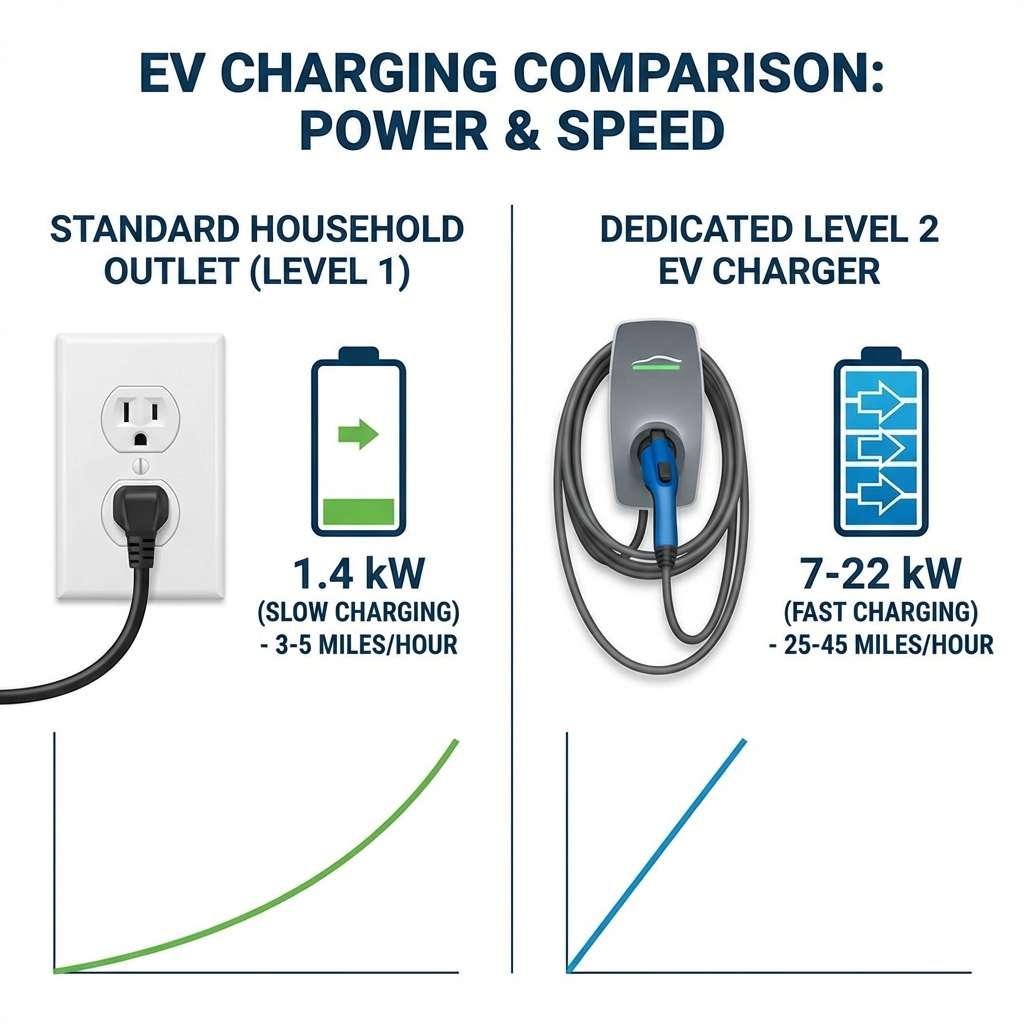
| Charge rate | 3-5 miles of range per hour | 25-40 miles of range per hour |
| Amperage | About 12 amps | 16-48 amps |
| Circuit needed | Standard 120V household outlet (15- or 20-amp circuit) | Dedicated 240V circuit with a 20-60 amp breaker (50-amp is most common) |
| Electrical scope | Existing listed receptacle must be evaluated | $1,200–$3,500 typical; $1,200–$4,500 total band only for long, detached, outdoor, trenched, or otherwise complex routes; EVSE hardware separate |
| Power delivered | ~1.4 kW | 3.8-11.5 kW |
| Full charge time (60 kWh battery) | 40-50 hours | 5-8 hours |
| Permit required | No | Yes (all Northern Virginia jurisdictions) |
| Best for | Plug-in hybrids, drivers under 20 miles per day | Daily battery-electric driving |
Understanding Level 1 Charging (120V)
Level 1 charging is the simplest form of EV charging. Every electric vehicle sold in the United States includes a portable Level 1 cord set that plugs into a standard grounded 120-volt household outlet — no installation required. At 120 volts and roughly 12 amps, it delivers about 1.4 kW, which works out to 3-5 miles of driving range per hour. For a typical EV with a 60 kWh battery, charging from 20% to 100% takes 40-50 hours — nearly two full days.
The practical limitation is daily driving. If you drive 40 miles per day, a common Northern Virginia commute, you need 8-13 hours of Level 1 charging just to replace that day's miles. One busy evening or early departure and you fall behind. For battery-electric vehicles with 60-100 kWh packs, Level 1 simply cannot keep pace with moderate daily use.
Understanding Level 2 Charging (240V)
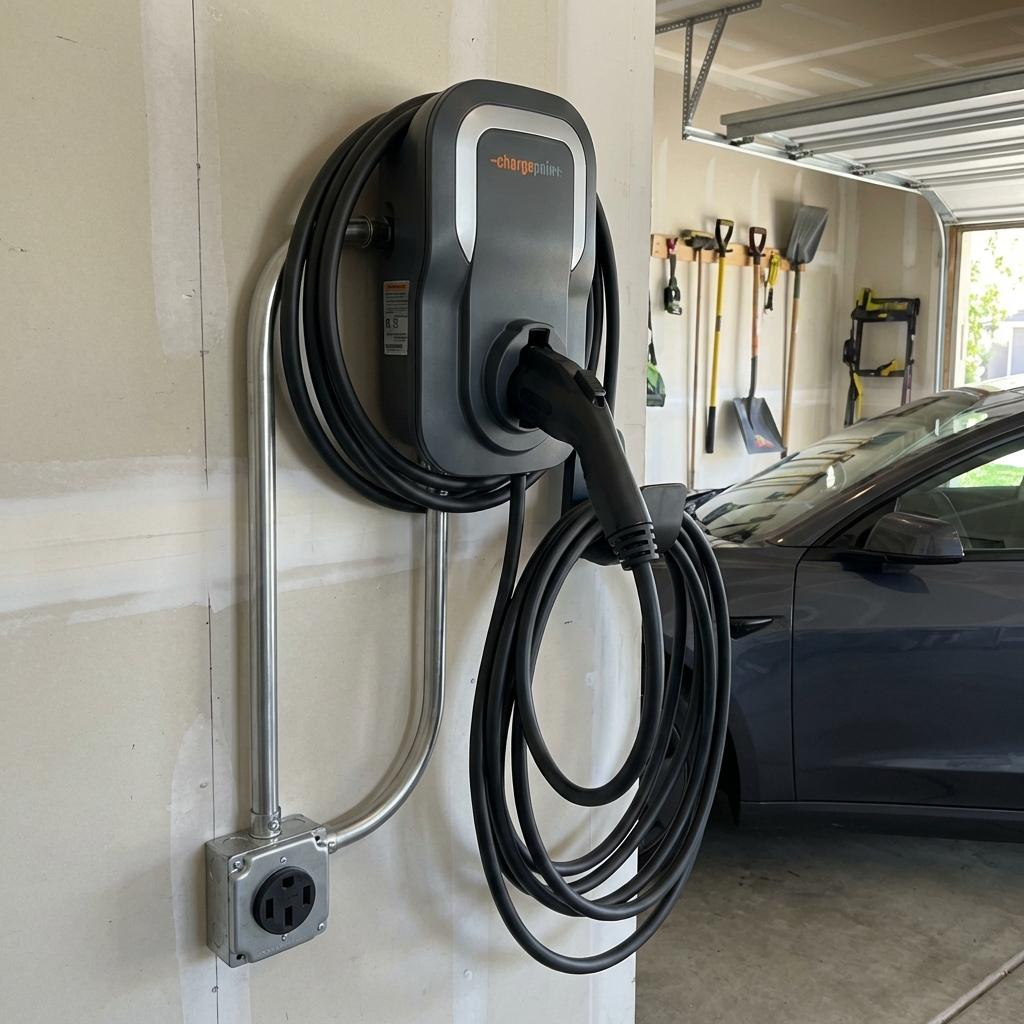
Level 2 charging uses a dedicated 240-volt circuit, the same voltage that powers your electric dryer or oven. The charger is either hardwired or plugged into a NEMA 14-50 or 6-50 outlet, on a breaker sized 20-60 amps depending on the unit. Delivering 3.8-11.5 kW, Level 2 adds 25-40 miles of range per hour; a 60 kWh battery refills from 20% to 100% in 5-8 hours, comfortably inside an overnight window.
A typical Level 2 circuit and hookup is $1,200–$3,500; only long, detached, outdoor, trenched, or otherwise complex routes extend to the $1,200–$4,500 total band. EVSE hardware is separate. If a load calculation establishes that a 200-amp panel upgrade is required, the separate panel range is $3,500–$7,500. Permit requirements are confirmed for the address.
Level 1 vs Level 2 Charging Cost
The utility bills energy by kilowatt-hour regardless of charging level. Current rates and programs change, so confirm them directly with the utility. The Level 2 electrical scope is $1,200–$3,500 typical, with the $1,200–$4,500 total band applying only to long, detached, outdoor, trenched, or otherwise complex routes; EVSE hardware is separate.
Cost Per Mile
Cost per mile depends on the vehicle's measured efficiency, charging losses, current utility tariff, rate-plan enrollment, schedule, weather, and the comparison fuel or public-station price. Use those address- and vehicle-specific inputs rather than a universal cost or savings claim.
Comparing Rate Plans
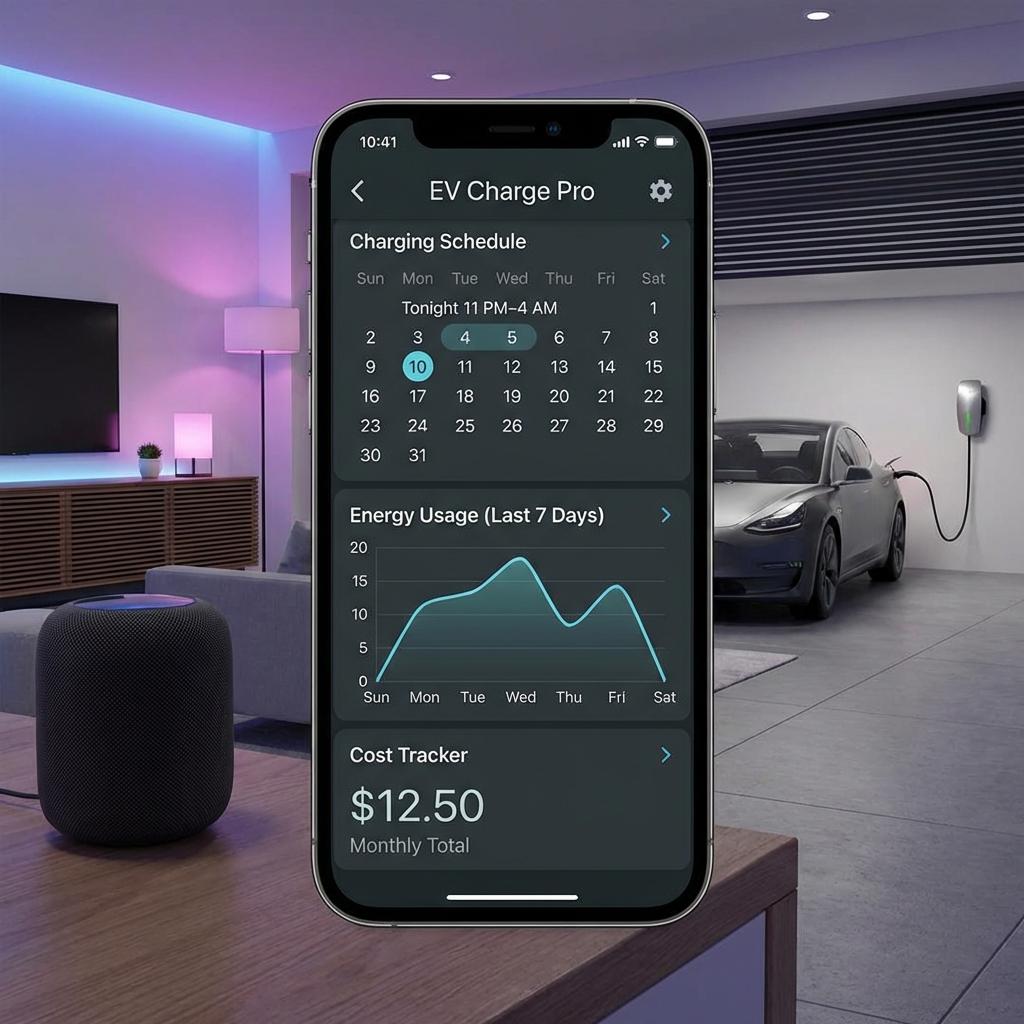
Level 2 equipment can support scheduled charging, but an off-peak rate is not automatic. Confirm the current utility tariff, eligibility, enrollment terms, event controls, charging window, and whole-home usage before estimating cost. Vehicle efficiency, charging losses, mileage, and schedule determine the result; AJ Long Electric does not guarantee an annual savings amount.
Total Cost of Ownership
A typical Level 2 circuit and hookup is $1,200–$3,500; only documented long, detached, outdoor, trenched, or otherwise complex routes extend to the $1,200–$4,500 total band, and EVSE hardware is separate. There is no universal payback period. The federal Section 30C credit is unavailable for equipment placed in service after June 30, 2026; review the current IRS guidance and a qualified tax professional. AJ Long Electric does not provide tax advice.
Do I Need a Level 2 Charger?
You need a Level 2 charger if you drive more than about 30 miles a day in a battery-electric vehicle. At Level 1's 3-5 miles of range per hour, a 40-mile day takes 8-13 hours to replace — longer than most overnight windows once real life intervenes. If you drive fewer than 20 miles a day, own a plug-in hybrid, or the EV is a rarely driven second car, Level 1 is usually enough.
When Level 1 Is Enough
- Plug-in hybrids: Small 10-18 kWh batteries fully recharge on Level 1 in 6-12 hours, and the gas engine backs you up regardless.
- Short commutes: Under 20 miles per day, Level 1 replenishes overnight without strain.
- Secondary or weekend vehicles: A car that sits most of the week can trickle-charge between uses.
- Temporary housing: If you are renting or between homes, Level 1 avoids investing in an installation you will leave behind.
When You Need Level 2
- You drive more than 30 miles per day on a regular basis
- You own a battery-electric vehicle rather than a plug-in hybrid
- Your schedule varies and you need the battery ready regardless
- You want off-peak time-of-use rates, which require completing a charge inside the overnight window
- Two EVs share one driveway — Level 1 cannot keep up with both
Planning tip: Compare your daily mileage, overnight parking window, vehicle's onboard charging limit, existing receptacle condition, panel capacity, utility rate plan, and future vehicles before choosing Level 1 or Level 2.
Making Your Decision
Level 2 is often considered when Level 1 cannot replenish the driver's measured daily use within the available parking window. The actual charging result depends on the vehicle, circuit, EVSE settings, temperature, battery state, and schedule. Level 1 may remain practical for some plug-in hybrids, lower-mileage driving, or temporary situations.
AJ Long Electric installs listed Level 2 EV charging equipment across Fairfax, Vienna, Arlington, Loudoun, and Prince William counties. Our licensed electricians assess the panel and service, load calculation, selected EVSE, route, permit, inspection, utility, and access inputs, then provide a project-specific work window in the written scope. Call (571) 444-6886 to discuss the charging setup for your home.