
Plug-in versus hardwired is a choice about equipment, connections, and daily use. It is not simply a choice between cheap and expensive, or slow and fast. Decide how the charger will be used, then compare complete installation scopes at an appropriate output.
What each connection actually provides
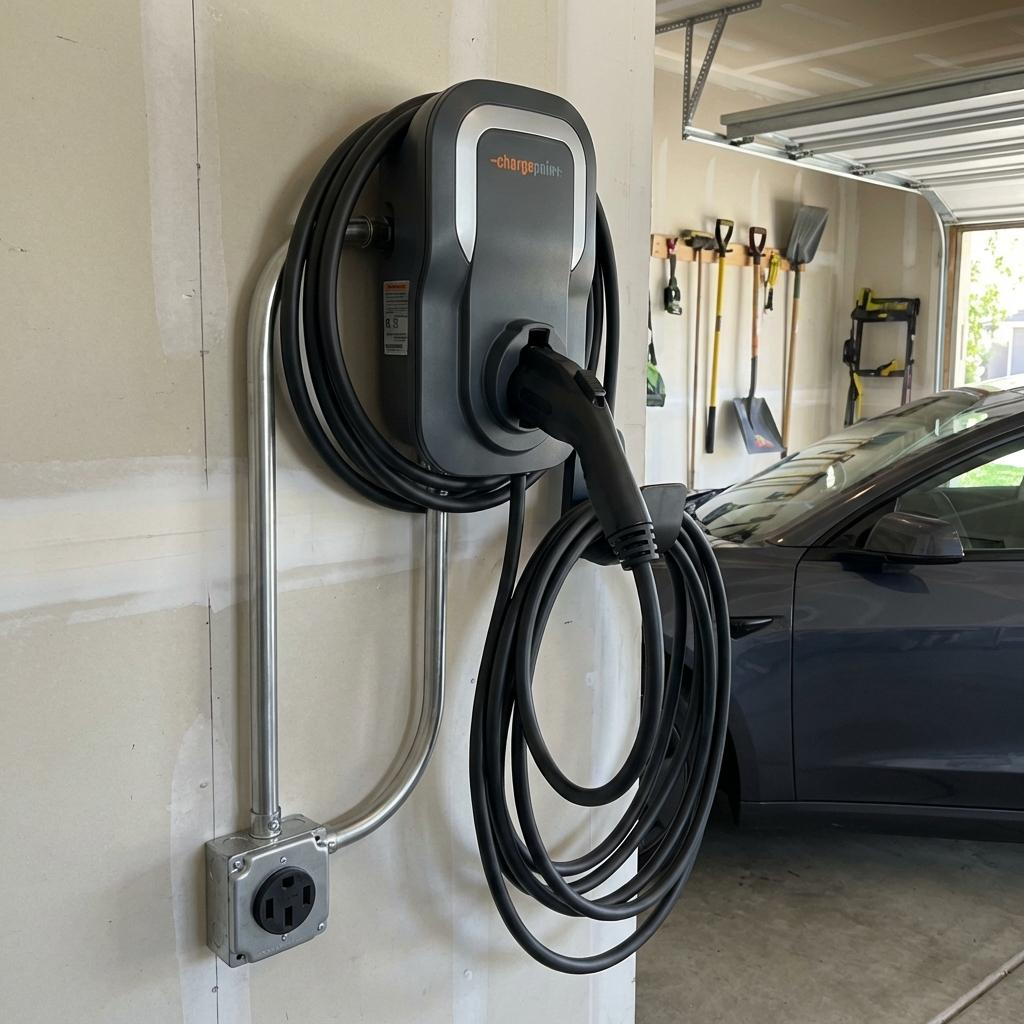
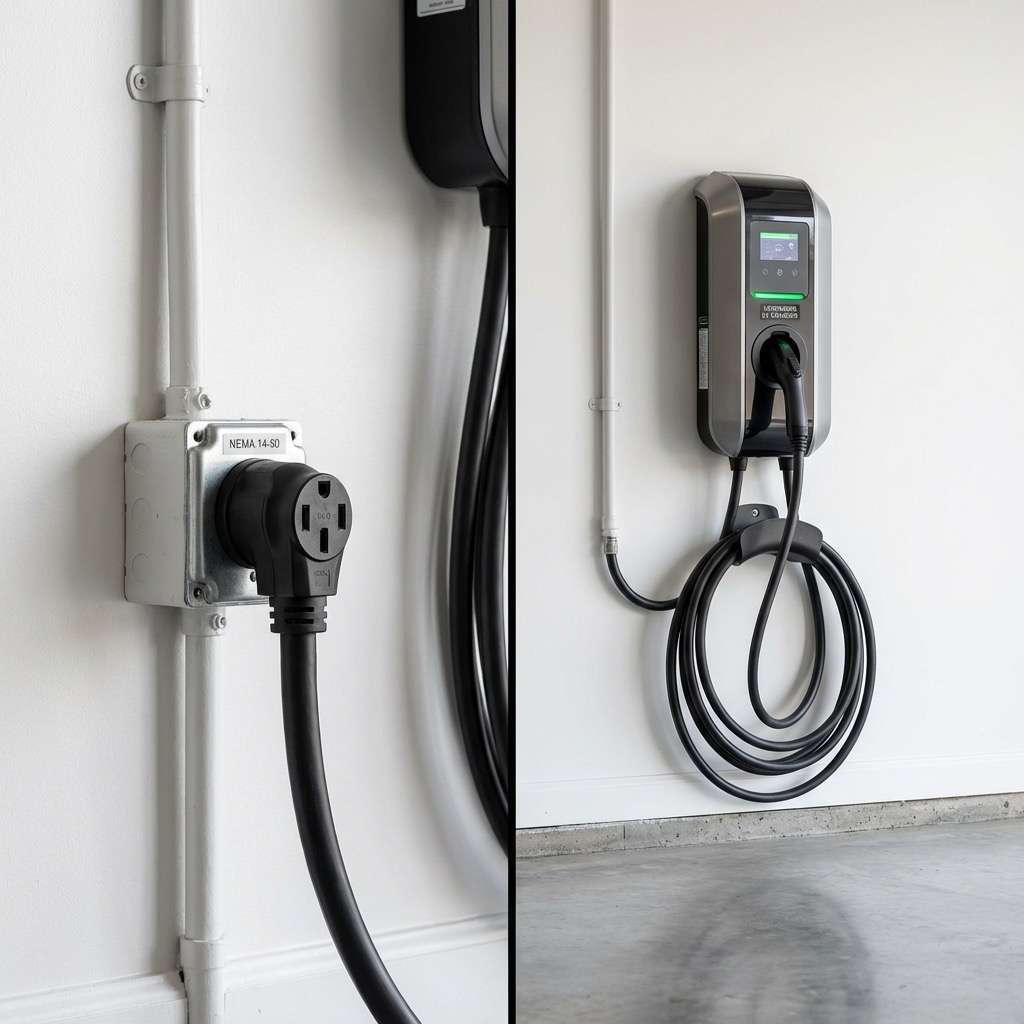
A NEMA 14-50 installation uses a matching plug and receptacle. The receptacle adds a connection that must be suitable for the sustained load and remain in good condition. A hardwired installation connects equipment through its approved wiring entry and terminations, without that plug-and-receptacle pair. Both require the correct circuit, protection, mounting, and manufacturer-directed installation.
Portability can favor a supported plug-in unit if you genuinely need to move it. For a charger expected to stay on one wall, ask whether portability offers any practical benefit. Moving the unit also requires verifying the destination circuit; taking the charger to another building does not make an unfamiliar outlet suitable.
Compare charging output on an equal basis
For commonly used continuous-load sizing, 40 amps of charging requires a suitable 50-amp circuit, and 48 amps requires a suitable 60-amp circuit. The vehicle can impose a lower limit. Tesla's supported circuit/output table illustrates that difference for its equipment. Other chargers must follow their own instructions.
Ready to Install a Home EV Charger?
Our licensed electricians evaluate panel capacity, circuit routing, equipment requirements, and permit needs for home EV charging. Call (571) 444-6886 or request an estimate online.
Removing a receptacle from an existing 50-amp circuit does not authorize 48-amp charging. The wiring, terminations, breaker, equipment rating, and service capacity must all support any proposed change. Conductor selection cannot be reduced to one wire gauge based only on distance; wiring method, temperature ratings, routing conditions, and voltage drop also matter.
When an existing receptacle deserves closer review
Tell the electrician what the outlet previously served, whether charging has caused interruptions, and whether you have noticed discoloration, odor, or a loose fit. Stop using visibly damaged or overheating equipment and arrange an assessment. Do not repeatedly reset protection to keep a charging session going.
The evaluation should identify the circuit's actual load and protection, not just the breaker label. An outlet installed for another appliance may have different requirements. A dryer adapter or passive splitter does not create a dedicated charging circuit. Listed load-management equipment is a separate design question with specific compatibility and installation requirements.
Check model-specific conversion and protection rules
Some chargers allow a supported hardwire conversion; others do not. Grizzl-E's model guidance, for example, distinguishes hardwire-capable Connect models from plug-in-only models and hardwire-only Ultimate products. Instructions for a similar-looking unit are not a substitute for the exact model's manual.
Receptacle GFCI requirements and the charger's built-in protective functions also need to be reconciled with the applicable code and instructions. Repeated tripping calls for investigation of the installation and equipment. Removing required protection to make charging continue is not a remedy.
Price the finished installation, including the route
Ask both proposals to use the same parking location and useful charging output. Compare the circuit route, receptacle or hardwire equipment, protection, permit coordination, penetrations, and restoration. A low-priced outlet installation is not directly comparable with a quote that also fixes a capacity or routing problem.
Typical Level 2 circuit-and-hookup work is $1,200–$3,500; charger hardware is separate. Long, detached, outdoor, trenched, or otherwise complex routing can bring the total installation into the $1,200–$4,500 band. Any panel or service changes should be identified in the written scope rather than assumed from the connection style.
Make the final decision around everyday use
For a fixed charger, compare hardwiring first with any equipment-supported plug-in alternative. For genuine portability, confirm the unit and every intended supply location. In either case, check cable reach, storage, vehicle compatibility, and the overnight charging window. Send closed-panel and parking-area photos with the exact charger model for a free installation estimate. Staff will review the request before an appointment is confirmed.