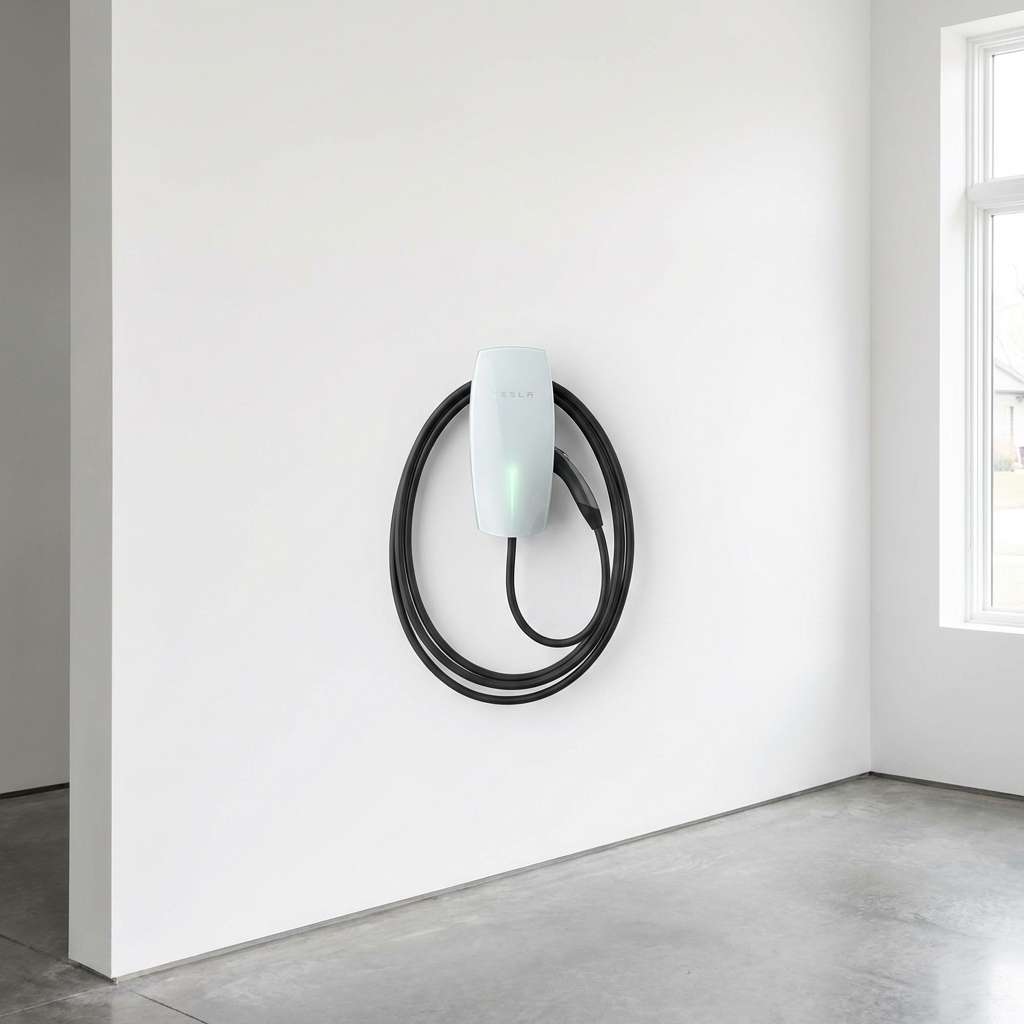

The Tesla Wall Connector is Tesla's premium home charging solution, delivering up to 44 miles of range per hour to your Model 3, Model Y, Model S, or Model X. For Tesla owners across Northern Virginia, from the tech corridors of Tysons and Reston to the growing communities of Ashburn and Bristow, a professionally installed Wall Connector turns your garage into your personal Supercharger station. This guide covers everything you need to know about Tesla Wall Connector installation, including electrical requirements, placement strategy, and why professional installation matters.
Key Takeaways
- The Tesla Wall Connector delivers up to 48 amps and 11.5 kW, adding up to 44 miles of range per hour.
- Maximum charging speed requires a 60-amp circuit breaker with 6-gauge copper wiring.
- Built-in WiFi enables over-the-air updates, power sharing between multiple Wall Connectors, and Tesla app integration.
- Professional installation ensures NEC code compliance, proper grounding, and warranty protection.
- The Wall Connector is rated NEMA 3R for both indoor and outdoor installation.
Tesla Wall Connector Specifications and Features
The third-generation Tesla Wall Connector represents a significant upgrade over previous versions. It is sleeker, smarter, and more versatile than ever. Understanding its specifications helps you plan the right installation.
Ready to Install a Home EV Charger?
Our licensed electricians evaluate panel capacity, circuit routing, equipment requirements, and permit needs for home EV charging. Call (571) 444-6886 or request an estimate online.
Power and Performance
A compatible Wall Connector configuration may supply up to 48 amps at 240 volts, subject to the exact model, circuit, load calculation, commissioning setting, vehicle, and current manufacturer instructions. Range added and total session time vary with the vehicle onboard charger, battery size and starting state of charge, temperature, charging curve, and losses; an overnight window does not guarantee a full battery.
Smart Connectivity
Confirm the exact model's current network, app, update, monitoring, scheduling, privacy, and support terms in Tesla documentation. Scheduling may align charging with a selected rate window, but the live tariff, enrollment, whole-home usage, vehicle efficiency, charging losses, and charging schedule determine the bill result; no savings is guaranteed.
Power Sharing for Multiple Teslas
Compatible Wall Connectors may support manufacturer-defined power sharing under a listed and commissioned design. Confirm current model compatibility, circuit configuration, maximum units, network requirements, load calculation, and authority requirements. The effect on equipment, charging time, installation complexity, and price is project-specific.
Durability and Weather Rating
The Wall Connector carries a NEMA 3R rating, meaning it is suitable for both indoor garage installations and outdoor mounting exposed to rain, snow, and temperature extremes. The 24-foot integrated cable is designed for thousands of plug-and-unplug cycles. This durability is important for Northern Virginia's climate, where summer temperatures can exceed 95 degrees and winter temperatures regularly drop below freezing.
Good to know: The Tesla Wall Connector uses a proprietary Tesla connector (NACS), which is the same connector found at Tesla Superchargers. Non-Tesla EVs that have adopted the NACS standard, or those with a NACS adapter, can also use the Wall Connector. As more manufacturers adopt NACS, the Tesla Wall Connector becomes an increasingly universal home charging solution.
Electrical Requirements for Tesla Wall Connector Installation
Proper electrical infrastructure is critical for safe, reliable Tesla Wall Connector operation. Here is what the installation requires.
Circuit Breaker Sizing
A 48-amp continuous charging setting ordinarily calls for a 60-amp branch circuit under the continuous-load sizing rule, subject to the exact equipment instructions and applicable code. If the service load calculation does not support that circuit, compatible equipment may be commissioned at a lower setting. A 50-amp circuit can support a 40-amp continuous setting; the vehicle, battery, temperature, losses, and driving pattern determine the range recovered during any session.
Wire Gauge Requirements
A 60-amp circuit requires 6-gauge copper wire for runs up to approximately 50 feet. For longer distances, such as running from a basement panel to a detached garage, 4-gauge wire may be necessary to prevent voltage drop. Our electricians perform voltage drop calculations for every installation to ensure your Wall Connector receives clean, stable power. In many Northern Virginia homes, particularly colonial and split-level designs common in Fairfax and Arlington counties, the panel-to-garage run is typically 25-40 feet, well within standard 6-gauge wire capabilities.
Panel Capacity
A 60-amp circuit is a significant addition to your electrical panel. Homes with 200-amp service, standard in most Northern Virginia construction since the 1990s, can typically accommodate this without issues. Older homes with 100-amp or 150-amp panels may need an upgrade. Our electricians perform a detailed load calculation before every installation, accounting for your existing air conditioning, electric water heater, kitchen appliances, and other major loads.
Optimal Placement for Your Tesla Wall Connector
Where you mount the Wall Connector affects daily convenience, installation cost, and cable management.
Charge Port Location
Tesla's charge port is located on the driver's side rear quarter panel. Position your Wall Connector so the 24-foot cable reaches the charge port comfortably when the vehicle is parked in its normal position. For most garage installations, mounting the charger on the wall near the front-left corner of the parking space provides optimal cable reach and a clean cable path.
Indoor vs. Outdoor Mounting
A garage location may shorten the wiring route and shelter the equipment. Outdoor driveway charging can also be designed when the exact charger is listed for the location and the wiring method, mounting, connections, and clearances follow its instructions and applicable code. Route length, trenching, mounting, and weather-exposed materials can change the project scope.
Height and Accessibility
Follow the current manufacturer mounting instructions and confirm cable reach, parking position, wall structure, weather exposure, working clearances, accessibility, and protection from physical damage for the actual site.
Planning tip: During new construction or renovation, ask the electrician to document the intended EVSE, load calculation, service and panel capacity, raceway, conductors, route, permit, and future equipment. A rough-in may reduce later access work, but future compatibility, savings, and installation time are not guaranteed.
Professional Installation vs. DIY: Why It Matters
While the Tesla Wall Connector itself is straightforward to mount, the electrical work behind it requires professional expertise and is governed by building codes.
Code Compliance
All EV charger installations in Fairfax, Arlington, Loudoun, and Prince William counties require electrical permits and inspection. A licensed electrician ensures your installation meets current NEC requirements, including proper grounding, correct wire sizing, appropriate breaker protection, and compliant conduit installation. Unpermitted work can create liability issues and complications when selling your home.
Safety Considerations
A 60-amp, 240-volt circuit carries serious energy. Improper connections, undersized wire, or incorrect grounding can create fire hazards or electrocution risks. Professional electricians test every connection, verify ground fault protection, and ensure proper torque on all terminals. These details may seem minor but are critical for long-term safety.
Warranty Protection
Tesla's Wall Connector warranty covers manufacturing defects but does not cover damage resulting from improper installation. Having a licensed electrician perform the installation protects your warranty and provides recourse if any issues arise. AJ Long Electric provides a workmanship warranty on all installations in addition to the manufacturer's product warranty.
Installation Timeline and Process
A Wall Connector project follows a structured sequence, but timing and inspection outcome depend on the address-specific inputs.
- Site assessment: We review the service and panel, load calculation, exact listed equipment, route, mounting, permit, inspection, utility, and access inputs. Assessment length depends on those conditions.
- Detailed quote: You receive a written electrical scope after the site and design inputs are resolved. EVSE hardware is separate.
- Permit filing: We submit the applicable electrical permit; review timing follows the jurisdiction's current queue.
- Installation: The project-specific work window is set after equipment, route, permit, utility, inspection, and access inputs are confirmed.
- Inspection: We schedule the required county inspection and attend on your behalf, handling any questions from the inspector.
A typical Level 2 circuit and hookup is $1,200–$3,500. Only a documented long, detached, outdoor, trenched, or otherwise complex route extends to the $1,200–$4,500 total band. EVSE hardware is separate.
Schedule Your Tesla Wall Connector Installation
AJ Long Electric has years of experience installing Tesla Wall Connectors across Northern Virginia. Our licensed electricians understand the specific requirements of Tesla's charging system and have experience working in every type of home, from older Arlington colonials to brand-new Loudoun County construction. We handle the entire process from assessment through inspection, so you can focus on enjoying your Tesla. Contact AJ Long Electric today at (571) 444-6886 to schedule your Tesla Wall Connector installation consultation.