
Rivian R1T and R1S vehicles can place a substantial energy demand on a home charging circuit. The right design starts with the exact vehicle and connector, the available service capacity, daily energy use, parking window, route, and equipment instructions. Charging output and range recovered vary with the configured circuit, battery, starting charge, temperature, charging curve, and losses. This guide explains how Northern Virginia homeowners can compare those inputs before choosing a home-charging setup.
Key Takeaways
- Confirm the exact model year, onboard-charger limit, connector, and current manufacturer instructions.
- Battery size, starting charge, target charge, temperature, and circuit setting all affect session time.
- Use only compatible, listed EVSE and any manufacturer-approved adapter required by the exact vehicle.
- The branch circuit and commissioned output must follow the load calculation, equipment instructions, wiring method, and applicable code.
- Scheduling can target an eligible utility window, but it does not guarantee a full battery or a particular electric rate.
Rivian R1T and R1S Charging Specifications
Understanding the Rivian's charging hardware helps you match your home infrastructure to the vehicle's capabilities.
Ready to Install a Home EV Charger?
Our licensed electricians evaluate panel capacity, circuit routing, equipment requirements, and permit needs for home EV charging. Call (571) 444-6886 or request an estimate online.
Onboard Charger
Both the R1T truck and R1S SUV come equipped with an 11.5 kW onboard charger that accepts up to 48 amps at 240 volts via Level 2. This is the maximum rate at which the vehicle can convert AC power from your wall charger into DC power for the battery. Any charger delivering 48 amps or more will maximize your home charging speed.
Battery Pack Options
Rivian offers two primary battery sizes. The Standard battery pack (approximately 75 kWh usable) provides roughly 260-270 miles of range and charges from 10% to 100% in about 7-8 hours on a 48-amp charger. The Large battery pack (approximately 135 kWh usable) delivers up to 320-400 miles of range depending on the model and configuration, but takes 12-14 hours for a full charge at maximum Level 2 speed. For Large pack owners, overnight charging from a typical 30-40% level to 80-90% takes about 6-8 hours, fitting comfortably into an overnight window.
Charge Port Location
The Rivian charge port is located on the driver's side front fender, above the wheel well. It is protected by a power-operated door that opens automatically when you approach with the charger connector. When planning your charger placement, position it to reach the driver's side front corner of the vehicle with minimal cable stretch.
The Rivian Wall Charger
Rivian offers its own branded wall charger designed specifically for its vehicles, though it uses the standard J1772 connector and works with any EV.
Specifications and Features
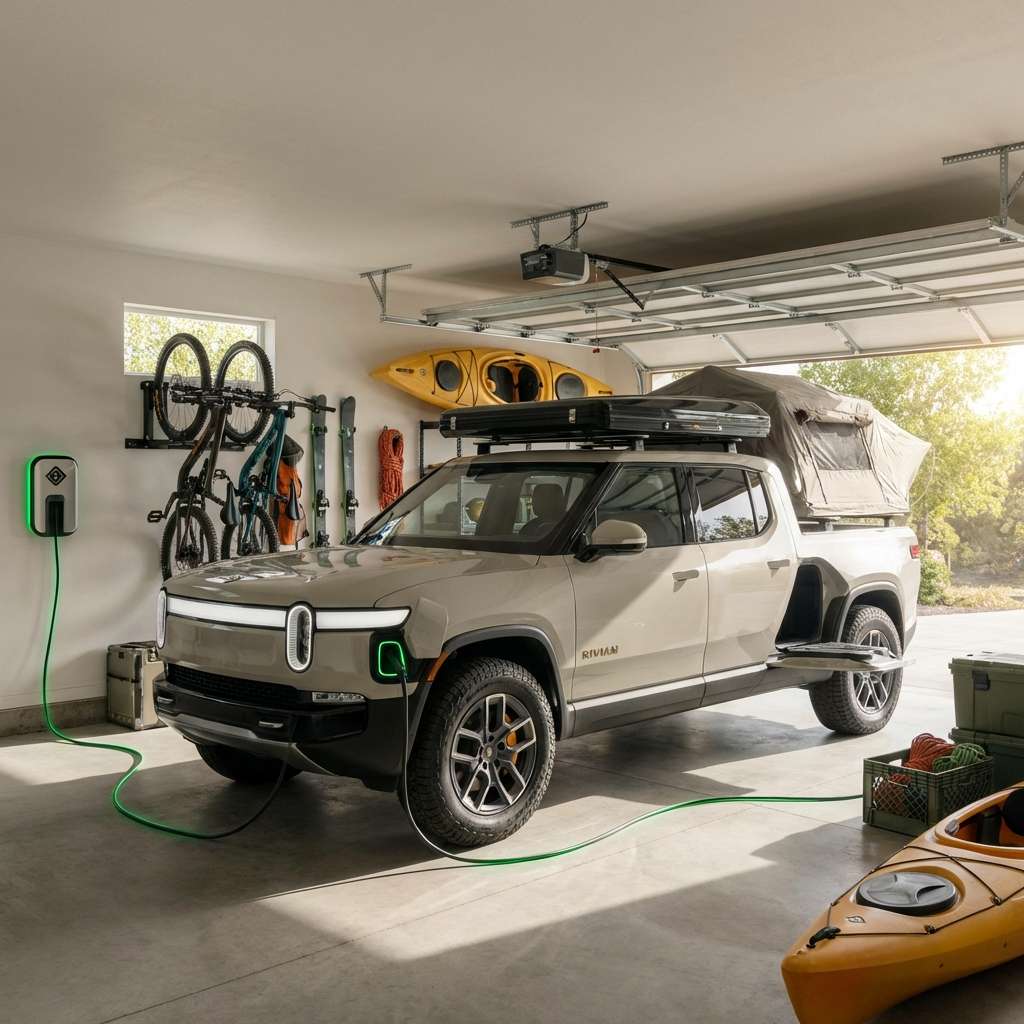
The Rivian Wall Charger delivers up to 48 amps at 240 volts (11.5 kW), matching the vehicle's maximum acceptance rate. It features a sleek, minimalist design that matches Rivian's aesthetic sensibility, a durable cable with a 24-foot reach, WiFi connectivity for firmware updates, and integration with the Rivian mobile app for monitoring and scheduling. The unit is rated for both indoor and outdoor installation.
Rivian App Integration
Supported Rivian app and charger configurations may provide charge-status monitoring, scheduling, and energy-history features. A departure schedule can target a preferred charge limit, but completion depends on the connection, starting charge, available output, temperature, charging window, software, and vehicle settings. Verify current manufacturer instructions and the live terms of any utility rate plan before relying on a schedule or cost estimate.
Pricing Consideration
The Rivian Wall Charger is priced at a premium compared to third-party alternatives. If the Rivian-branded experience and tightest possible app integration matter to you, it is worth the investment. If you prioritize value, several excellent third-party chargers deliver identical charging speed at lower cost.
Good to know: Rivian includes a portable charger with every vehicle that works with both 120V standard outlets and 240V NEMA 14-50 outlets. If you already have a 14-50 outlet in your garage from an RV hookup, electric dryer, or previous EV installation, you can begin Level 2 charging immediately with the included portable charger while you plan a permanent wall-mounted installation.
Recommended Third-Party Chargers for Rivian
Connector standards and vehicle configurations change. Verify the exact Rivian model year, charge port or approved adapter, EVSE listing, output setting, and current manufacturer compatibility instructions before selecting equipment.
ChargePoint Home Flex
The adjustable amperage (16-50 amps) makes the Home Flex ideal for Rivian owners whose panels may not support a full 60-amp circuit. At maximum output, it delivers the full 48 amps the Rivian can accept. The ChargePoint app provides energy tracking and scheduling independent of the Rivian app.
Grizzl-E Classic or Smart
The Grizzl-E is a popular choice among Rivian owners who appreciate its rugged build quality and excellent value. The Classic model delivers 40 amps without WiFi, while the Smart model adds WiFi and app control. Both feature a generous 24-foot cable and NEMA 4 weather rating, making them excellent for outdoor installations where Rivian trucks are often parked.
JuiceBox 48
The JuiceBox 48 delivers the full 48 amps at a competitive price point with strong smart features including WiFi, scheduling, energy monitoring, and voice assistant integration. Its 25-foot cable provides excellent reach for large vehicles like the R1T and R1S.
Tesla Wall Connector with Adapter
If your household includes both a Rivian and a Tesla, the Tesla Wall Connector can charge the Rivian using a Tesla-to-J1772 adapter. However, for a single-vehicle household, a dedicated J1772 charger is more practical and avoids the adapter requirement.
Circuit Requirements for Rivian Home Charging
Given the Rivian's large battery packs, maximizing your charging speed makes a noticeable difference in daily convenience.
Maximum Speed Configuration
A compatible 48-amp continuous setting ordinarily calls for a 60-amp branch circuit under the continuous-load sizing rule, subject to the exact equipment instructions and applicable code. The service load calculation, wiring method, route, temperature ratings, and commissioning setting determine the final design. Range recovered and session time still vary with the vehicle, battery, starting and target charge, temperature, charging curve, and losses.
Alternative Configurations
A 50-amp circuit supporting 40 amps of continuous charging delivers 9.6 kW and adds approximately 21 miles of range per hour. While slower, this is still adequate for most daily driving patterns. For a commuter driving 40 miles round trip in Fairfax County, a 50-amp circuit replenishes the daily driving range in about 2 hours.
Large Battery Special Considerations
A larger battery and a low arrival state of charge can require a longer session. Compare the exact usable capacity, arrival and target charge, vehicle acceptance rate, commissioned EVSE output, temperature, charging curve, losses, and available parking window. A preferred daily charge limit may change the energy requested, but follow the current vehicle and battery guidance rather than assuming one setting or circuit will always recover a particular amount overnight.
Design note: Drivers returning from longer or hillier trips may arrive with a lower state of charge. Bring the actual driving pattern and parking window to the load-calculation review so the proposed circuit output can be compared with the energy that needs to be recovered.
Outdoor Installation Considerations for Rivian
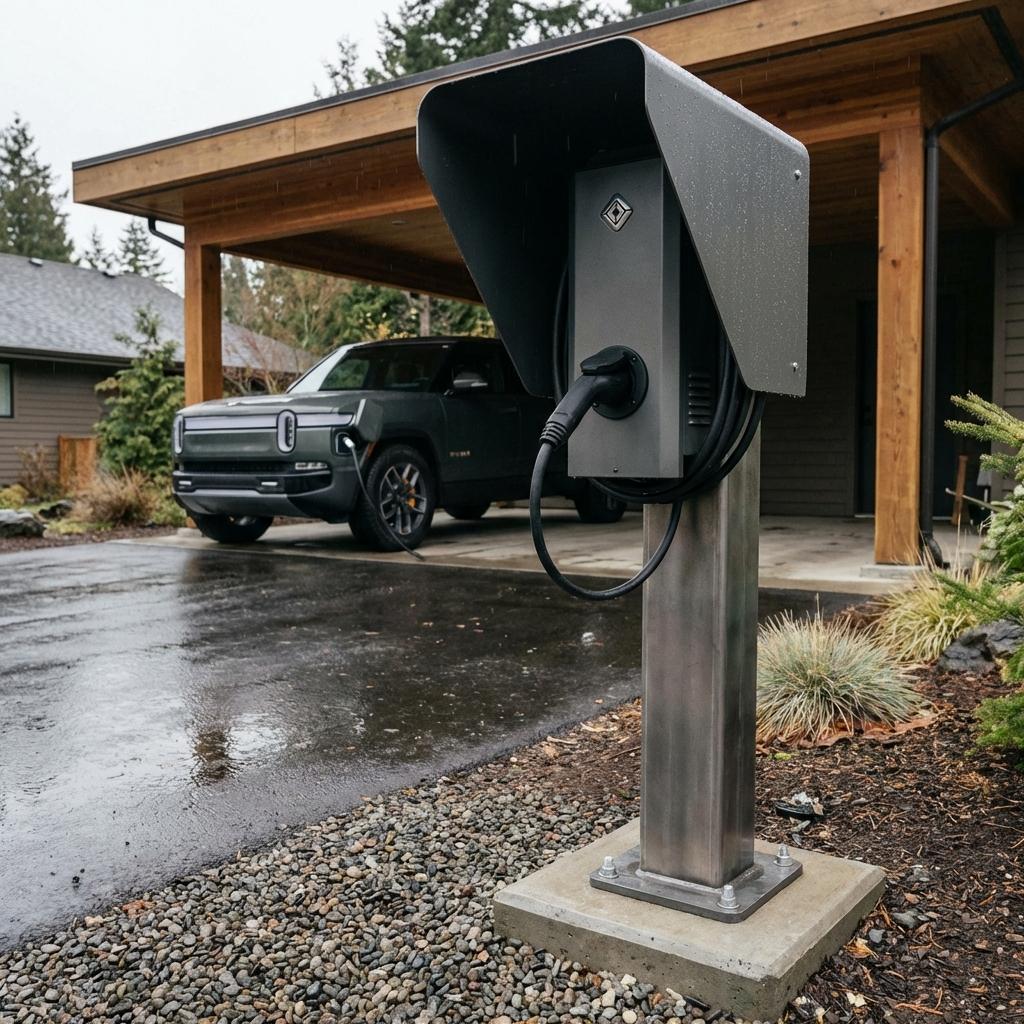
The R1T and R1S may be parked in a driveway rather than a garage. An outdoor charging location can be designed when the exact EVSE is listed for the location and its mounting, connections, wiring method, clearances, and cable reach follow the manufacturer instructions and applicable code.
Driveway Mounting
A wall-mounted charger on the exterior of your garage, with the cable reaching to the driveway, is the most common outdoor configuration. For homes in communities like Great Falls, McLean, and Clifton where driveways may be longer, a pedestal or post mount positioned closer to the parking area reduces cable reach requirements.
Weather Considerations
Rivian vehicles are designed for outdoor use in all weather conditions, and their charge ports seal tightly against moisture. An outdoor-rated charger (NEMA 3R or NEMA 4) paired with weatherproof electrical connections provides safe, reliable charging through every Northern Virginia season.
Schedule Your Rivian Home Charger Installation
AJ Long Electric has installed home chargers for Rivian R1T and R1S owners across Northern Virginia. We understand the unique requirements of these vehicles, including their large battery capacities and the common need for outdoor installations. Our team handles everything from panel assessment and charger recommendation through permitting, installation, and inspection across Fairfax, Arlington, Loudoun, and Prince William counties. Contact AJ Long Electric at (571) 444-6886 to set up your Rivian home charging station.