
A useful backup plan names the circuits you need and explains how they can operate together. Start with household priorities, then have the designer check equipment and electrical limits before choosing a battery.
Key Takeaways
- Power determines what can run; usable energy helps determine how long it can run.
- A motor's starting demand can exceed its normal running demand.
- Selected circuits may still need priorities or automatic load controls.
- Medical-device continuity needs its own verified backup and emergency plan.
Start with the consequences of losing each load
List what you need during a short interruption and what matters if the outage lasts overnight or longer. Keeping food cold, controlling water, maintaining communication, and supporting heating controls may be more useful than backing up every receptacle. Priorities differ for a house with a well, a basement sump, or electric heat.
Planning Backup Power for Your Home?
Plan for the next outage with a listed portable-generator hookup or a compatible battery-backup installation. We evaluate the panel, selected loads, equipment, and transfer method before quoting the electrical scope. Call (571) 444-6886 to request an in-home assessment.
Divide the list into essential, useful if capacity permits, and acceptable to leave off. Those labels express your preferences; they do not establish electrical compatibility. Do not assume a circuit labeled “kitchen” supplies only a refrigerator, or that a furnace needs no electricity because its fuel is gas.
Bring this circuit worksheet to the assessment
| Candidate | Information to collect |
|---|---|
| Refrigerator or freezer | Exact appliance, starting demand, cycling behavior and other loads sharing its circuit |
| Sump or well pump | Motor model, voltage, starting demand and expected operation during the outage |
| Heating or cooling | Controls, blower, compressor and any electric resistance or auxiliary heat as separate loads |
| Internet and lighting | Modem/router and any provider terminal; actual lighting circuits and shared receptacles |
| Medical device | Exact model and manufacturer-approved source, transfer and backup requirements |
| EV charging or other large loads | Whether it should be excluded, reduced, scheduled or automatically shed during backup |
Record the desired hours of operation and which loads must run together. Use accessible labels, instructions, and existing records; leave electrical covers in place. The electrician verifies circuit identification, actual demand where needed, and the proposed circuit arrangement. Breaker-handle numbers alone are not an estimate of energy use.
Check power before estimating runtime
Kilowatts describe the rate at which equipment uses or supplies energy. Kilowatt-hours describe an amount of energy. A battery with enough stored energy for a long outage can still lack the output needed to start a particular motor or run several large loads together.
Ask for continuous output, applicable starting capability, supported voltage, and limits on simultaneous loads. The Powerwall 3 design documentation, for example, separates motor starting and supported loads from added stored energy. That is an example of why the exact system matters, not a recommendation of a brand or a claim of AJLE installer authorization.
Extra storage does not always add inverter output. Likewise, a battery count or a “whole-home” label is not a complete answer. Ask which circuits remain connected, which can operate simultaneously, and which are restricted by the actual design.
Use a runtime example with explicit assumptions
For a simplified illustration, assume 8 kilowatt-hours are actually available to the selected AC loads after the applicable reserve and losses have already been accounted for. At a constant combined demand of 0.5 kilowatts, the arithmetic is 8 ÷ 0.5 = 16 hours. At 2 kilowatts, it is 8 ÷ 2 = 4 hours.
These are invented planning inputs, not a product specification, measured AJLE job, or runtime promise. They show how demand changes duration. A real estimate must use the installed system's available energy, starting state of charge, reserve settings, temperature and operating limits. Loads cycle and change; pumps may run more frequently during the weather that caused the outage.
Have the proposal state whether its estimate assumes solar recharge. Request a second estimate without that recharge so you understand a cloudy or overnight scenario. Do not count the same loss or reserve twice if it is already included in an available-energy figure.
Decide what pauses when demand is high
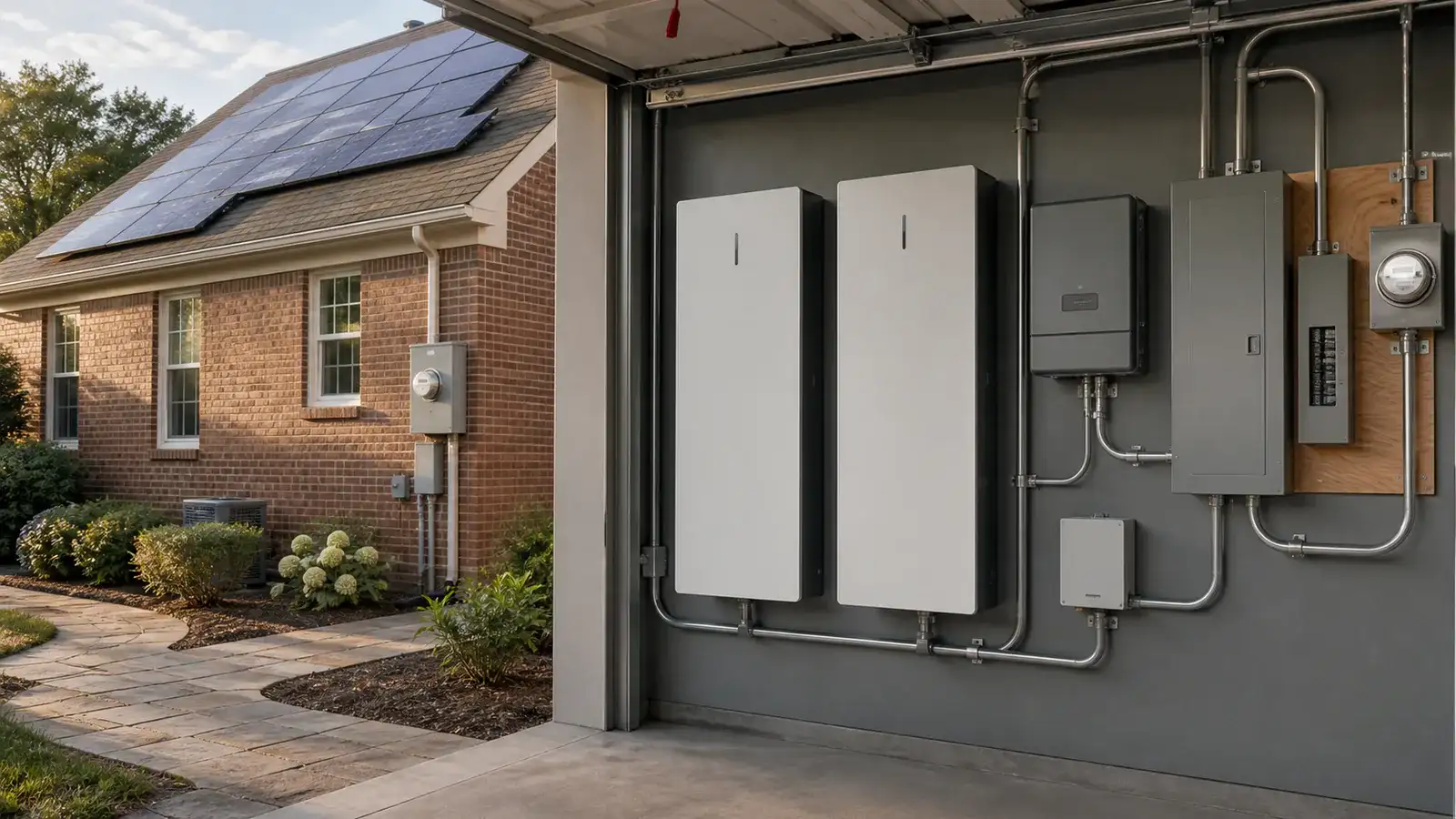
Backup may use a selected-load panel, an approved whole-home arrangement, or compatible automatic controls. The design should identify what happens when demand exceeds the source's capability or stored energy becomes low. Merely showing circuit usage in an app is not automatic load management.
Ask whether an EV charger, water heater, compressor, or other discretionary load is left outside backup, reduced, or shed by supported controls. Document the priorities, how loads return, and what the homeowner should do if the system stops supporting a load. Adding another appliance later can change the assessment.
For coordinated future work, use the staged EV, solar and battery planning checklist. It keeps today's electrical project separate from unspecified future equipment.
Keep medical-device backup separate
Obtain device-manufacturer compatibility for the exact source, voltage, frequency, waveform, grounding, transfer interruption and restart behavior. Discuss the plan with the device supplier and healthcare team. The FDA's outage guidance directs users to device instructions or the manufacturer and warns that settings may change after power is restored.
Keep device-specific backup and an emergency plan for a depleted, unavailable, or unsuitable source. No home battery promises uninterrupted medical power. Do not treat a backed-up receptacle as proof that a particular device will tolerate the transfer. If an interruption creates an immediate medical emergency, seek emergency assistance.
Confirm recharge and the operating handoff
A grid-charged battery cannot depend on the unavailable grid to refill during an outage. Solar recharge requires a compatible system capable of operating in that mode. The Department of Energy resilience overview explains why ordinary grid-connected solar alone is not an outage-power plan. Do not assume every battery works with an existing array or generator.
Before accepting the installation, ask for the circuit list, operating limits, reserve and priority settings, normal transfer behavior, maintenance instructions and manufacturer support contacts. Have the installer demonstrate the specified operation safely. Keep an accessible copy of the instructions for when internet access is unavailable.
For a present electrical project, request a free estimate with the equipment information and your circuit priorities. Staff review requests before discussing scope and timing. Equipment choice and service availability need project-specific confirmation.
Our quoted electrical installations include a five-year workmanship warranty from completion. Parts and equipment carry their manufacturer warranties.