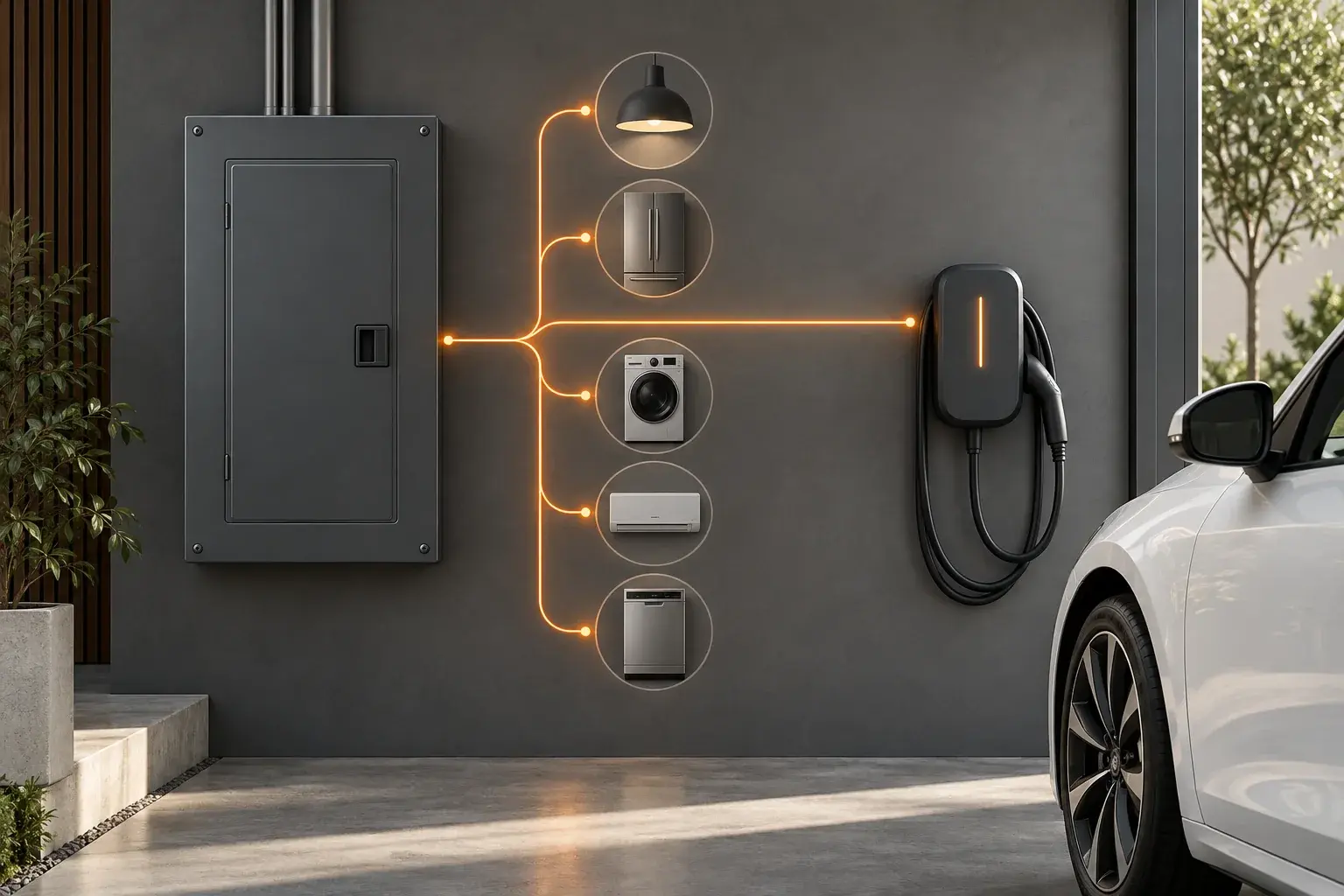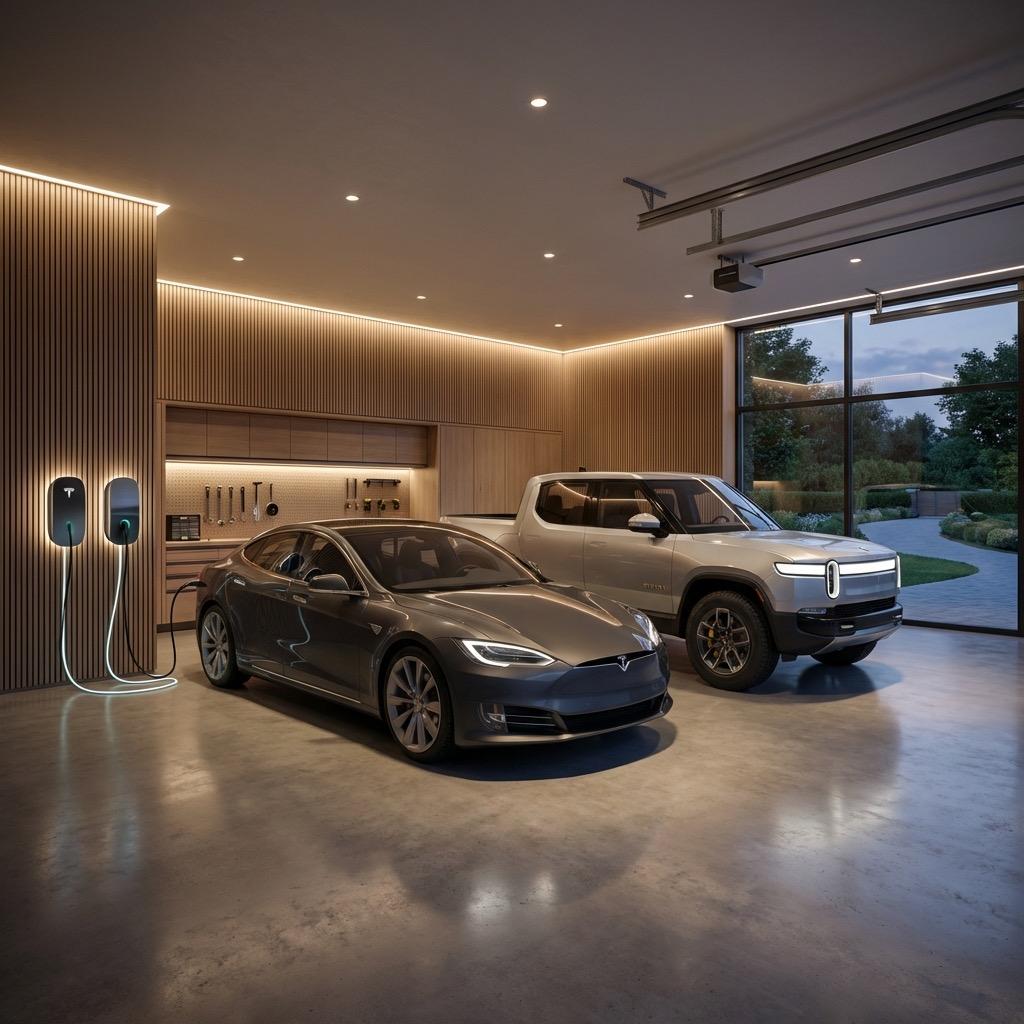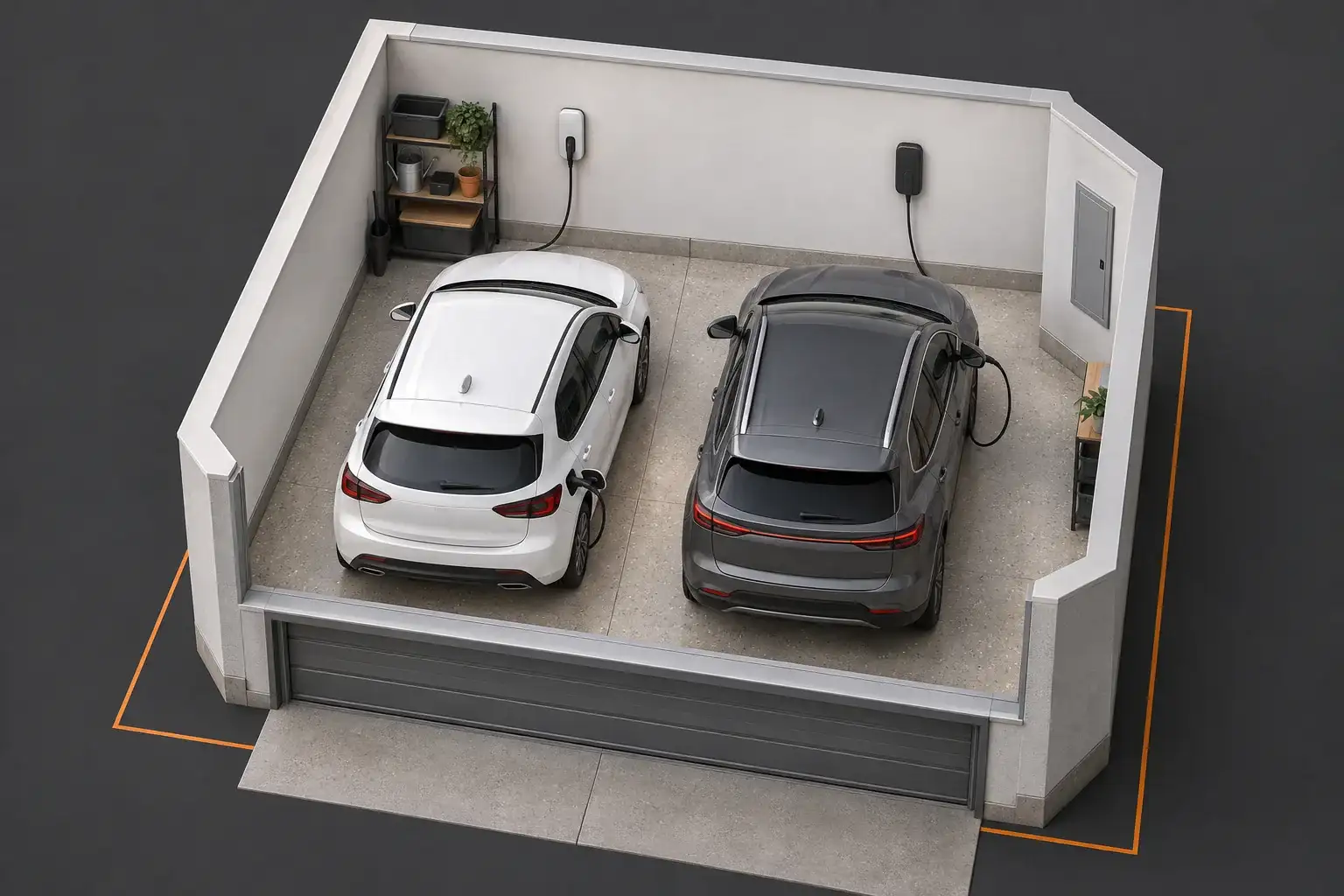

A second EV adds another continuous load to the household service calculation. Instead of guessing whether your panel can carry a second 50-amp or 60-amp breaker, we calculate your actual service demand and compare dedicated circuits, a compatible listed load-sharing design, or a service upgrade.
Key Takeaways
- Coordinated charging must be supported by the exact listed equipment and manufacturer instructions.
- Feeder or branch-circuit topology, overcurrent protection, conductors, communications, and configured output are model- and design-specific.
- Two dedicated circuits remain a straightforward option when the load calculation and panel spaces support them.
- When a 100-amp or 150-amp panel is already near capacity, a $3,500–$7,500 200-amp upgrade or listed load management resolves the bottleneck safely.
Compare four ways to charge two EVs at home
Before buying a second wall unit, review how both vehicles are driven and parked alongside your home's existing heating, cooking, and laundry loads. The Department of Energy EV infrastructure planning resource highlights how daily mileage and dwell time determine the charging power you actually need.
Ready to Install a Home EV Charger?
Our licensed electricians evaluate panel capacity, circuit routing, equipment requirements, and permit needs for home EV charging. Call (571) 444-6886 or request an estimate online.
| Two-EV Strategy | How It Works Electrically | When It Fits Best | Typical Scope Reference |
|---|---|---|---|
| 1. Alternating One Level 2 Charger | Single dedicated 240V circuit and one EVSE mounted where the cord reaches both parking spots | Moderate daily driving where both cars rarely need simultaneous multi-hour recovery | $1,200–$3,500 typical single circuit (EVSE hardware separate) |
| 2. Coordinated Load-Sharing EVSE | Two compatible listed units configured under manufacturer instructions to divide a fixed circuit or feeder allocation | Both cars park every night and want plug-and-forget convenience without doubling panel demand | Model-specific subpanel/branch routing based on exact listed equipment |
| 3. Two Moderate-Output Dedicated Circuits | Two independent 240V branch circuits configured at a lower fixed output (e.g., 20A–30A circuits for 16A–24A charging) | 200A panels with physical space and moderate spare load capacity where both vehicles plug in nightly | $1,200–$3,500 typical per ordinary circuit run |
| 4. Panel Upgrade + Dual Full-Output Circuits | Upgrade 100A/150A service to 200A (or add subpanel capacity) to support two higher-output dedicated circuits | Undersized or crowded legacy panels, high-mileage drivers, or homes also planning heat pumps or battery storage | $3,500–$7,500 for 200A panel upgrade plus EV circuit scopes |
Pick the electrical topology first, then select the EVSE
A marketing label or smartphone app screen does not establish an approved load-management topology under the Virginia Uniform Statewide Building Code. The exact listed equipment and manufacturer instructions, breaker and conductor ratings, continuous-load calculation, inter-unit communications, installer-locked settings, and AHJ-approved design control the installation.
Specifically, coordinated EVSE systems fall into different electrical wiring patterns depending on their listing:
- Subpanel-fed paired branch circuits: A single feeder from the main panel supplies a small garage subpanel holding two separate branch breakers—one for each charger—while listed software/hardware communication caps their combined draw to the feeder rating.
- Listed multi-unit branch circuit: Certain exact listed equipment is specifically evaluated and instructions-approved to share a single branch circuit and overcurrent device when wired in the manufacturer's designated configuration.
- Dual-cable single enclosure: A single listed enclosure mounts on one dedicated circuit and splits its internal output across two integrated J1772 or NACS cords.
Why two 48-amp chargers rarely belong on an unmanaged 200-amp panel
Two 48-amp chargers running simultaneously draw 96 amps of continuous load—which counts as 120 amps in a continuous-load calculation before adding central air conditioning, an electric range, a clothes dryer, or a water heater. Even on a 200-amp service, adding 96 amps of unmanaged continuous charging often exceeds the permissible NEC load calculation. Sharing a 40-amp or 48-amp total allocation across two coordinated units—or configuring two dedicated circuits at 24 amps or 32 amps each—keeps total demand well within a typical 200-amp residential service while still delivering substantial overnight energy recovery.
What to send for a two-EV estimate in Northern Virginia
Permits are required for new EV charging circuits across Fairfax County, Arlington, Alexandria, and Loudoun County. To compare options for your garage or driveway, send photos of your closed main electrical panel, breaker directory, existing EV charger (if one is already installed), and both parking positions.
Our quoted electrical installations include a five-year workmanship warranty from completion. Parts and equipment carry their manufacturer warranties.
See hardwired vs receptacle vs load-sharing, explore EV charging, or request a free project estimate.