Loading services…

Residential project planning
Dedicated Circuit Installation in Burke, VA
A dedicated circuit is sized for a specific load instead of sharing capacity with unrelated devices. The design accounts for appliances, workshop equipment, HVAC auxiliaries, EV equipment, or pumps, along with voltage, amperage, receptacle, and routing needs.
- Licensed & insured
- Family-owned since 1996
5.0 ★ on our Burke, VA Google Profile (54+ Local Reviews)Backed by 1,463+ 4.9 ★ Reviews Across the DMV
5244 Lyngate Ct, Burke, VA 22015Our long-standing Burke local presence — serving the Burke and Springfield communities since the 1990s.
Field briefing / Burke, VA
Project briefing
Jurisdiction confirmed by property address
- Project
- Dedicated Circuit Installation
- Have the equipment model, nameplate, operating location, and preferred hardwired or receptacle connection available before the circuit is sized.
- Permit path
- Fairfax County Land Development Services
- Final jurisdiction is confirmed from the property address.
Scope first
What this project involves
Circuit requirements
Match voltage, amperage, conductor size, and protection to the equipment's electrical load.
Connection and route
Confirm the receptacle or direct connection and choose a practical path from the panel to the equipment.
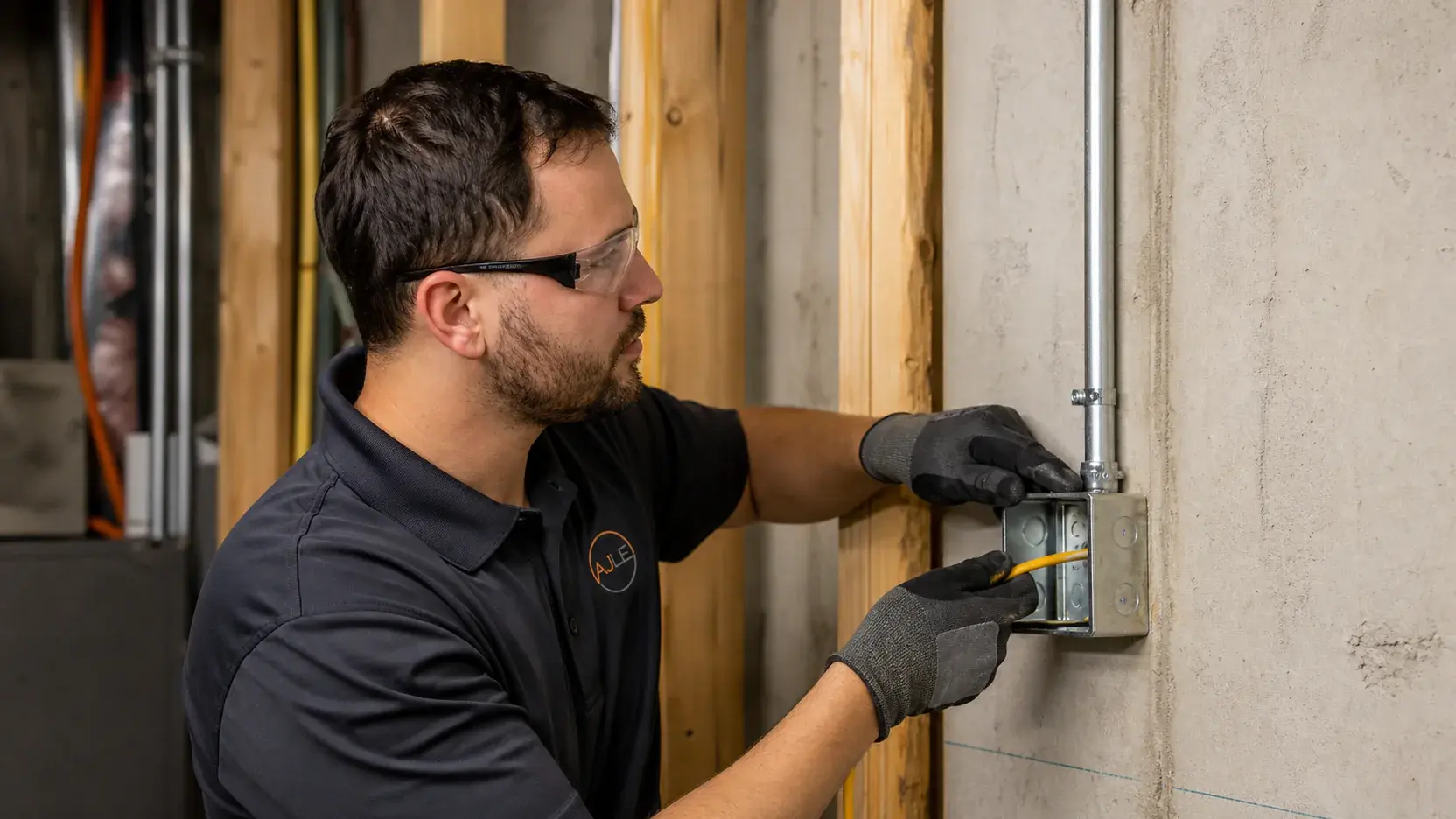
Field view / Dedicated Circuit Installation
Representative field view for Dedicated Circuit Installation; final scope is confirmed at the property.Address-specific planning
What matters in Burke
A Burke dedicated-circuit plan starts with the exact appliance, workshop tool, office equipment, or pump rather than a generic breaker size. Its nameplate and connection instructions establish the load that the panel and circuit need to support.
In Burke Centre, Lakewood Hills, and Rolling Valley, the workable path may change when the panel and equipment are separated by finished rooms or when a load sits in a detached structure. We compare route length and access with panel capacity, a compatible breaker position, conductor and protection requirements, and a hardwired or receptacle connection. Any permit responsibility is confirmed for the defined scope with Fairfax County Land Development Services.
Explore the Burke service areaProject fit / review at the property
- A 120V appliance or home-office load whose nameplate calls for an individual circuit
- A 240V workshop tool with a verified amperage and connection requirement
- A pump or detached-structure load that needs its serving panel and route identified first
Local housing & wiring
Planning electrical work in Burke
Finished basements in Burke, VA are where space heaters, treadmills and home offices end up on extension cords. AJ Long Electric replaces those setups with dedicated 20A and 240V circuits in Burke Centre, Lake Braddock and Rolling Valley homes.
Burke's housing is mostly 1970s and 1980s colonials and townhomes, including the Burke Centre clusters, Lake Braddock split-levels and Rolling Valley two-stories. Basements were finished by owners over the years, and the original wiring often has a single circuit serving a whole recreation room. A portable space heater on a 15A circuit with a TV and a lamp is a common cause of tripping, and a heater with a worn cord is a hazard. The fix is a circuit sized for the heater, or a hardwired wall heater on a 240V circuit with its own thermostat. Treadmills, bar refrigerators and workshop benches follow the same pattern. Burke Centre townhomes and HOA properties add a layer of review for exterior changes, so an outdoor disconnect or a visible conduit is planned with that in mind. Most panels here have spaces, but we still read the label for tandem rules and total the existing load. Fairfax County Land Development Services issues the permit for new branch-circuit wiring.
Quote inputs
Scope and cost drivers
Included in the defined scope
- Confirm the equipment load, voltage, amperage, and connection requirements
- Check the electrical panel for a suitable circuit position and capacity
- Plan a code-sized wiring method and route to the equipment location
- Install the required breaker, wiring, and receptacle or direct connection
What can change scope and cost
- Equipment load and required circuit size
- Routing distance and access conditions
- Receptacle, disconnect, or direct-connection requirements
- Panel capacity and breaker compatibility
Work sequence
From assessment to completion
- 01
Confirm the load
Review the equipment information and intended operating location.
- 02
Check the panel
Evaluate capacity, circuit position, and compatible protection.
- 03
Plan the route
Define the wiring path, connection type, access, and permit scope.
- 04
Install and test
Complete the circuit and verify voltage and operation at the connection point.
Property-specific answers
Local questions
How are voltage and amperage selected for a Burke dedicated circuit?
The equipment nameplate and installation instructions identify whether the load is 120V or 240V and its electrical demand. Those details guide breaker amperage, conductor sizing, and any overcurrent, ground-fault, or arc-fault protection that applies to the equipment and location.
What can change the circuit route at a Burke property?
Panel capacity and compatible breaker position are checked along with distance, finished-space access, exterior exposure, and any feeder serving a detached structure. The endpoint is also reviewed so the plan uses the equipment's specified receptacle or a direct hardwired connection.
Why does my Burke basement breaker trip when two space heaters run?
Most portable heaters draw close to the full capacity of a standard circuit. Two together, or one with other loads, exceeds it. A dedicated circuit or a hardwired heater designed for the room solves it, whereas a larger breaker on the same wire does not.
Does the Burke Centre Conservancy review a new outdoor disconnect?
The Burke Centre Conservancy reviews many visible exterior changes, so check its standards for equipment placement and ask before work starts. We try to put any required disconnect where it is least visible and still allowed by code, and we can describe the equipment for your application.
Is a hardwired wall heater better than a portable heater for a Lake Braddock basement?
For a room heated every winter, often yes. A hardwired heater sized for the room runs on its own 240-volt circuit with a wall thermostat, so there is no cord to wear and no shared circuit to trip. A portable heater on a 15-amp circuit uses most of that circuit by itself. We size the heater circuit to the unit's nameplate.
Related Services
Related Services in Burke
Guides
Dedicated Circuit Installation Planning Guides
Expert electrical guides to help you make informed decisions.
Nearby Dedicated Circuit Installation Service Areas
We also provide expert electrical services in these communities.
Next step / property-specific quote
Request a quote for Dedicated Circuit Installation in Burke
Share the property address and project goal so the scope can be reviewed for your home.