Loading services…

Residential project planning
EV Charger Installation in Burke, VA
Home EV charging work centers on a code-sized dedicated 240V circuit and the capacity available at the electrical panel. Planning covers a hardwired or receptacle-fed charger, cable reach, placement, and permit and inspection requirements.
- Licensed & insured
- Family-owned since 1996
5.0 ★ on our Burke, VA Google Profile (54+ Local Reviews)Backed by 1,463+ 4.9 ★ Reviews Across the DMV
5244 Lyngate Ct, Burke, VA 22015Our long-standing Burke local presence — serving the Burke and Springfield communities since the 1990s.
Field briefing / Burke, VA
Project briefing
Jurisdiction confirmed by property address
- Project
- EV Charger Installation
- Choose the parking position and vehicle-side charge-port reach before finalizing the charger location.
- Permit path
- Fairfax County Land Development Services
- Final jurisdiction is confirmed from the property address.
Scope first
What this project involves
Charging output
Choose an output that fits the vehicle, charging habits, circuit size, and available panel capacity.
Connection and placement
Choose hardwired or receptacle-fed equipment and place it indoors or outdoors with practical cable reach.
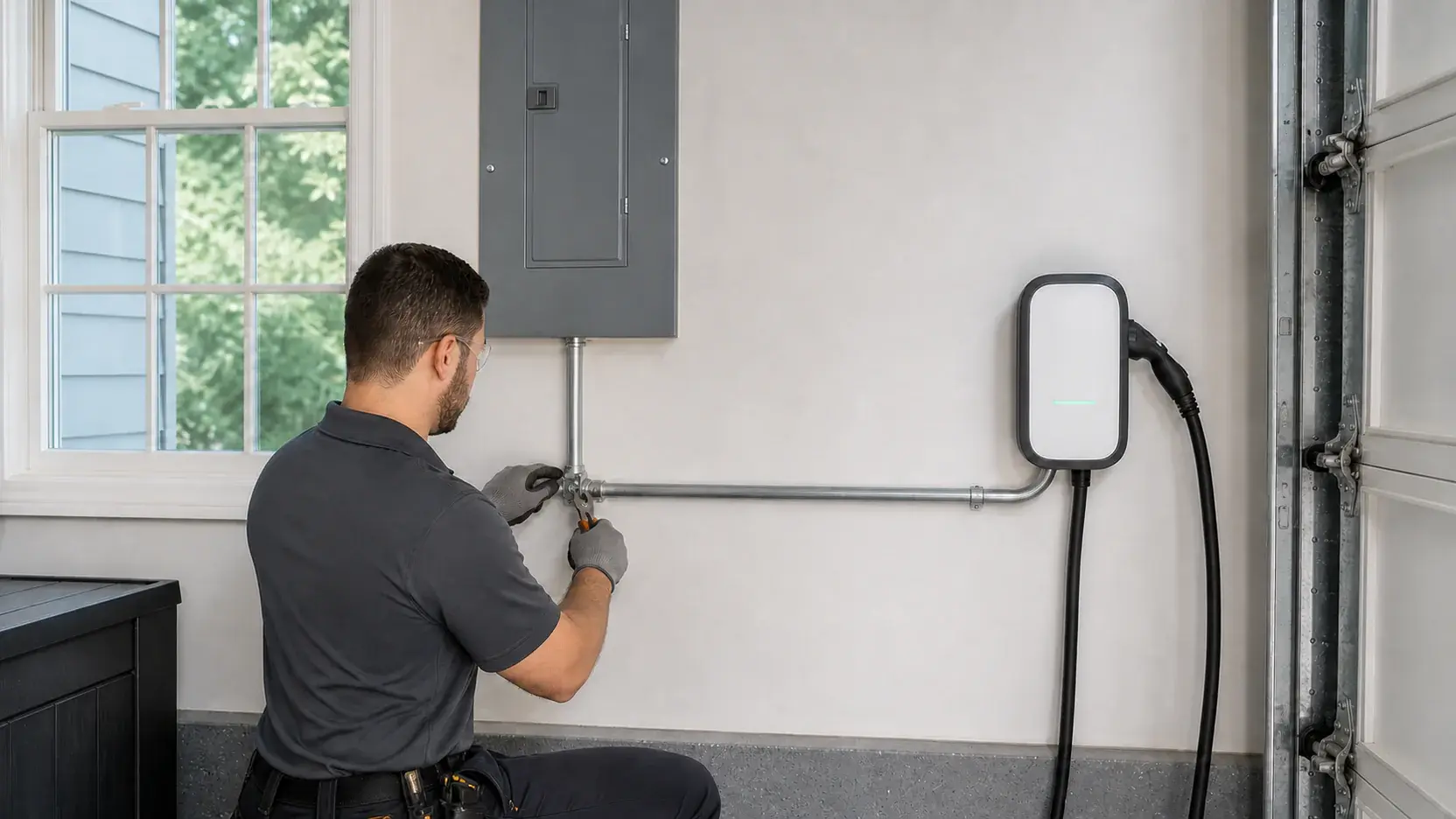
Field view / EV Charger Installation
Representative field view for EV Charger Installation; final scope is confirmed at the property.Address-specific planning
What matters in Burke
A useful Burke EV-charger plan starts with the electrical panel and the parking location, not the charger brand. We confirm available capacity, the route to the garage or driveway, and the charging rate the vehicle can actually accept before sizing the circuit.
For homes around Burke Centre, Kings Park, and Lake Braddock, circuit-route length and finished-basement access can matter as much as panel capacity. Outdoor equipment also needs a location and enclosure suitable for weather exposure. Fairfax County requires an electrical permit for a new EV charging circuit or outlet and uses the PLUS system for applications and inspections.
Explore the Burke service areaProject fit / review at the property
- A new Level 2 charger in an attached garage
- A weather-rated charger serving a driveway or carport
- A load calculation before adding an EV circuit to an older panel
Local housing & wiring
Planning electrical work in Burke
In Burke, an EV charger plan may need the association's approval. Townhomes around Burke Centre Town Center, Signal Hill and Burke Station Square park in garages, on assigned pads or in common courts, and the answer depends on who owns the wall and the ground the charger would sit on.
Burke Centre has many townhome clusters, and exterior changes there usually go through architectural review. A charger inside a garage rarely needs it, though your documents govern. A charger on an exterior wall or a parking pad almost always does, and it needs written approval before work starts. A good request includes a one-page scope, the equipment model and finish, the conduit route, the mounting location and a note on who maintains it. We prepare that, with a sketch, so the committee can say yes or no on one page. Conduit is usually painted or finished to match siding or brick. Older detached houses in Rolling Valley and Lakewood Hills may still have 100 amp panels, where capacity is the first question. Fairfax County Land Development Services issues the permit once approval is in hand.
Quote inputs
Scope and cost drivers
Typical published range for this work: $1,200-$3,500 typical; long or detached runs up to $4,500. The written Burke proposal is project-specific.
Included in the defined scope
- Review the charger requirements and desired parking location
- Calculate available panel capacity for the proposed charging load
- Plan and install a dedicated 240V circuit for hardwired or receptacle-fed equipment
- Coordinate the electrical permit and inspection for the installation
What can change scope and cost
- Circuit amperage and charger connection method
- Distance and route from the panel to the parking location
- Available panel capacity and related electrical work
- Indoor or outdoor mounting conditions
Work sequence
From assessment to completion
- 01
Review
Confirm the charger requirements, parking position, cable reach, and connection preference.
- 02
Calculate
Evaluate the panel and calculate whether it can support the charging load.
- 03
Route
Define the dedicated circuit path, mounting location, and permit scope.
- 04
Install and inspect
Install the circuit and connection, test the work, and coordinate the required inspection.
Property-specific answers
Local questions
Does a new charging circuit in Burke need a Fairfax County permit?
Yes. Fairfax County requires an electrical permit when the installation adds a new charging circuit or outlet. A stand-alone charger plugged into an existing suitable outlet is treated differently. We confirm the scope and permit path for the property before work begins.
What usually changes the circuit route in a Burke home?
The panel location, finished ceilings or walls, attached versus outdoor parking, and the distance to the vehicle determine the cleanest route. We inspect those conditions before quoting the work.
What does a Burke Centre architectural review usually want to see for an EV charger?
Most committees want a short written scope, the charger model and color, the mounting location, a sketch of the conduit route and who will maintain it. Some want photos of the wall. We prepare those items, but the form and decision belong to your association, and a written approval should come before any work.
What if the association says no to an exterior charger in Burke?
You still have options. An interior garage mount may not need review, a different wall may be acceptable, or the association may reconsider with a better plan. Virginia law touches on some restrictions, but we are electricians, not attorneys, so ask your association's counsel about your rights.
Which Burke homes tend to have 100 amp panels, and what then?
Older detached homes in places like Rolling Valley and Lakewood Hills may still have them, while newer Burke Centre townhomes often have larger panels. We cannot tell by neighborhood alone. We check the panel, run the load calculation and then recommend a smaller charger setting, load management or panel work, whichever the numbers support.
Related Services
Related Services in Burke
Guides
EV Charger Installation Planning Guides
Expert electrical guides to help you make informed decisions.
Intermediate
How to Prepare Your Home for EV Charger Installation
Everything you need to know to prepare your home for a Level 2 EV charger installation, from panel assessment to choosing the perfect charging location.
12 min read
Read GuideBeginner
How to Choose the Right EV Charger for Your Home
Compare home Level 2 EV chargers and learn how amperage, connector type (J1772 vs NACS), hardwired vs receptacle wiring, and panel load management affect your installation.
10 min read
Read GuideIntermediate
Solar-Ready Electrical Panel Upgrade Guide for Northern Virginia
A solar-ready panel is documented busbar capacity, backfeed space, and grounding — not modules on the roof. Plan it with EV and battery loads so you do not replace the panel twice.
9 min read
Read GuideNearby EV Charger Installation Service Areas
We also provide expert electrical services in these communities.
Next step / property-specific quote
Request a quote for EV Charger Installation in Burke
Share the property address and project goal so the scope can be reviewed for your home.