Loading services…

Residential project planning
Electrical Panel Upgrades in McLean, VA
A panel upgrade starts with the home's present electrical demand and the equipment it needs to support. The work can include panel replacement, load calculations, grounding and bonding updates, and permit and inspection coordination.
- Licensed & insured
- Family-owned since 1996
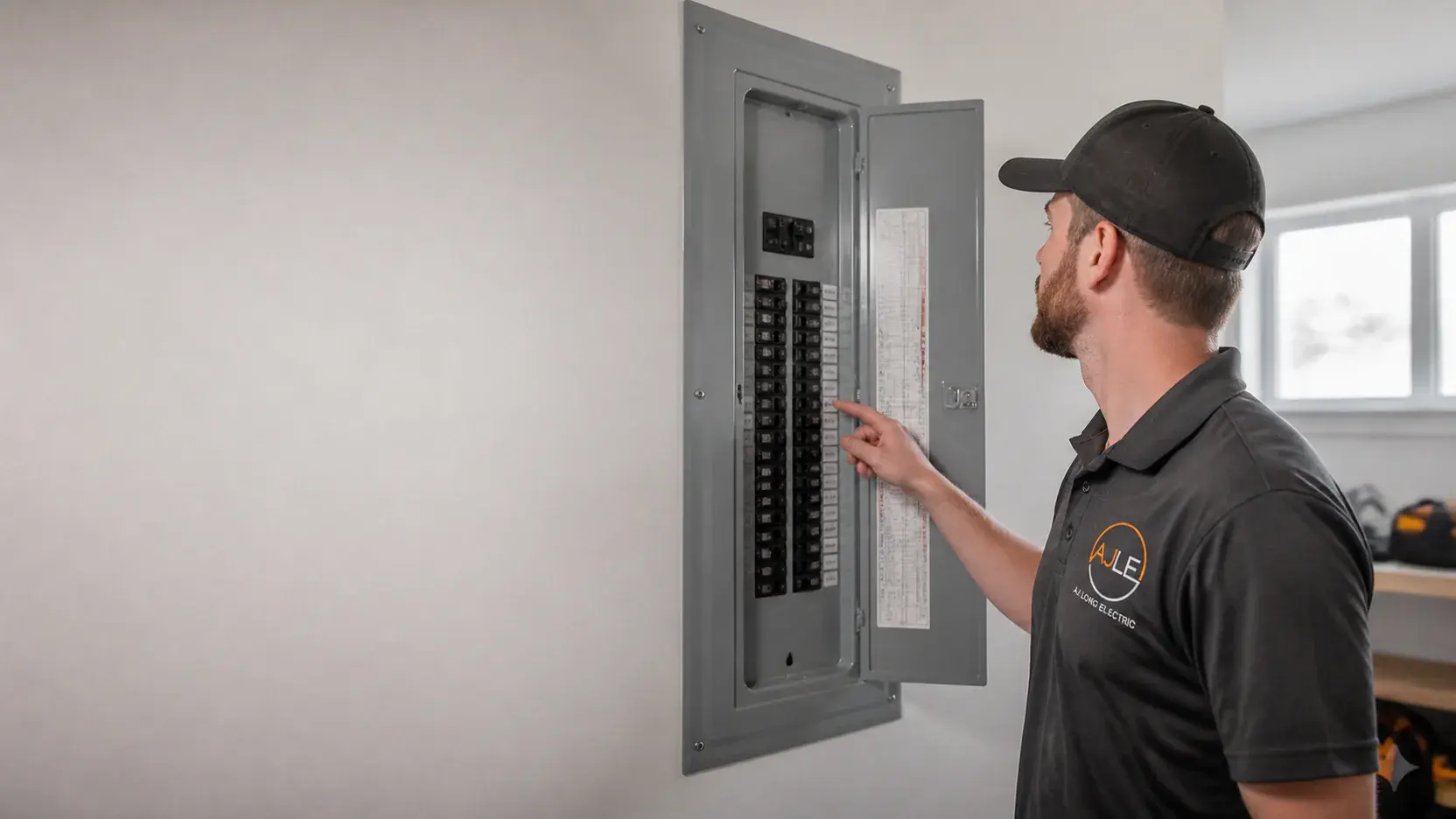
Field briefing / McLean, VA
Project briefing
Jurisdiction confirmed by property address
- Project
- Electrical Panel Upgrades
- List the planned loads and verify the complete service path so equipment capacity and access work are scoped from evidence at the property.
- Permit path
- Fairfax County Land Development Services
- Final jurisdiction is confirmed from the property address.
Scope first
What this project involves
Service capacity
Compare 100A, 150A, and 200A capacity against the calculated load and the homeowner's planned equipment.
Location and service entrance
Determine whether the panel can remain in place or needs relocation, and account for the condition of the service-entrance equipment.
Address-specific planning
What matters in McLean
A McLean panel upgrade is defined by the actual service and planned loads, not by the size or value of the property. We calculate demand, inspect service-entrance equipment, and trace the access route before choosing capacity or a panel location.
Langley, Chesterbrook, and McLean Hamlet include varied layouts, so the meter, panel, and major loads may relate differently at each address. A long interior route, finished equipment area, or exterior service condition can change labor and relocation choices. Fairfax County Land Development Services handles the electrical permit and inspection process.
Explore the McLean service areaProject fit / review at the property
- A load calculation for multiple planned electric loads or future circuits
- A replacement where service-entrance and grounding work must be separated clearly
- A panel or meter arrangement with finished, concealed, or extended access
Local housing & wiring
Planning electrical work in McLean
McLean panel projects often start as a renovation question, such as a heat pump, an induction range, or a second EV charger, and end as a load calculation. AJ Long Electric consolidates the extra subpanels in Chesterbrook, Langley, and McLean Hamlet homes into one organized, labeled distribution.
Houses in Chesterbrook and McLean Hamlet were commonly built in the 1950s and 60s, then enlarged by later owners: a kitchen addition, a family room, a finished lower level. Each addition got its own subpanel, and each subpanel was fed from whichever panel had a spare space. A McLean panel may turn out to feed a subpanel that feeds another subpanel, with breakers in a mix of brands and the directory describing rooms that no longer exist. That arrangement can work, but it makes troubleshooting slow and makes a load calculation harder to trust. Our first task is to trace what feeds what and what each breaker serves. Then we calculate the demand for the new heat pump, induction range, and charger together, rather than one at a time. If the result fits the existing service, the project is a panel consolidation. If it does not, the job becomes a service upgrade: 200A under our published panel package, or 400A quoted per project. In the larger Langley homes, the electrical room may hold two or three panels that the calculation treats as one service. Fairfax County Land Development Services issues the permit.
Quote inputs
Scope and cost drivers
Published planning range for defined 200A work: $3,500-$7,500 (200A); 400A quoted per project. The written McLean proposal is project-specific.
Included in the defined scope
- Document the existing panel, service rating, and visible service-entrance condition
- Calculate the home's electrical load and size the proposed equipment
- Plan panel replacement with required grounding and bonding work
- Coordinate the electrical permit and inspection for the defined scope
What can change scope and cost
- Selected service capacity and panel equipment
- Same-location replacement or panel relocation
- Service-entrance, grounding, and bonding work
- Access and circuit-labeling conditions
Work sequence
From assessment to completion
- 01
Assess
Review the panel, service equipment, grounding, and the homeowner's goals.
- 02
Calculate
Complete a load calculation and define the appropriate service capacity.
- 03
Plan
Confirm equipment location, scope, permit needs, and inspection steps.
- 04
Replace and inspect
Complete the approved electrical work, label circuits, and coordinate the required inspection.
Property-specific answers
Local questions
Does a larger McLean home automatically need a 200-amp panel?
No. Service capacity is based on the calculated electrical load and planned equipment, not floor area alone. Some projects need more capacity, while others call for equipment replacement at the existing rating.
What service-entrance details are checked at a McLean property?
We review the meter, service rating, conductor route, exterior equipment, grounding and bonding, panel access, and whether overhead or underground conditions affect the replacement scope.
Can the subpanels in my Chesterbrook house be combined into one panel?
Often, if one panel has enough spaces and the feeders can be rerouted to reach it. We trace what feeds what first, then check that each branch circuit can reach the new location, using an accessible junction box where it cannot. Combining panels does not change the service rating, which the load calculation still has to support.
How does an induction range change my McLean panel plan?
An induction range usually needs a dedicated 240 volt circuit sized to the nameplate, and its demand enters the load calculation along with your other large appliances. Tell us the model or the manufacturer's electrical specification and we will include it. We connect the listed range you select.
Why does my McLean Hamlet house have a subpanel fed from another subpanel?
Usually because each addition was wired from whichever panel had a spare space. That chain can be acceptable when each feeder is sized and protected correctly, but it makes faults harder to trace and the load harder to read. We check each feeder's size and breaker, confirm neutrals and grounds are separated where required, and recommend consolidation when the chain causes problems.
Related Services
Related Services in McLean
Guides
Electrical Panel Upgrades Planning Guides
Expert electrical guides to help you make informed decisions.
Advanced
Complete Guide to Electrical Panel Upgrades
A comprehensive guide to electrical panel upgrades covering signs you need an upgrade, the process, costs, and what to expect.
15 min read
Read GuideIntermediate
Solar-Ready Electrical Panel Upgrade Guide for Northern Virginia
A solar-ready panel is documented busbar capacity, backfeed space, and grounding — not modules on the roof. Plan it with EV and battery loads so you do not replace the panel twice.
9 min read
Read GuideBeginner
Electrical Panel Maintenance Guide for Homeowners
Essential tips for maintaining your electrical panel, including what homeowners can safely inspect and when professional service is needed.
8 min read
Read GuideNearby Electrical Panel Upgrades Service Areas
We also provide expert electrical services in these communities.
Next step / property-specific quote
Request a quote for Electrical Panel Upgrades in McLean
Share the property address and project goal so the scope can be reviewed for your home.