Loading services…

Residential project planning
EV Charger Installation in Springfield, VA
Home EV charging work centers on a code-sized dedicated 240V circuit and the capacity available at the electrical panel. Planning covers a hardwired or receptacle-fed charger, cable reach, placement, and permit and inspection requirements.
- Licensed & insured
- Family-owned since 1996
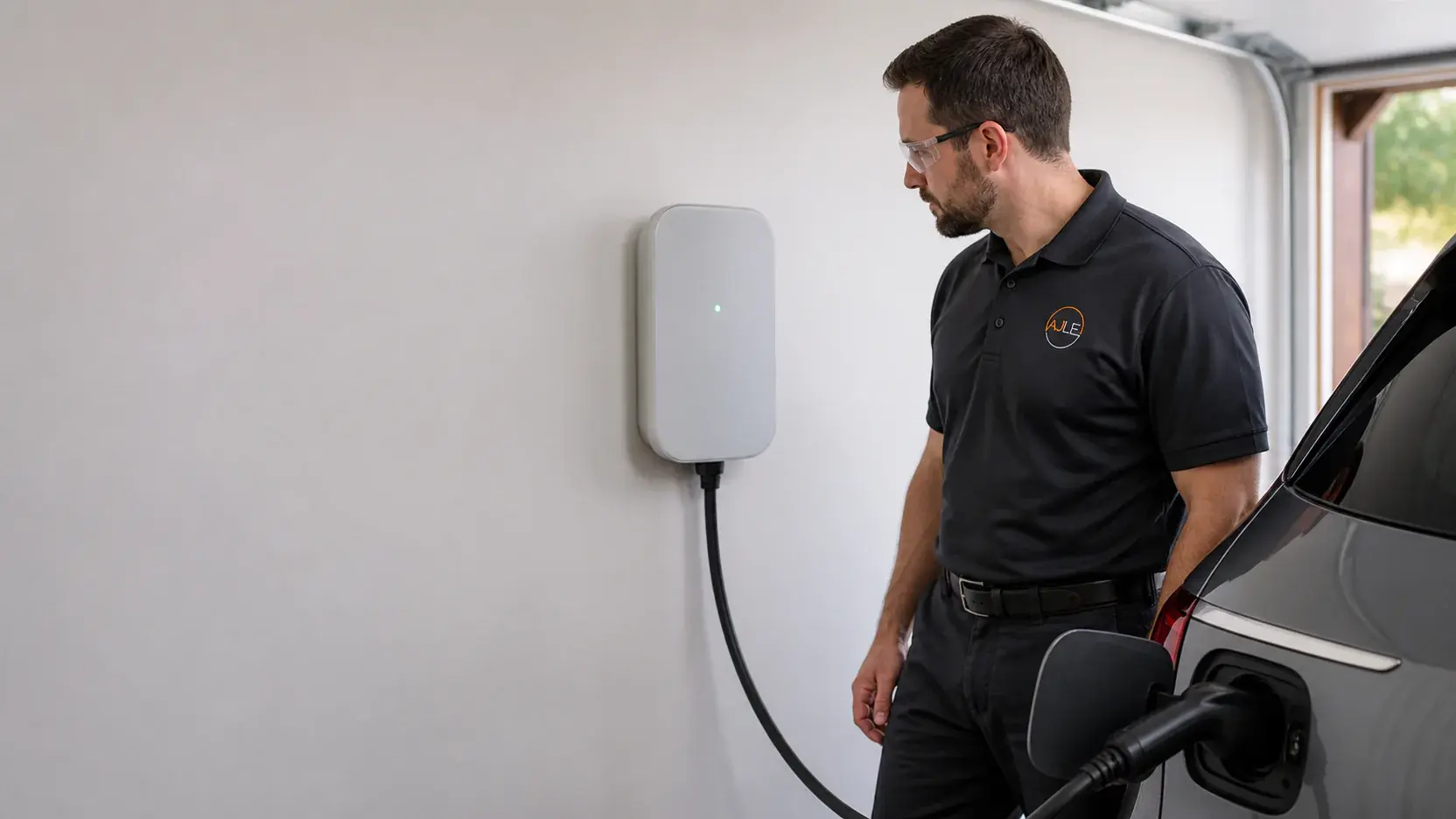
Field briefing / Springfield, VA
Project briefing
Jurisdiction confirmed by property address
- Project
- EV Charger Installation
- Park the vehicle in its normal position and test cable reach before choosing the wall, pedestal, or exterior mounting point.
- Permit path
- Fairfax County Land Development Services
- Final jurisdiction is confirmed from the property address.
Scope first
What this project involves
Charging output
Choose an output that fits the vehicle, charging habits, circuit size, and available panel capacity.
Connection and placement
Choose hardwired or receptacle-fed equipment and place it indoors or outdoors with practical cable reach.
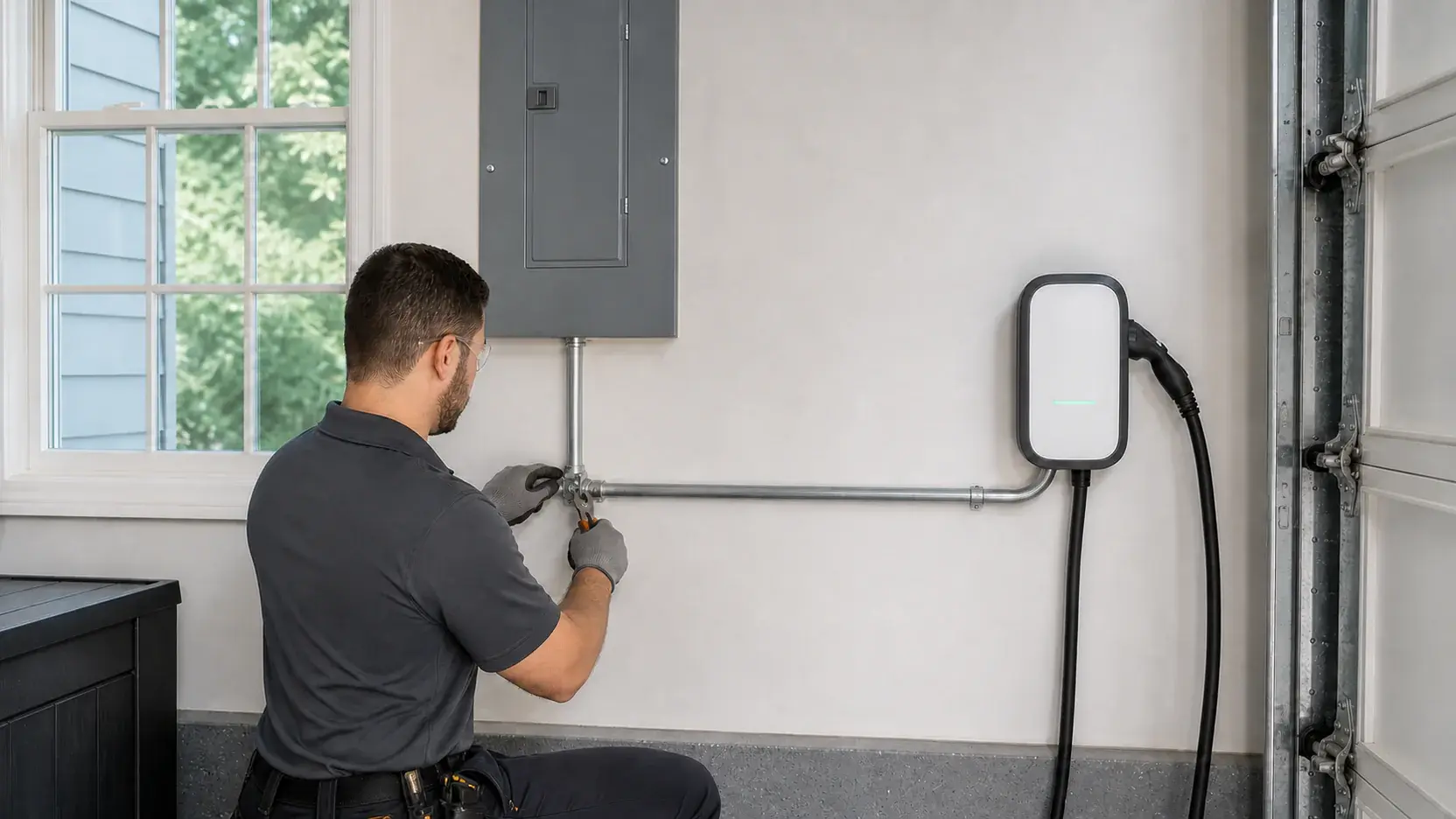
Field view / EV Charger Installation
Representative field view for EV Charger Installation; final scope is confirmed at the property.Address-specific planning
What matters in Springfield
A Springfield home-charging plan begins at the space where the vehicle will actually park. Cable reach, the vehicle's charge-port position, and the path back to the panel are set alongside charging needs and available electrical capacity.
In West Springfield, Saratoga, and Cardinal Forest, a panel may be separated from garage or driveway parking by finished basement rooms, utility areas, or exterior walls. Those conditions affect whether the route is concealed, surfaced, or outdoors, and exposed equipment must suit the mounting location. When the work adds a charging circuit or outlet, Fairfax County's electrical and EV charging permit guidance defines the applicable path.
Explore the Springfield service areaProject fit / review at the property
- A hardwired charger positioned for an attached-garage parking space
- A driveway installation where cable reach and outdoor exposure need review
- A lower or managed charging load when the panel calculation does not support the first requested output
Local housing & wiring
Planning electrical work in Springfield
An EV charger in Springfield may have to fit a 100 amp split-level panel. Homes in Kings Park West and Cardinal Forest from the 1960s and early 1970s can have a panel in a basement closet that is nearly full of breakers before a charging circuit is considered.
When the panel has no open spaces, the question is how to make room or share. Twin breakers can free spaces where the panel is listed for them. A listed device that shares an existing dryer circuit with a charger, so only one runs at a time, can work when the load calculation supports it. A hardwired charger set to a lower current on a smaller circuit is another route. Heat pumps and induction ranges planned for the next few years matter too, since they take the same capacity. Splits often put the panel on a lower level and the garage or driveway at the opposite end, which the route has to cross. We compare those choices against a panel replacement and show the trade-offs plainly. Fairfax County Land Development Services issues the permit for the defined circuit work.
Quote inputs
Scope and cost drivers
Typical published range for this work: $1,200-$3,500 typical; long or detached runs up to $4,500. The written Springfield proposal is project-specific.
Included in the defined scope
- Review the charger requirements and desired parking location
- Calculate available panel capacity for the proposed charging load
- Plan and install a dedicated 240V circuit for hardwired or receptacle-fed equipment
- Coordinate the electrical permit and inspection for the installation
What can change scope and cost
- Circuit amperage and charger connection method
- Distance and route from the panel to the parking location
- Available panel capacity and related electrical work
- Indoor or outdoor mounting conditions
Work sequence
From assessment to completion
- 01
Review
Confirm the charger requirements, parking position, cable reach, and connection preference.
- 02
Calculate
Evaluate the panel and calculate whether it can support the charging load.
- 03
Route
Define the dedicated circuit path, mounting location, and permit scope.
- 04
Install and inspect
Install the circuit and connection, test the work, and coordinate the required inspection.
Property-specific answers
Local questions
How does a finished basement affect a Springfield EV circuit?
Finished ceilings and walls can limit concealed routing between the panel and parking area. We compare accessible joist paths, utility spaces, exterior routing, and finish impacts before selecting the circuit path.
Is the highest charger output always the best choice in Springfield?
No. Useful output depends on the vehicle, charging routine, circuit size, and capacity available at the panel. A load calculation can support a smaller circuit or another capacity strategy when appropriate.
What if my Springfield panel has no empty breaker spaces?
There are a few options. Listed twin breakers can free spaces if the panel allows them. A panel replacement gives more room. A charger that shares an existing high-load circuit is another route. The load calculation decides which is acceptable, and we tell you what the panel's label permits before suggesting any of them.
Can an EV charger share the dryer circuit in a Springfield home?
Sometimes. A listed device can let a charger and a dryer use one circuit, with only one running at a time. It requires a matching receptacle and a load calculation that supports it. It is not suitable everywhere, and the inspector reviews it. We explain how it works and when charging would pause.
I plan to add a heat pump or induction range soon. Should that change the charger circuit?
Yes, plan them together. Each large load uses the same spare capacity, and adding them one at a time can leave you with a panel that cannot take the last one. We calculate the combined load, then size the charger circuit and any panel work so the next project is not blocked.
Related Services
Related Services in Springfield
Guides
EV Charger Installation Planning Guides
Expert electrical guides to help you make informed decisions.
Intermediate
How to Prepare Your Home for EV Charger Installation
Everything you need to know to prepare your home for a Level 2 EV charger installation, from panel assessment to choosing the perfect charging location.
12 min read
Read GuideBeginner
How to Choose the Right EV Charger for Your Home
Compare home Level 2 EV chargers and learn how amperage, connector type (J1772 vs NACS), hardwired vs receptacle wiring, and panel load management affect your installation.
10 min read
Read GuideIntermediate
Solar-Ready Electrical Panel Upgrade Guide for Northern Virginia
A solar-ready panel is documented busbar capacity, backfeed space, and grounding — not modules on the roof. Plan it with EV and battery loads so you do not replace the panel twice.
9 min read
Read GuideNearby EV Charger Installation Service Areas
We also provide expert electrical services in these communities.
Next step / property-specific quote
Request a quote for EV Charger Installation in Springfield
Share the property address and project goal so the scope can be reviewed for your home.