Loading services…

Residential project planning
EV Charger Installation in Fairfax, VA
Home EV charging work centers on a code-sized dedicated 240V circuit and the capacity available at the electrical panel. Planning covers a hardwired or receptacle-fed charger, cable reach, placement, and permit and inspection requirements.
- Licensed & insured
- Family-owned since 1996
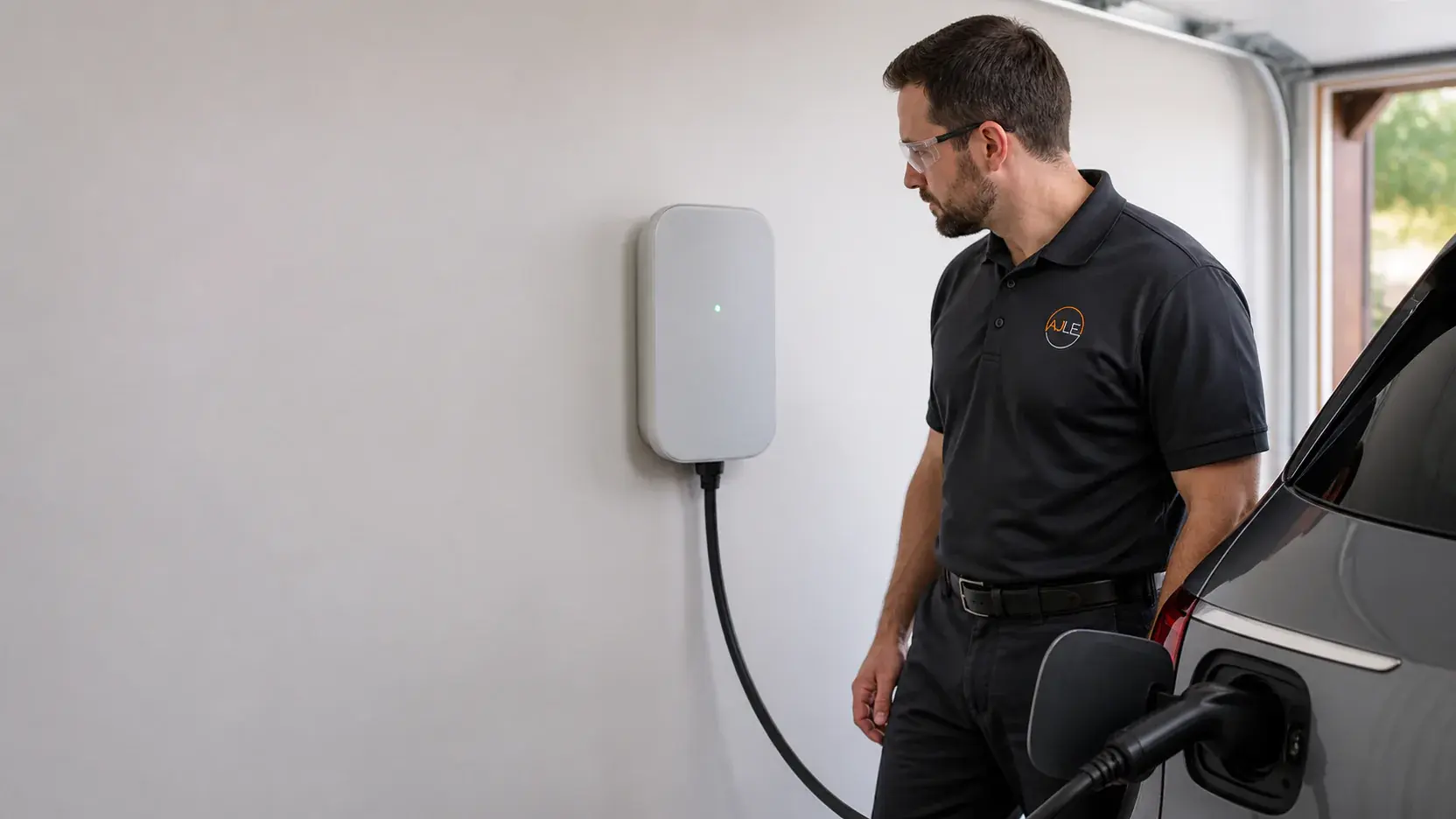
Field briefing / Fairfax, VA
Project briefing
Jurisdiction confirmed by property address
- Project
- EV Charger Installation
- Confirm City or County jurisdiction independently from the charging design, then size the circuit from vehicle needs and verified panel capacity.
- Permit path
- City of Fairfax Code Administration for City addresses; Fairfax County Land Development Services outside the independent city
- Final jurisdiction is confirmed from the property address.
- Local condition
- Fairfax
- Mantua, Fairfax City, and Fairfax Station demonstrate why a Fairfax label is not a permit answer. We verify the property boundary, then map the route from panel to garage, driveway, or other on-property parking and check the proposed mount against cable reach and exposure. City addresses follow City of Fairfax Code Administration; County addresses follow Fairfax County electrical requirements and applicable EVCS guidance.
Before your estimate
Choose a Fairfax charging route before buying the charger
Check the right permit path for the address
City of Fairfax properties use the City's electrical permit process. In Fairfax County, the EV guidance calls for an electrical permit for new circuits and outlets and distinguishes plugging a standalone charger into an existing outlet. That permitting distinction is not an assessment of the outlet's condition or suitability. A new hardwired charger, a new receptacle and an existing plug-in arrangement should be described accurately when the scope is reviewed.
Make the route useful for the parked vehicle
Photograph the car in its normal overnight position and identify its charge-port side. Then show the possible mount and the route back to the panel. A short electrical route is not useful if the charging cable blocks a doorway or cannot reach the vehicle. For a detached garage or parking area across landscaping, flag paving, buried services and finished spaces before comparing routes. If any land or parking is shared, settle permission to use it before treating the installation as a private-garage job.
Compare charging output against your actual routine
Provide the vehicle model, daily driving distance, time parked at home and any second-EV plans. The fastest setting on the equipment is not automatically the appropriate circuit design. Evaluate the household load and consider a suitable lower output or supported load management where appropriate. Ask the quote to state circuit work, charger supply, mounting, any trenching and restoration responsibilities separately. At handoff, confirm the configured output, cable storage, user controls and inspection documentation; a request through this site is not a confirmed installation date.
What to include in your request
- Full street address and parking ownership or association information
- Vehicle model, charge-port location and usual parking orientation
- Closed-panel photo and views of the whole proposed circuit route
- Expected daily mileage, overnight charging window and future second vehicle
Photograph only accessible equipment with covers in place. The office reviews your request and confirms the next step; sending it does not book an appointment.
Estimates are free for every service. Scheduled estimate visits and written project prices are free. Diagnostic and repair work is a separately priced service.
Our quoted electrical installations include a five-year workmanship warranty from completion. Parts and equipment carry their manufacturer warranties.
Scope first
What this project involves
Charging output
Choose an output that fits the vehicle, charging habits, circuit size, and available panel capacity.
Connection and placement
Choose hardwired or receptacle-fed equipment and place it indoors or outdoors with practical cable reach.
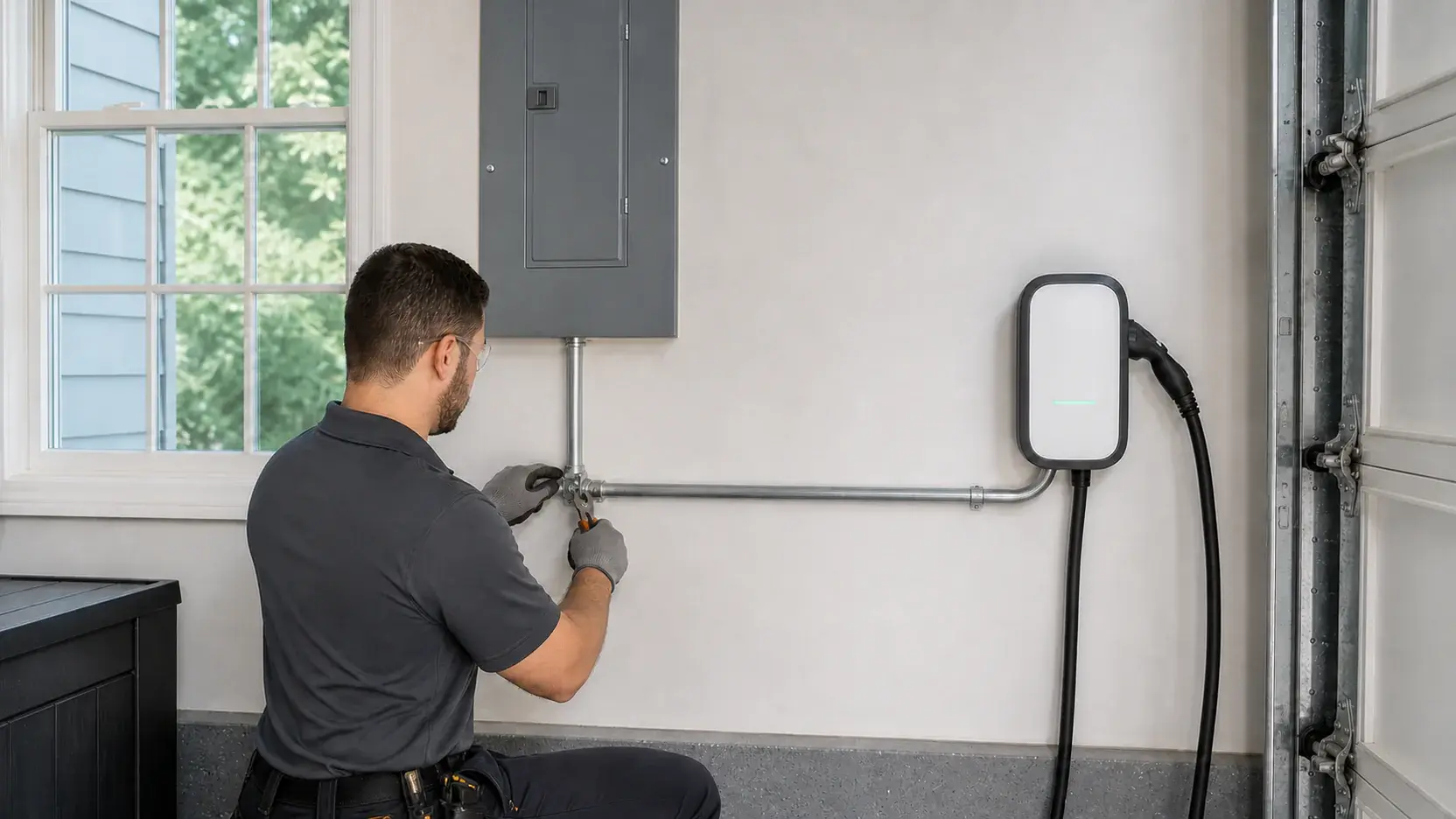
Field view / EV Charger Installation
Representative field view for EV Charger Installation; final scope is confirmed at the property.Address-specific planning
What matters in Fairfax
A Fairfax EV-charging plan separates address jurisdiction from electrical design. City or County status determines the permit path, while the parked vehicle, connector reach, circuit route, weather exposure, and panel load calculation determine the installation itself.
Mantua, Fairfax City, and Fairfax Station demonstrate why a Fairfax label is not a permit answer. We verify the property boundary, then map the route from panel to garage, driveway, or other on-property parking and check the proposed mount against cable reach and exposure. City addresses follow City of Fairfax Code Administration; County addresses follow Fairfax County electrical requirements and applicable EVCS guidance.
Explore the Fairfax service areaProject fit / review at the property
- A Fairfax address requiring City versus County permit confirmation
- A garage or outdoor charger positioned from the vehicle's charge-port reach
- A new charging load that needs calculation before circuit output is selected
Quote inputs
Scope and cost drivers
Typical published range for this work: $1,200-$3,500 typical; long or detached runs up to $4,500. The written Fairfax proposal is project-specific.
Included in the defined scope
- Review the charger requirements and desired parking location
- Calculate available panel capacity for the proposed charging load
- Plan and install a dedicated 240V circuit for hardwired or receptacle-fed equipment
- Coordinate the electrical permit and inspection for the installation
What can change scope and cost
- Circuit amperage and charger connection method
- Distance and route from the panel to the parking location
- Available panel capacity and related electrical work
- Indoor or outdoor mounting conditions
Work sequence
From assessment to completion
- 01
Review
Confirm the charger requirements, parking position, cable reach, and connection preference.
- 02
Calculate
Evaluate the panel and calculate whether it can support the charging load.
- 03
Route
Define the dedicated circuit path, mounting location, and permit scope.
- 04
Install and inspect
Install the circuit and connection, test the work, and coordinate the required inspection.
Property-specific answers
Local questions
Who reviews an EV charger at a Fairfax address?
City of Fairfax properties use City Code Administration. Fairfax County properties use County Land Development Services, including the County's EV charging guidance where it applies to the defined circuit or outlet scope.
What determines the charger location at a Fairfax home?
The normal parking position, charge-port side, cable length, panel route, mounting surface, and indoor or outdoor exposure are considered together. The shortest route is not useful if the connector cannot serve the parked vehicle safely.
Does a Fairfax EV charger always require a new service?
No. The charging requirement and calculated household load determine the options. A suitable charging output or supported load-management arrangement may fit the existing service; a larger supply is separately evaluated.
Is an existing Fairfax garage outlet automatically suitable for EV charging?
No. Whether a new permit is needed does not establish outlet condition, circuit suitability or equipment compatibility. Have the intended equipment and existing circuit assessed before relying on the outlet for charging.
Related Services
Related Services in Fairfax
Guides
EV Charger Installation Planning Guides
Expert electrical guides to help you make informed decisions.
Intermediate
How to Prepare Your Home for EV Charger Installation
Everything you need to know to prepare your home for a Level 2 EV charger installation, from panel assessment to choosing the perfect charging location.
12 min read
Read GuideBeginner
How to Choose the Right EV Charger for Your Home
Compare popular home EV chargers and learn which features matter most for your electric vehicle charging needs.
10 min read
Read GuideIntermediate
Solar-Ready Electrical Panel Upgrade Guide for Northern Virginia
A solar-ready panel is documented busbar capacity, backfeed space, and grounding — not modules on the roof. Plan it with EV and battery loads so you do not replace the panel twice.
9 min read
Read GuideNearby EV Charger Installation Service Areas
We also provide expert electrical services in these communities.
Next step / property-specific quote
Request a quote for EV Charger Installation in Fairfax
Share the property address and project goal so the scope can be reviewed for your home.