Loading services…

Residential project planning
EV Charger Installation in Alexandria, VA
Home EV charging work centers on a code-sized dedicated 240V circuit and the capacity available at the electrical panel. Planning covers a hardwired or receptacle-fed charger, cable reach, placement, and permit and inspection requirements.
- Licensed & insured
- Family-owned since 1996
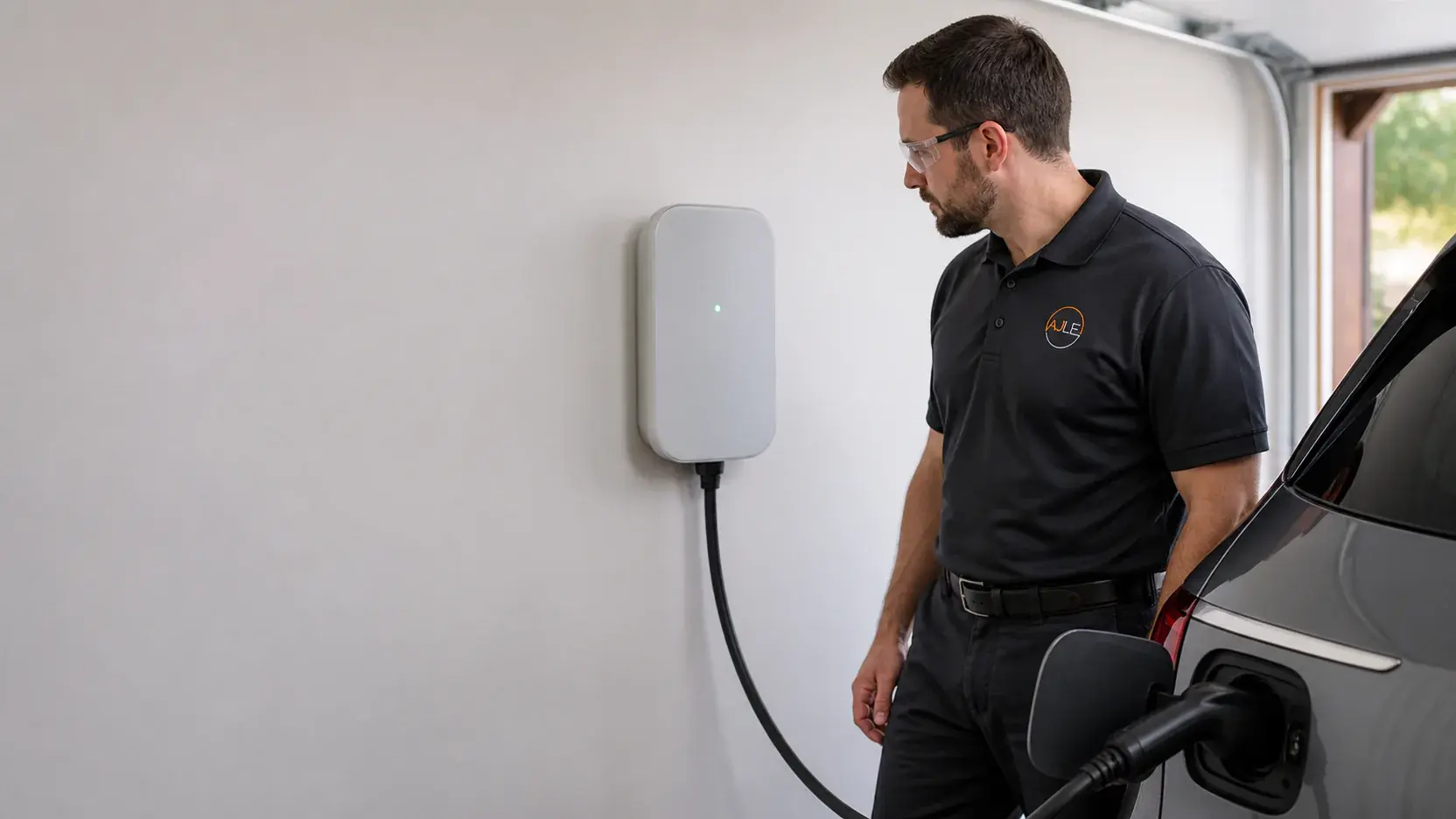
Field briefing / Alexandria, VA
Project briefing
Jurisdiction confirmed by property address
- Project
- EV Charger Installation
- Verify that the proposed mounting point serves parking on the property and identify the correct jurisdiction before designing the circuit route.
- Permit path
- City of Alexandria Permit Center for City addresses; Fairfax County Land Development Services for the Alexandria postal area outside the independent city
- Final jurisdiction is confirmed from the property address.
Before your estimate
Private parking and public curbside charging are different projects
Confirm the jurisdiction and the parking arrangement
For an Alexandria address, first determine whether the property is inside the independent City or in Fairfax County. Then identify a driveway, garage or other parking space you have permission to serve. Record who controls every part of the circuit route. A rear parking space, shared lot and public street are different project starting points; proximity to your home does not establish permission to install equipment or run a cable.
Do not confuse the City curbside program with a home installation
Alexandria approved a public curbside EV charging program in February 2026. It uses qualified vendors to install and operate publicly accessible chargers. That program is separate from a private homeowner's charger and does not establish AJ Long Electric as a participating vendor. If you depend on street parking, consult the City's current program information before assuming a private circuit can serve that space. An older guide's blanket statement about curbside charging may no longer describe the public program.
Review the mount, visible route and electrical scope together
For a private installation, show the normal parking position, charge-port side and full route from the panel. Identify whether the charger will be wall-mounted or freestanding and whether any route crosses shared property. At a designated historic property, check proposed visible exterior changes with Preservation staff before committing to a mount or conduit route. Compare circuit output with actual driving needs and the household load assessment. The written scope should identify equipment, mounting, wiring, access and restoration responsibilities, with any additional review or building coordination identified before scheduling.
What to include in your request
- Full address and confirmation of private or shared parking
- Sketch of parking, property boundaries and the proposed route
- Vehicle and charger model if selected; daily charging needs
- Known historic designation and any association or management instructions
Photograph only accessible equipment with covers in place. The office reviews your request and confirms the next step; sending it does not book an appointment.
Estimates are free for every service. Scheduled estimate visits and written project prices are free. Diagnostic and repair work is a separately priced service.
Our quoted electrical installations include a five-year workmanship warranty from completion. Parts and equipment carry their manufacturer warranties.
Scope first
What this project involves
Charging output
Choose an output that fits the vehicle, charging habits, circuit size, and available panel capacity.
Connection and placement
Choose hardwired or receptacle-fed equipment and place it indoors or outdoors with practical cable reach.
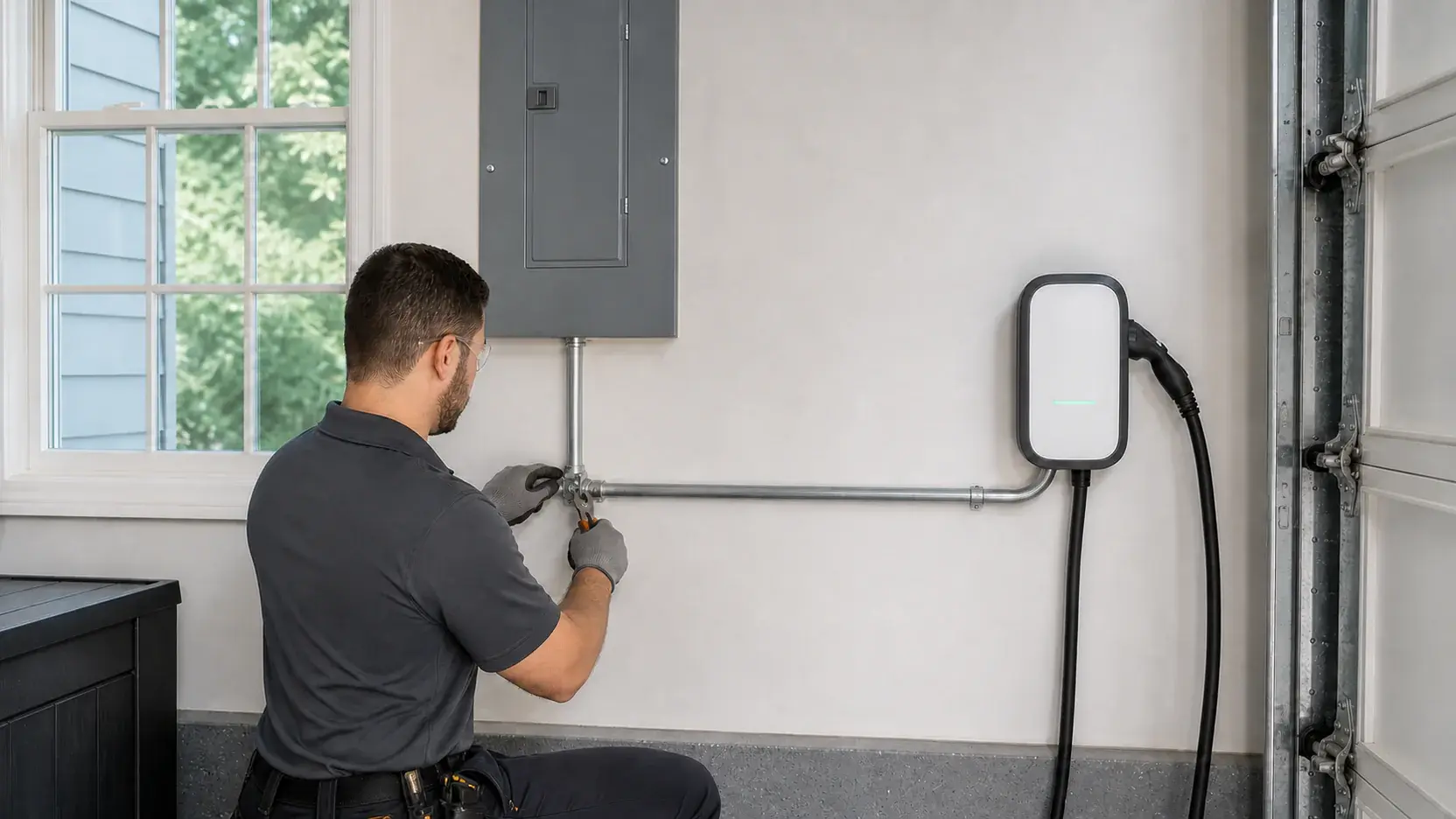
Field view / EV Charger Installation
Representative field view for EV Charger Installation; final scope is confirmed at the property.Address-specific planning
What matters in Alexandria
An Alexandria EV charger cannot be planned from the mailing city alone. We confirm City versus Fairfax County jurisdiction, then place the charger around lawful on-property parking, vehicle-side cable reach, the circuit route, and the capacity available at the panel.
Old Town, Del Ray, and Kingstowne span different property and jurisdiction contexts. A garage wall, driveway-side exterior mount, or coordinated shared area presents a different route and exposure, so the actual parking and access conditions are documented. City properties use the City of Alexandria Permit Center; Alexandria postal addresses outside the independent city may use Fairfax County Land Development Services for the defined electrical work.
Explore the Alexandria service areaProject fit / review at the property
- An address that needs City of Alexandria versus Fairfax County confirmation
- A constrained garage or exterior parking position where connector reach drives placement
- A charging circuit that requires load calculation and a route through finished space
Local housing & wiring
Planning electrical work in Alexandria
EV charger installation in Alexandria changes block by block. An Old Town rowhouse may park in an alley garage, a Del Ray bungalow in a detached rear garage, and a Kingstowne townhome in a one-car garage governed by an association.
Detached and alley garages are the common challenge in Old Town and Del Ray. The panel is inside the house, the car is at the back of a narrow lot, and the feeder has to cross a side yard or patio. A detached garage also needs its own disconnecting means where the wiring enters it, which we plan into the scope. In Old Town, visible exterior changes can trigger the City's historic review where a property falls inside a regulated district, so we favor interior garage walls and rear locations and confirm the designation by address rather than by neighborhood name. Kingstowne is different again. Despite its Alexandria mailing address it sits in Fairfax County, so permits go through Land Development Services, and association rules cover anything on an exterior wall. City addresses use City of Alexandria Code Administration.
Quote inputs
Scope and cost drivers
Typical published range for this work: $1,200-$3,500 typical; long or detached runs up to $4,500. The written Alexandria proposal is project-specific.
Included in the defined scope
- Review the charger requirements and desired parking location
- Calculate available panel capacity for the proposed charging load
- Plan and install a dedicated 240V circuit for hardwired or receptacle-fed equipment
- Coordinate the electrical permit and inspection for the installation
What can change scope and cost
- Circuit amperage and charger connection method
- Distance and route from the panel to the parking location
- Available panel capacity and related electrical work
- Indoor or outdoor mounting conditions
Work sequence
From assessment to completion
- 01
Review
Confirm the charger requirements, parking position, cable reach, and connection preference.
- 02
Calculate
Evaluate the panel and calculate whether it can support the charging load.
- 03
Route
Define the dedicated circuit path, mounting location, and permit scope.
- 04
Install and inspect
Install the circuit and connection, test the work, and coordinate the required inspection.
Property-specific answers
Local questions
Is there room for a charger in a narrow Alexandria garage?
That is checked with the car inside. The charger goes on the side the charge port faces, at a height that keeps the cable and connector out of the door swing and the path between the car and the wall. In a tight garage, cable storage matters more than charger output.
What placement issue matters for an Alexandria exterior charger?
The mount must work with the on-property parking position, vehicle charge-port side, weather exposure, cable storage, and pedestrian path. We review all of those before routing the circuit.
Does Alexandria’s curbside program let me install a private charger in the street?
The City describes a qualified-vendor program for publicly accessible chargers. Treat it separately from a private home project and check the current program requirements; it is not approval for an individual cable route or evidence that AJ Long Electric participates.
What should I send for an Alexandria rear-parking charger estimate?
Send the full address, parking location, who owns or controls the route, vehicle position and photos between the panel and parking. Include association instructions or known historic designation so access and review needs can be identified early.
Does Old Town historic review apply to an EV charger inside my garage?
Review applies to visible exterior alterations on a property within a regulated historic district. A charger on an interior garage wall is generally not visible, while an exterior mount or surface conduit on a street face might be. Whether your property is in a district depends on the address, so we confirm that before drawing the route.
How deep does the conduit go for a charger feeder to a Del Ray alley garage?
It depends on the wiring method and what sits over it. Rigid metal conduit can be buried shallower than PVC, and a run under a driveway or patio has its own depth. We choose the method for the route and the yard, call Virginia 811 for public utility locates, and tell you what will be dug up before the trench starts.
Can a detached alley garage in Del Ray get a charger without a new service?
Often it can. If the load calculation leaves room, we run a dedicated feeder in buried conduit from the house panel and add a disconnect at the garage. The route across the yard, the depth of the trench and anything already underground decide the effort, so we walk it with you first.
Related Services
Related Services in Alexandria
Guides
EV Charger Installation Planning Guides
Expert electrical guides to help you make informed decisions.
Intermediate
How to Prepare Your Home for EV Charger Installation
Everything you need to know to prepare your home for a Level 2 EV charger installation, from panel assessment to choosing the perfect charging location.
12 min read
Read GuideBeginner
How to Choose the Right EV Charger for Your Home
Compare home Level 2 EV chargers and learn how amperage, connector type (J1772 vs NACS), hardwired vs receptacle wiring, and panel load management affect your installation.
10 min read
Read GuideIntermediate
Solar-Ready Electrical Panel Upgrade Guide for Northern Virginia
A solar-ready panel is documented busbar capacity, backfeed space, and grounding — not modules on the roof. Plan it with EV and battery loads so you do not replace the panel twice.
9 min read
Read GuideNearby EV Charger Installation Service Areas
We also provide expert electrical services in these communities.
Next step / property-specific quote
Request a quote for EV Charger Installation in Alexandria
Share the property address and project goal so the scope can be reviewed for your home.