Loading services…

Residential project planning
EV Charger Installation in Falls Church, VA
Home EV charging work centers on a code-sized dedicated 240V circuit and the capacity available at the electrical panel. Planning covers a hardwired or receptacle-fed charger, cable reach, placement, and permit and inspection requirements.
- Licensed & insured
- Family-owned since 1996
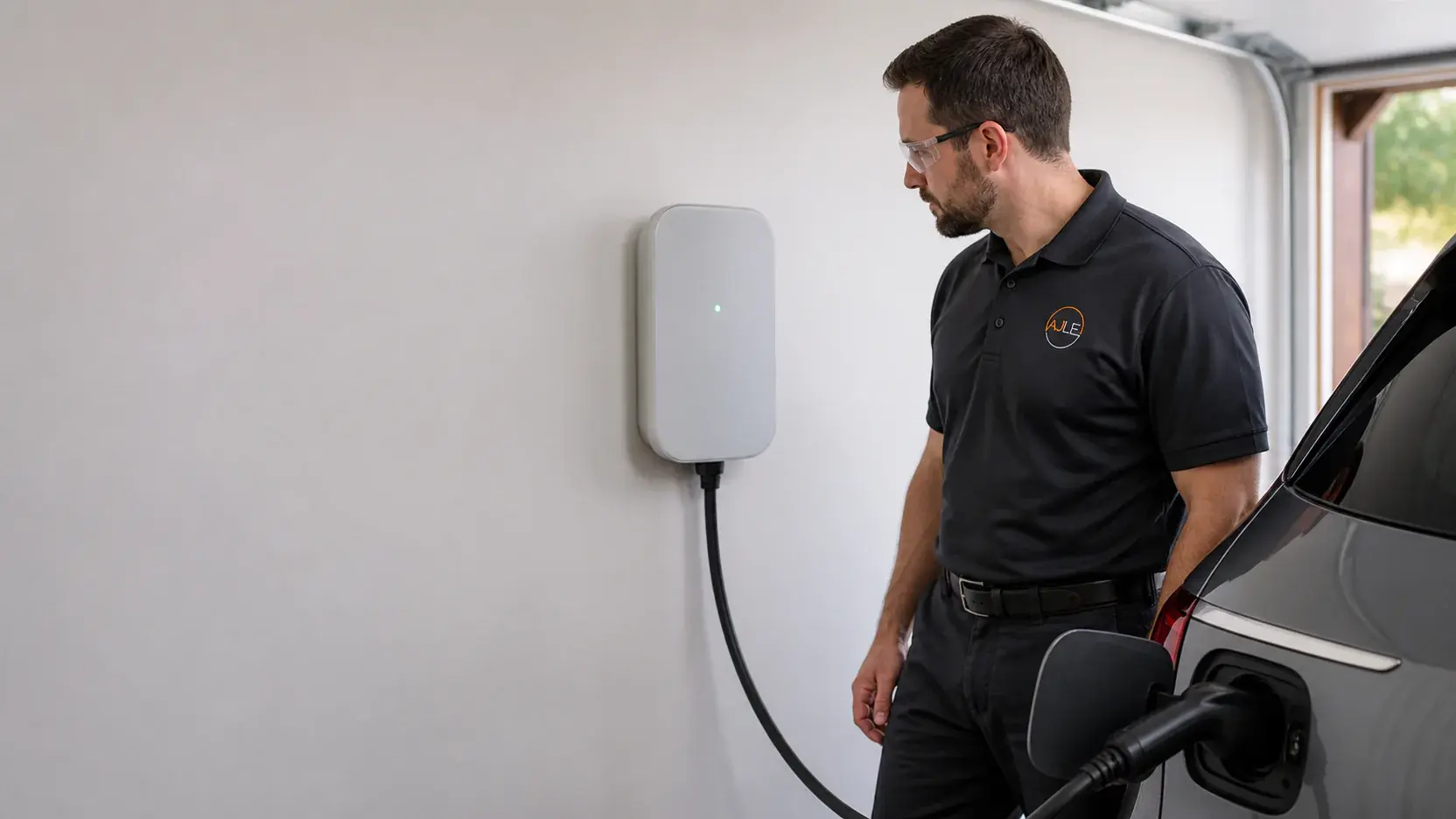
Field briefing / Falls Church, VA
Project briefing
Jurisdiction confirmed by property address
- Project
- EV Charger Installation
- Resolve jurisdiction and parking rights before choosing an exterior mount or committing to a route through shared or finished areas.
- Permit path
- City of Falls Church for City addresses; Fairfax County Land Development Services for nearby Falls Church postal addresses
- Final jurisdiction is confirmed from the property address.
Before your estimate
Match your Falls Church charging plan to the actual property
Confirm City versus County authority
Falls Church is both an independent city and a mailing address used beyond the city boundary. Confirm the property jurisdiction before choosing the permit route. The City’s EV guidance directs electricians to apply for an electrical permit for wiring changes; County properties use the Fairfax County process. The request should identify the actual address and proposed work rather than relying on a ZIP code or a nearby project’s permit history.
Treat an existing outlet as something to assess
A receptacle in a garage may look like the charger plug without having the circuit, condition or protection needed for continuous charging. Photograph the closed outlet and its location without removing the cover. Provide the EVSE model and any existing circuit documentation. Do not use a dryer adapter or assume that changing the breaker is enough. The electrician compares grounding, wiring, terminals, load and the equipment instructions before recommending reuse, hardwiring or a new circuit.
Keep the cable on an approved, usable route
Show the car in its normal parking position and identify doors, steps and the path people use to enter the home. For assigned or shared parking, identify who can approve the mounting surface, cable route and use of the electrical supply. A cable cover does not establish permission to cross a public sidewalk or another property. Ask the written quote to distinguish hardware, circuit routing, mounting, permits and surface restoration. A service request starts review; it does not reserve a work date or guarantee permit approval.
What to include in your request
- Full address with City or County jurisdiction if known
- Vehicle/charger model and typical parking orientation
- Photos of closed panel and any existing charging outlet
- Shared-parking permissions and route or restoration constraints
Photograph only accessible equipment with covers in place. The office reviews your request and confirms the next step; sending it does not book an appointment.
Estimates are free for every service. Scheduled estimate visits and written project prices are free. Diagnostic and repair work is a separately priced service.
Our quoted electrical installations include a five-year workmanship warranty from completion. Parts and equipment carry their manufacturer warranties.
Official local requirements
Scope first
What this project involves
Charging output
Choose an output that fits the vehicle, charging habits, circuit size, and available panel capacity.
Connection and placement
Choose hardwired or receptacle-fed equipment and place it indoors or outdoors with practical cable reach.
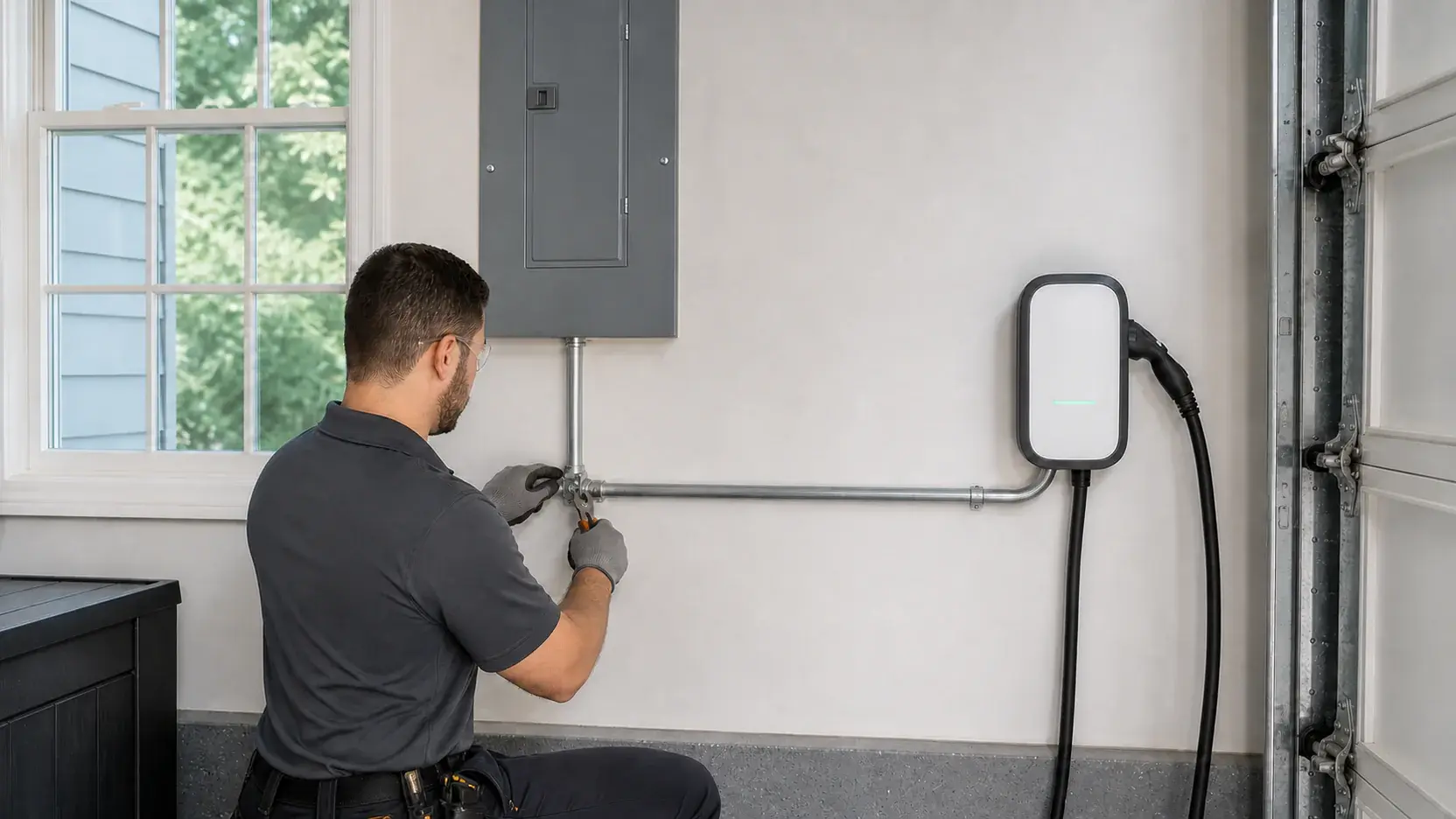
Field view / EV Charger Installation
Representative field view for EV Charger Installation; final scope is confirmed at the property.Address-specific planning
What matters in Falls Church
A Falls Church charging project starts with the exact address and the exact parking space. City and Fairfax County permit paths differ, while charger placement still has to reconcile panel capacity, connector reach, route access, and weather exposure.
Falls Church City, Pimmit Hills, and Seven Corners share a mailing-area identity without one electrical authority. We confirm the boundary before planning the permit path, then check whether the vehicle uses a garage, driveway, carport, or coordinated parking area. Finished-route access and outdoor equipment conditions are included in the circuit plan rather than added after placement is chosen.
Explore the Falls Church service areaProject fit / review at the property
- An EV installation requiring City versus Fairfax County jurisdiction confirmation
- A driveway or garage location where parking orientation controls cable reach
- A circuit output selected from vehicle needs and calculated panel capacity
Local housing & wiring
Planning electrical work in Falls Church
In Falls Church, an EV charger may have to start with a panel that is decades older than the car. Cottages and colonials in Falls Church City and the ramblers of Pimmit Hills and Seven Corners may have fuse boxes or small breaker panels that were never sized for a charging load.
Older houses here, from the 1920s through the 1950s, can have a 60 amp fuse box, ungrounded branch circuits, plaster ceilings and little spare room. A new EV circuit is separate from that old wiring and does not require rewiring the whole house, but it does require the panel and service to be in suitable condition. If the calculation shows a 60 or 100 amp service cannot carry a charger, the first job is the panel and sometimes the service, and any service change involves Dominion Energy, which our electrical service upgrade page explains. If you already bought a charger, we check that the listed unit suits the circuit and the car. Lots in Falls Church City are small, which keeps routes short but crowds meters, gas lines and doors. The City of Falls Church handles city permits and Fairfax County handles the county areas.
Quote inputs
Scope and cost drivers
Typical published range for this work: $1,200-$3,500 typical; long or detached runs up to $4,500. The written Falls Church proposal is project-specific.
Included in the defined scope
- Review the charger requirements and desired parking location
- Calculate available panel capacity for the proposed charging load
- Plan and install a dedicated 240V circuit for hardwired or receptacle-fed equipment
- Coordinate the electrical permit and inspection for the installation
What can change scope and cost
- Circuit amperage and charger connection method
- Distance and route from the panel to the parking location
- Available panel capacity and related electrical work
- Indoor or outdoor mounting conditions
Work sequence
From assessment to completion
- 01
Review
Confirm the charger requirements, parking position, cable reach, and connection preference.
- 02
Calculate
Evaluate the panel and calculate whether it can support the charging load.
- 03
Route
Define the dedicated circuit path, mounting location, and permit scope.
- 04
Install and inspect
Install the circuit and connection, test the work, and coordinate the required inspection.
Property-specific answers
Local questions
Are finish repairs part of a Falls Church charger estimate?
They are written into it. Any wall or ceiling opening along the route, who restores the finish, and outdoor items such as a weather-rated box or protected conduit are listed with the charger location. That way the cost of the route is known before the placement is final, not added after it.
Can charger output be adjusted to fit a Falls Church panel?
The output can be selected around the vehicle, charging routine, circuit design, and calculated panel capacity. We present a suitable charging-load option or separately scoped capacity work based on those findings.
Can the City of Falls Church issue a permit for every Falls Church postal address?
No. Confirm which jurisdiction serves the parcel. Properties outside the independent City can fall under Fairfax County even with a Falls Church mailing address.
Can an existing garage receptacle be used for my charger?
Possibly, after the complete circuit and exact EVSE are assessed. Plug shape and a breaker label alone do not establish suitability for continuous charging.
Can I install an EV charger if my Falls Church house still has a fuse box?
Not directly. A fuse box is usually too small and has no room for a charging breaker. The panel, and sometimes the service, has to be replaced first. Once a breaker panel with enough capacity is in, the charging circuit goes on its own breaker. We scope the two together so you see the whole job.
Does an EV circuit mean rewiring the rest of an older Falls Church house?
No. The charging circuit is a new run from the panel to the charger, grounded and separate from the old branch wiring. We may point out hazards we see at the panel, such as damaged insulation or double-tapped breakers, but the rest of the house is not required to change for the charger.
What circuit size do I need if my Falls Church panel is only 100 amps?
It depends on what else the house runs, not on the panel number alone. A 100 amp service with gas heat and cooking may carry a 40 amp circuit. One with electric heat, range and dryer may not. The load calculation tells us, and a lower charger setting is a legitimate answer.
Related Services
Related Services in Falls Church
Guides
EV Charger Installation Planning Guides
Expert electrical guides to help you make informed decisions.
Intermediate
How to Prepare Your Home for EV Charger Installation
Everything you need to know to prepare your home for a Level 2 EV charger installation, from panel assessment to choosing the perfect charging location.
12 min read
Read GuideBeginner
How to Choose the Right EV Charger for Your Home
Compare home Level 2 EV chargers and learn how amperage, connector type (J1772 vs NACS), hardwired vs receptacle wiring, and panel load management affect your installation.
10 min read
Read GuideIntermediate
Solar-Ready Electrical Panel Upgrade Guide for Northern Virginia
A solar-ready panel is documented busbar capacity, backfeed space, and grounding — not modules on the roof. Plan it with EV and battery loads so you do not replace the panel twice.
9 min read
Read GuideNearby EV Charger Installation Service Areas
We also provide expert electrical services in these communities.
Next step / property-specific quote
Request a quote for EV Charger Installation in Falls Church
Share the property address and project goal so the scope can be reviewed for your home.