Loading services…

Residential project planning
EV Charger Installation in Annandale, VA
Home EV charging work centers on a code-sized dedicated 240V circuit and the capacity available at the electrical panel. Planning covers a hardwired or receptacle-fed charger, cable reach, placement, and permit and inspection requirements.
- Licensed & insured
- Family-owned since 1996
4.9 ★ on our Annandale, VA Google Profile (67+ Local Reviews)Backed by 1,463+ 4.9 ★ Reviews Across the DMV
7138 Little River Turnpike #305, Annandale, VA 22003Our long-standing Annandale local presence — serving the Annandale community for over two decades.
Field briefing / Annandale, VA
Project briefing
Jurisdiction confirmed by property address
- Project
- EV Charger Installation
- Confirm whether the cable must serve one fixed parking position or more than one before placing equipment or choosing a route.
- Permit path
- Fairfax County Land Development Services
- Final jurisdiction is confirmed from the property address.
Scope first
What this project involves
Charging output
Choose an output that fits the vehicle, charging habits, circuit size, and available panel capacity.
Connection and placement
Choose hardwired or receptacle-fed equipment and place it indoors or outdoors with practical cable reach.
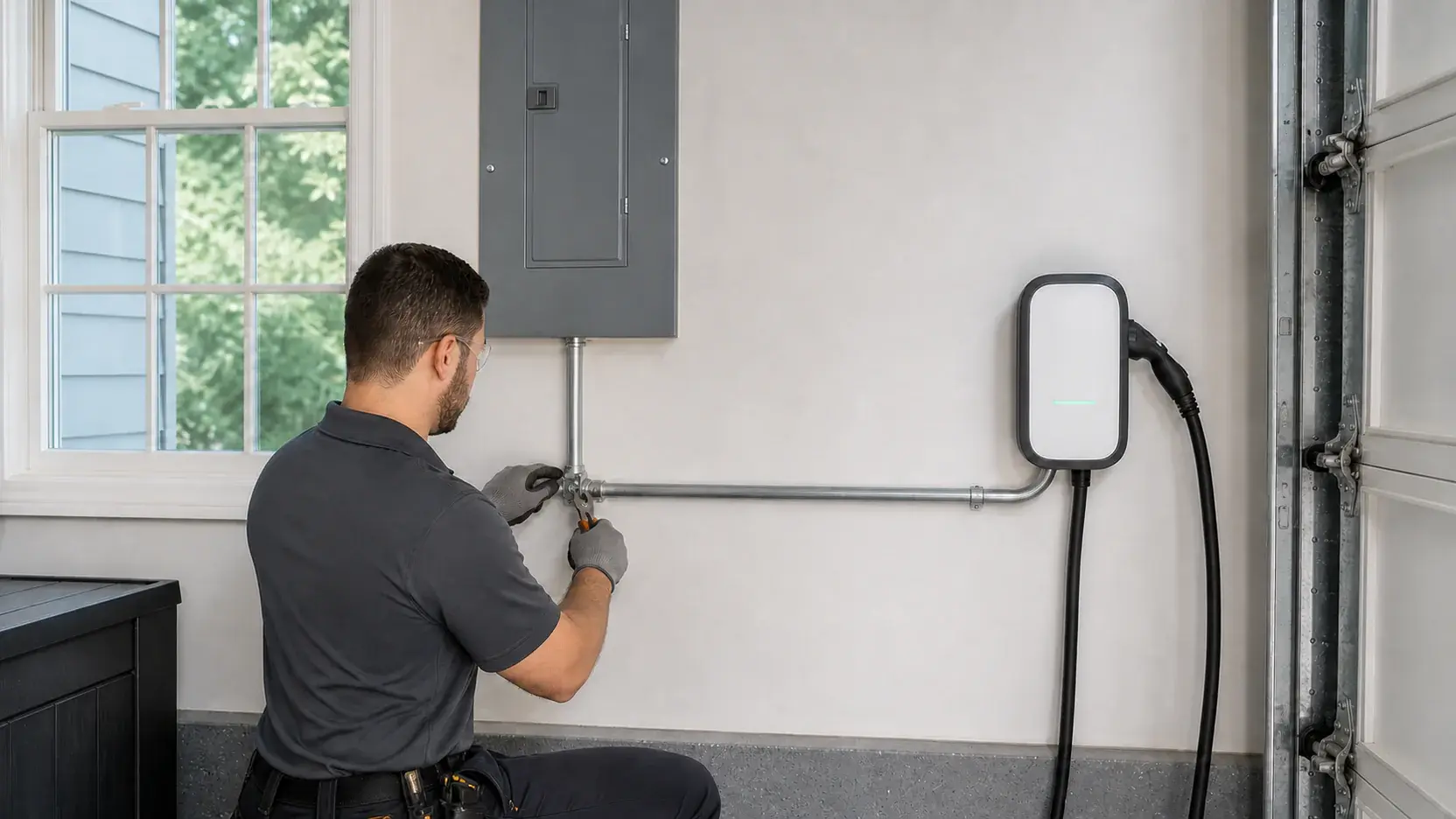
Field view / EV Charger Installation
Representative field view for EV Charger Installation; final scope is confirmed at the property.Address-specific planning
What matters in Annandale
An Annandale EV charger should be located from the vehicle outward, then connected back to the panel by a route the property can support. That sequence keeps cable reach, weather exposure, circuit length, and panel capacity in the same decision.
Ravensworth, Woodburn, and Sleepy Hollow Woods include homes with varied renovation histories, so a seemingly direct garage route may cross finished or previously altered spaces. We verify accessible framing, exterior mounting surfaces, panel compatibility, and the normal parking position. Fairfax County electrical and EVCS guidance establishes the permit path when the defined installation adds the charging circuit or outlet it covers.
Explore the Annandale service areaProject fit / review at the property
- A charger in a garage where prior finish work affects the wiring route
- An exterior charger that needs suitable equipment and a weather-aware cable position
- A panel-capacity calculation before selecting circuit amperage and charger output
Local housing & wiring
Planning electrical work in Annandale
In Annandale, an EV charger plan can come down to a choice between a panel upgrade and a smarter charging setup. Ravensworth, Woodburn and Sleepy Hollow Woods have 1950s and 1960s ramblers and split-levels, some with 100 amp panels and carports or one-car garages.
Both paths are legitimate. Replacing the panel with a larger one makes room for a 40 or 60 amp charging circuit and leaves spare spaces for a heat pump or a kitchen later. Keeping the 100 amp panel and adding listed load management is a permanent answer, not a stopgap, as long as the household accepts that charging slows when big loads run. The better choice depends on what else you plan to do in the next few years. If the work leads to a larger service, our electrical service upgrade page covers the Dominion Energy side. Carports are common here, which means a weather-rated unit on the house wall or a post, with metal conduit exposed on the exterior. A basement panel and a driveway car can leave a long run through a finished rec room. Fairfax County Land Development Services issues the permit.
Quote inputs
Scope and cost drivers
Typical published range for this work: $1,200-$3,500 typical; long or detached runs up to $4,500. The written Annandale proposal is project-specific.
Included in the defined scope
- Review the charger requirements and desired parking location
- Calculate available panel capacity for the proposed charging load
- Plan and install a dedicated 240V circuit for hardwired or receptacle-fed equipment
- Coordinate the electrical permit and inspection for the installation
What can change scope and cost
- Circuit amperage and charger connection method
- Distance and route from the panel to the parking location
- Available panel capacity and related electrical work
- Indoor or outdoor mounting conditions
Work sequence
From assessment to completion
- 01
Review
Confirm the charger requirements, parking position, cable reach, and connection preference.
- 02
Calculate
Evaluate the panel and calculate whether it can support the charging load.
- 03
Route
Define the dedicated circuit path, mounting location, and permit scope.
- 04
Install and inspect
Install the circuit and connection, test the work, and coordinate the required inspection.
Property-specific answers
Local questions
What is checked before routing an Annandale EV circuit?
We locate the panel and parking space, check finished and accessible paths, measure practical cable reach, review mounting exposure, and calculate the panel capacity available for continuous charging load.
Will an Annandale charger serve one parking position or more than one?
That is settled before any equipment is placed. Cable reach, connector storage, and the mounting location are chosen for the confirmed parking position or positions, and only then is the route back to the panel set. A mount between two spaces works only when the cable reaches both charge ports without crossing a walkway or door path.
Should I upgrade my Annandale panel or use load management for an EV charger?
It depends on what else you plan. If a heat pump, kitchen or addition is coming, a larger panel solves more than the charger. If the charger is the only change and the numbers fit with load management, that works and avoids panel work. We lay out both so you can compare the trade-offs.
Can an EV charger go on a carport post or wall in Annandale?
Yes, with weather-rated equipment and conduit that is protected from impact. A wall under the roof is simpler than a free-standing post, which needs a footing and a trench. We choose by where the cable reaches the charge port and where the conduit can run neatly.
How does a long run from a basement panel to an Annandale driveway get planned?
We trace the shortest path that avoids finished space, such as a utility chase, an unfinished corner or the exterior wall. The conductor size and conduit type follow the route length. We show you where cable will be visible and what, if anything, needs patching, in the written estimate.
Related Services
Related Services in Annandale
Guides
EV Charger Installation Planning Guides
Expert electrical guides to help you make informed decisions.
Intermediate
How to Prepare Your Home for EV Charger Installation
Everything you need to know to prepare your home for a Level 2 EV charger installation, from panel assessment to choosing the perfect charging location.
12 min read
Read GuideBeginner
How to Choose the Right EV Charger for Your Home
Compare home Level 2 EV chargers and learn how amperage, connector type (J1772 vs NACS), hardwired vs receptacle wiring, and panel load management affect your installation.
10 min read
Read GuideIntermediate
Solar-Ready Electrical Panel Upgrade Guide for Northern Virginia
A solar-ready panel is documented busbar capacity, backfeed space, and grounding — not modules on the roof. Plan it with EV and battery loads so you do not replace the panel twice.
9 min read
Read GuideNearby EV Charger Installation Service Areas
We also provide expert electrical services in these communities.
Next step / property-specific quote
Request a quote for EV Charger Installation in Annandale
Share the property address and project goal so the scope can be reviewed for your home.