Loading services…

Residential project planning
EV Charger Installation in Vienna, VA
Home EV charging work centers on a code-sized dedicated 240V circuit and the capacity available at the electrical panel. Planning covers a hardwired or receptacle-fed charger, cable reach, placement, and permit and inspection requirements.
- Licensed & insured
- Family-owned since 1996
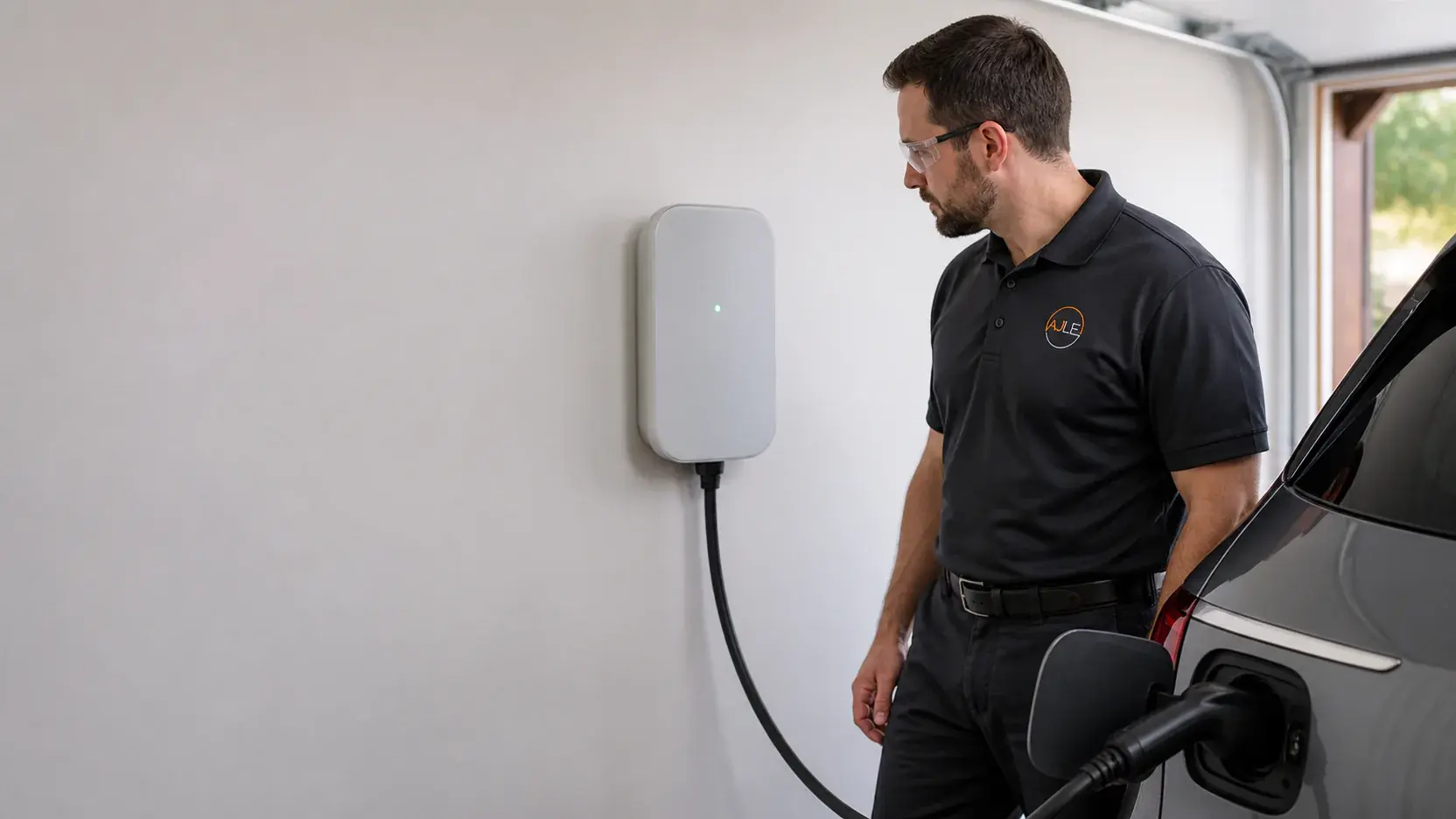
Field briefing / Vienna, VA
Project briefing
Jurisdiction confirmed by property address
- Project
- EV Charger Installation
- Check the Town boundary and park the vehicle in its normal orientation before approving the mount, circuit route, or review sequence.
- Permit path
- Fairfax County Land Development Services is the building official; a separate Town of Vienna review follows when required for a property within town limits
- Final jurisdiction is confirmed from the property address.
Before your estimate
Resolve the Vienna review path before selecting the circuit
Town address or Vienna mailing address?
Confirm whether the property is inside the Town of Vienna or in unincorporated Fairfax County. A Vienna mailing address alone does not answer that question. The Town reviews applicable land-use and site matters, while Fairfax County serves as the building official for electrical requirements. Where Town review is required, its published process starts with the County application and uses that application number for the Town submission. Ask which reviews apply to the actual charger position and route; do not assume every electrical replacement needs the same land-use submission.
Plan the route to the parked car
Describe where the car normally stops, where its charge port sits and whether the charger will be inside a garage or outside. A short route to the nearest wall can still place the cable across an entrance. For a detached parking area, identify paving, landscaping and any shared or uncertain property boundary before comparing underground and building-mounted routes. Exterior changes, trench restoration and permission to cross another area belong in the planning discussion before equipment is ordered.
Compare capacity and restoration together
Send the vehicle and charger models, normal daily travel and overnight parking window. The commissioned output follows a load assessment and the equipment instructions; the largest available breaker is not the starting requirement. A written estimate should distinguish circuit work, charger hardware, mounting, permit coordination and repair of any access openings or disturbed surfaces. If management or another trade must provide access or restoration, identify that responsibility. Staff confirm timing after reviewing the complete scope.
What to include in your request
- Full address and whether Town jurisdiction has been confirmed
- Vehicle and EVSE model, daily travel and charging window
- Photos of the closed panel, parking position and proposed route
- Known Town, HOA, access and finish-work requirements
Photograph only accessible equipment with covers in place. The office reviews your request and confirms the next step; sending it does not book an appointment.
Estimates are free for every service. Scheduled estimate visits and written project prices are free. Diagnostic and repair work is a separately priced service.
Our quoted electrical installations include a five-year workmanship warranty from completion. Parts and equipment carry their manufacturer warranties.
Scope first
What this project involves
Charging output
Choose an output that fits the vehicle, charging habits, circuit size, and available panel capacity.
Connection and placement
Choose hardwired or receptacle-fed equipment and place it indoors or outdoors with practical cable reach.
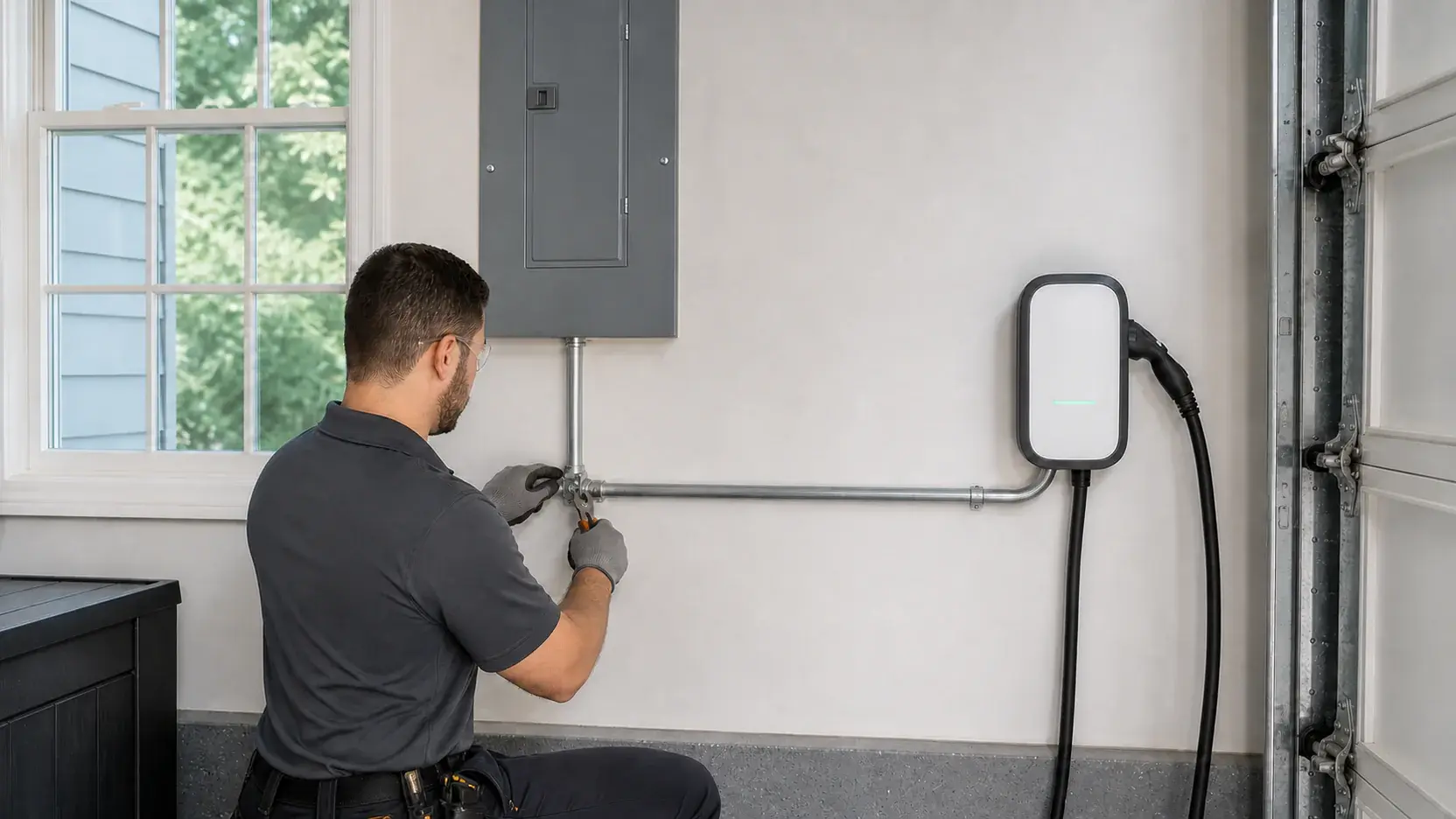
Field view / EV Charger Installation
Representative field view for EV Charger Installation; final scope is confirmed at the property.Address-specific planning
What matters in Vienna
A Vienna EV charger needs both a property-specific electrical plan and a boundary-aware permit plan. We place the equipment for the normal parking position, measure the route, calculate panel capacity, and check whether Town review joins the Fairfax County process.
Vienna Woods, Wolf Trap Woods, and Tysons Woods may involve different Town-boundary and parking conditions. A garage mount, driveway wall, or outdoor pedestal changes cable reach, route access, and weather exposure. Fairfax County is the building official and provides EV charging guidance for covered circuit work; a separate Town of Vienna review follows when required for a property within town limits.
Explore the Vienna service areaProject fit / review at the property
- A charger inside or outside Town limits that needs the approval path confirmed
- A driveway or garage installation where cable reach controls the mounting point
- A charging load that must be balanced against existing panel capacity
Local housing & wiring
Planning electrical work in Vienna
In Vienna, an EV charger may have to work around a brick rambler. Some houses in Vienna Woods, Windover Heights and Wolf Trap Woods were built with carports, converted garages and slab sections, so the panel and the parking space may not line up the way a newer plan would.
Ramblers from the 1950s and 1960s often sit on a slab, with no crawlspace to route a new circuit through. That leaves the attic, a surface conduit run along an exterior wall, or a short trench. A garage that was converted into a family room pushes the car to the driveway or a carport, where the equipment needs a weather-rated enclosure. Brick veneer needs masonry anchors and a mounting plate chosen so the mortar joints and the veneer are not damaged. Panels are often 100 amps and tucked into a laundry or utility room, so the load calculation comes before the location. If it points toward a larger service, the Dominion Energy side is covered on our electrical service upgrade page. Fairfax County is the building official, and a separate Town of Vienna review can follow for properties inside town limits.
Quote inputs
Scope and cost drivers
Typical published range for this work: $1,200-$3,500 typical; long or detached runs up to $4,500. The written Vienna proposal is project-specific.
Included in the defined scope
- Review the charger requirements and desired parking location
- Calculate available panel capacity for the proposed charging load
- Plan and install a dedicated 240V circuit for hardwired or receptacle-fed equipment
- Coordinate the electrical permit and inspection for the installation
What can change scope and cost
- Circuit amperage and charger connection method
- Distance and route from the panel to the parking location
- Available panel capacity and related electrical work
- Indoor or outdoor mounting conditions
Work sequence
From assessment to completion
- 01
Review
Confirm the charger requirements, parking position, cable reach, and connection preference.
- 02
Calculate
Evaluate the panel and calculate whether it can support the charging load.
- 03
Route
Define the dedicated circuit path, mounting location, and permit scope.
- 04
Install and inspect
Install the circuit and connection, test the work, and coordinate the required inspection.
Property-specific answers
Local questions
Can I see where a Vienna charger and its conduit will go before the work starts?
Yes. We mark the mount and the conduit path with the car parked in its normal spot, note any section that will run on the surface, and put both in the written estimate. You approve that placement before the circuit route is final.
What changes between a Vienna garage and driveway charger?
A driveway location adds outdoor exposure, mounting, cable storage, and physical-routing questions. Either location still needs practical charge-port reach and a circuit sized to the panel calculation and vehicle needs.
Does a Vienna mailing address mean the Town issues my electrical permit?
No. Confirm the parcel jurisdiction. Fairfax County serves as the Town’s building official for electrical work; Town review may address separate land-use or site requirements.
Should I buy the highest-output charger before requesting a Vienna estimate?
Confirm vehicle compatibility, available capacity, parking needs and the proposed installation first. The unit’s maximum output may exceed what the home or daily routine needs.
Can an EV charger be mounted on brick in Vienna?
Yes, with the right hardware. We use masonry anchors set in mortar joints where possible, and a backing plate or weather-rated enclosure so the charger and conduit are held securely. We look at the veneer condition before drilling, since loose or damaged brick would change the mounting plan.
How is a circuit run in a slab-on-grade Vienna rambler?
Without a crawlspace, we normally go through the attic and drop down inside a wall or run a surface conduit on the exterior. A trench is the other option for a driveway or detached location. Cutting the slab is a last resort. We pick the least disruptive path during the visit.
Is a carport acceptable for a hardwired EV charger?
A carport works when the equipment is listed for the exposure and mounted where it is protected from vehicle impact and the cable does not cross a walkway. The roof gives some shelter, but wind-blown rain still reaches the wall. We choose a weather-rated unit and fittings and place it by cable reach.
Related Services
Related Services in Vienna
Guides
EV Charger Installation Planning Guides
Expert electrical guides to help you make informed decisions.
Intermediate
How to Prepare Your Home for EV Charger Installation
Everything you need to know to prepare your home for a Level 2 EV charger installation, from panel assessment to choosing the perfect charging location.
12 min read
Read GuideBeginner
How to Choose the Right EV Charger for Your Home
Compare home Level 2 EV chargers and learn how amperage, connector type (J1772 vs NACS), hardwired vs receptacle wiring, and panel load management affect your installation.
10 min read
Read GuideIntermediate
Solar-Ready Electrical Panel Upgrade Guide for Northern Virginia
A solar-ready panel is documented busbar capacity, backfeed space, and grounding — not modules on the roof. Plan it with EV and battery loads so you do not replace the panel twice.
9 min read
Read GuideNearby EV Charger Installation Service Areas
We also provide expert electrical services in these communities.
Next step / property-specific quote
Request a quote for EV Charger Installation in Vienna
Share the property address and project goal so the scope can be reviewed for your home.