
Learn: sizing
How Much Solar Do I Need?
Add up the kilowatt-hours on your last 12 bills and divide by about 1,250, our planning yield per installed kilowatt in Northern Virginia. That is the array size, in kW, that offsets a year of use.
Reviewed 2026-09-24
Google reviews
1,463 across four profiles
Family-owned
Since 1996
Licensed and insured
VA 2705031092
Answer first
The short answer
Array size in kW equals your annual kWh divided by the kWh one kilowatt of panels produces in a year on your roof. We plan at about 1,250 kWh per kW in Northern Virginia, a modeled estimate. As an example, the EIA's 2022 average U.S. home used 10,791 kWh, which works out to about 8.6 kW. Your own bills, roof, and planned loads set your number, and Dominion caps a system at 150 percent of expected annual use.
- Use kWh from 12 months of bills, not dollars. Rates and riders change; kWh do not lie.
- Planning yield: about 1,250 kWh per kW per year, a modeled estimate for Northern Virginia roofs.
- Add planned loads such as an EV or a heat pump before you size.
- Dominion caps a system at a size that would not reasonably produce more than 150 percent of expected annual consumption.
Size your array in four steps
You need your bills and a calculator. The math is simple; the judgment is in the inputs.
- 01
Total a year of kWh
Add the kilowatt-hours used on your last 12 Dominion or NOVEC bills. Your online account usually shows a 12-month usage chart. A full year captures both summer cooling and winter heating.
- 02
Add loads you are about to add
An electric vehicle, a heat pump replacing gas heat, a pool, or a finished basement all raise annual use. Estimate them now, not after the array is on the roof.
- 03
Divide by the yield for your roof
Divide annual kWh by about 1,250. That is our planning yield per installed kW in Northern Virginia, a modeled estimate. The site visit replaces it with a model of your actual roof, direction, and shade.
- 04
Check the roof and the cap
Confirm the roof has room for that many panels and that the result stays under Dominion's 150 percent limit.
Worked examples
These examples show the arithmetic. They are illustrations, not a quote for any house.
| Example household | Annual kWh | Array size |
|---|---|---|
| EIA 2022 U.S. average home | 10,791 | about 8.6 kW |
| Same home plus an example EV rated 30 kWh per 100 miles, driven 15,000 miles | 15,291 | about 12.2 kW |
| A home using 8,000 kWh a year | 8,000 | about 6.4 kW |
Panel count: divide the array size by the module rating. With 400-watt modules as an example, 8.6 kW is about 21 panels.
Where the 1,250 kWh per kW comes from
PVWatts, the production model from the federal lab formerly called NREL, estimates about 1,378 kWh per installed kW per year for an unshaded, south-facing roof at a 30 degree tilt in Fairfax. Real roofs face east or west, carry some shade, and have a pitch set by the architect, not the sun. We plan at 1,250 so the first estimate is not built on a perfect roof.
The site visit replaces the planning number with a model of your roof. An east-west split array produces less per kW than a south array, and a roof shaded in the afternoon produces less again. We show the modeled production for your exact layout in the proposal, labeled as a modeled estimate, because weather varies year to year.
Planning for an EV or a heat pump
For an EV, the EPA fuel economy label lists consumption in kWh per 100 miles, and the label's cost estimate assumes 15,000 miles a year. Multiply your car's rating by your annual miles and divide by 100. An example car rated 30 kWh per 100 miles, driven 15,000 miles, uses about 4,500 kWh a year, or about 3.6 kW of array at our planning yield.
For a heat pump replacing gas heat, ask the HVAC contractor for the modeled annual kWh of the new system. It depends on the home's size, insulation, and the equipment, so we do not guess at it.
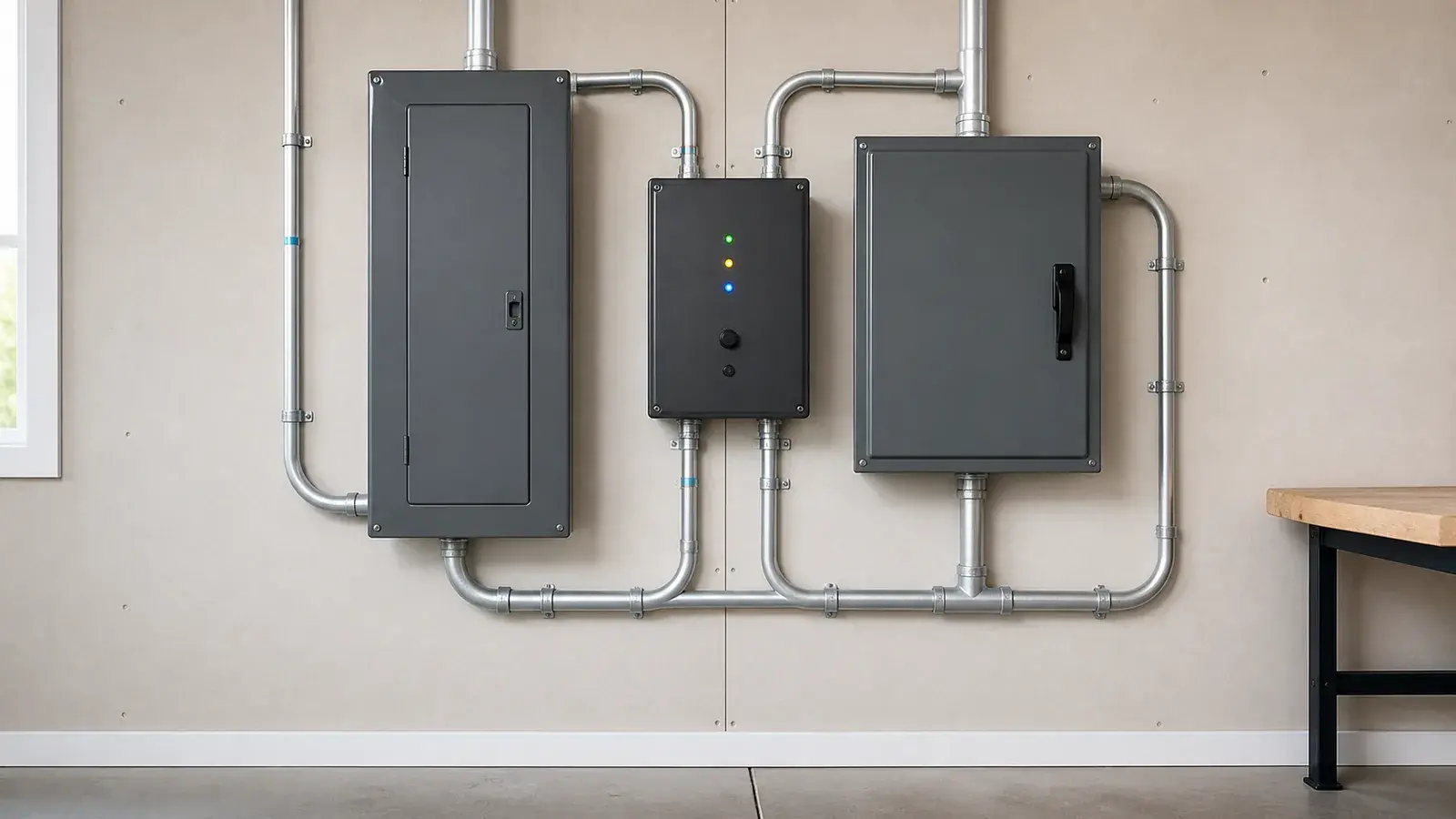
Both loads also change the panel math. An EV charger circuit and a heat pump circuit take breaker space and service capacity, and a solar array takes a backfeed breaker in the same panel. We run the load calculation and the busbar math for all three together, so the array, the charger, and the heat pump fit the same service.
Dominion's 150 percent cap, and why bigger is not better
Dominion's net metering page says a system must be sized so that it does not reasonably produce more than 150 percent of the expected annual electrical consumption. For the EIA average home, that ceiling is about 16,187 kWh a year, or about 12.9 kW at our planning yield.
Hitting the cap is rarely the goal. Under net metering, production that offsets your own use is credited at the retail rate over a 12-month period. Production beyond your annual use is paid at a much lower rate at the end of that period. The last few panels past 100 percent of your use are the least valuable panels on the roof.
NOVEC customers size under NOVEC's net metering rules. We confirm the serving utility from your bill first.
From size to cost
Our published cash planning band is $2.40–$2.85/W installed. A typical 8 to 12 kW Northern Virginia rooftop comes to $19,000–$34,000. For reference, an 8 kW array is $19,200–$22,800 and a 10 kW array is $24,000–$28,500. A panel upgrade, a battery, or roof work is itemized separately on the proposal.
Straight answers
Questions
- How many solar panels do I need for my house?
- Divide your annual kWh by about 1,250 to get the array size in kW, then divide by the module rating. With 400-watt modules as an example, an 8.6 kW array is about 21 panels.
- Should I size solar from my bill in dollars?
- No. Use the kWh. Dollars mix in rates, fuel charges, riders, and fixed fees that change over time. Kilowatt-hours measure what the array has to produce.
- Can I install a bigger system than I need?
- Dominion caps residential systems at a size that would not reasonably produce more than 150 percent of expected annual consumption, and excess at year end is paid well below retail. Size to your use, including planned loads.
- Does my roof limit the system size?
- Often. Usable roof area, setbacks, vents, and shade set a ceiling. We lay out the panels on your actual roof before we price the system.
Next step
Get a size built from your bills and your roof
Send us a year of usage and we will model your roof and size the array to your use, including planned loads. The quote is free.
Solar energy company
AJ Long Electric Solar
AJ Long Electric
7138 Little River Turnpike #305
Annandale, VA 22003
Serving Annandale, Fairfax County, and Northern Virginia.