
How it works
How Solar Installation Works, From Bill to Permission to Operate
A home solar project runs in a fixed order: your bill and address, a roof and panel study, a written design and price, HOA and utility approval, the county permit, installation, inspection, and the utility's permission to operate. Here is each step, who does it, and what you do.
Reviewed 2026-09-24
Google reviews
1,463 across four profiles
Family-owned
Since 1996
Licensed and insured
VA 2705031092
On every install
Master electrician on site
Backed by
Workmanship warranty
Answer first
Eleven steps, and you handle three of them
Solar installation works in this order: you send a bill and your address, we study the roof, shade, and electrical panel, you approve a written design and price, we file the HOA request if there is one and the utility interconnection notification, we pull the county permit, we install, the county inspects, the utility sets the meter and issues permission to operate, and then the system runs. Your jobs are the first step, approving the proposal, and signing the utility and HOA forms.
- The order matters: the utility's contingent approval and the county permit come before installation, and permission to operate comes after inspection.
- Only steps backed by a published rule have a stated timeline. The utility has 30 days to review a residential notification under Virginia's interconnection rules.
- A master electrician is on site for every solar project.
- The roof study and the written quote are free.
Before you sign anything
The first four steps cost nothing and commit you to nothing. Their job is to produce a design that fits your roof, your panel, and your usage, and a written price you can compare.
- 01
Send a bill and your address
A recent Dominion Energy or NOVEC bill shows your annual usage and your rate schedule. The address tells us the permit office, the utility, and whether the lot is shaded. Use the solar intake form or call.
- 02
Roof and panel study
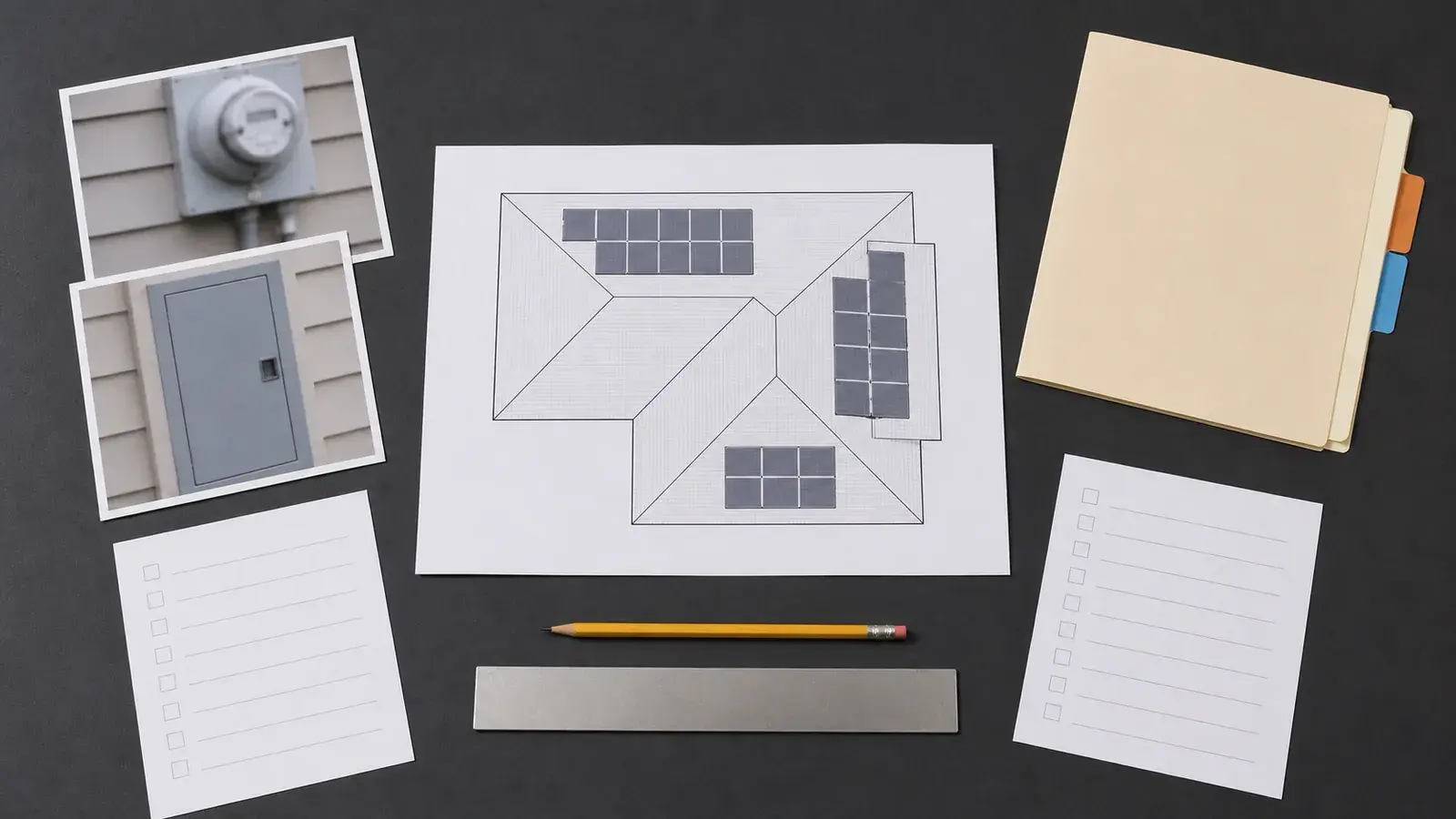
We look at the roof's orientation, pitch, age, and condition, the shade from trees and neighboring buildings, and the electrical panel and service. Fairfax County suggests six or more hours of direct sun and a roof under five years old as starting points.
- 03
Design and written proposal
We size the system to your usage and roof, model its production (a modeled estimate, not a promise), and price it. Our published cash planning rate is $2.40–$2.85/W. Panel work, batteries, and roof work are itemized separately.
- 04
You decide
Compare the proposal against any others you have. Ask about the panel connection, the permit holder, and who certifies the system to the utility. When you sign, the approvals begin.
Approvals: HOA, utility, and county
Three different bodies may have to say yes before installation, and they run in parallel where the rules allow.
- 01
HOA review, if you have one
Virginia law limits how far a community association can restrict rooftop solar, but many associations still require an application. We prepare the drawings; you submit or sign it as the owner.
- 02
Utility interconnection notification
For Dominion Energy Virginia, we submit the Net Metering Interconnection Notification. Dominion reviews the system against the grid at your address, then sends you and us the form to sign. Contingent approval follows once both signatures are in. NOVEC customers follow NOVEC's program.
- 03
County permit
In Fairfax County, one residential solar permit covers the solar equipment. If the service needs to be replaced or upgraded, a separate electrical record is filed for that work. The county waives its permit fee for solar applications. Cities and towns with their own permit offices follow their own process.
Installation to permission to operate
Once the approvals are in, the physical work is the shortest part of the project.
- 01
Installation
Our in-house crew mounts the racking and modules, runs the conductors, sets the inverter or microinverters, and makes the panel connection. Any panel upgrade in the design is done in the same project.
- 02
County inspection
Fairfax County conducts combination inspections, so the related inspections for the project are scheduled on the same day. We schedule it and meet the inspector.
- 03
Electrician certification and utility metering
Dominion requires the system to be certified by a licensed Virginia electrician or approved by the local inspection authority. After that, Dominion installs a bi-directional meter and completes the billing setup.
- 04
Permission to operate
Dominion emails permission to operate to you and to us. Only then is the system switched on as grid-connected generation. We walk you through the monitoring and the shutdown procedure.
After the system is on
Fairfax County's Department of Tax Administration offers a five-year exemption for certified solar energy equipment, applied for after the permits pass. Other counties and cities run their own programs.
The homeowner federal credit does not apply: the IRS Residential Clean Energy Credit is not available for property placed in service after December 31, 2025. Your net metering credits show up on the utility bill, and we stay the contact for service, monitoring questions, and any later battery or EV charger addition.
Straight answers
Questions
- How long does solar installation take?
- The installation itself is the short part. The overall timeline depends on HOA review, utility review, the county permit queue, and inspection scheduling. Virginia's rules give the utility 30 days to review a residential interconnection notification. Your written proposal lists the project-specific steps.
- Can I turn my system on after it passes inspection?
- No. A passed inspection is not permission to operate. The utility grants that separately after the metering and billing work.
- Who pulls the permit?
- We do, as the licensed contractor. In Fairfax County that is the residential solar permit, plus a separate electrical record if the service is being upgraded.
- What do I need to get started?
- A recent electric bill and the property address. We take it from there.
Sources
- Fairfax County Office of Environmental and Energy Coordination, Going Solar
- Fairfax County Land Development Services, Solar (SOLARR) Residential
- Fairfax County Land Development Services, Building and Trade Inspections
- Dominion Energy Virginia, Net Metering
- Virginia Administrative Code 20VAC5-315-30, Company notification
- Code of Virginia 55.1-1820.1, Installation of solar energy collection devices
- Fairfax County Department of Tax Administration, Solar Energy Equipment Tax Exemption
- IRS, Residential Clean Energy Credit
- NOVEC, Net Metering
Next step
Step one takes two minutes
Send a recent bill and your address through the solar intake form. We come back with a roof and panel study and a written, itemized proposal.
Solar energy company
AJ Long Electric Solar
AJ Long Electric
7138 Little River Turnpike #305
Annandale, VA 22003
Serving Annandale, Fairfax County, and Northern Virginia.