
Why electrician-led
The Solar Company That Is Also the Electrician
Many solar companies sell the array and subcontract the electrical work. At AJ Long Electric, the electrical work is the company. The panel, the service, the grounding, the county inspection, and the utility interconnection are handled by the same licensed contractor that has been doing electrical work in Northern Virginia since 1996.
Reviewed 2026-09-24
Google reviews
1,463 across four profiles
Family-owned
Since 1996
Licensed and insured
VA 2705031092
On every install
Master electrician on site
Backed by
Workmanship warranty
Answer first
Solar is an electrical project with a roof on top
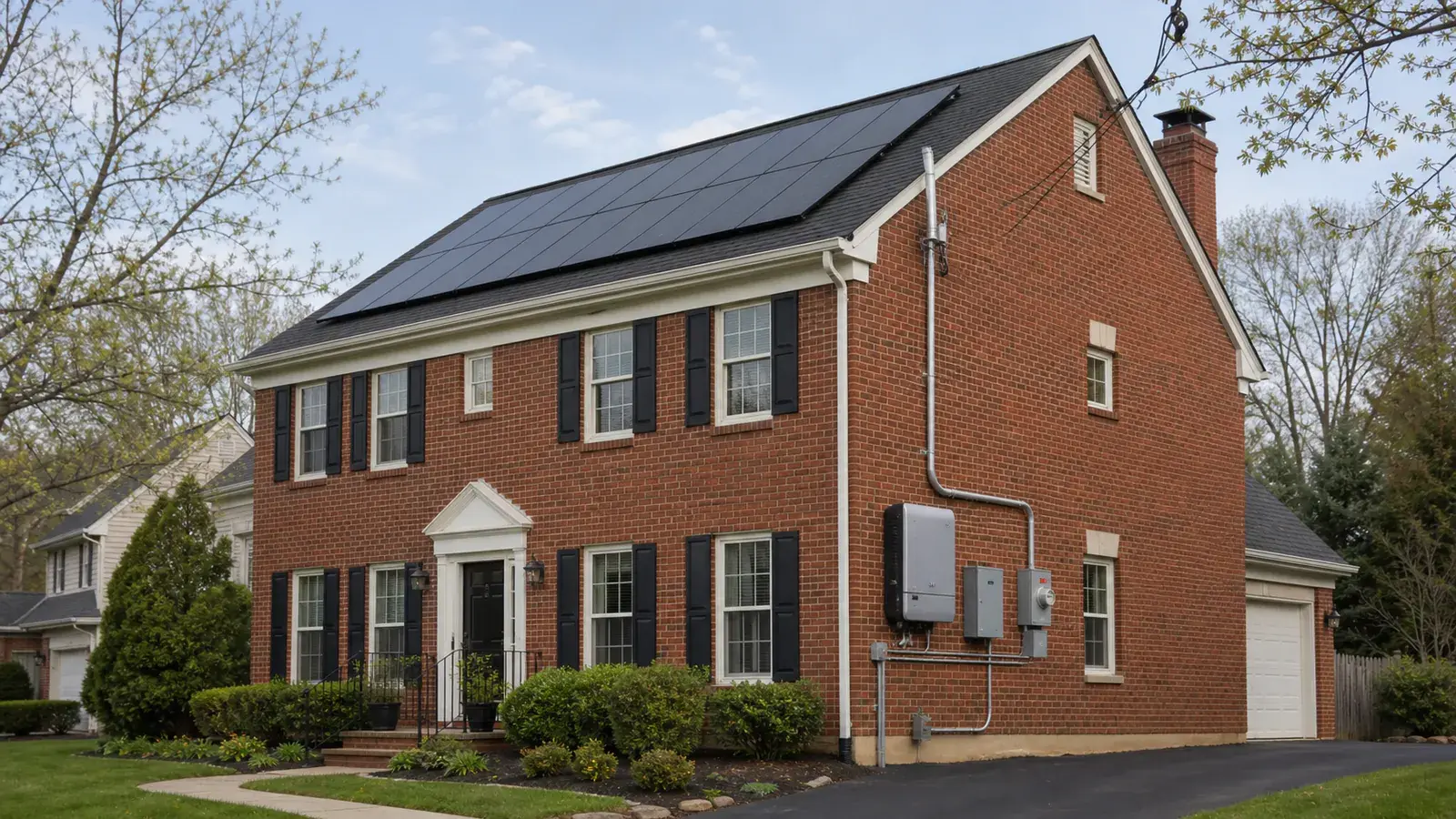
An electrician-led solar company designs the system around your electrical panel and service first, then the roof. That matters because the parts of a solar job most likely to cause a redesign, a failed inspection, or a delayed permission to operate are electrical: panel capacity, the 120% busbar rule, service upgrades, grounding, and utility interconnection. AJ Long Electric does all of it in-house, with no subcontracted electrical work.
- A master electrician is on site for every solar project.
- The installation crew is in-house. There is no commissioned sales team and no electrical subcontractor.
- The same company that wires the array answers for the panel, the permit, and the Dominion or NOVEC paperwork.
- We also service systems other companies installed, including systems whose installer is gone.
Who actually does the electrical work
A typical solar sale has three parties behind it: the company that sold the system, a crew that mounts the modules, and a licensed electrician who connects the system to your house. On many jobs those are three different businesses. The homeowner signs with the first one and meets the other two on installation day.
That arrangement works until something electrical goes wrong. If the panel cannot legally accept the solar breaker, if the inspector flags the grounding, or if the utility asks for a change, the fix belongs to a subcontractor who was not part of the design and is not the name on your contract.
At AJ Long Electric there is one company. The people who look at your panel during the roof study are electricians, and the crew that installs the system works for us. When a question comes up, it is answered by the licensed contractor who holds the permit.
Panel capacity comes before panel count
Every solar system has to connect somewhere, and in most homes that somewhere is the main electrical panel. Before we count modules we look at the panel's busbar rating, the main breaker size, the open spaces, the panel's age and condition, and the size of the service coming in from the utility.
Older Northern Virginia homes often have a smaller service, a full panel, or a panel brand that inspectors and insurers treat with suspicion. None of that shows up on a satellite image. It shows up when an electrician opens the dead front, which is why our roof study includes the panel.
When the panel has to change, it goes in the same design and the same written proposal. A 200A panel upgrade or replacement runs $3,500–$7,500 as a published range, including the permit and Dominion coordination.
The 120% rule decides where the solar can connect
The National Electrical Code limits how much current can be fed into a panel's busbar. For the most common connection, a backfed breaker at the opposite end of the busbar from the main, the main breaker plus the solar breaker may not exceed 120% of the busbar rating.
Here is the arithmetic on a common panel. A 200A busbar with a 200A main breaker allows 240A in total, so the solar breaker can be 40A at most. A 40A breaker covers an inverter output of about 32A continuous, which is roughly 7.7 kW of AC output at 240 volts. A larger system on that panel needs a different connection.
The options are well defined: a supply-side connection ahead of the main breaker where the equipment and utility allow it, a smaller main breaker when the home's load calculation supports it, or a panel with a larger busbar. Choosing among them is electrical engineering, and it is the part of the design we do ourselves.
Heavy-ups and service upgrades
When a home needs a bigger service to carry solar, a battery, an EV charger, or a heat pump, the job becomes a heavy-up: a new meter base, new service conductors, and often a new panel, coordinated with the utility's disconnect and reconnect.
Fairfax County treats that work separately. The residential solar permit covers the solar equipment, but replacing or upgrading the electrical service requires its own standalone electrical record. We pull both, schedule both inspections, and coordinate the utility work, so the homeowner is not managing two contractors and two permit tracks.
Grounding and bonding are where inspections fail
A solar array adds metal to the roof, conductors down the wall, and equipment at the panel. All of it has to be bonded and grounded to the requirements of the National Electrical Code, and the home's existing grounding electrode system has to be adequate for the new equipment.
In older houses the existing grounding is often the weak point: a connection to a water pipe that was later replaced with plastic, a clamp that corroded, or a ground rod nobody can find. We check it during the roof study and correct it in the same job, instead of learning about it from the inspector.
The county inspection and the utility interconnection
Fairfax County conducts combination inspections, where all related inspections for a project are scheduled on the same day. Other jurisdictions in Northern Virginia run their own permit offices and their own rules, which we confirm from the property address.
Dominion Energy Virginia's net metering process has four steps: the interconnection notification, contingent approval, certification of the system by a licensed Virginia electrician or a passed local inspection, and permission to operate after the metering and billing work. Virginia's interconnection rules also have the licensed electrician who installs the system certify the installation on the commission-approved form. An electrician-led company signs that line for its own work.
NOVEC customers follow NOVEC's own net metering program. Either way, the system is not turned on as grid-connected generation until the utility grants permission to operate.
What electrician-led costs
Our published cash planning rate is $2.40–$2.85/W, and a typical 8 to 12 kW rooftop array runs $19,000–$34,000. Panel upgrades, batteries, and roof work are itemized separately in the written proposal, so you can see exactly what the electrical side adds.
The roof study and the written quote are free.
Straight answers
Questions
- Do most solar companies use subcontracted electricians?
- Many do. A common model is a sales company that contracts out installation and the electrical tie-in. Ask any company you are considering who will pull the electrical permit and who will certify the system to the utility.
- Why does the 120% rule matter for my solar system?
- It limits the size of the solar breaker your existing panel can accept. On a 200A busbar with a 200A main breaker, the solar breaker can be 40A at most, which caps a panel-connected inverter at roughly 7.7 kW AC. Larger systems need a supply-side connection, a derated main, or a new panel.
- Do I need a new panel to go solar?
- Not always. Many panels can accept a modest system. We decide after looking at the busbar rating, main breaker, open spaces, condition, and service size during the roof study.
- Who signs the utility paperwork?
- For a Dominion Energy Virginia interconnection, the system must be certified by a licensed Virginia electrician or approved by the local inspection authority. As the licensed electrical contractor on the job, we handle that step for our own installations.
Sources
- NFPA 70, National Electrical Code
- Fairfax County Land Development Services, Solar (SOLARR) Residential
- Fairfax County Land Development Services, Building and Trade Inspections
- Dominion Energy Virginia, Net Metering
- Virginia Administrative Code 20VAC5-315-40, Conditions of interconnection
- NOVEC, Net Metering
Next step
Start with the panel, not the pitch
Send a recent electric bill and your address. An electrician looks at the roof, the shade, the panel, and the service, and you get a written proposal that shows the electrical work line by line.
Solar energy company
AJ Long Electric Solar
AJ Long Electric
7138 Little River Turnpike #305
Annandale, VA 22003
Serving Annandale, Fairfax County, and Northern Virginia.