
Solar + battery backup
Solar and Battery Backup Installation in Northern Virginia
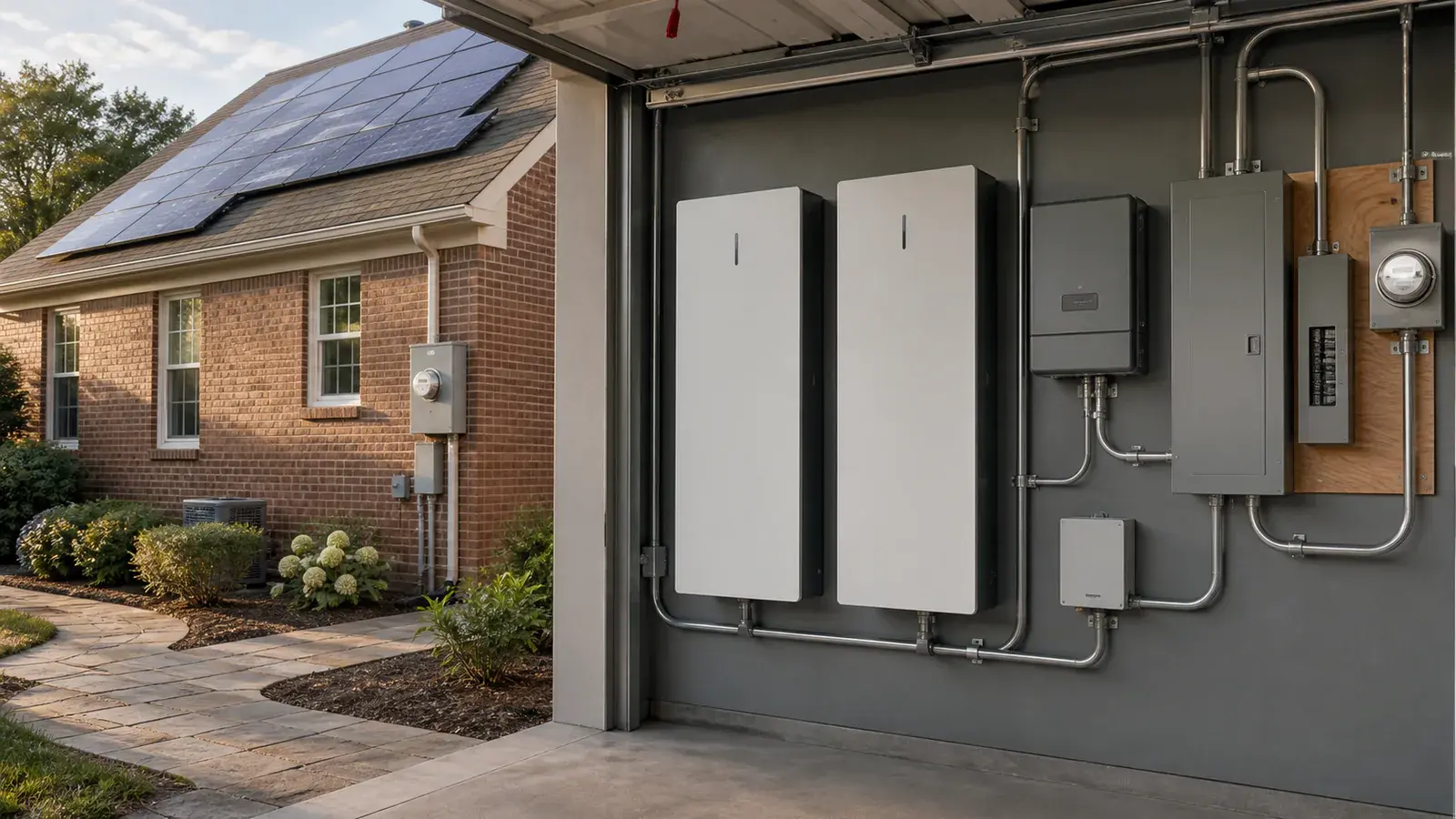
The array, the battery, the transfer equipment, and the panel from one electrical crew under one license and one warranty. The roof charges the battery by day, and the circuits you pick stay on when the grid goes down.
A 10 kW array plus one Powerwall-class battery runs $30,000–$43,500+ installed, cash. A master electrician is on site for every solar project.
Content reviewed 2026-09-02
Google reviews
1,463 across four profiles
Family-owned
Since 1996
Licensed and insured
VA 2705031092
On every install
Master electrician on site
Backed by
Workmanship warranty
Answer first
Solar and battery are one electrical job
A standard grid-tied solar array shuts off in an outage. Add a battery and transfer equipment and the array keeps charging the battery while the circuits you chose stay on. AJ Long Electric installs the array, the battery, the transfer equipment, and any panel work as one job, so the whole system is designed for backup from the first drawing.
- A 10 kW array at $24,000–$28,500 plus one whole-home battery at $6,000–$15,000+ is a typical $30,000–$43,500+ project.
- Backup starts with the circuits: fridge, furnace blower or heat pump, well or sump pump, internet, and a few lights and outlets.
- We pull the permit, file the Dominion or NOVEC interconnection with the battery on the application, and commission the battery so it charges from the roof when the grid is out.
Cost
What solar plus battery costs in Northern Virginia
Two published bands, added together. A typical 10 kW array installs for $24,000–$28,500 at $2.40–$2.85/W, and one Powerwall-class battery with its transfer equipment installs for $6,000–$15,000+. Roof work, a heavy-up, and a second battery are itemized separately.
Typical example: a 10 kW array plus one battery
10 kW rooftop array
Modules, racking, inverter, and interconnection labor at $2.40–$2.85/W, cash.
$24,000–$28,500
One Powerwall-class battery
Whole-home battery integration with the transfer equipment and the backed-up-load panel.
$6,000–$15,000+
Typical combined project
$30,000–$43,500+
A typical example, not a quote. Your bill, your roof, and your backup list set the real number in the written proposal.
Why an electrician
Why one crew for solar and battery
Solar companies subcontract the electrical. We are the electrical. Here is what that changes for a battery.
- 01 / circuits
We start with the circuits you need on
Fridge, furnace or heat pump, well or sump pump, internet, lights. We size the battery to that list and the starting loads behind it, then size the array to refill it.
- 02 / equipment
One inverter plan for the array and the battery
Tesla Powerwall 3 carries its own solar inverter. FranklinWH aPower and Enphase IQ Battery 5P pair with the array's microinverters or string inverter. The combination that fits your roof and your backup list goes in the written proposal.
- 03 / panel
We already do the panel and the transfer equipment
The battery lands in a backed-up-load panel or a SPAN Panel, and many Northern Virginia homes on 100A or 150A service need a heavy-up first. That is our core trade, priced in the same proposal at the published $3,500–$7,500 range.
- 04 / utility
Permit, inspection, and interconnection, handled
We pull the county permit, file the Dominion or NOVEC interconnection with the battery on the application, and close out the inspection and permission to operate.
System sequence
One electrical design
- 01ArrayModules and racking sized to your bill and to refilling the battery.Review
- 02BatteryCapacity and surge rating matched to your backup list.Review
- 03TransferListed transfer equipment or a backed-up-load panel keeps the battery and the grid separate.
- 04PanelCapacity and backfeed checked, upgraded or replaced with a smart panel when the house needs it.Review
How it works
From your bill to a battery that charges from the roof
Six steps. We handle the permit, the utility, and the inspection.
- 01
Free quote from your bill and outage list
Send a recent electric bill, the address, and the circuits you want on to get a preliminary array size, battery size, and price range.
- 02
Site and electrical review
A master electrician checks the roof, the service size, the panel, the battery location, and the interconnection point.
- 03
Written proposal
Array, battery, transfer equipment, panel work, and price in writing, itemized line by line.
- 04
Permit and interconnection
We pull the permit and file the Dominion or NOVEC interconnection with the battery on the application.
- 05
Installation
Our crew installs the array, the battery, and the electrical. A master electrician is on site for every solar project.
- 06
Inspection, permission to operate, and commissioning
We close out the inspection and the utility, then test the backup switching and set the battery to charge from the roof.
Straight answers
Frequently asked questions
Will solar panels power my home during an outage?
Not on their own. A standard grid-tied array shuts off when the grid goes down. Add a battery and transfer equipment and the circuits you chose stay on while the array recharges the battery. That is why we quote the two together.
Can a battery charge from solar?
Yes. Tesla Powerwall 3 has its own solar inverter, and FranklinWH aPower and Enphase IQ Battery 5P charge from the array through the inverter. When we install both, the charging path is designed in from the start.
What does solar plus battery cost?
A typical 10 kW array at $24,000–$28,500 plus one Powerwall-class battery at $6,000–$15,000+ comes to $30,000–$43,500+ installed. Your bill, your roof, and your backup list set the real number in the written proposal.
Which circuits should I back up?
Start with the refrigerator, the furnace blower or heat pump, the well or sump pump, the internet, and a few lights and outlets. We size the battery to that list and the array to refill it.
Does the battery qualify for Dominion's Virtual Power Plant?
Dominion's pilot launches in 2026 and runs through July 2028. Any Dominion Energy Virginia customer with an eligible device can enroll, most customers join free, and Dominion says participants may earn credits or payments for letting the battery help the grid. We install listed batteries and set up the app so you are ready when enrollment opens.
Who is on site for the installation?
A master electrician is on site for every solar project. The array, the battery, the transfer equipment, and the panel are one electrical design and one crew.
Related electrical planning
Content reviewed 2026-09-02
Each piece of this job has its own page with the published price.
Next step
Start with your bill and your outage list
Send a recent electric bill, the address, and the circuits you want on. A preliminary system size, battery size, and price range comes back first, then a site visit with a master electrician turns it into a written proposal.
Solar energy company
AJ Long Electric Solar
AJ Long Electric
7138 Little River Turnpike #305
Annandale, VA 22003
Serving Annandale, Fairfax County, and Northern Virginia.