
Battery retrofit
Add a Battery to Your Existing Solar System
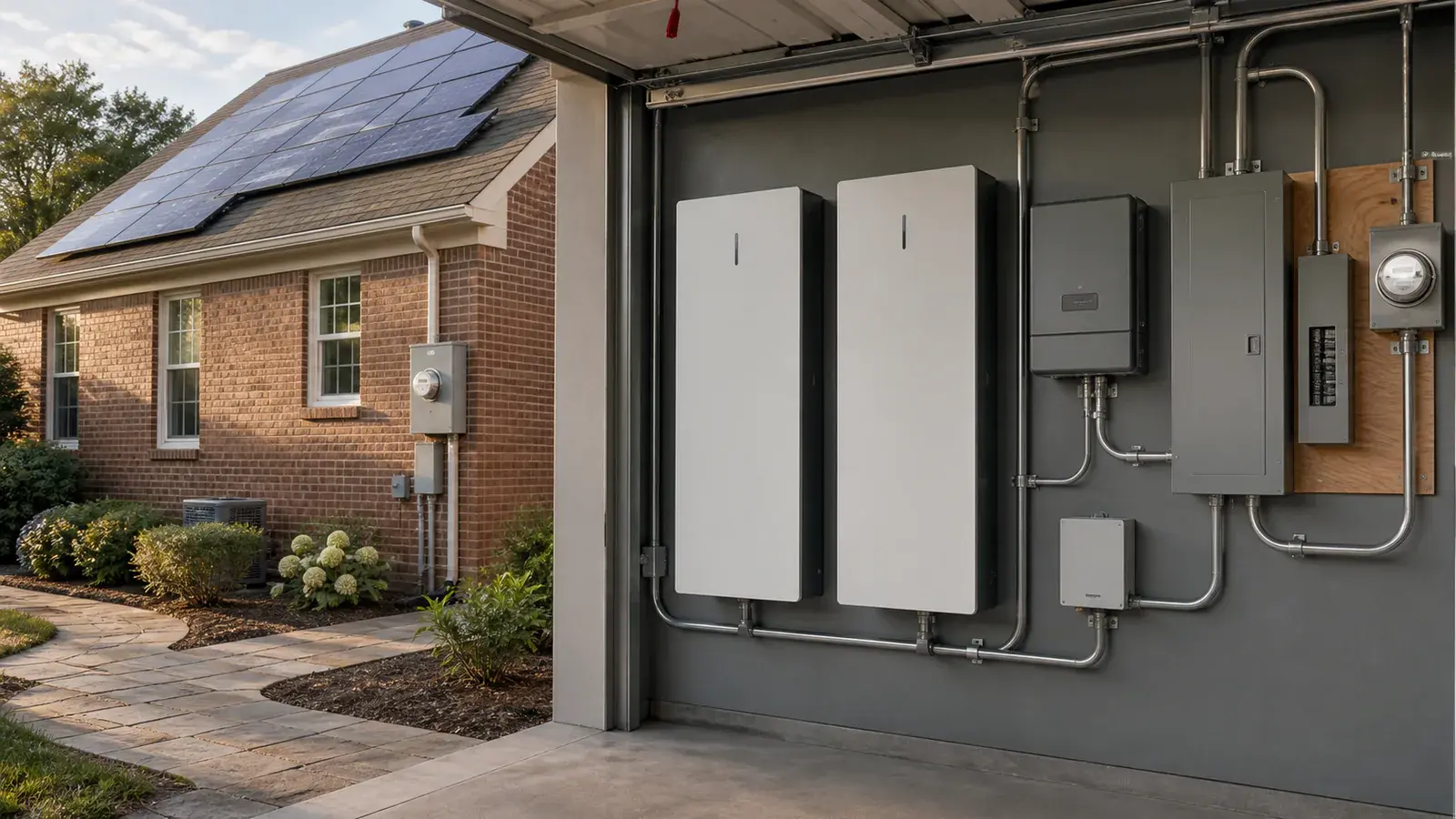
Most existing solar systems can take a battery. The battery is the easy part. The panel's backfeed limit, the transfer equipment, and the utility paperwork decide what the job looks like, and that is electrical work.
Reviewed 2026-09-24
Google reviews
1,463 across four profiles
Family-owned
Since 1996
Licensed and insured
VA 2705031092
On every install
Master electrician on site
Backed by
Workmanship warranty
Answer first
Can you add a battery to existing solar?
Yes. Most existing solar systems in Northern Virginia can take a battery. The battery connects either on the AC side with its own inverter, which works with most existing arrays, or on the DC side through a hybrid inverter that usually replaces the solar inverter. What decides the design is electrical: the room left in your panel under the 120 percent rule, the transfer equipment that separates the house from the grid in an outage, and the change filed with Dominion or NOVEC.
- A whole-home battery with transfer equipment installs for $6,000–$15,000+. A smaller battery or power station with its install runs $2,500–$6,000.
- We add batteries to systems other companies installed. The original installer does not need to be involved.
- The free estimate starts with a photo of your panel label and the model numbers on your inverter.
AC-coupled or DC-coupled, in plain terms
Solar modules make direct current (DC). Your house runs on alternating current (AC). An inverter converts one to the other, and the question is where the battery joins that path.
An AC-coupled battery has its own inverter and ties into the house wiring as another source. It charges from the solar output after the solar inverter has already converted it. It leaves the existing array alone, which makes it the usual retrofit for microinverter systems and for string inverters that still work well.
A DC-coupled battery shares a hybrid inverter with the array, so the power is converted once. On a retrofit that usually means replacing the existing string inverter. It makes sense when the old inverter is failing or nearing the end of its warranty anyway.
| AC-coupled | DC-coupled | |
|---|---|---|
| How it connects | Its own inverter, tied into the house wiring | Through a hybrid inverter shared with the array |
| Existing solar inverter | Stays in place | Usually replaced |
| Best retrofit fit | Microinverter systems and working string inverters | A string inverter that is failing or due for replacement |
| Panel impact | Adds a second backfed breaker to the calculation | One inverter output sized for solar and battery together |
Your panel's backfeed limit
The 120 percent rule covers every source that feeds the panel: the utility, the solar, and the battery. Multiply the busbar rating by 1.2 and subtract the main breaker. What is left is the total backfed breaker capacity the panel can carry.
A 200A panel with a 200A main leaves 40 amps. If the existing solar already sits on a 30 amp breaker, there are 10 amps left, which is not enough for most batteries. A panel with a 225A busbar and a 200A main leaves 70 amps, which changes the answer.
When there is no room, the fixes are a supply-side connection ahead of the main, a smaller main breaker when the load calculation allows it, battery equipment that moves the connection point to the service, or a panel replacement at the published $3,500–$7,500 range. We check the panel label before we price anything.
The transfer equipment keeps the lights on
Dominion's own guidance is direct: a grid-tied solar system is forced offline when the grid goes down, so it cannot feed power onto lines that crews are repairing. The only way to run the house from solar during an outage is energy storage plus a transfer switch.
The transfer equipment opens the connection to the grid and lets the battery run the house as its own small grid. There are two common layouts. A backup panel moves the circuits you choose, such as the refrigerator, sump pump, furnace, and internet, onto a protected panel. A whole-home transfer at the service backs up everything, and it needs load management so the battery is not asked to start a large air conditioner, range, and EV charger at once.
Whether the existing array keeps recharging the battery during an outage depends on how the solar inverter and the battery work together. We confirm that from the model numbers before we write the price.
Dominion or NOVEC paperwork changes
Virginia's net metering statute counts battery storage as part of the generating facility, and Dominion's application records whether a system has battery backup. State rules require notice before capacity is added to an existing facility and approval before the expanded facility connects. We file the change with Dominion, or with NOVEC's net metering team, and wait for the answer before the battery runs in parallel with the grid.
Adding a battery does not end net metering. Dominion notes that a battery can be part of a renewable system but does not qualify as a renewable source by itself, so the battery rides along with the solar account.
On the county side, a battery is new electrical work, and Fairfax County requires a permit for new electrical equipment. We pull it and meet the inspector. If the solar is leased, the leasing company owns the array, so we get its written approval before anything connects to it.
What a battery retrofit costs
A whole-home battery with its transfer equipment installs for $6,000–$15,000+. A smaller battery or power station with its install runs $2,500–$6,000. Panel work, when the backfeed math needs it, is itemized separately.
The federal residential clean energy credit, which once covered home batteries, does not apply to property placed in service after December 31, 2025.
Straight answers
Questions
- Will a battery work with my microinverters?
- Yes, in most cases, through an AC-coupled battery with its own inverter. The microinverters stay in place. We confirm from the model numbers that the battery and the microinverters can work together during an outage.
- Do I need a new panel to add a battery?
- Only if the panel has no room left under the 120 percent rule and no other connection works. A 200A panel with a 200A main allows 40 amps of backfed breakers in total, and the existing solar already uses part of that. We check the label first.
- Does adding a battery change my net metering?
- You keep net metering. The change is filed with Dominion or NOVEC, and the utility approves it before the battery connects in parallel with the grid.
- Can a battery run my whole house?
- It can with a whole-home transfer at the service and load management for the large appliances. Many owners back up a set of essential circuits instead, which takes a smaller battery and a backup panel.
- My solar installer is out of business. Can you still add a battery?
- Yes. We work on systems other companies installed. We start with the equipment labels and the permit record, then design the battery around what is already on the roof and in the panel.
Sources
- Dominion Energy Virginia: Net Metering (application steps, sizing, FAQs)
- Virginia Code 56-594: Net energy metering provisions
- 20VAC5-315-30: Net metering company notification (Virginia SCC rules)
- NYSERDA NY-Sun fact sheet: The 120% Rule
- Fairfax County Land Development Services: Does my project require a permit?
- IRS: Residential Clean Energy Credit
- U.S. Department of Energy: Solar and Resilience Basics
Related
Keep reading
- Home battery backup installation
- Home battery electrical integration guide
- Do solar panels work during an outage?
- Solar and battery installation
- Adding panels to an existing system
- Solar panel repair and service
- How Much Does a Solar Battery Cost in Virginia?
- Solar Battery Equipment for Northern Virginia Homes
Next step
Price a battery for your solar
Send a photo of your electrical panel label, your inverter's model number, and the circuits you want to keep on in an outage. We come back with a written design and price. The estimate is free.
Solar energy company
AJ Long Electric Solar
AJ Long Electric
7138 Little River Turnpike #305
Annandale, VA 22003
Serving Annandale, Fairfax County, and Northern Virginia.