
Residential solar installation
Residential Solar Installation, Start to Finish
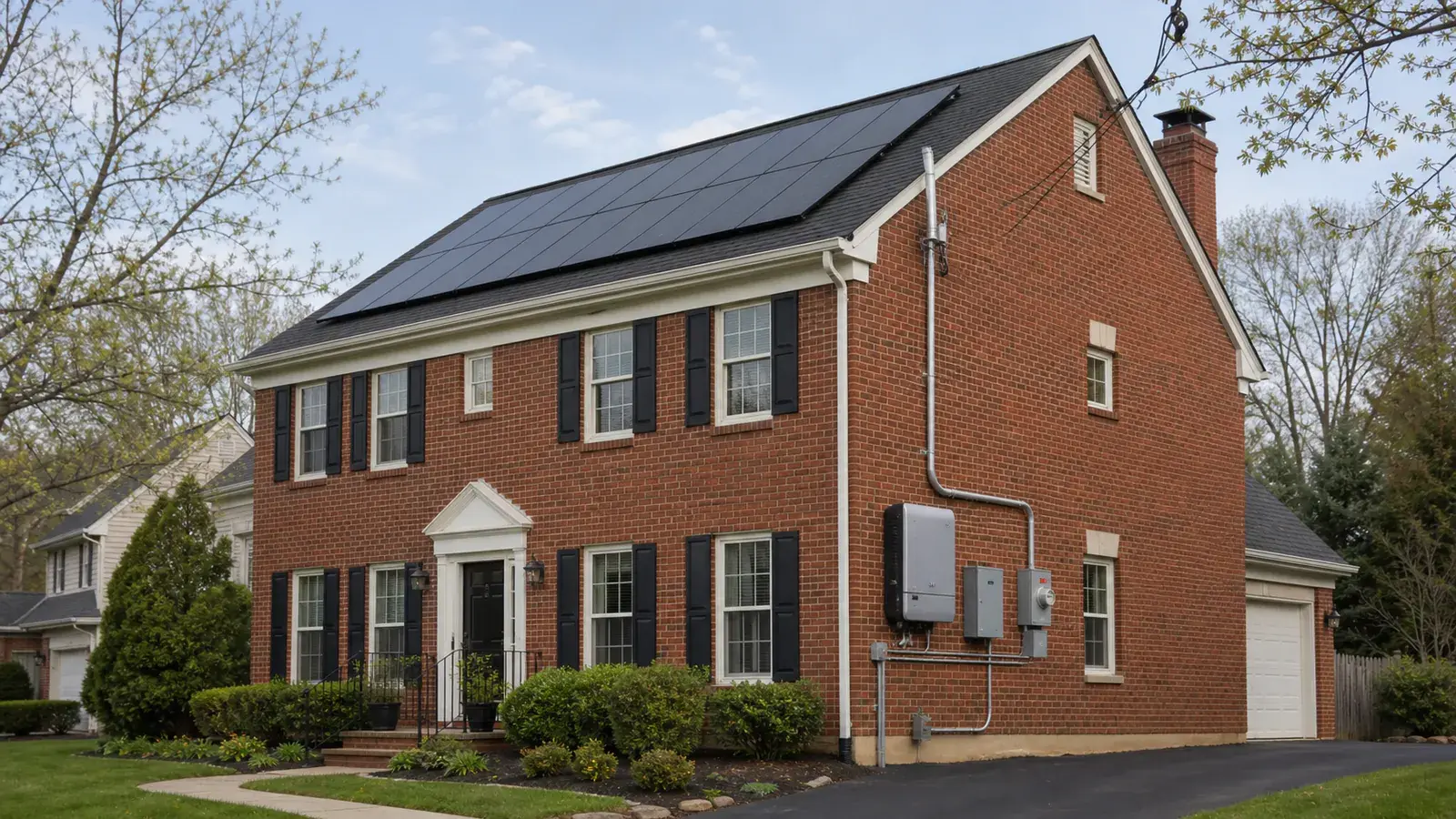
One in-house crew handles the whole job: the roof layout, the modules and inverters, the connection at your electrical panel, the county permit, and the utility interconnection through permission to operate. The panel work is designed with the array, not added later as a change order.
Reviewed 2026-09-24
Google reviews
1,463 across four profiles
Family-owned
Since 1996
Licensed and insured
VA 2705031092
On every install
Master electrician on site
Backed by
Workmanship warranty
Answer first
What a residential solar installation includes
A residential solar installation from AJ Long Electric covers the whole project with our own crew: the roof layout and attachments, the modules and inverters, the electrical connection at your panel, the county permit and inspection, and the Dominion or NOVEC interconnection through permission to operate. A master electrician is on site for every solar project. A typical 8 to 12 kW rooftop system installs for $19,000–$34,000 cash, which is $2.40–$2.85/W.
- Installation is in-house. There is no commissioned sales team and no subcontracted electrical.
- Panel work is priced in the same proposal. A 200A panel replacement, when the house needs one, is itemized at the published $3,500–$7,500 range.
- We pull the permit, file the interconnection, meet the inspector, and hand you the permission to operate letter.
- The estimate is free, and the written proposal is specific to your roof, your panel, and your bills.
What the installation includes
Every residential project follows the same scope. The proposal lists each item, so you can see what is in the price and what is itemized separately.
- Site assessment: roof measurements, shading, roof age and condition, and a look inside your electrical panel at the busbar and main breaker ratings.
- System design: module layout, roof attachment plan, inverter selection, and a production figure labeled as a modeled estimate.
- Roof work: flashed attachments, racking, modules, and roof wiring run in a way the inspector can follow.
- Electrical work: microinverters or a string inverter, rapid shutdown equipment, the utility disconnect, grounding and bonding, and the connection at your panel.
- Paperwork: the county permit, the utility interconnection application, the electrician certification, and the final inspection.
- Startup: commissioning, monitoring connected to your home network, and a walkthrough of how to shut the system down.
The electrical side decides the design
Many solar companies treat the panel connection as the last step. We treat it as the first one, because it decides how large the array can be. The backfed solar breaker has to fit the National Electrical Code's 120 percent rule: multiply the busbar rating by 1.2, subtract the main breaker, and what is left is the largest solar breaker the panel can take. A common 200A panel with a 200A main leaves 40 amps, which carries about 7.6 kW of inverter output.
When the math does not work, there are three honest fixes: a supply-side connection ahead of the main breaker, a smaller main breaker when the load calculation supports it, or a panel replacement. We are a panel shop first, so the fix is designed and priced with the array.
Dominion also limits where the connection goes. The system connects on your side of the meter, and nothing may be tied in inside the meter base or the current transformer cabinet without Dominion's approval.
Permit and interconnection, in order
The paperwork has a fixed order. Virginia rules require a residential customer to notify the utility before construction starts, and the utility has 30 days to review it. On NOVEC, the same state rules apply and the application goes to NOVEC's net metering team.
- 01
Utility application
We file Dominion's Net Metering Interconnection Notification before construction. After you and we both sign, Dominion sends contingent approval.
- 02
County permit
In Fairfax County we apply for the residential solar record in the PLUS portal, and the related electrical equipment goes on the same record. A service replacement or heavy-up needs its own electrical record, which we file too. Homes in the towns of Vienna and Clifton also need town approval. Fairfax County waives the permit fee for solar permit applications.
- 03
Installation
Our crew installs the attachments, racking, modules, inverters, and electrical equipment. A master electrician is on site for every solar project.
- 04
Inspection and certification
The county inspects the work. Dominion requires certification by a licensed Virginia electrician or approval by the local inspection authority, and we complete that section of the application.
- 05
Meter and permission to operate
Dominion installs a bi-directional meter and emails permission to operate to you and to us. The system runs for good after that email, not before.
How big the system can be
Virginia sets two limits on a residential net metering system. It can be no larger than 25 kilowatts, and on Dominion it must be sized so it does not reasonably produce more than 150 percent of the home's expected annual use, based on the last 12 months of bills. Dominion also adds a monthly standby charge for residential systems larger than 20 kW AC.
Most homes land well under those lines. We size from your bills and your roof, and every production number in the proposal is a modeled estimate.
What it costs, and what is itemized
A typical 8 to 12 kW rooftop system installs for $19,000–$34,000 cash, which is $2.40–$2.85/W. That covers modules, racking, inverters, and the interconnection labor.
The federal residential credit does not apply to systems installed after December 31, 2025. Fairfax County offers a five-year property tax exemption for solar equipment.
| Item | How it is priced |
|---|---|
| Modules, racking, inverters | In the cash price, $2.40–$2.85/W |
| Interconnection labor and utility paperwork | In the cash price |
| County solar permit | Pulled by us; Fairfax County waives the solar permit fee |
| 200A panel replacement, when needed | $3,500–$7,500 |
| Whole-home battery, if you add one | $6,000–$15,000+ |
| Level 2 EV charger circuit, if you add one | $1,200–$3,500 |
Roof repairs are done by your roofer and scheduled with us before the array goes on.
Who is on your roof
A master electrician is on site for every solar project. The people who install the array are our crew, and the electrical work is done by our licensed electricians, not a subcontractor.
AJ Long Electric is a family-owned electrical contractor, licensed and insured, working in Fairfax County since 1996 under Virginia Class B license 2705031092. We have pulled permits and closed inspections here for three decades, and solar is that same work with modules on the roof.
Straight answers
Questions
- How long does a residential solar installation take?
- The work on the roof and at the panel is a small part of the calendar. Most of the time goes to the county permit review, the utility review, and the meter change. Virginia gives the utility 30 days to review a residential application. Your proposal carries a schedule built from those steps.
- Do I need a new electrical panel for solar?
- Not always. It depends on the 120 percent rule. A 200A panel with a 200A main can take a 40 amp solar breaker, which carries about 7.6 kW of inverter output. Larger systems need a supply-side connection, a smaller main breaker, or a new panel, and we design that with the array.
- Will my solar work during a power outage?
- Not by itself. Dominion requires grid-tied systems to shut off when the grid goes down so line workers stay safe. Powering the house from solar during an outage takes a battery and transfer equipment, which we can design into the same proposal.
- Is there still a federal tax credit for home solar?
- Not for a home you live in. The federal residential clean energy credit does not apply to property placed in service after December 31, 2025. Rental and business property fall under a different federal credit.
- Is the solar estimate free?
- Yes. The site assessment and the written proposal are free. The proposal itemizes the array, any panel work, and any battery or EV charger, so you can compare it line by line.
Sources
- Dominion Energy Virginia: Net Metering (application steps, sizing, FAQs)
- Virginia Code 56-594: Net energy metering provisions
- 20VAC5-315-30: Net metering company notification (Virginia SCC rules)
- Fairfax County Land Development Services: Solar (SOLARR) Residential permit
- Fairfax County: Going Solar
- NYSERDA NY-Sun fact sheet: The 120% Rule
- IRS: Residential Clean Energy Credit
Related
Keep reading
- Electrician-led solar in Northern Virginia
- How much solar costs in Virginia
- Solar-ready panel upgrade by a licensed electrician
- How to compare solar proposals
- Solar and battery installation
- Adding a battery to an existing system
- What a Solar Site Assessment Covers
- The Solar Panels We Install and How We Choose Them
- Solar Installation Day: What to Expect
- How Solar Installation Works, From Bill to Permission to Operate
- The Solar Company That Is Also the Electrician
Next step
Get a free residential solar proposal
Send your address and a recent electric bill. We look at the roof and the panel, then give you a written proposal with the array, any panel work, and the permit and utility steps laid out.
Solar energy company
AJ Long Electric Solar
AJ Long Electric
7138 Little River Turnpike #305
Annandale, VA 22003
Serving Annandale, Fairfax County, and Northern Virginia.