
Small business solar
Solar for Small Business Rooftops
We install rooftop solar on small commercial buildings at the scale we know: an office, a shop, a professional building. The work needs a commercial permit, inverters matched to the building's service, and a non-residential net metering application.
Reviewed 2026-09-24
Google reviews
1,463 across four profiles
Family-owned
Since 1996
Licensed and insured
VA 2705031092
On every install
Master electrician on site
Backed by
Workmanship warranty
Answer first
Small business solar, led by electricians
AJ Long Electric installs rooftop solar on small commercial buildings in Northern Virginia. The project needs a commercial solar permit, an array and inverters matched to the building's service voltage, a panel connection that passes the 120 percent rule, and a non-residential net metering application with Dominion. Business-owned solar may qualify for the Section 48E federal credit if it is placed in service by December 31, 2027. Confirm with a CPA.
- Fairfax County requires a commercial solar permit for roof-mounted systems on commercial buildings, and condos and apartment buildings count as commercial.
- Dominion net meters non-residential customers on its general service schedules, and state rules give the utility 60 days to review a non-residential application.
- Commercial services are often three-phase. The inverters must match the service, and the panel connection follows the same 120 percent rule as a house.
- A master electrician is on site for every solar project, and the electrical work is ours, not subcontracted.
The federal credit for business solar
Business property is depreciable, so business-owned solar falls under Section 48E, the clean electricity investment credit. A facility under 1 megawatt AC may qualify for the 30 percent Section 48E business rate without the prevailing-wage and apprenticeship requirements that apply to large projects.
Under Section 48E, the credit does not apply to solar placed in service after December 31, 2027. Fairfax County's Going Solar page notes an exception for projects whose construction began on or before July 4, 2026. For a project starting now, plan to be installed and operating before the end of 2027.
Two more tax points for your CPA: the code treats qualifying property as 5-year property, and only half the credit reduces the depreciable basis. For construction beginning after December 31, 2025, a system that includes material assistance from a prohibited foreign entity does not qualify, so your CPA should review the equipment list. The business may qualify; the CPA confirms.
Fairfax County's five-year solar equipment tax exemption is open to commercial property as well as homes.
Commercial permits
In Fairfax County, a commercial solar record (SOLARC) is required for roof-mounted systems on commercial buildings. It is filed in PLUS under the Building tab with architectural and structural drawings. Reviews can include building plan review, the Fire Marshal's Office, and zoning, and the county's plan-ahead list asks whether the project needs a registered design professional.
Condos and apartment buildings are commercial under the building code, even when the owners think of them as homes. Projects in the towns of Vienna and Clifton also need town approval. Fairfax County waives the permit fee for solar permit applications.
Service size and the panel connection
A house has single-phase 120/240 volt service. A commercial building may have that, or a three-phase service at 120/208 or 277/480 volts. The inverters must match. On a three-phase service, that means three-phase inverters or single-phase inverters balanced across the phases.
The 120 percent rule applies to commercial panelboards the same way it applies at home: busbar rating times 1.2, minus the main breaker, is the backfeed ceiling. When the panel has no room, a supply-side connection ahead of the main is often the answer.
Many commercial services are metered through current transformers. Dominion does not allow a tie-in inside the meter base or the current transformer cabinet without its approval, so we design the connection point with the metering in mind.
Dominion non-residential net metering
Dominion lists these non-residential rate schedules as compatible with net metering: GS-1, GS-2T, GS-2, GS-3, GS-4, and 6TS. If your account is on one of them, the building can net meter.
Virginia allows non-residential net metering systems up to three megawatts, and on Dominion a system must not exceed 150 percent of the building's expected annual use based on the last 12 months of bills. A small rooftop is well under both. The application asks for more facility information than a residential one, and state rules give the utility 60 days to review it.
If your building is on a demand-billed schedule, solar lowers the energy portion of the bill, and the demand portion depends on when your peak happens. The proposal models your actual schedule. On NOVEC, the application goes to its net metering team.
If you lease your space
The roof belongs to the building owner, so the owner has to approve the system. The federal credit follows ownership of the system, and the bill savings follow the utility account the array connects to. Settle who owns the array and whose meter it feeds before design starts.
Straight answers
Questions
- Can a small business still get a solar tax credit in 2026?
- Business-owned solar may qualify for the Section 48E credit if it is placed in service by December 31, 2027. Confirm with a CPA how it applies to your business.
- Do I need a commercial permit for solar on my office?
- In Fairfax County, yes, if the building is commercial under the building code. The commercial solar record is filed in PLUS with drawings. Condos and apartment buildings also count as commercial.
- Can my business net meter with Dominion?
- Yes, if the account is on a compatible schedule: GS-1, GS-2T, GS-2, GS-3, GS-4, or 6TS. The system must be sized within 150 percent of the building's expected annual use.
- I lease my building. Can I put solar on it?
- With the owner's approval. Agree first on who owns the system, since the tax credit follows ownership, and whose utility account the array feeds, since that account gets the bill savings.
Sources
- 26 U.S.C. 48E: Clean electricity investment credit
- IRS: Clean Electricity Investment Credit
- 26 U.S.C. 168: Accelerated cost recovery system (5-year property)
- 26 U.S.C. 50: Recapture and basis adjustment for investment credits
- Fairfax County Land Development Services: Solar (SOLARC) Commercial permit
- Fairfax County Land Development Services: Solar (SOLARR) Residential permit
- Fairfax County: Going Solar
- Fairfax County: Solar Energy Equipment Tax Exemption
- Dominion Energy Virginia: Net Metering (application steps, sizing, FAQs)
- Virginia Code 56-594: Net energy metering provisions
- 20VAC5-315-30: Net metering company notification (Virginia SCC rules)
Next step
Price solar for your building
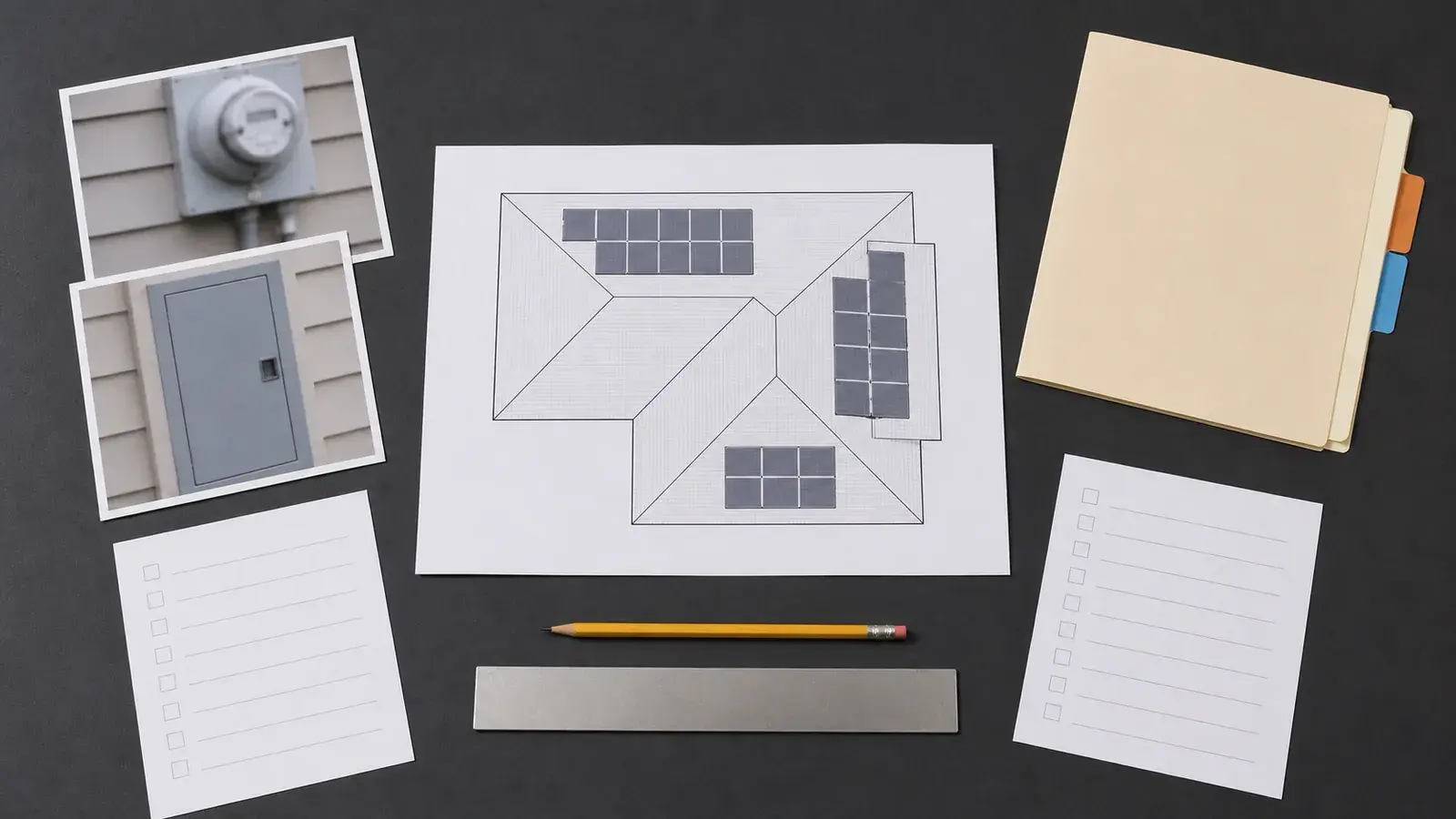
Send the building address, 12 months of electric bills, and a photo of the main electrical panel or switchboard label. We visit, check the service and the roof, and give you a written proposal. The estimate is free.
Solar energy company
AJ Long Electric Solar
AJ Long Electric
7138 Little River Turnpike #305
Annandale, VA 22003
Serving Annandale, Fairfax County, and Northern Virginia.