
Roof fit
Is Your Roof Right for Solar?
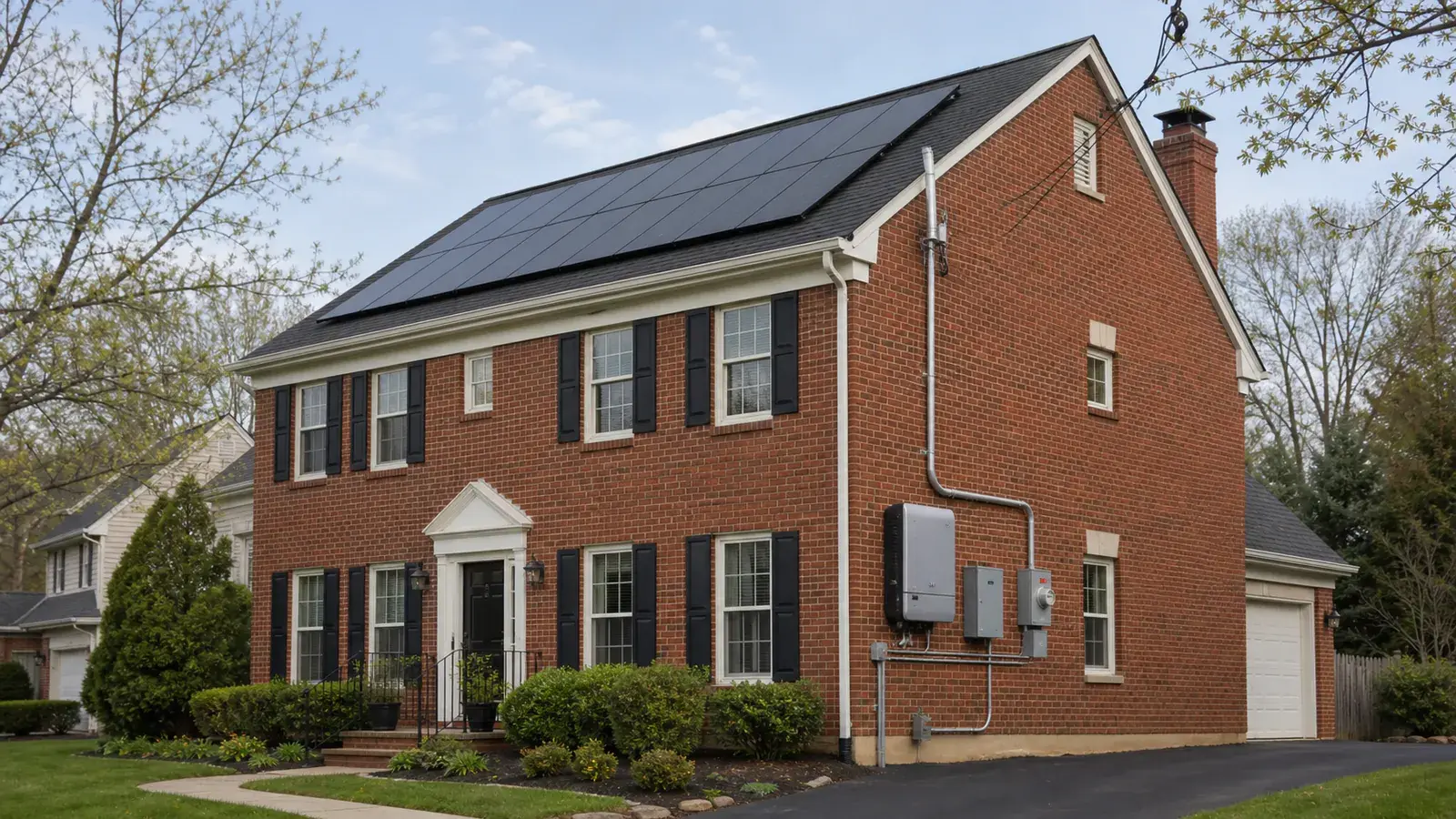
A roof is a good fit when it has a plane facing south, west, or east with little shade, a pitch the racking can attach to, sound roofing with years of life left, and enough open area after the fire-code access paths. Here is how to check each one before anyone climbs a ladder.
Reviewed 2026-09-24
Google reviews
1,463 across four profiles
Family-owned
Since 1996
Licensed and insured
VA 2705031092
Answer first
Is my roof good for solar?
Probably, if it has at least one large plane facing south, west, or east that stays sunny most of the day, a pitch between a low slope and a steep 12/12, asphalt shingle or standing-seam metal in good condition, and enough years left to outlast the panels. The Department of Energy says panels typically perform best on south-facing roofs pitched 15 to 40 degrees, and that other roofs can work too.
- Direction: south is best; west and east work with less output; north planes usually stay empty.
- Pitch: most Northern Virginia roofs, from about 4/12 to 10/12, sit inside the 15 to 40 degree range.
- Age: panels last 25 to 35 years, so a roof with far less life left should be replaced first.
- Space: vents, chimneys, skylights, and required fire access paths all come out of the usable area.
Which way the roof faces
In Northern Virginia, a south-facing plane collects the most sun over a year. West-facing planes produce less in total but more in the late afternoon, and east-facing planes favor the morning. Many good arrays use an east and a west plane together on a gable roof.
North-facing planes collect the least. On most roofs we leave them empty, because the panels there produce noticeably less for the same installed cost as a panel on a better plane.
The easiest way to check: open a map of your house, find the long roof planes, and note which way each one faces. Then look for tall trees on that side.
Roof pitch, in the numbers roofers use
Roofers describe pitch as rise over a 12-inch run. The Department of Energy's 15 to 40 degree range covers most houses in the area. Flat and very low-slope roofs can still carry panels on tilted racking, and very steep roofs are harder to work on and may cost more to install.
| Pitch (rise over 12) | Angle | Where it sits |
|---|---|---|
| 2/12 | About 9.5 degrees | Low slope; panels often tilted on racking |
| 4/12 | About 18.4 degrees | Inside the typical range |
| 6/12 | About 26.6 degrees | Inside the typical range |
| 8/12 | About 33.7 degrees | Inside the typical range |
| 10/12 | About 39.8 degrees | Top of the typical range |
| 12/12 | 45 degrees | Steep; workable with more setup time |
Angle is the arctangent of rise divided by 12, rounded to one decimal.
Roofing material
The material decides how the racking attaches and how much care the attachments take.
- Asphalt shingle. The most common roof in the area and the most straightforward. Each attachment is flashed into the shingle courses.
- Standing-seam metal. Clamps grip the seams, so many attachments need no roof penetration at all.
- Slate, clay tile, and cedar shake. Possible, but the material is fragile or hard to replace, attachments take special hardware, and the cost goes up. Some owners reroof the array area in shingle or metal instead.
- Membrane flat roofs. Usually ballasted or specially flashed racking, reviewed with the roofer who holds the roof warranty.
Roof age
The Department of Energy cites a Berkeley Lab survey putting the average operating life of a solar panel at 25 to 35 years. If the roof under the array will need replacing well before that, the array has to come off and go back on in the middle of its life. DOE's own guide tells homeowners to consider how long until the roof needs replacement before going solar.
We do not do roofing. During the site visit we note the visible condition and tell you if the roof looks close to the end, and a roofer gives you the real remaining-life answer.
Obstructions and fire-code access paths
The usable part of a roof is smaller than the roof. Plumbing vents, bath fans, chimneys, skylights, dormers, and satellite dishes each take space, and panels cannot shade or cover them.
Virginia's 2021 residential and fire codes also require clear access paths on residential roofs with solar, including a clear strip along the ridge and a path from the eave to the ridge, so firefighters can work on the roof. In Fairfax County, the Fire Marshal's Office is among the reviewers of a residential solar permit package. On a small or chopped-up roof, these paths are often what limits the array size.
Structure matters too. Fairfax County asks applicants to consider whether a registered design professional is needed, and older rafters sometimes need an engineer's letter or added framing before the array goes on.
The part under the roof
A perfect roof still has to connect to a panel that can take it. On older houses, the electrical panel is the more common limit than the roof. If you have an association, Virginia Code 55.1-1820.1 limits how far it can restrict rooftop solar unless the recorded declaration says otherwise.
Straight answers
Questions
- Can you put solar panels on an east or west roof?
- Yes. East and west planes produce less over the year than a south plane, but many good arrays use them, often together on the two sides of a gable roof. The modeled estimate shows the output of each plane.
- Is my roof too steep for solar?
- Rarely. Roofs up to about 12/12, or 45 degrees, can carry panels. Steeper roofs take more safety setup and time. Most Northern Virginia roofs fall between 4/12 and 10/12.
- How old is too old for a roof before solar?
- Compare the roof's remaining life with the panels' 25 to 35 year operating life. If the roof will need replacing within the life of the array, replacing it first usually costs less than removing and reinstalling the array later. A roofer should give you the remaining-life estimate.
- Do you do the roofing too?
- No. AJ Long Electric installs the array and all the electrical work. Roofing goes to a roofer you hire, and we coordinate the schedule with them.
- How much roof space do I need?
- It depends on panel size and the access paths, so we lay it out from measurements. As a rule, a typical 8 to 12 kW array needs one or two large, mostly unshaded planes rather than several small ones.
Sources
- U.S. Department of Energy: Homeowner's Guide to Going Solar
- U.S. Department of Energy: End-of-Life Management for Solar Photovoltaics
- Fairfax County Land Development Services: Solar (SOLARR), Residential
- Virginia DHCD: Codes (2021 USBC and the 2020 National Electrical Code, effective January 18, 2024)
- Virginia Code 55.1-1820.1: Installation of solar energy collection devices
Next step
Have us check the roof and the panel
One visit covers the roof planes, the shade, the access paths, and the electrical panel. You get a layout and a written proposal. Estimates are free.
Solar energy company
AJ Long Electric Solar
AJ Long Electric
7138 Little River Turnpike #305
Annandale, VA 22003
Serving Annandale, Fairfax County, and Northern Virginia.