
Learn: HOA rules
Virginia HOA Solar Law: What Your Association Can and Cannot Require
In Virginia, an HOA cannot ban solar on your own property unless its recorded declaration already does. It can set reasonable rules on size, placement, and appearance, and the statute defines when a rule stops being reasonable.
Reviewed 2026-09-24
Google reviews
1,463 across four profiles
Family-owned
Since 1996
Licensed and insured
VA 2705031092
Answer first
The short answer
Virginia Code 55.1-1820.1 says a property owners' association cannot prohibit a solar installation on property you own unless the recorded declaration establishes that prohibition. The association may set reasonable restrictions on the size, place, and manner of placement. A restriction is not reasonable if it raises the installed cost more than 5 percent or cuts projected production more than 10 percent compared with your original proposal. Condominiums and cooperatives have matching sections.
- No ban on your own roof unless the recorded declaration already contains one.
- Reasonable rules on size, place, and manner are allowed; rules that add more than 5 percent to cost or remove more than 10 percent of production are not reasonable.
- The association can prohibit or restrict panels on common area or common elements.
- HOA approval and the county building permit are two separate approvals. You need both.
What the statute actually says
Section 55.1-1820.1 sits in the Property Owners' Association Act, the law that governs most single-family and townhouse HOAs in Northern Virginia. It started life as sections 67-700 and 67-701 in 2006 and was moved into Title 55.1 when the property laws were recodified. Fairfax County's own Going Solar page points homeowners to it.
The statute defines a solar energy collection device broadly: any device made and sold for the sole purpose of collecting and using solar energy, including photovoltaic equipment. A rooftop array, its racking, and its inverters all fall inside that definition.
Subsection B carries the core rule. No association shall prohibit an owner from installing solar on that owner's property unless the recorded declaration establishes the prohibition. The key word is recorded. A rule the architectural review board adopted last spring is not a recorded declaration. The declaration is the document filed in the county land records when the community was created, plus any amendments the owners recorded under the declaration's own amendment process.
The same subsection lets the association set reasonable restrictions on size, place, and manner of placement on property designated for individual ownership. That is where most HOA solar conversations happen: panel color, conduit routing, which roof face, setbacks from the ridge.
When an HOA rule stops being reasonable
Subsection C gives a number, which is rare in HOA law. A restriction is deemed not reasonable if applying it to your proposal increases the installation cost by more than 5 percent over the projected cost of the proposal you first submitted, or reduces energy production more than 10 percent below the projected production of that proposal.
Here is how that plays out. Suppose your best roof faces south toward the street and the board asks you to move the array to the rear slope. In a PVWatts model of a Fairfax roof at a 30 degree pitch, a modeled estimate, the same panels facing north produce about 45 percent less than facing south, and facing east or west about 20 percent less. Either move is past the statute's 10 percent line, so that rule is not reasonable as applied to that house. Your roof's own model decides the real number.
The burden of proof sits with the owner. The statute requires documentation prepared by an independent solar panel design specialist who holds the certification the statute names and is licensed in Virginia, and the documentation has to be satisfactory to the association. Ask for that requirement in writing from your board before you commission any study, so everyone agrees on what counts.
Our written proposal gives you the two numbers that test depends on: the projected installed cost and the modeled annual production for the layout you asked for. When the board proposes a change, we model the changed layout the same way so you can see the difference in production and cost side by side.
Condominiums, cooperatives, and townhouse roofs
Condominium owners are covered by Virginia Code 55.1-1951.1 and cooperative owners by 55.1-2133.1. Both repeat the same rules: no ban unless the recorded declaration has one, reasonable restrictions only, and the same 5 percent and 10 percent test.
The question that decides most condo and townhouse cases is who owns the roof. Every one of these statutes lets the association prohibit or restrict solar on common area or common elements. If your condominium instruments make the roof a common element, the association can say no. If your townhouse plat and declaration put the roof inside your lot, it is your property and the protection applies.
Read the declaration and the plat before you design anything. In a townhouse community, also check whether the declaration assigns roof replacement to the association or to each owner. That answer affects who needs to approve roof penetrations and who coordinates a future reroof.
- Single-family and most townhouse HOAs: Property Owners' Association Act, 55.1-1820.1.
- Condominiums: Condominium Act, 55.1-1951.1.
- Cooperatives: Virginia Real Estate Cooperative Act, 55.1-2133.1.
How to get an HOA solar application approved
Architectural review boards approve clean, complete applications. Send the full package the first time.
- 01
Pull the governing documents
Get the recorded declaration, any recorded amendments, and the current architectural guidelines. Note any solar rule and whether it is recorded or just a guideline.
- 02
Submit a real layout
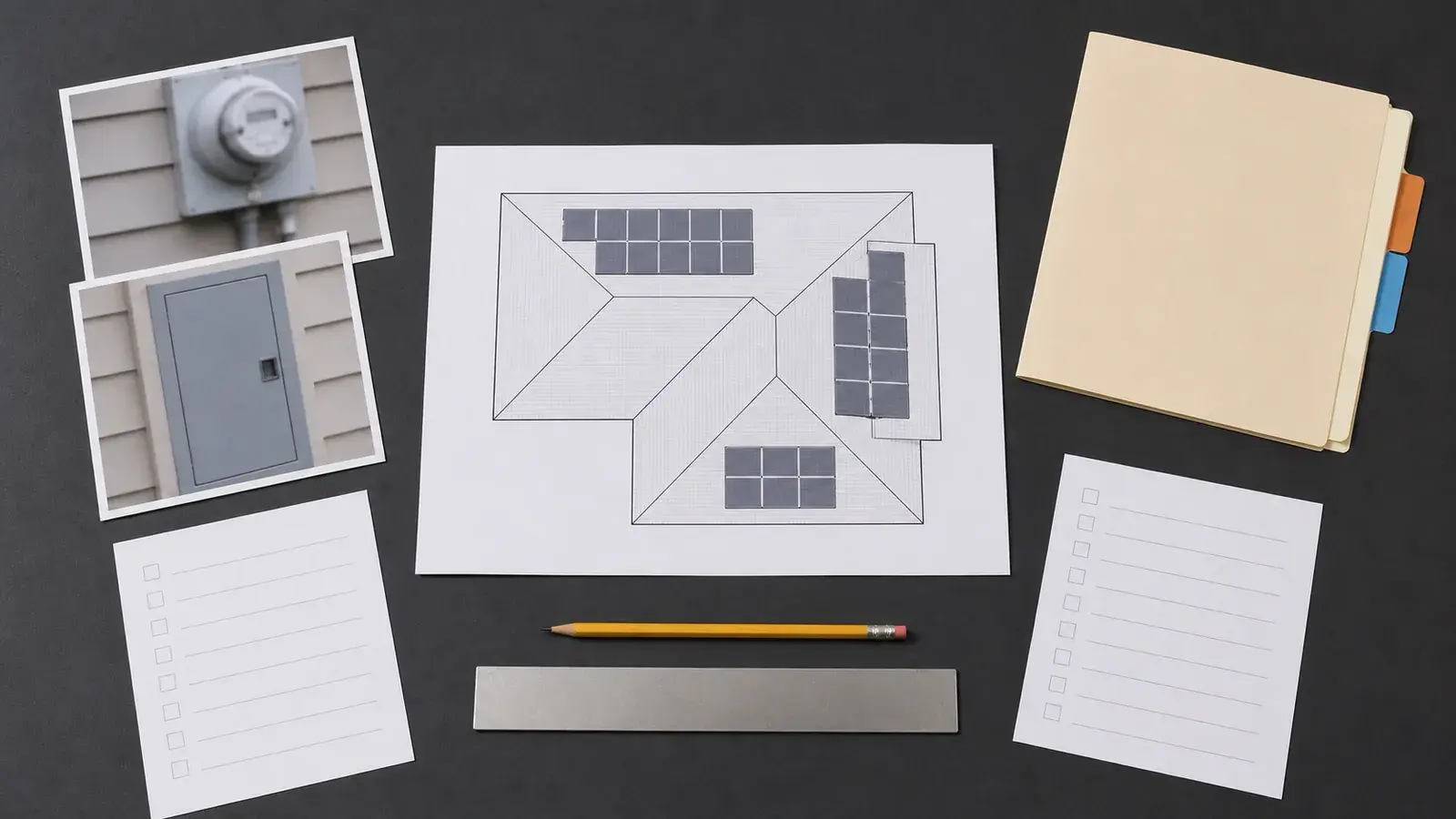
Include a roof plan with panel positions, a photo or rendering from the street, equipment spec sheets, and the route for conduit and exterior equipment.
- 03
Address appearance up front
Boards ask about panel color, frame color, conduit paint, and where the disconnect and meter equipment sit. Answer those in the application.
- 04
Keep the numbers ready
Keep the projected cost and modeled production from your proposal on file. If the board asks for changes, those are the baseline for the 5 percent and 10 percent test.
- 05
Get the decision in writing
A written approval belongs in the permit file and in your records for resale.
HOA approval is not the building permit
An HOA approval is a private approval under your community documents. The county building permit is a public approval under the building code. You need both, and one does not replace the other.
In Fairfax County, Land Development Services issues the residential solar permit, runs plan review, and inspects the finished system, and the county waives the permit fee for residential solar. We pull that permit, file the Dominion or NOVEC interconnection, and include the county's solar tax exemption form in the permit package.
Timing matters. Most boards want to see the same layout the county will review, so we finalize the design, send it to the board, and file the permit on the approved layout. That way the plans the inspector reviews match what the neighbors see.
Buying into an HOA? Check the resale certificate
Each of these statutes requires the resale certificate given to a purchaser to state any restriction, limitation, or prohibition on installing or using solar. If you plan to add solar after you close, read that section of the certificate before you sign the contract, and ask the association for the architectural guidelines at the same time.
Straight answers
Questions
- Can my HOA stop me from installing solar panels in Virginia?
- Only if the recorded declaration for your association already prohibits solar. Otherwise, Virginia Code 55.1-1820.1 lets the HOA set reasonable rules on size, place, and manner of placement, but not ban the system.
- Can the HOA make me put panels on the back of the house?
- It can ask. If moving the panels raises the installed cost more than 5 percent or cuts projected production more than 10 percent compared with your original proposal, the statute treats that rule as not reasonable. You document the difference with the independent study the statute describes.
- Does the law protect condo owners?
- Yes, through Virginia Code 55.1-1951.1, which mirrors the HOA statute. The limit is ownership: if the roof is a common element under your condominium instruments, the association can prohibit or restrict solar there.
- Do I still need a county permit if my HOA approved the solar?
- Yes. HOA approval is private and the building permit is public. In Fairfax County, Land Development Services issues the residential solar permit and inspects the system, and the permit fee is waived.
Sources
- Code of Virginia 55.1-1820.1, Property Owners' Association Act: solar energy collection devices
- Code of Virginia 55.1-1951.1, Condominium Act: solar energy collection devices
- Code of Virginia 55.1-2133.1, Virginia Real Estate Cooperative Act: solar energy collection devices
- Fairfax County Office of Environmental and Energy Coordination, Going Solar
- Fairfax County Land Development Services, Residential Solar permit library
- PVWatts Calculator, National Laboratory of the Rockies (formerly NREL)
Next step
Get a layout your HOA can approve
We design the array, prepare the drawings your architectural review board asks for, and file the county permit on the approved layout. The quote is free.
Solar energy company
AJ Long Electric Solar
AJ Long Electric
7138 Little River Turnpike #305
Annandale, VA 22003
Serving Annandale, Fairfax County, and Northern Virginia.