
Learn: batteries
Do You Need a Battery With Solar?
Not to save on your bill. Dominion's net metering credits your excess production over a 12-month period, so the grid acts as the storage. You need a battery if you want power during outages.
Reviewed 2026-09-24
Google reviews
1,463 across four profiles
Family-owned
Since 1996
Licensed and insured
VA 2705031092
Answer first
The short answer
For most Dominion customers, no battery is needed to get the bill value of solar, because net metering credits exported energy and uses it to offset later use over a 12-month period. A battery is for backup: a grid-tied array shuts off in an outage, and Dominion says the only way to power a home from solar during an outage is an energy storage system and a transfer switch. Whole-home battery integration typically runs $6,000–$15,000+.
- Bill savings: net metering does the banking. No battery required.
- Outage power: solar alone shuts off; a battery with the right transfer equipment keeps selected circuits on.
- A typical solar plus battery example runs $30,000–$43,500+; a portable battery station with install runs $2,500–$6,000.
- You can add a battery later if the first design leaves room for it.
Why net metering makes a battery optional for savings
In states without full net metering, a battery stores midday solar for the evening because exported power earns little. Virginia's Dominion customers are in a different position. Dominion records the excess energy your system sends to the grid as a credit and uses it to offset energy delivered to your home later, netted over a 12-month period. A kilowatt-hour sent out at noon offsets a kilowatt-hour used at 9 p.m.
That means a battery does not raise the bill value of an array sized to your use. What it adds is the ability to keep power on when the grid is down, and possibly participation in utility programs that pay for access to stored energy.
NOVEC runs its own net metering program with its own terms. We read the serving utility off your bill before we recommend anything.
When a battery is worth it: outages
A grid-tied array stops producing when the grid goes down, to keep it from feeding power into lines that crews are repairing. Dominion's net metering page says it directly: the only way to supply power to your home from distributed generation during an outage is an energy storage system and a transfer switch.
The Department of Energy describes the other side: a solar system with battery storage can detect the loss of grid power and switch to an islanded mode, then reconnect when service returns. In an outage, the array can recharge the battery on sunny days, within the limits of the equipment and the design.
A battery earns its place in homes with a well pump, a sump pump, medical equipment, a home office, or a history of long outages. Medical equipment needs a separate, device-specific backup plan and a written emergency plan; do not rely on any single source for it.
Selected circuits or the whole house
A battery is sized to the loads you want during an outage and how long you want them. Most homes back up a list of circuits: refrigerator, sump or well pump, furnace blower, internet, some lights and outlets. Backing up an air conditioner, a range, or an EV charger takes more battery and a design that manages those loads.
We build the circuit list at the panel, match it to the listed output and usable capacity of the equipment, and write the list into the proposal. The proposal names the circuits, not a promise of whole-house backup the equipment cannot deliver.
| Option | Typical installed range |
|---|---|
| Portable battery station plus install | $2,500–$6,000 |
| Whole-home battery integration | $6,000–$15,000+ |
| Typical 10 kW solar plus battery example | $30,000–$43,500+ |
The electrical work behind a battery
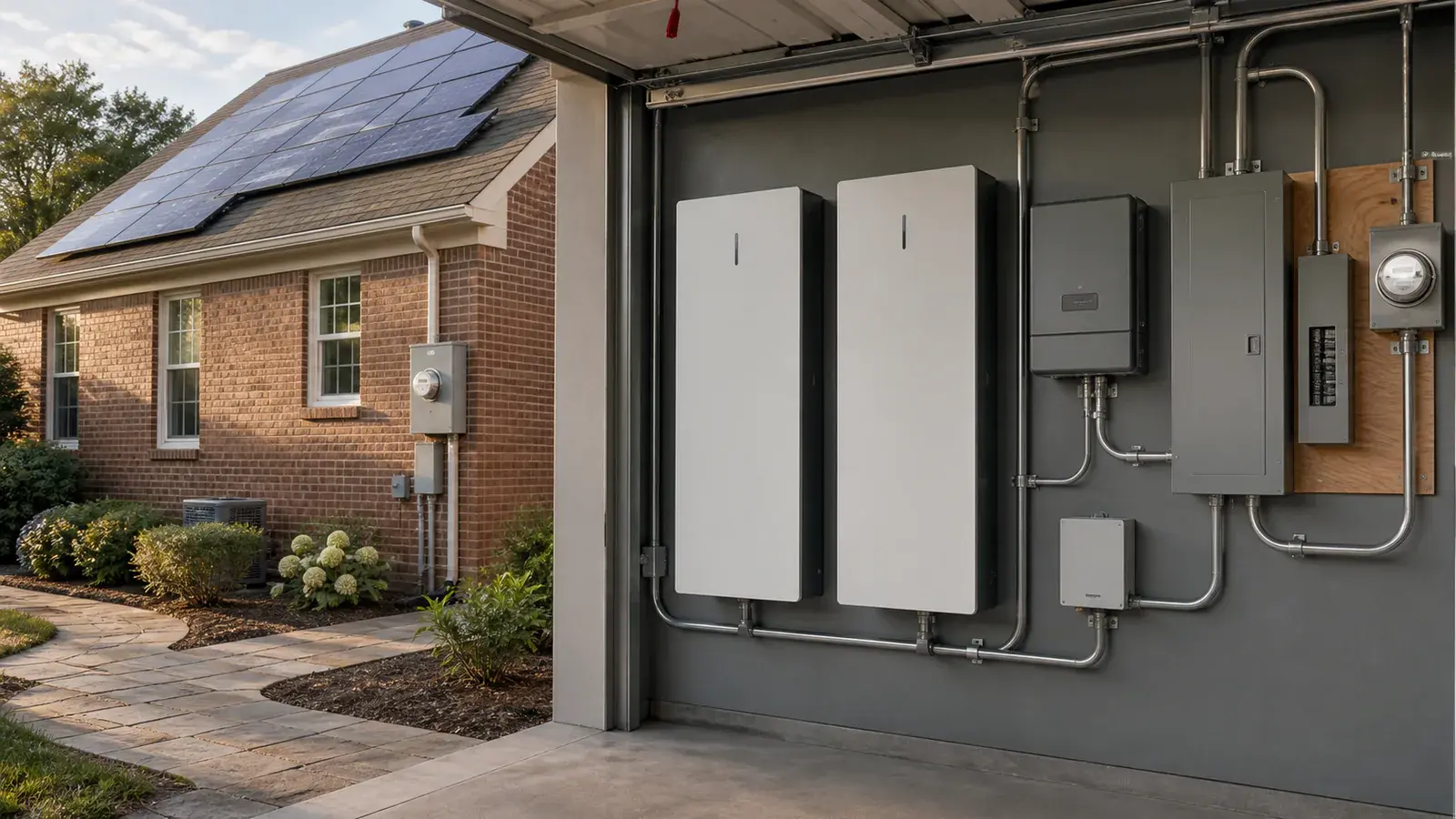
A battery is an electrical project first. It needs a way to isolate the house from the grid during an outage, usually a transfer device or a gateway, and a place for the backed-up circuits to live, either a separate critical loads panel or a whole-home design with load control. It adds another source to the panel, which interacts with the solar backfeed and the busbar rating.
Older or crowded panels often need work before a battery goes in. Some homes are better served by a smart panel that sheds loads automatically. We look at the panel first, because that is where a battery project succeeds or stalls.
Adding a battery later, and the tax picture
If you are not ready for a battery now, design the array so one can be added: leave panel space, choose an inverter approach that accepts storage, and note the future battery location in the plan. Adding storage later is a normal project, not a redesign.
The homeowner federal credit under Section 25D, which used to cover battery storage, does not apply to property installed after December 31, 2025. For a battery installed in 2026, the homeowner credit is zero. Dominion's Virtual Power Plant pilot, approved by the State Corporation Commission, is the program to watch: Dominion says most customers join for free, can earn incentives, and stay in control of their devices. We will add program details here when Dominion publishes enrollment terms.
Straight answers
Questions
- Can I have solar without a battery?
- Yes. Most Northern Virginia solar homes run without one. Dominion net metering credits your exports over a 12-month period, so the array delivers its bill value without storage.
- Will my solar panels work in a power outage without a battery?
- No. A grid-tied array shuts off when the grid goes down. Dominion says an energy storage system and a transfer switch are the way to power a home from solar in an outage.
- How much does a solar battery cost in Northern Virginia?
- Whole-home battery integration typically runs $6,000–$15,000+. A portable battery station plus install runs $2,500–$6,000. A typical 10 kW solar plus battery example is $30,000–$43,500+.
- Can I add a battery to my solar system later?
- Yes. Adding storage later is a normal project. It goes smoothest when the original design leaves panel space, uses an inverter approach that accepts storage, and marks a battery location that meets the equipment listing.
- Is there a federal tax credit for a home battery in 2026?
- Not for homeowners. The Section 25D homeowner credit does not apply to property installed after December 31, 2025. Check the IRS page and your tax preparer for your situation.
Related
Keep reading
Next step
Decide on the battery with the panel in front of you
We check your panel, build the backup circuit list, and quote solar with or without storage. The quote is free.
Solar energy company
AJ Long Electric Solar
AJ Long Electric
7138 Little River Turnpike #305
Annandale, VA 22003
Serving Annandale, Fairfax County, and Northern Virginia.